Reserve Management: A Treasury Decision You’re Not Making
Last Updated on October 1, 2026 by Dimitri Akhrin
Why most eCommerce businesses accept worse reserve terms than their processing history justifies — and how to change that
Learn why merchant account reserves are a negotiating variable, not a fixed penalty. Discover how to leverage your processing history to renegotiate reserve terms and reclaim trapped cash flow.
TL;DR
- Reserves are negotiable, not fixed – Your processor set reserve terms based on your risk profile at signup. If your processing history has improved, those terms should change too.
- Your processing history is leverage – A clean chargeback ratio, stable volume, and low refund rates are proof that your reserve percentage should decrease. Document the data and bring it to the table.
- Negotiate at onboarding, not after a freeze – The best time to discuss reserve terms is during merchant account approval, before holds appear and create cash flow pressure mid-growth.
- Treat reserves as a treasury decision – Every dollar held in reserve is working capital you can’t deploy. Managing reserves actively shortens your cash conversion cycle and reduces dependence on external credit.
Your Processor Decided What You Could Afford. You Let Them.
Here’s something most eCommerce businesses never question: the reserve sitting on their merchant account. It showed up during merchant account approval, buried in paperwork, and nobody pushed back. Now it’s quietly siphoning cash flow every month, holding 5% or 10% of revenue in a rolling reserve that no longer reflects the business you’ve become. Reserve management isn’t a back-office footnote. It’s a treasury decision you’re not making.
The “Reserves Are Just Part of the Deal” Myth
The conventional wisdom is straightforward. Reserves exist because processors need protection against chargebacks, refunds, and fraud exposure. If you’re in eCommerce, you accept them. They’re the cost of doing business online.
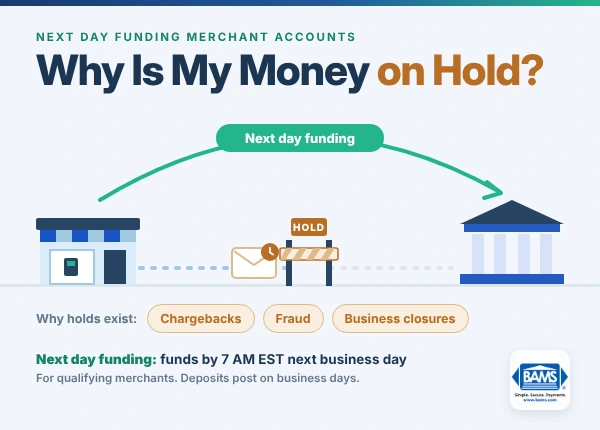
And to be fair, that logic made sense at one point. When your business was new, unproven, and had no processing history, a reserve requirement was a reasonable hedge. Chargebacks, fraud, and merchant risk remain significant concerns for payment providers, giving acquirers legitimate reason to require reserves from higher-risk or newly onboarded merchants.
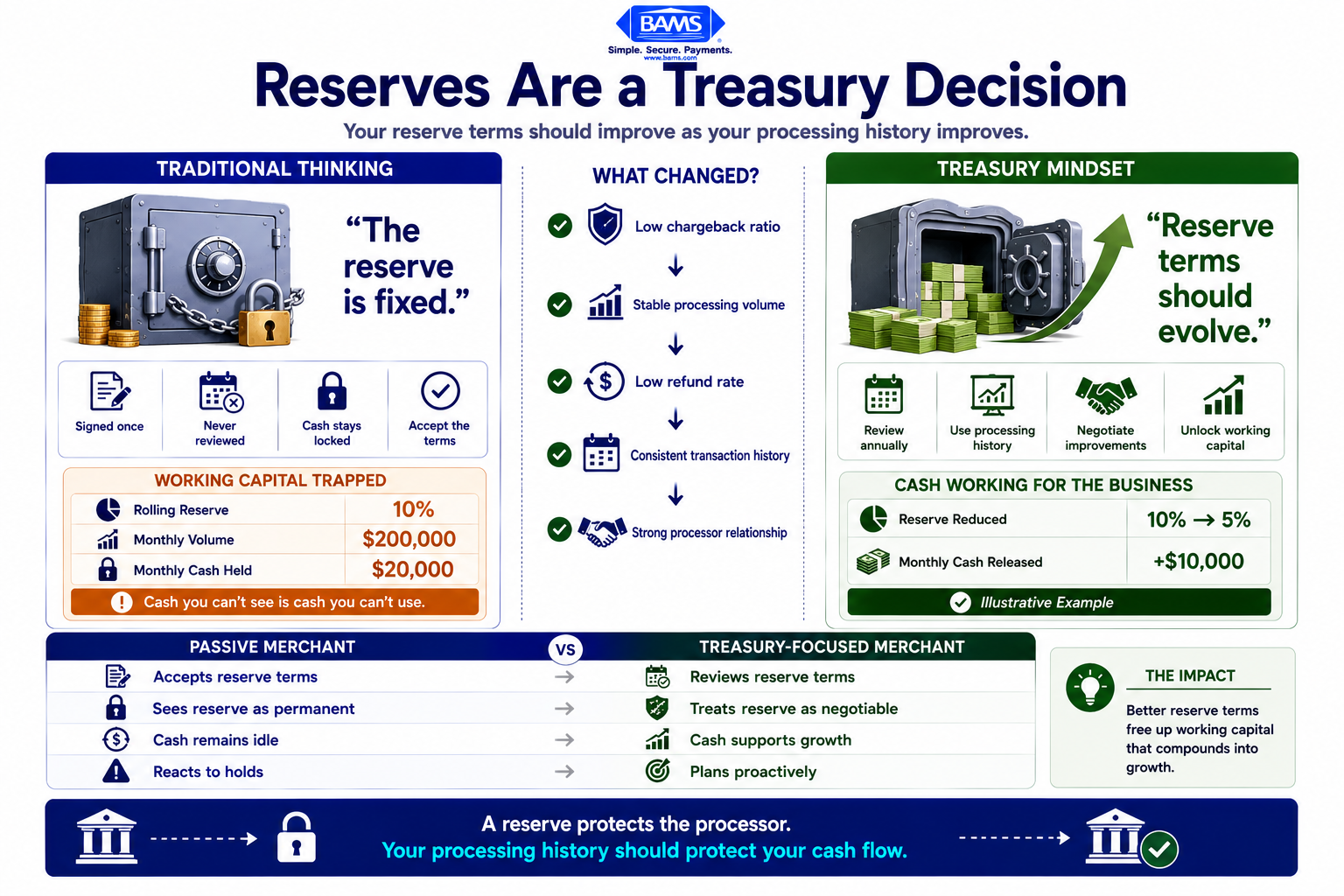
But here’s where the logic breaks down: most processors never revisit those initial terms. The reserve percentage set when you processed $30,000 a month is the same one applied when you’re processing $300,000. The risk profile changed. The terms didn’t. And because nobody told you reserves were negotiable, you never asked.
Merchant account reserves shouldn’t remain frozen while your business improves. Strong processing history should lead to stronger reserve terms.
Reserves Are a Negotiating Variable, Not a Fixed Penalty
We believe something most merchants have never been told directly: your reserve requirement is a negotiable term, and your processing history is the leverage you’re not using. The businesses that treat reserve management as an active treasury decision, rather than a processor-imposed condition, free up working capital that compounds into real growth.
Reserve Management Belongs in Your Treasury Strategy
The cash you can’t see is the cash you can’t deploy
Consider what a rolling reserve actually does to your operations. If your processor holds 10% of every batch for 180 days and you’re processing $200,000 monthly, that’s $20,000 per month locked away. After six months, you’ve got $120,000 in limbo. Not earning interest. Not funding inventory. Not covering payroll during a seasonal dip.
Access to working capital remains one of the biggest challenges facing many small businesses, making reserve requirements especially important when managing cash flow. According to the Bipartisan Policy Center, improving access to capital remains a critical factor in small-business growth.
The onboarding trap
Most merchants encounter reserves reactively. They apply for a merchant account, get approved, and discover the reserve terms after the fact. Or worse, they’re processing smoothly for months, hit a growth spike, and suddenly see payout holds appear mid-stride because their volume triggered an automated risk flag.
This is the reactive posture we see constantly. The merchant scrambles to understand why funds are being held. They call support. They get a scripted answer about “standard risk procedures.” Meanwhile, cash flow tightens and operational decisions get made under pressure.
The proactive alternative? Negotiate reserve terms at the account approval stage, before you need to.
What your processing history is actually worth
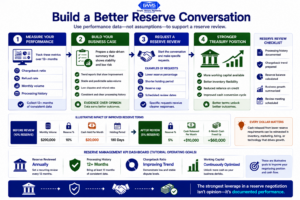
Reserve reductions rarely happen automatically. A structured review backed by data gives merchants the strongest negotiating position.
Processors assess risk using a handful of signals: chargeback ratios, refund rates, average ticket size, transaction velocity, and industry category. If you’ve been processing for 12 or more months with a chargeback ratio below 1%, low refund volume, and consistent transaction patterns, you’ve built a risk profile that deserves better terms than what you started with.
Poor visibility into incoming cash can make treasury decisions more difficult, especially for growing businesses managing inventory and operating expenses. Maintaining accurate cash flow forecasting is a key financial management practice, as outlined by NetSuite’s cash flow forecasting guidance. If you don’t track your chargeback ratio month over month, you have no ammunition to bring to a renegotiation.
This is where the work lives. Pull your processing statements. Document your chargeback ratio trend. Calculate the dollar amount sitting in reserves. Then pick up the phone.
The conversation most merchants never have
Here’s what a reserve renegotiation actually looks like. You contact your processor (or your account manager, if you have one) and present your case: 14 months of processing history, chargeback ratio of 0.4%, refund rate under 2%, consistent monthly volume. You ask for a reduction from 10% to 5%, or a shorter hold period, or a cap on the total reserve balance.
Some processors will work with you. Many won’t, because their systems aren’t built for merchant-level flexibility. That’s a signal worth paying attention to.
At BAMS, this is the kind of conversation that happens through dedicated account management. Because when your processor actually knows your business, reserve adjustments become a natural part of the relationship, not a fight you have to escalate through a support ticket.
Working capital directly affects a business’s ability to invest, hire, purchase inventory, and withstand unexpected disruptions. Reserve balances are part of that working capital and should be reviewed regularly rather than accepted indefinitely.
What Changes When You Treat Reserves as Negotiable
If this thesis is right, the implications ripple through your entire financial operation. Your cash conversion cycle shortens. Your ability to purchase inventory ahead of peak seasons improves. Your dependence on external credit lines decreases because you’ve unlocked capital you already earned.
It also changes how you evaluate processors. Instead of comparing rates alone, you start asking: What’s the reserve policy? Is it reviewable? How often? What triggers a reduction? These questions belong in your merchant account setup process, not as an afterthought six months into a contract.
And here’s the uncomfortable part: every month you don’t renegotiate, you’re effectively giving your processor an interest-free loan secured by your own revenue. Effective cash management depends on understanding when funds become available, not simply when sales occur. That’s why reserve management should be treated as part of your broader cash flow forecasting strategy.
A New Way to Think About Reserves
Stop thinking of reserves as a risk penalty imposed on your business. Start thinking of them as a deposit you’ve placed with your processor, one that should shrink as your track record grows.
The mental model shift is simple: reserves are collateral, and collateral requirements should decrease as creditworthiness increases. Your processing history is your credit score in this relationship. A clean chargeback ratio, stable volume, and low refund rates are proof of creditworthiness. If your processor won’t recognize that proof, they’re pricing you for the merchant you were, not the merchant you are.
That’s a lens worth carrying into every processor conversation you have from here forward.
Your Processing History Is Leverage. Use It.
Reserves will always exist in payment processing. The risk is real, and processors have legitimate reasons to hold capital against uncertainty. But uncertainty is supposed to decrease with evidence. If you’ve given your processor 12, 18, 24 months of clean evidence and your reserve terms haven’t moved, the problem isn’t risk. The problem is that nobody asked.
Ask.
Frequently Asked Questions
What is reserve and hold management in merchant services?
Reserve management is the practice of monitoring, forecasting, and negotiating the funds your payment processor withholds from your settlements as a risk buffer. Effective reserve management treats these held funds as a controllable variable rather than a fixed cost, using your processing history and chargeback data to negotiate lower percentages or shorter hold periods.
How can merchants reduce their reserve requirements over time?
Document your chargeback ratio, refund rate, and monthly volume trends, then present this data to your processor or account manager to request a reduction in reserve percentage, a shorter rolling hold period, or a cap on total reserves. Processors evaluate risk dynamically, so a clean track record of 12 or more months gives you concrete leverage to renegotiate.
Why do payment processors withhold reserves from merchants?
Processors hold reserves to protect against potential losses from chargebacks, fraud, and refunds, especially for newer accounts or industries with higher dispute rates. The reserve acts as collateral, but the initial terms are often set conservatively and rarely revisited unless the merchant proactively requests a review.
Sources
- https://merchantriskcouncil.org/learning/resource-center/member-news/blog/2025/chargebacks-and-fraud-2025-fighting-advanced-fraud-tactics-with-equally-sophisticated-strategies
- https://bipartisanpolicy.org/report/small-businesses-matter-capital-access/
- https://www.netsuite.com/portal/resource/articles/accounting/cash-flow-forecasting.shtml#