How to Cut Payment Processing Costs for eCommerce
Last Updated on May 26, 2026 by Dimitri Akhrin
Turn hidden interchange savings into growth capital by closing the gap between your processing statement and real costs
Learn how to decode your processing statement, identify costly commercial card volume hiding in your transaction mix, and recover interchange savings that translate directly into reinvestable margin for eCommerce growth.
TL;DR
- Your effective rate tells the real story — Divide total fees by total volume on your processing statement. If the result is more than 0.3% above your quoted rate, you have recoverable margin hiding in downgrades and miscategorized transactions.
- Commercial cards are your biggest optimization opportunity — Purchasing, corporate, and government cards qualify for significantly lower interchange rates when you pass Level 2 and Level 3 transaction data. Most eCommerce merchants don’t realize they’re processing these cards at the highest possible rates.
- Data quality drives interchange costs down — Passing tax amounts, customer codes, and line-item detail on eligible transactions can reduce interchange by 0.5% to 1.0% per transaction. This requires interchange-plus pricing to capture the benefit.
- Recovered margin is growth capital — Frame interchange savings as customer acquisition funding, not just cost reduction. A 0.5% improvement across $1.2M in annual volume recovers $6,000 that can fund new customers, inventory, or hiring.
- This is a recurring discipline, not a one-time fix — Transaction mixes shift, interchange tables update twice a year, and business growth changes the equation. Quarterly statement audits keep savings compounding over time.
Guide Orientation: What This Guide Covers and Who It’s For
This guide is for eCommerce managers at established online businesses who suspect their payment processing costs are higher than they need to be but can’t pinpoint exactly where the money leaks. If your processing statement looks like a wall of line items you’ve learned to ignore, this is for you.
By the end, you’ll understand the layered structure behind every transaction fee, know how to identify commercial card volume hiding in your transaction mix, and see how recovering interchange savings on those transactions translates directly into margin you can reinvest in growth.
This guide does not cover PCI compliance, gateway selection, or chargeback dispute tactics. It focuses entirely on the gap between what your processing statement shows and what it actually costs you, then gives you a concrete method to close that gap.
Why Payment Processing Costs Deserve Strategic Attention
U.S. merchants paid a record $172.05 billion in credit card swipe fees in 2023. That number isn’t a rounding error. It represents the single largest non-labor, non-inventory cost category for many online businesses, and it’s growing.
Interchange fees averaged 2.24% in 2023, up from prior years. Layer on assessment fees (0.13% to 0.15%), processor markup (0.10% to 1.00% plus per-transaction charges), and the total cost of processing often lands between 2.87% and 4.35% per transaction. For an eCommerce business running $2 million in annual card volume, that’s $57,400 to $87,000 a year in processing alone.
Here’s the problem: most merchants treat that number as fixed. They negotiate a rate once, set up their gateway, and never look at the statement again. Meanwhile, the composition of their transaction mix shifts. Commercial cards, corporate purchasing cards, and government cards start appearing in the mix as B2B orders grow or wholesale accounts pay by card. Each of those transactions qualifies for different interchange categories, and without the right data passing through, they default to the most expensive tier.
The cost of inaction isn’t dramatic. It’s a slow, steady drain. A few basis points here, a downgrade surcharge there. Over 12 months, those leaks compound into five or six figures of margin that could have funded ad spend, inventory, or hiring. Treating processing fees as a back-office accounting task means leaving growth capital on the table.
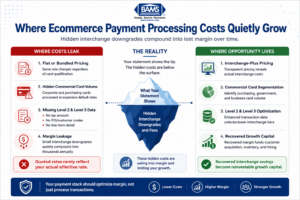
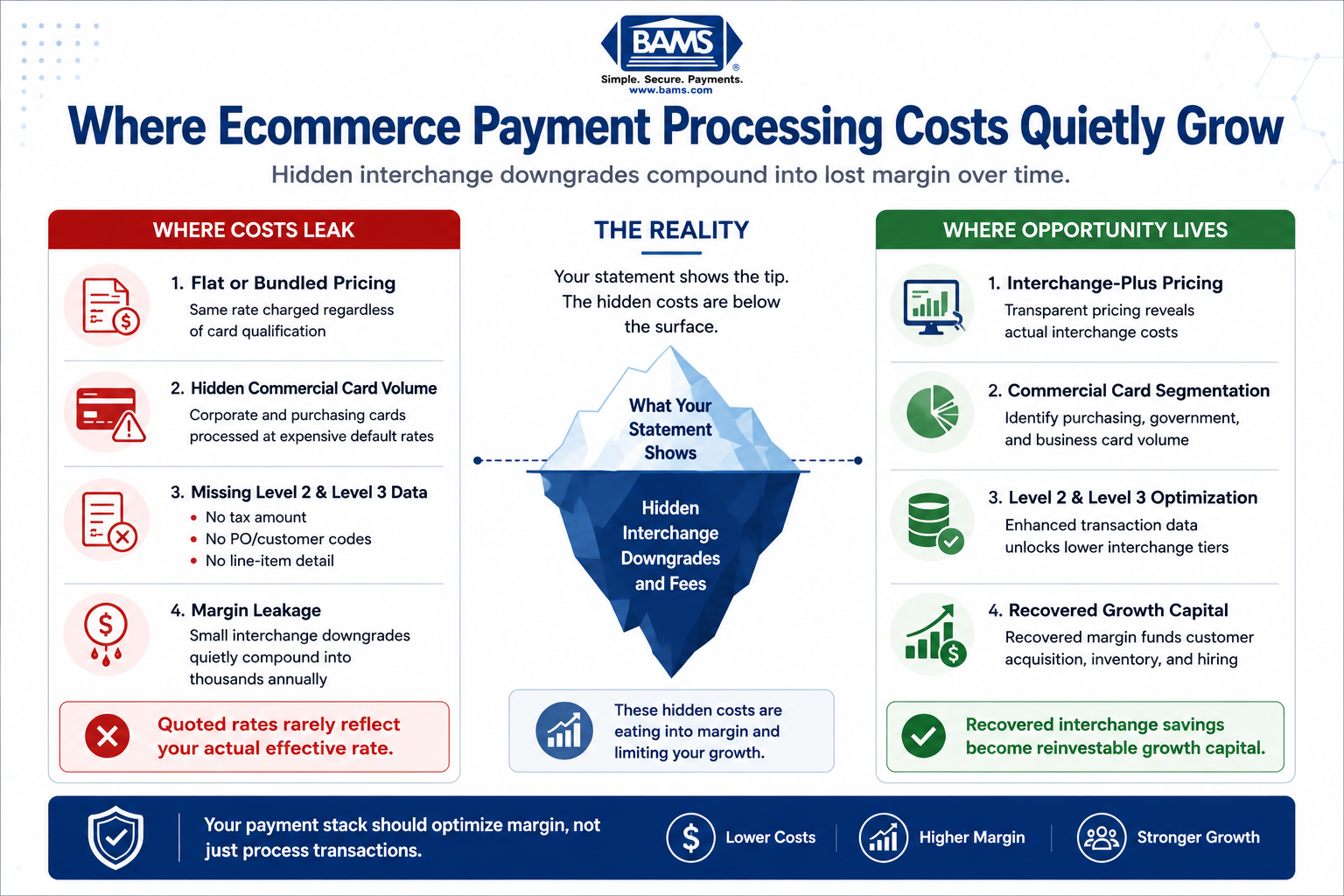
Most eCommerce businesses focus on quoted rates while hidden interchange downgrades quietly increase their real processing costs.
Core Concepts: What Your Statement Isn’t Telling You
The Three-Layer Fee Structure
Every card transaction you process carries three distinct cost layers. Interchange goes to the card-issuing bank and accounts for 70-80% of your total fee. Assessments go to the card network (Visa, Mastercard). Processor markup is what your payment processor charges on top. Only that third layer is negotiable, but interchange is where the biggest optimization opportunity hides.
Interchange Qualification Levels
Visa and Mastercard assign interchange rates based on the quality and completeness of data submitted with each transaction. There are three levels.
- Level 1 is the baseline: card number, expiration, transaction amount.
- Level 2 adds tax amount and customer code.
- Level 3 adds line-item detail: product descriptions, quantities, unit costs, freight amounts, and more. The more data you submit, the lower the interchange rate the networks assign.
The Commercial Card Blind Spot
Most eCommerce merchants assume their customers pay with personal consumer cards. But a meaningful percentage of orders, especially from small businesses, procurement teams, and government buyers, arrive on commercial or purchasing cards. These cards are eligible for significantly lower interchange rates when Level 2 or Level 3 data is submitted. Without that data, they default to standard or “non-qualified” rates, which are the most expensive categories available.
The Misconception About “Fixed” Rates
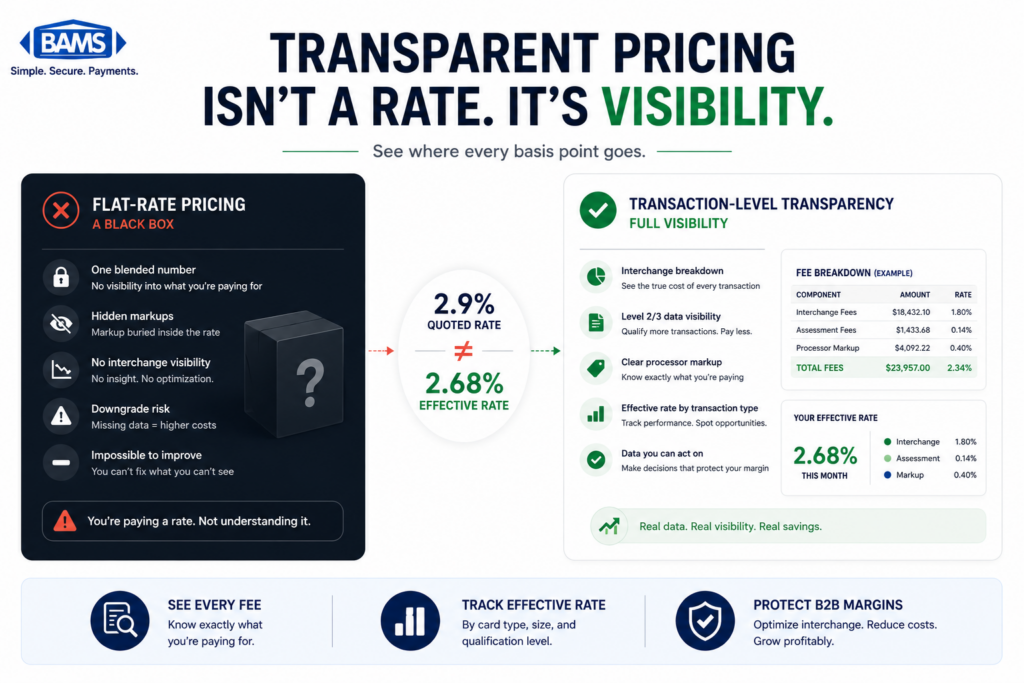
If your processor quotes you a flat rate or bundled rate, every transaction costs the same regardless of card type. That simplicity comes at a price: your processor pockets the difference when a transaction qualifies for a lower interchange tier. This is why interchange-plus pricing matters. It passes the actual interchange cost through to you, so when you optimize data quality, you capture the savings directly.
The Framework: From Statement Audit to Margin Recovery
The method for turning processing fees from a fixed cost into a variable you control follows five stages. Each builds on the last, and skipping stages leads to incomplete results.
- Stage 1: Decode — Read your processing statement as a diagnostic tool, not a bill.
- Stage 2: Segment — Identify what percentage of your volume comes from commercial, purchasing, and government cards.
- Stage 3: Evaluate — Determine which transactions are downgrading to higher interchange tiers and why.
- Stage 4: Optimize — Implement data-quality improvements that push eligible transactions into lower interchange categories.
- Stage 5: Reinvest — Redirect recovered margin into acquisition, inventory, or cash flow stabilization.
These stages form a cycle, not a one-time project. Your transaction mix changes as your business grows, so revisiting the audit quarterly keeps savings compounding.
co
Interchange optimization is not a one-time negotiation. It is an ongoing margin recovery system.
Step-by-Step Breakdown: Recovering Interchange Savings That Fund Growth
Step 1: Decode Your Processing Statement
Objective: Calculate your true effective rate and identify the gap between what you think you’re paying and what you actually pay.
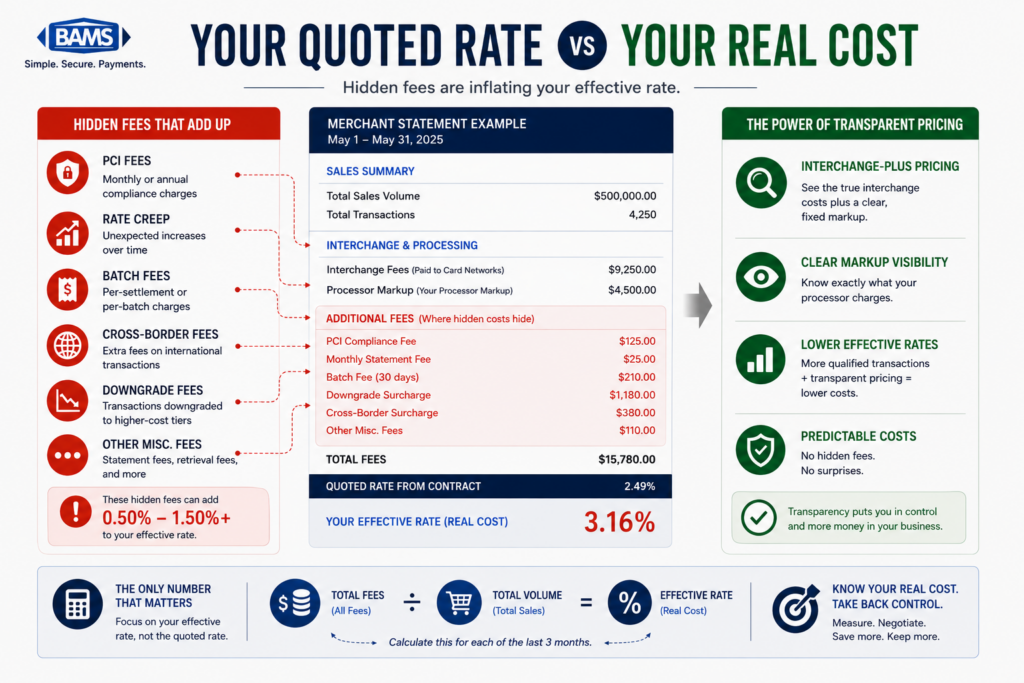
Pull your most recent three months of processing statements. Find two numbers: total processing fees charged and total card volume processed. Divide fees by volume. That’s your effective rate. If your processor quoted you 2.4% and your effective rate is 3.1%, the 0.7% gap is where the story your statement isn’t telling lives.
That gap comes from downgrades, non-qualified surcharges, batch timing penalties, and miscategorized transactions. Your statement may list these as line items, or it may bury them in a bundled total. If you’re on tiered or flat-rate pricing, the gap is invisible by design because your rate never changes regardless of the underlying interchange cost.
Anti-patterns: Don’t accept your processor’s summary page as the full picture. The summary often shows only the rate tier and total fees. The detail pages, sometimes 10-20 pages deep, show individual transaction-level qualification. Don’t skip those pages.
Success indicator: You can state your effective rate to two decimal places and identify at least three line items contributing to the gap between your quoted rate and your effective rate. For a detailed walkthrough of fee structures, see this guide to credit card processing fees.
Step 2: Segment Your Transaction Mix by Card Type
Objective: Determine what percentage of your monthly volume comes from commercial, purchasing, corporate, or government cards versus standard consumer cards.
Your processing statement (or your gateway’s reporting dashboard) should categorize transactions by card type. Look for labels like “Commercial,” “Purchasing,” “Corporate,” “Business,” or “GSA” (government). Many eCommerce managers are surprised to find that 8-15% of their volume comes from these card types, especially if they sell products that businesses also buy: office supplies, equipment, specialty goods, or anything ordered in bulk.
This matters because commercial card interchange rates have a wider spread between their best and worst qualification tiers than consumer cards. A consumer Visa credit card might vary by 0.2-0.4% between qualification levels. A Visa purchasing card can vary by 0.5-1.0% or more. That spread is your opportunity.
Anti-patterns: Don’t assume you have no commercial card volume just because you sell direct to consumers. Small business owners use business cards for personal and company purchases interchangeably. Procurement teams at mid-size companies use purchasing cards for online orders without identifying themselves as B2B buyers.
Success indicator: You have a percentage breakdown of your monthly volume by card category and can identify the dollar volume flowing through commercial or purchasing card types.
Step 3: Identify Interchange Downgrades
Objective: Pinpoint which transactions are qualifying at higher (more expensive) interchange tiers than necessary, and understand why.
Downgrades happen when a transaction fails to meet the data or timing requirements for its optimal interchange category. Common causes include: settling batches more than 24 hours after authorization, missing tax amount fields, omitting customer reference codes, or failing to pass line-item detail on commercial card transactions.
On your statement, look for interchange categories with words like “Standard,” “Non-Qualified,” or “EIRF” (Electronic Interchange Reimbursement Fee). These are penalty tiers. Every transaction sitting in one of those categories is costing you more than it should. Federal Reserve interchange fee data continues to show how interchange qualification differences materially affect effective merchant costs over time.
Anti-patterns: Don’t blame your gateway or processor without checking your own batch settlement timing first. Late settlements are the most common and most preventable cause of downgrades. Also, don’t assume that because your processor hasn’t mentioned downgrades, they aren’t happening. If your processor profits from a flat-rate model, they have no incentive to flag them.
Success indicator: You can list the specific interchange categories your transactions are falling into and calculate the dollar cost of downgrades over a 90-day period.
Step 4: Implement Data Quality Improvements for Interchange Optimization
Objective: Pass the required Level 2 and Level 3 data fields on eligible transactions to qualify for lower interchange rates.
Level 2 data requires two additional fields beyond the basics: the sales tax amount and a customer code (like a PO number or account reference). Most modern payment gateways can pass Level 2 data with minimal configuration. This alone can reduce interchange on commercial card transactions by 0.3-0.5%.
Level 3 data goes further, requiring line-item detail: item descriptions, product codes, quantities, unit costs, discount amounts, and freight charges. This is where the real savings live. Visa and Mastercard offer their lowest commercial interchange rates to transactions that pass full Level 3 data, sometimes reducing rates by 0.5-1.0% compared to standard qualification.
The practical challenge is that most ecommerce platforms don’t pass Level 3 data natively. You need either a gateway that supports enhanced data, a processor that handles data enrichment on your behalf, or middleware that maps your order data to the required fields. This is where your choice of merchant services partner matters. BAMS, for example, works with merchants to identify commercial card volume and implement the data-passing requirements without forcing a complete tech stack overhaul.
Anti-patterns: Don’t try to pass Level 3 data on consumer card transactions. The lower rates only apply to commercial, purchasing, corporate, and government cards. Also, don’t assume your current processor is already optimizing this. Ask them directly: “What percentage of my commercial card transactions are qualifying at Level 2 or Level 3 interchange?” If they can’t answer, that’s your answer.
Success indicator: You can confirm that Level 2 fields (tax amount, customer code) are passing on all transactions and that Level 3 fields are passing on identified commercial card transactions. Your next statement should show fewer transactions in “Standard” or “Non-Qualified” categories.
Step 5: Evaluate Alternative Payment Rails for High-Ticket Transactions
Objective: Reduce processing costs on large or recurring transactions by routing them through lower-cost payment methods where appropriate.
Not every transaction needs to run on card rails. NACHA ACH Network resources continue to highlight the scale and efficiency of ACH processing for recurring and high-ticket business payments. Many ecommerce businesses use ACH specifically because the cost structure is dramatically lower than cards.
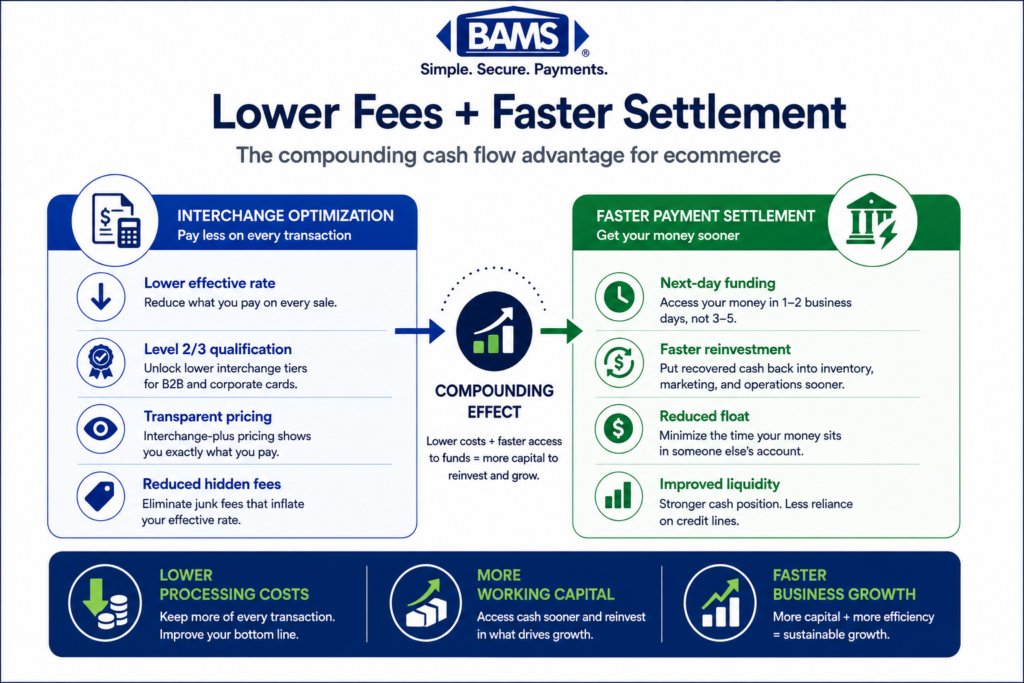
For ecommerce businesses with recurring B2B orders, wholesale accounts, or high-ticket items, offering ACH as a payment option at checkout can save significant money. A business processing $50,000 monthly in recurring invoices at 2.9% pays $1,450 in card fees. Moving that same volume to ACH at 0.5% drops the cost to $250, saving $1,200 per month or $14,400 annually.
The tradeoff is speed and customer preference. Cards settle faster (especially with next-day funding), and many buyers prefer the convenience and rewards of card payments. The decision framework is straightforward: offer ACH for high-ticket, recurring, or B2B transactions where the buyer relationship supports it, and optimize card data quality for everything else.
Anti-patterns: Don’t force ACH on customers who prefer cards. The conversion cost of lost sales outweighs the processing savings. Don’t ignore the chargeback exposure differences between payment methods either. ACH disputes follow different rules than card chargebacks.
Success indicator: You’ve identified which customer segments or transaction types are candidates for ACH, implemented it as a checkout option, and can measure adoption and savings monthly.
Step 6: Connect Recovered Margin to Growth Investment
Objective: Treat interchange savings as a funding source for customer acquisition or operational improvement, not just a line item reduction.
This is where cost reduction strategies become growth strategies. Most guides stop at “you’ll save money on processing.” That framing keeps interchange optimization trapped in the finance department. The real question is: what does recovered margin do for your unit economics?
If your customer acquisition cost (CAC) is $35 and your average order value is $120, a 0.5% reduction in processing costs recovers $0.60 per order. Across 10,000 monthly orders, that’s $6,000 per month or $72,000 annually. That funds roughly 2,057 additional customer acquisitions per year at your current CAC, which is organic growth funded entirely by money that was previously leaking to unnecessary interchange charges.
Frame the conversation this way when presenting to leadership or stakeholders. “We reduced processing costs” gets a nod. “We funded 2,000 new customers by fixing our payment data” gets budget and attention.
Anti-patterns: Don’t let savings disappear into general overhead without tracking them. Create a separate line item or internal account for recovered interchange margin so you can measure and allocate it deliberately.
Success indicator: You have a documented before-and-after effective rate, a dollar figure for monthly savings, and a plan for how those dollars are being reinvested.
Practical Examples: What This Looks Like in Context
Scenario A: The Specialty Equipment Retailer
An online retailer selling commercial kitchen equipment processes $180,000 monthly in card transactions. Their effective rate is 3.2%. A statement audit reveals that 18% of their volume ($32,400) comes from commercial and purchasing cards, all qualifying at standard (non-optimized) interchange rates because no Level 2 or Level 3 data is being passed.
After implementing Level 2 data passing through their gateway and working with their processor to enable Level 3 on commercial transactions, their interchange on that $32,400 drops by an average of 0.6%. Monthly savings: $194. Annual savings: $2,333. Not transformative alone, but combined with batch settlement timing fixes that eliminate another $80/month in downgrades on consumer cards, total annual recovery reaches $3,293.
Scenario B: The B2B Office Supply eCommerce Store
A mid-size online office supply company processes $500,000 monthly. Their customer base is 60% business accounts paying with corporate and purchasing cards. Their processor uses flat-rate pricing at 2.9%, so they’ve never seen interchange detail. Switching to interchange-plus pricing reveals their actual interchange on commercial cards averages 2.1% when properly qualified, but they’re paying 2.9% on everything.
By moving to interchange-plus, implementing Level 3 data, and offering ACH for their top 20 accounts (representing $120,000 in monthly volume), they reduce their blended effective rate from 2.9% to 2.15%. Monthly savings: $3,750. Annual savings: $45,000. That funds a part-time marketing hire or a significant paid acquisition budget increase.
The Transparency Question
Both scenarios share a common thread: the merchants didn’t know they were overpaying because their processors had no incentive to tell them. Flat-rate processors profit from the spread between actual interchange and the quoted rate. If your commercial card transactions qualify for 1.8% interchange and you’re paying 2.9% flat, your processor keeps the 1.1% difference. Transparency in pricing, specifically interchange-plus models, is the prerequisite for every optimization in this guide.
Common Mistakes and Pitfalls
Optimizing before auditing. Many merchants jump to negotiating rates without understanding their transaction mix. You can’t negotiate effectively if you don’t know which interchange categories your transactions are falling into.
Ignoring small percentages. A 0.3% improvement sounds trivial until you multiply it by annual volume. On $1 million in processing, that’s $3,000. On $5 million, it’s $15,000. Basis points compound.
Assuming your processor is optimizing for you. Unless your agreement explicitly includes interchange optimization or data enrichment services, your processor is passing through whatever interchange rate your transactions qualify for, or profiting from the spread if you’re on flat-rate pricing.
Treating this as a one-time project. Your transaction mix changes as your business grows, your customer base shifts, and card networks update interchange tables (which happens twice a year). Quarterly reviews keep savings from eroding.
Overlooking the surcharge and convenience fee option. Depending on your state and customer base, passing some processing costs to buyers is a legitimate strategy, but it requires careful implementation to avoid customer friction.
What to Do Next
Start with one action: calculate your effective rate. Pull your last three processing statements, divide total fees by total volume, and write down the number. Compare it to your quoted rate. If there’s a gap larger than 0.3%, you have recoverable margin waiting.
From there, request a transaction-level breakdown by card type from your processor or gateway. If they can’t provide one, that’s a signal worth paying attention to. A processor that can’t show you where your money goes is a processor that benefits from you not knowing.
This guide is a reference, not a checklist to rush through. Revisit it as your volume grows, your B2B mix changes, or your processor contract comes up for renewal. Each stage compounds on the last, and the merchants who treat interchange optimization as an ongoing discipline rather than a one-time negotiation are the ones who turn processing costs into a competitive advantage.
Frequently Asked Questions
What is Level 3 data in merchant services?
Level 3 data refers to detailed, line-item transaction information submitted to card networks during payment processing. It includes fields like item descriptions, quantities, unit costs, product codes, freight amounts, and tax details. When this data is passed on eligible commercial, purchasing, or government card transactions, Visa and Mastercard assign lower interchange rates because the enhanced data reduces fraud risk and simplifies reconciliation for card issuers.
How can Level 3 data optimize interchange rates for B2B transactions?
Commercial and purchasing cards have a wider spread between their best and worst interchange tiers than consumer cards. Passing Level 3 data qualifies these transactions for the lowest available interchange category, often reducing rates by 0.5% to 1.0% compared to transactions that only pass basic (Level 1) data. For businesses with significant B2B volume, this translates into thousands of dollars in annual savings without changing pricing or losing customers.
Which types of transactions are eligible for Level 3 interchange rates?
Only commercial, corporate, purchasing, business, and government card transactions are eligible for Level 2 and Level 3 interchange discounts. Standard consumer credit and debit cards do not benefit from enhanced data submission. This is why segmenting your transaction mix by card type is a critical first step: you need to know how much eligible volume you actually have before investing in data optimization.
What specific data fields are required for Level 3 processing?
Level 2 requires the sales tax amount and a customer reference code (such as a PO number). Level 3 adds line-item detail: item description, product code, item quantity, unit of measure, unit cost, extended amount, discount amount, and freight/shipping amount. The exact required fields vary slightly between Visa and Mastercard, so confirm requirements with your processor or gateway provider.
How do I know if my processor is already optimizing my interchange rates?
Ask your processor directly: “What percentage of my commercial card transactions are qualifying at Level 2 or Level 3 interchange?” If they can’t answer or don’t track this metric, they’re likely not optimizing. Additionally, if you’re on flat-rate or tiered pricing, interchange optimization provides no benefit to you because your rate stays the same regardless of qualification level. You need interchange-plus pricing to capture the savings from enhanced data.
Is it worth optimizing interchange if most of my customers are consumers?
Even businesses that primarily serve consumers often have 5-15% of their volume coming from commercial or business cards without realizing it. Small business owners frequently use business cards for online purchases. At scale, optimizing even a small segment of commercial card volume can recover meaningful margin. Additionally, fixing common downgrade causes like late batch settlements benefits all transaction types, not just commercial cards.
Sources
- Merchant Payments Coalition Resources
- Federal Reserve Interchange Fee Data
- NACHA ACH Network Resources