Chargeback Prevention: A Cash Flow Protection Guide
Last Updated on August 6, 2026 by Dimitri Akhrin
How undefended chargebacks trigger rolling reserves, freeze deposits, and quietly wreck your weekly cash plan
Learn how chargeback spikes cascade into rolling reserves and delayed deposits that destabilize your funding cycles. This guide shows eCommerce operators how to build a layered prevention posture that protects predictable cash flow.
TL;DR
- Chargebacks are a cash flow architecture problem, not just a dispute management task — A chargeback spike can trigger rolling reserves that lock up 5% to 10% of your deposits for months, disrupting your entire weekly cash plan.
- Prevention costs a fraction of what chargebacks cost — Pre-chargeback alerts run $20 to $30 per prevented dispute versus $110 to $450 for a formal chargeback, and U.S. merchants lose $4.61 for every $1 in chargeback value.
- Representment alone won’t save you — Net recovery rates after costs and second chargebacks fall to 12% to 18%, making prevention the only reliable way to protect your ratio and your deposits.
- Connect dispute data to your financial planning — Track your chargeback ratio weekly, model potential reserve scenarios, and adjust your cash flow forecast to include dispute-adjusted deposit estimates.
- Start with visibility — Pull six months of chargeback data, identify your top reason codes, and confirm the exact thresholds that would change your settlement terms with your processor.
Guide Orientation: What This Guide Covers and Who It’s For
This guide treats chargeback prevention as a cash flow architecture problem. Instead of walking through dispute response templates, it shows you how undefended chargebacks and the reserve holds they trigger erode the deposit predictability your weekly cash plan depends on.
It’s written for eCommerce managers at established online businesses (roughly 10 to 50 employees) who already process meaningful volume and rely on consistent funding cycles to cover payroll, inventory buys, and supplier commitments.
By the end, you’ll understand exactly how chargeback spikes cascade into rolling reserves and delayed deposits, how to build a layered prevention posture that keeps your funding stable, and how to connect dispute metrics directly to cash flow planning decisions. This guide does not cover PCI compliance procedures or fraud investigation workflows.
Why Predictable Cash Flow Depends on Chargeback Control
Most eCommerce operators think of chargebacks as a cost-of-doing-business line item. A dispute here, a lost product there. The real damage is structural. When your chargeback ratio climbs, your processor doesn’t just charge you fees. It changes the terms under which you receive your own revenue.
As digital commerce continues to grow, merchants face increasing pressure to manage disputes effectively while maintaining predictable funding and healthy processor relationships. That upward pressure means more merchants will cross the thresholds that trigger monitoring programs, rolling reserves, and delayed settlement windows.
The cost compounds fast. The total cost of a chargeback extends well beyond the disputed transaction, including operational effort, chargeback fees, lost merchandise, and potential impacts on future settlement terms. But even that figure understates the real impact because it doesn’t account for the cash flow disruption when your processor holds back 5% to 10% of your daily deposits in a rolling reserve for 90 to 180 days.
When deposits become unpredictable, you lose the ability to time inventory purchases, negotiate early-payment supplier discounts, or confidently eliminate short-term credit lines. The cost of inaction isn’t just the chargeback itself. It’s the downstream financial friction that quietly erodes your margins for months.
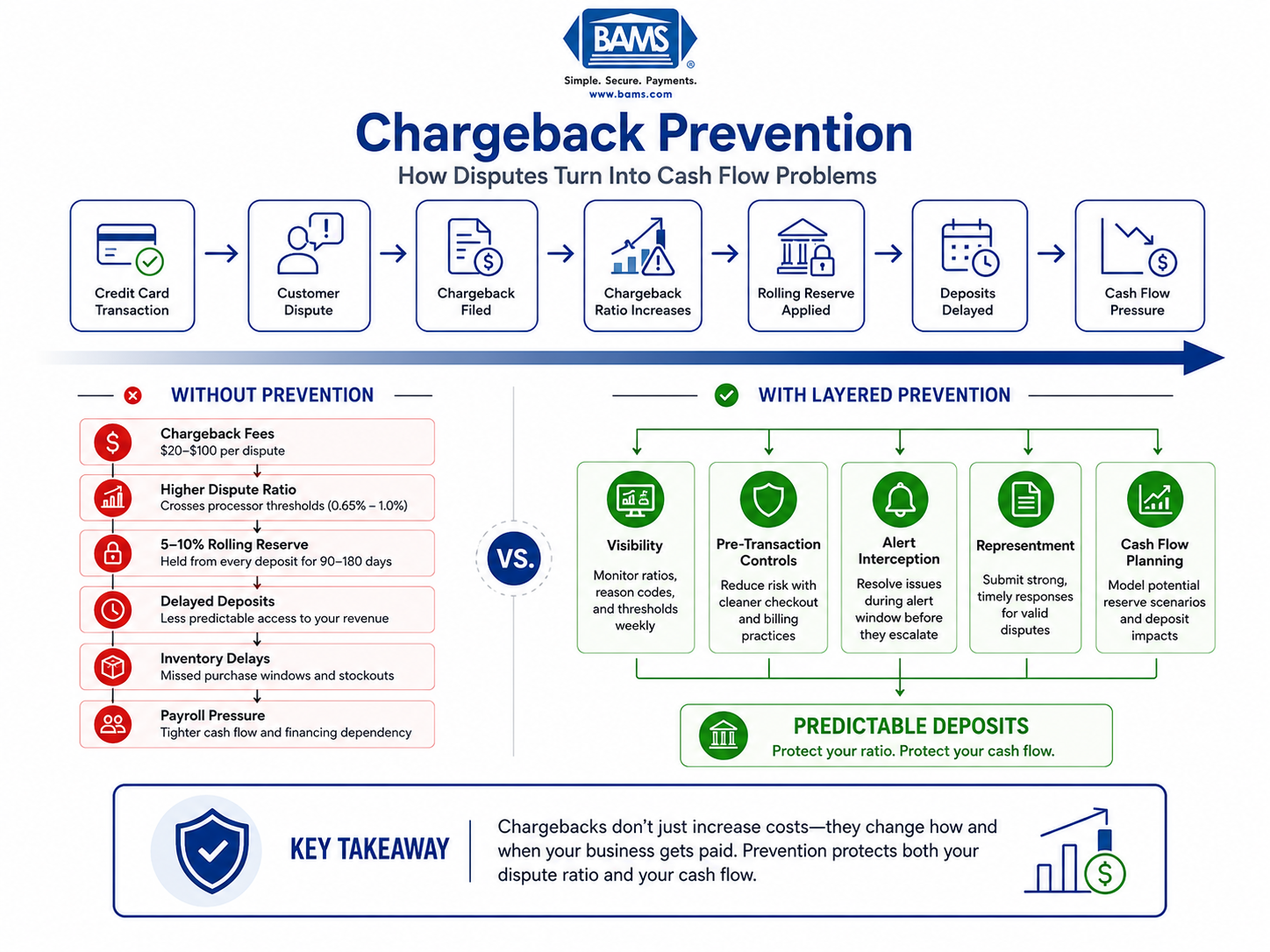
Every unresolved chargeback can trigger a chain reaction that impacts deposit timing, reserves, and business cash flow.
Core Concepts: How Chargebacks Actually Disrupt Your Cash Flow
The Chargeback-to-Reserve Pipeline
A chargeback isn’t a single event. It’s the start of a chain reaction. When a cardholder disputes a transaction, your processor debits the full transaction amount from your merchant account, adds a chargeback fee (typically $20 to $100), and records the dispute against your chargeback ratio. If that ratio crosses your processor’s internal threshold (usually 0.65% to 1.0% of transactions), the consequences escalate.
Your processor may impose a rolling reserve, holding a percentage of every deposit in escrow for a fixed period. This isn’t a penalty you pay once. It’s a structural change to how and when you receive revenue. A 10% rolling reserve on $100,000 in monthly processing means $10,000 of your cash is perpetually locked up, released only on a delayed schedule.
Friendly Fraud: The Hidden Volume Driver
Nearly half of all chargebacks are driven by friendly fraud, where a legitimate customer disputes a charge they actually authorized. These disputes are particularly damaging because they look like normal transactions at the point of sale, bypass most fraud filters, and tend to repeat. A friendly-fraud-heavy portfolio is more likely to push you into monitoring programs and reserve pressure than a merchant dealing primarily with true card theft.
The Representment Illusion
Many merchants assume they can fight their way out of chargeback problems through representment (the formal dispute response process). The math doesn’t support that assumption. Representment plays an important role in recovering eligible transactions, but preventing disputes before they become chargebacks generally provides a greater operational and financial benefit than relying solely on post-dispute recovery.
The Framework: Defense-First Cash Flow Architecture
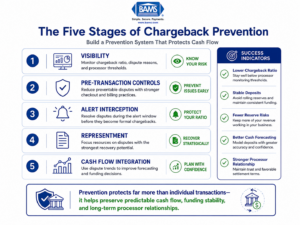
Protecting predictable cash flow from chargeback disruptions requires a five-stage system that treats prevention as a financial planning function, not just a fraud operations task.
- Stage 1: Visibility — Map your current chargeback exposure and its connection to deposit timing
- Stage 2: Pre-Transaction Prevention — Stop disputes before they start through authorization-level controls
- Stage 3: Post-Transaction Interception — Catch disputes in the alert window before they become formal chargebacks
- Stage 4: Representment Optimization — Defend the disputes that do land, efficiently and with high-quality evidence
- Stage 5: Cash Flow Integration — Connect dispute metrics to your weekly funding plan and reserve management
These stages are sequential but also cyclical. Data from Stage 5 feeds back into Stages 1 and 2, creating a continuous improvement loop. The goal is not zero chargebacks (which is unrealistic) but a dispute profile that keeps your processor relationship stable and your deposits predictable.
Step-by-Step: Building Your Chargeback Prevention Posture
Step 1: Map Your Chargeback Exposure to Deposit Risk
Objective: Understand your current chargeback ratio, the reason codes driving it, and how close you are to the thresholds that trigger reserve holds or monitoring programs.
Start by pulling your chargeback data for the last six months. Calculate your ratio two ways: by transaction count and by dollar volume. Visa’s Dispute Monitoring Program triggers at 0.65% of transactions or 75 disputes in a month. Mastercard’s Excessive Chargeback Program triggers at 1.5% with 100 disputes. Know exactly where you stand relative to both. For the latest monitoring thresholds, dispute programs, and operational requirements, review the current guidance published by Visa and Mastercard.
Break your disputes down by reason code. The distribution matters. If 60% of your chargebacks are “product not as described” or “subscription not canceled,” those are operational problems with operational fixes. If they’re concentrated in “transaction not recognized,” you likely have a billing descriptor or friendly fraud problem.
Then connect this data to your deposit schedule. Ask your processor directly: at what chargeback ratio will my settlement terms change? What reserve percentage would apply? Many merchants discover they’re operating closer to the edge than they realized.
Anti-patterns: Don’t rely solely on your processor’s monthly summary. These reports often lag by 30 to 45 days, meaning you could cross a threshold without knowing it for weeks. Don’t average your ratio across all months; look for spikes that coincide with promotions, product launches, or seasonal volume.
Success indicators: You can state your current chargeback ratio for each card network, identify your top three reason codes, and name the specific thresholds that would trigger reserve holds with your processor.
Step 2: Implement Pre-Transaction Prevention Controls
Objective: Reduce the volume of transactions that are likely to generate disputes before they settle.
Pre-transaction prevention operates at the authorization level. The most effective controls for eCommerce include requiring CVV verification on every transaction, enabling Address Verification Service (AVS) with rules that decline mismatches on both street and ZIP, and implementing velocity filters that flag multiple orders from the same card, IP address, or device fingerprint within a short window.
Beyond fraud filters, address the operational causes of disputes. The card networks encourage merchants to reduce disputes through recognizable billing descriptors, clear refund policies, accurate fulfillment practices, and responsive customer support before transactions escalate into formal disputes. That means clear billing descriptors that customers recognize on their statements, transparent refund and cancellation policies displayed before checkout, and proactive shipping notifications with tracking links.
For subscription businesses, implement pre-billing reminders and make cancellation easy to find. A significant portion of friendly fraud chargebacks come from customers who couldn’t figure out how to cancel and filed a dispute instead.
Merchants handling cardholder data should also ensure their operational procedures remain aligned with guidance from the PCI Security Standards Council.
Anti-patterns: Don’t set fraud filters so aggressively that you decline legitimate orders. A false-decline rate above 2% to 3% costs more in lost revenue than the chargebacks you’re preventing. Don’t hide your contact information or make customers work to reach support; every unresolved complaint is a potential dispute.
Success indicators: Your authorization decline rate stays below 3%, your billing descriptor is recognizable in test statements, and your customer service team can point to a documented escalation path for order disputes. For a detailed implementation checklist, see this guide on how to prevent chargebacks and unlock faster deposits.
Step 3: Deploy Pre-Chargeback Alert Interception
Objective: Catch disputes during the alert window (before they become formal chargebacks) and resolve them through refunds that don’t count against your ratio.
Visa’s Verifi and Mastercard’s Ethoca both offer alert networks that notify merchants when a cardholder initiates a dispute. During this window (typically 24 to 72 hours), you can issue a refund that satisfies the cardholder and prevents the dispute from becoming a formal chargeback on your record.
The economics are straightforward. Pre-chargeback alert tools cost $20 to $30 per prevented dispute, compared to $110 to $450 once a dispute becomes a formal chargeback. More importantly, prevented disputes don’t count toward your chargeback ratio, which means they don’t push you toward monitoring programs or rolling reserves.
Combined Verifi and Ethoca alerts can reduce chargeback volume by up to 80%. Even if the reduction for your business is more modest, the ratio impact alone justifies the investment. A merchant processing 5,000 transactions per month who drops from 40 chargebacks to 15 moves from a 0.80% ratio (dangerously close to Visa’s threshold) to 0.30% (comfortably safe).
Merchants working with BAMS get proactive chargeback defense built into their account management, which means alert interception is handled as part of the processing relationship rather than requiring a separate vendor integration.
Anti-patterns: Don’t treat alerts as optional or delay responding to them. The window is short, and a missed alert becomes a chargeback. Don’t issue refunds on alerts without logging the data; you need the pattern information to feed back into prevention.
Success indicators: Your alert response rate is above 90%, your formal chargeback count has dropped measurably, and your chargeback ratio is trending below 0.50%.
Step 4: Optimize Representment for the Disputes That Land
Objective: Maximize recovery on formal chargebacks through efficient, evidence-rich representment while keeping operational costs proportional to recovery value.
Not every chargeback is worth fighting. Build a decision framework based on transaction value, evidence strength, and reason code.
- For “item not received” disputes, you need carrier tracking confirmation with delivery proof.
- For “not as described” disputes, you need product listing screenshots, customer communications, and return policy documentation.
- For “fraud” disputes on orders that passed AVS and CVV, compile the authorization record, device fingerprint data, and any prior purchase history from the same customer.
Automating evidence collection and response workflows helps merchants submit complete representment packages more consistently and within network deadlines (typically 20 to 45 days depending on the network).
Set a minimum transaction threshold for representment. If your average representment costs $50 in staff time and the transaction is worth $30, the math doesn’t work. Focus representment resources on high-value disputes and disputes from repeat offenders whose patterns you want to document.
Anti-patterns: Don’t submit boilerplate responses without transaction-specific evidence. Generic representment packages have significantly lower win rates. Don’t ignore second chargebacks (pre-arbitration); they erode your net recovery rate and signal to the network that your evidence was insufficient.
Success indicators: Your representment win rate exceeds 45%, you have a documented threshold for which disputes to fight, and your average cost per representment is tracked and declining.
Step 5: Connect Dispute Metrics to Your Weekly Cash Flow Plan
Objective: Integrate chargeback data into your financial planning process so that dispute trends inform deposit expectations, inventory timing, and working capital decisions.
This is where chargeback prevention stops being a fraud operations task and becomes a cash flow planning function. Build a weekly dashboard that tracks three numbers: your current chargeback ratio by network, the dollar value of disputes in progress (money that’s been debited but not yet resolved), and your reserve balance if one exists.
Use these numbers to adjust your cash flow forecast. If your chargeback ratio is trending upward, model the impact of a potential reserve hold on your available cash. A 10% reserve on your average weekly deposits gives you a concrete number to plan around, even before the reserve is imposed. This lets you make preemptive decisions: delaying a non-critical inventory purchase, drawing on a credit line before terms change, or accelerating collections from other channels.
Batch timing also matters. If your eCommerce platform batches transactions at end of day, confirm that the batch cutoff aligns with your processor’s settlement window. A batch that closes at 11 PM but misses the processor’s midnight cutoff delays your deposit by a full business day. For faster deposit strategies, aligning batch timing with your processor’s schedule is one of the simplest optimizations available.
Anti-patterns: Don’t treat chargeback data and cash flow planning as separate workflows managed by different teams. Don’t wait for your processor to impose a reserve before modeling the impact. Don’t ignore the timing dimension; a $5,000 chargeback debit on Monday morning can create a real shortfall even if you win the representment eight weeks later.
Success indicators: Your weekly cash flow forecast includes a dispute-adjusted deposit estimate, your finance team receives chargeback ratio updates at least weekly, and you have a contingency plan for reserve scenarios.
Practical Example: How a Reserve Hold Disrupts a Real Cash Plan
Consider an eCommerce business processing $80,000 per week with next-day funding. Their weekly cash plan allocates $30,000 to inventory replenishment on Tuesdays, $25,000 to payroll on Fridays, and the remainder to supplier payments and operating costs. Deposits arrive predictably each morning, and the timing works.
After a holiday promotion, their chargeback ratio spikes from 0.40% to 0.85% over six weeks. Their processor imposes a 10% rolling reserve with a 90-day hold. Overnight, $8,000 per week disappears from their available deposits. That’s not a fee they can absorb. It’s a structural change that blows up their Tuesday inventory buy and forces them onto a supplier credit line at 18% APR.
Now contrast this with a business running the same volume but using pre-chargeback alerts and proactive prevention. Their post-promotion chargeback ratio climbs to 0.55%, stays below monitoring thresholds, and no reserve is imposed. Their deposits continue arriving on schedule, and their cash plan holds. The difference isn’t luck. It’s architecture.
This is exactly the kind of scenario where treating chargeback risk management as a cash flow lever pays for itself many times over. The prevention costs are measured in hundreds of dollars. The reserve hold costs are measured in tens of thousands.
Common Mistakes and Pitfalls
- Treating chargebacks as a customer service problem only. Dispute resolution matters, but if you’re not connecting chargeback metrics to your deposit schedule and reserve risk, you’re managing symptoms while the structural damage accumulates.
- Ignoring friendly fraud because the customer “seemed legitimate.” Friendly fraud accounts for nearly half of all chargebacks. Legitimate customers file illegitimate disputes. Your prevention system needs to account for this.
- Over-investing in representment while under-investing in prevention. Fighting chargebacks after they land recovers cents on the dollar. Preventing them before they’re filed preserves your ratio, your reserves, and your deposit schedule.
- Assuming your processor will warn you before changing terms. Most processing agreements give the processor discretion to impose reserves or adjust settlement timing based on risk. By the time you get the notification, the hold is already in place.
- Running cash flow projections without dispute-adjusted estimates. If your forecast doesn’t account for chargebacks in progress and potential reserve scenarios, it’s incomplete. The gap between projected and actual available cash is where operational crises start.
What to Do Next
Start with Step 1. Pull your chargeback data for the last six months, calculate your ratio by network, and identify your top three reason codes. This single action gives you the visibility to assess how close you are to the thresholds that affect your deposits.
If you’re already above 0.50%, prioritize Step 3 (alert interception) to bring your ratio down before it triggers consequences. If you’re below 0.50%, focus on Step 2 (pre-transaction controls) and Step 5 (integrating dispute data into your cash plan) to build the architecture that keeps you there.
This guide is designed as a reference you can return to as your volume changes, your product mix shifts, or your processor relationship evolves. Chargeback prevention isn’t a one-time project. It’s an ongoing discipline that protects the deposit predictability your entire operation depends on. For a broader view of how the right merchant services partner supports positive cash flow, that’s a natural next step once your prevention posture is in place.
Frequently Asked Questions
What is a rolling reserve, and how does it affect my deposits?
A rolling reserve is a percentage of your daily or weekly processing volume that your payment processor holds in escrow, typically for 90 to 180 days. It’s imposed when your chargeback ratio or risk profile crosses internal thresholds. The practical effect is that a portion of your revenue becomes unavailable for weeks or months, reducing the cash you can deploy for inventory, payroll, and supplier payments.
At what chargeback ratio will my processor impose a reserve or monitoring program?
Visa’s Dispute Monitoring Program triggers at 0.65% of transactions or 75 disputes per month. Mastercard’s Excessive Chargeback Program triggers at 1.5% with 100 disputes. However, many processors set their own internal thresholds lower than the card network levels. Ask your processor directly what ratio triggers reserve holds or settlement changes in your specific agreement.
How do pre-chargeback alerts work, and are they worth the cost?
Visa’s Verifi and Mastercard’s Ethoca notify you when a cardholder initiates a dispute, giving you a 24 to 72 hour window to issue a refund before it becomes a formal chargeback. Alerts cost $20 to $30 per prevented dispute, compared to $110 to $450 for a formal chargeback. More importantly, resolved alerts don’t count against your chargeback ratio, keeping you below monitoring thresholds.
Why can’t I just fight chargebacks through representment instead of investing in prevention?
Representment win rates average about 41%, and after second chargebacks and associated costs, net recovery drops to 12% to 18%. Even when you win, the dispute still counted against your ratio during the months it was in progress. Prevention keeps disputes from landing in the first place, protecting both your cash and your processor relationship.
How does next-day funding connect to chargeback risk?
Next-day funding gives you faster access to your processing revenue, which improves cash flow planning. But that speed depends on maintaining a clean risk profile with your processor. If your chargeback ratio spikes and a reserve is imposed, next-day funding still applies, but only to the portion of your deposits not held in reserve. Prevention protects the full value of fast settlement.
What’s the single most impactful thing I can do this week to reduce chargeback risk?
Check your billing descriptor. If customers don’t recognize the charge on their statement, they file disputes. Test your descriptor by making a small purchase and reviewing how it appears on your bank or credit card statement. A clear, recognizable descriptor that includes your business name and a customer service phone number prevents a meaningful share of “transaction not recognized” disputes.