Payment Orchestration: A Practical Guide for eCommerce
Last Updated on August 6, 2026 by Dimitri Akhrin
How to unify fragmented payment data across your website, Amazon, and in-person channels
Learn how to consolidate disconnected payment flows into a single system that reduces reconciliation overhead and speeds up deposits. This guide turns payment orchestration into actionable steps for multichannel eCommerce businesses.
TL;DR
- Fragmented payments cost more than you think – Reconciling data across your website, Amazon, and in-person sales channels eats team hours and creates cash flow blind spots that limit your ability to reinvest.
- Start with an audit – Map every payment channel, processor, fee structure, and deposit timeline in one document. You can’t optimize what you can’t see.
- Consolidate before you automate – Reduce the number of disconnected processors and dashboards first. A single merchant services partner for your controllable channels eliminates reconciliation drag at the source.
- Faster deposits are a reinvestment tool – Moving from three-day to next-day funding unlocks working capital that was already yours, letting you restock faster, scale ads sooner, and negotiate better supplier terms.
- Chargeback defense preserves revenue – Fix your billing descriptor, implement pre-charge notifications, and respond to disputes quickly. Prevention-first chargeback management protects both your revenue and your processor relationship.
Guide Orientation: What This Covers and Who It’s For
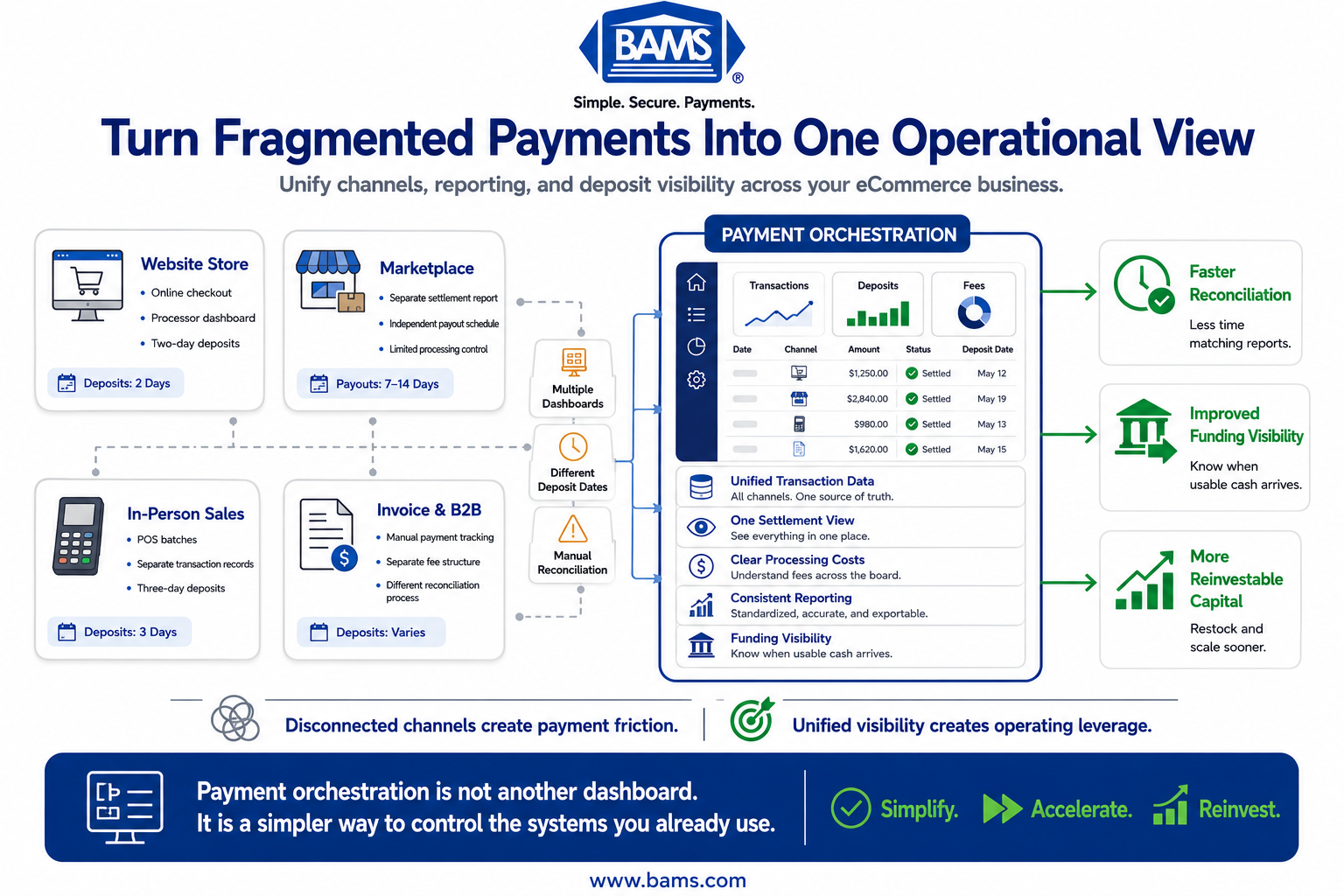
Payment orchestration brings disconnected channels, reports, and deposit schedules into one manageable payment system.
This guide is about turning payment orchestration from an abstract enterprise concept into a practical growth lever for eCommerce businesses selling across multiple channels. If your payment data currently lives in separate systems for your website, Amazon storefront, and in-person events, this is for you.
The intended reader is an eCommerce manager at an established online business (10 to 50 employees) who feels the daily friction of delayed deposits, inconsistent transaction data, and processing fees that seem to climb without explanation. You already know payments matter. You need to know what to do about it.
By the end, you’ll understand how to consolidate fragmented payment flows into a single operational system, reduce reconciliation overhead, and convert faster deposits into reinvestable capital. This guide does not cover enterprise-scale routing architecture or tokenization deep dives. It focuses on decisions you can make this quarter.
Why Payment Orchestration Matters for eCommerce Revenue
Selling across multiple channels is no longer a growth strategy reserved for large retailers. It’s table stakes. But every new channel you add (your Shopify store, an Amazon listing, a weekend pop-up) introduces another payment processor, another deposit timeline, and another reconciliation headache.
The cost isn’t just operational. It’s financial. When deposits from your website arrive in two days, Amazon payouts land biweekly, and your pop-up terminal settles on its own schedule, your cash flow becomes unpredictable. You can’t confidently reorder inventory, scale ad spend, or negotiate supplier terms when you don’t know exactly what’s in your account or when it will arrive.
Many growing eCommerce businesses rely on multiple payment providers to support different sales channels and customer payment preferences. While this increases flexibility, it also creates operational complexity when payment data, settlement timelines, and reporting remain fragmented across systems.
The cost of inaction is measurable. Every hour your team spends cross-referencing three dashboards is an hour not spent on conversion optimization, customer retention, or product development. Every day a deposit is delayed is a day your capital sits idle. Payment orchestration, approached practically, turns that dead time into working capital.
Core Concepts: What You Actually Need to Understand
Payment Orchestration vs. Payment Processing
Payment processing is the act of moving money from a customer’s account to yours. Payment orchestration is the layer above that: it manages how, when, and through which processor those transactions flow. Think of processing as a single road. Orchestration is the traffic system that routes cars across multiple roads based on conditions.
For a mid-size eCommerce business, orchestration doesn’t require building a custom tech stack. It means choosing a merchant services partner that can consolidate your payment data, normalize deposit timelines, and give you a single view of your revenue regardless of where the sale happened.
Reconciliation Drag
Reconciliation drag is the hidden cost of matching transactions across disconnected systems. When your Stripe dashboard shows one number, your Amazon Seller Central shows another, and your POS terminal has its own batch report, someone on your team has to stitch those together. That labor cost compounds weekly and introduces error risk that can cascade into accounting problems at tax time.
Funding Velocity
Funding velocity is the speed at which settled transactions become usable cash in your bank account. This is distinct from authorization speed (how fast a transaction is approved). A sale can authorize in milliseconds but take three to five business days to land in your account. The gap between authorization and deposit is where cash flow anxiety lives. Funding speed directly affects your ability to restock, reinvest, and respond to market opportunities. As faster payment infrastructure continues to expand, businesses have more opportunities to improve cash flow by reducing settlement delays.
Interchange-Plus vs. Bundled Pricing
Interchange-plus pricing separates the card network’s base cost (interchange) from your processor’s markup, giving you transparency into exactly what you’re paying and why. Bundled pricing rolls everything into a single rate, which sounds simpler but often hides margin. Understanding this distinction is foundational to reducing your processing costs without switching processors entirely. Mastercard provides additional guidance on how transparent pricing and payment optimization contribute to healthier payment ecosystems.
The Framework: Four Phases of Payment Consolidation
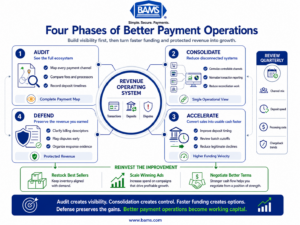
Payment consolidation works best as a repeating operating cycle: audit, consolidate, accelerate, and defend.
The method for turning faster deposits into a growth lever follows four phases. These aren’t sequential in the sense that you finish one before starting the next. They overlap and reinforce each other. But each phase addresses a distinct operational problem.
- Phase 1: Audit — Map every payment channel, processor, fee structure, and deposit timeline you currently operate.
- Phase 2: Consolidate — Reduce the number of disconnected systems by centralizing through a single merchant services relationship where possible.
- Phase 3: Accelerate — Optimize deposit timing and authorization rates to convert sales into usable cash faster.
- Phase 4: Defend — Build chargeback prevention and dispute management into your payment operations so recovered revenue stays recovered.
Each phase builds on the previous one. You can’t meaningfully accelerate deposits if you haven’t audited where the delays originate. You can’t defend revenue you can’t see clearly. The framework is designed to be revisited quarterly as your channel mix evolves.
Step-by-Step Breakdown: Executing Each Phase
Step 1: Audit Your Payment Ecosystem
Objective: Produce a complete map of every payment touchpoint, processor relationship, fee structure, and deposit timeline across all sales channels.
Start by listing every place you accept payments. This includes your primary eCommerce platform, any marketplace listings (Amazon, Etsy, Walmart Marketplace), in-person sales through POS terminals, and any invoice or B2B payment flows. For each channel, document the processor handling the transaction, the fee structure (interchange-plus or bundled), the average deposit timeline, and who on your team is responsible for reconciling that data.
Most eCommerce managers discover during this audit that they’re paying three different effective rates for the same type of card transaction, simply because each processor bundles fees differently. This is where transparent pricing becomes a competitive advantage rather than a nice-to-have. If you can’t see the interchange component separately from your processor’s markup, you can’t negotiate or optimize.
Anti-patterns to avoid: Don’t skip channels you consider “small.” A pop-up booth processing $3,000 per weekend still represents $150,000+ annually, and its deposit timeline affects your weekly cash position. Don’t rely on memory. Pull actual statements and settlement reports.
Success indicators: You have a single document (spreadsheet or dashboard) showing every channel, its processor, its effective rate, and its average time-to-deposit. You can identify which channel has the highest cost per transaction and which has the longest funding delay.
Step 2: Consolidate Payment Data Under One View
Objective: Reduce reconciliation drag by centralizing payment reporting and, where possible, processing relationships.
Full consolidation to a single processor isn’t always possible. Amazon, for example, handles its own payment processing. But you can consolidate everything you control: your website, your POS, your invoice payments. The goal is to minimize the number of separate dashboards your team checks daily.
A dedicated merchant services partner can process transactions across your website and in-person channels through a single relationship, giving you one settlement report instead of three. This isn’t just about convenience. It’s about data quality. When all your controllable transactions flow through one system, you can spot trends (declining authorization rates on a specific card type, rising chargebacks from a specific product category) that would be invisible across fragmented dashboards.
For channels you can’t consolidate at the processor level (like Amazon), build a weekly reconciliation routine that pulls settlement data into your central view. The audit from Step 1 gives you the map. This step builds the single pane of glass.
Anti-patterns to avoid: Don’t add another tool to solve a tool problem. The answer to three disconnected dashboards is not a fourth dashboard that aggregates them. Consolidate at the processor level first, then layer reporting tools if needed. Don’t confuse accounting software integration with payment consolidation. QuickBooks syncing your transactions is bookkeeping, not orchestration.
Success indicators: Your team’s weekly reconciliation time drops measurably. You can answer “What was our total revenue across all channels yesterday?” in under two minutes without opening multiple platforms.
Step 3: Accelerate Deposits and Authorization Rates
Objective: Reduce the time between a completed sale and usable cash in your bank account, while simultaneously improving the percentage of legitimate transactions that get approved.
Deposit speed is determined by several factors: your processor’s settlement schedule, your bank’s availability policy, your batch submission timing, and whether your account has reserve holds. Many processors default to two-to-three-day funding, but faster funding options exist that don’t require paying significantly more. Next-day funding, for example, can transform your cash flow by giving you access to yesterday’s sales revenue by the following business morning.
Authorization rates matter just as much as deposit speed. Working with a processor to improve authorization rates can reduce unnecessary declines and recover legitimate sales that might otherwise be lost because of routing issues, issuer responses, or outdated payment configurations. For a business processing $500,000 annually, even a 5% improvement in authorization rates can represent $25,000 in revenue that would have otherwise been lost to false declines.
To improve authorization rates without enterprise-level orchestration tools, focus on three areas: ensure your billing descriptors are clear (reducing bank-side flags), submit batches before your processor’s daily cutoff time, and work with your processor to identify which card types or issuing banks have the highest decline rates.
Payment optimization for eCommerce starts with these fundamentals before moving to more advanced routing strategies.
This is where a partner like BAMS can make a concrete difference. Their next-day funding and dedicated account management mean you’re not submitting a support ticket when your deposit is delayed. You’re calling a person who already knows your account and can resolve the issue the same day.
Anti-patterns to avoid: Don’t assume faster funding always means higher fees. Some processors charge a premium for next-day funding that erases the cash flow benefit. Evaluate the net impact, not just the speed. Don’t ignore batch timing. Submitting your batch at 11 PM instead of 8 PM can push your deposit back an entire business day.
Success indicators: Your average time-to-deposit decreases by at least one business day. Your authorization rate improves by 2% or more within 90 days. You can quantify the dollar value of recovered revenue from reduced false declines.
Step 4: Build Proactive Chargeback Defense
Objective: Prevent chargebacks before they happen and resolve disputes quickly when they do, preserving revenue that would otherwise be lost.
Chargebacks are not just a fraud problem. For most eCommerce businesses in the 10-to-50-employee range, the majority of chargebacks come from “friendly fraud” (customers who received their order but dispute the charge anyway) and unclear billing descriptors (customers who don’t recognize the charge on their statement). Both are preventable.
Start with your billing descriptor. If your legal business name is “XYZ Holdings LLC” but your customers know you as “BrightLeaf Home,” every transaction that shows “XYZ Holdings” on a bank statement is a chargeback risk. Fix this first. It’s the lowest-effort, highest-impact change you can make.
Next, implement transaction alerts.
Services that notify customers before a charge posts (like Ethoca alerts or Verifi alerts) give them a chance to recognize the charge before disputing it with their bank. This alone can reduce chargeback rates significantly without adding friction to your checkout process.
For disputes that do occur, response time is critical. Most processors give you a narrow window to respond to disputes. Visa’s dispute management guidance reinforces the importance of timely responses and complete supporting evidence when challenging chargebacks. If your payment data is scattered across three systems, gathering the evidence you need (transaction records, shipping confirmation, customer communication) takes longer than it should. The consolidation work from Step 2 directly supports faster dispute responses.
BAMS offers proactive chargeback defense as part of their merchant services relationship, meaning disputes are flagged and addressed before they escalate rather than after the money has already left your account. For a growing ecommerce business, this kind of prevention-first approach preserves both revenue and your processor relationship (since high chargeback ratios can trigger account reviews or termination).
Anti-patterns to avoid: Don’t treat chargebacks as a cost of doing business. Every uncontested chargeback trains the system to expect more. Don’t wait for your chargeback ratio to trigger a processor warning before taking action. By that point, you’ve already lost revenue and credibility.
Success indicators: Your chargeback ratio stays below 0.5% consistently. Your dispute win rate exceeds 40%. You can trace each chargeback to a root cause (billing descriptor, delivery issue, friendly fraud) and address patterns systematically.
Step 5: Reinvest Recovered Capital into Growth
Objective: Close the loop by directing the cash flow improvements from Steps 1 through 4 into specific growth activities, making your payment operations a revenue driver rather than a cost center.
This is where faster deposits become a genuine growth lever rather than just an operational improvement. When you receive yesterday’s revenue by tomorrow morning, you can make decisions that slower-funded competitors cannot. You can reorder a fast-selling product before it goes out of stock. You can increase ad spend on a campaign that’s converting well without waiting for last week’s deposits to clear. You can pay suppliers on shorter terms in exchange for better pricing.
The math is straightforward.
If your business processes $50,000 per week and you move from three-day funding to next-day funding, you gain access to roughly $100,000 in working capital that was previously trapped in transit. That’s not new revenue. It’s revenue you already earned, now available two days sooner. Over a year, the compounding effect of reinvesting that capital (into inventory, marketing, or supplier negotiations) can represent meaningful top-line growth.
Create a simple reinvestment framework: identify your highest-ROI growth activity (usually inventory restocking or paid acquisition), calculate how much additional capital faster funding makes available weekly, and allocate a fixed percentage of that recovered capital to the growth activity. Track the return monthly.
Anti-patterns to avoid: Don’t treat faster deposits as free money. It’s the same revenue arriving sooner, not additional revenue. Budget accordingly. Don’t spread reinvestment across too many initiatives. Pick one or two high-ROI activities and measure their impact before diversifying.
Success indicators: You can draw a direct line from faster funding to a specific growth outcome (e.g., “Next-day funding allowed us to restock Product X three days earlier, capturing $12,000 in sales we would have missed”). Your eCommerce revenue growth rate accelerates relative to the period before consolidation.
Practical Examples: What This Looks Like in Action
Scenario A: The Multi-Channel Home Goods Brand
A home goods brand sells through its own Shopify store, Amazon, and monthly pop-up markets. Before consolidation, the owner spent four hours every Monday reconciling three separate payment reports. Deposits arrived on different schedules: Shopify payments in two business days, Amazon payouts biweekly, and the POS terminal settling in three days.
After auditing their payment ecosystem, they consolidated their Shopify and POS processing under a single merchant services partner with next-day funding. Amazon remained separate (unavoidable), but they built a weekly reconciliation template that pulled Amazon settlement data into their central report. Result: Monday reconciliation dropped from four hours to 45 minutes. The owner reinvested three hours per week into product sourcing, launching two new product lines within six months.
Scenario B: The Subscription Skincare Brand
A subscription skincare company processing $80,000/month was experiencing a 1.2% chargeback rate, primarily from customers who forgot they’d subscribed. Their billing descriptor showed their parent company name, not their brand name. After fixing the descriptor and implementing pre-charge email notifications, their chargeback rate dropped to 0.3% within 90 days. The revenue preserved (roughly $7,200 annually in avoided chargebacks plus eliminated chargeback fees) funded a customer retention campaign that reduced voluntary churn by 8%.
The Tradeoff: Speed vs. Cost
Not every faster-funding option is worth the price. One eCommerce manager found that their processor’s “instant funding” option charged 1.5% per transaction, effectively doubling their processing cost. Next-day funding through a different partner cost a flat monthly fee that amounted to 0.1% of their volume. The lesson: evaluate funding speed improvements on a net-cost basis, not just a speed basis.
Common Mistakes and Pitfalls
The most common mistake is treating payment operations as a set-it-and-forget-it function. Your channel mix evolves, your transaction volume changes, and processor pricing shifts. Quarterly reviews of your payment ecosystem (revisiting the audit from Step 1) catch drift before it becomes costly.
Another frequent error is optimizing for one metric in isolation. Chasing the lowest processing rate while ignoring deposit speed, or prioritizing speed while ignoring authorization rates, creates new problems while solving old ones. The framework works because each phase reinforces the others.
Finally, many eCommerce managers underestimate the value of human support. When a deposit is delayed or a chargeback is escalated, the difference between a support ticket queue and a dedicated account manager can be measured in days of lost revenue and hours of lost productivity. As digital payments continue to evolve, businesses increasingly benefit from simplifying payment operations and improving visibility across every sales channel. Technology alone, however, delivers the best results when paired with experienced payment professionals who understand your business.
What to Do Next
Start with the audit. Block 90 minutes this week to map every payment channel, processor, fee structure, and deposit timeline your business currently uses. You don’t need new software for this. A spreadsheet works. The goal is visibility, not perfection.
Once you can see the full picture, identify the single highest-impact change: the channel with the longest deposit delay, the processor with the least transparent pricing, or the reconciliation task consuming the most team hours. Fix that one thing first.
This guide is designed as a reference, not a checklist. Revisit it as your channel mix changes, as your volume grows, or as you evaluate new merchant services relationships. Payment operations are never “done.” They evolve with your business. The businesses that treat payments as a growth function (rather than a back-office chore) are the ones that compound small advantages into meaningful revenue gains over time.
Frequently Asked Questions
What are the common payment challenges faced by multi-channel eCommerce merchants?
The biggest challenges are fragmented payment data across platforms, inconsistent deposit timelines, difficulty reconciling transactions from multiple processors, and limited visibility into effective processing rates. These issues compound as you add channels, creating cash flow unpredictability and consuming team hours that could be spent on growth activities.
How can eCommerce businesses optimize payment processing to reduce declines?
Start with clear billing descriptors so issuing banks don’t flag your transactions. Submit batches before your processor’s daily cutoff to avoid unnecessary delays. Work with your processor to identify which card types or issuing banks produce the highest decline rates, then address those specifically. These fundamentals can improve authorization rates by 2 to 5% before you invest in more advanced orchestration tools.
When should merchants conduct a payment processing audit?
At minimum, quarterly. You should also audit whenever you add a new sales channel, change processors, notice a spike in chargebacks, or experience unexplained deposit delays. The audit doesn’t need to be complex. A 90-minute review of every channel’s processor, fee structure, and deposit timeline gives you the visibility to make informed decisions.
Which factors affect the speed of payment deposits?
Several factors determine how quickly settled funds reach your bank account: your processor’s settlement schedule, your bank’s funds availability policy, the time you submit your daily batch, whether your account has reserve holds, and the type of funding program you’re enrolled in (standard two-to-three-day vs. next-day funding). Batch submission timing is the easiest factor to control immediately.
How do chargebacks impact eCommerce revenue beyond the refund amount?
Each chargeback costs more than the transaction value. You lose the product (if already shipped), pay a chargeback fee ($15 to $100 depending on your processor), and absorb the labor cost of gathering evidence and responding to the dispute. High chargeback ratios can also trigger processor account reviews, higher reserve requirements, or account termination, all of which disrupt your ability to accept payments entirely.
Is payment orchestration only relevant for enterprise-scale businesses?
No. While the term originated in enterprise contexts, the underlying principle (centralizing control over how and where transactions are processed) applies to any business selling through more than one channel. For a business with 10 to 50 employees, orchestration looks less like custom API integrations and more like choosing a single merchant services partner who can handle your website, POS, and invoice payments through one relationship with unified reporting and consistent deposit timelines.