
Contactless Payments: The Fraud Gap Nobody Audits
Last Updated on October 14, 2026 by Dimitri Akhrin
Why rising Apple Pay adoption is quietly reshaping your fraud exposure faster than your defenses can adapt
Learn why the same contactless payments driving checkout conversion gains are opening fraud gaps most merchants aren’t equipped to detect. This piece reframes payment mix shifts as an operational risk signal, not just a customer experience win.
TL;DR
- Apple Pay adoption is a risk signal, not just a conversion win – Tokenized transactions bypass traditional fraud filters, creating blind spots that show up as rising chargebacks months later.
- Biometric authentication proves device ownership, not cardholder identity – Fraudsters who provision stolen cards into their own wallets pass every security check Apple Pay offers.
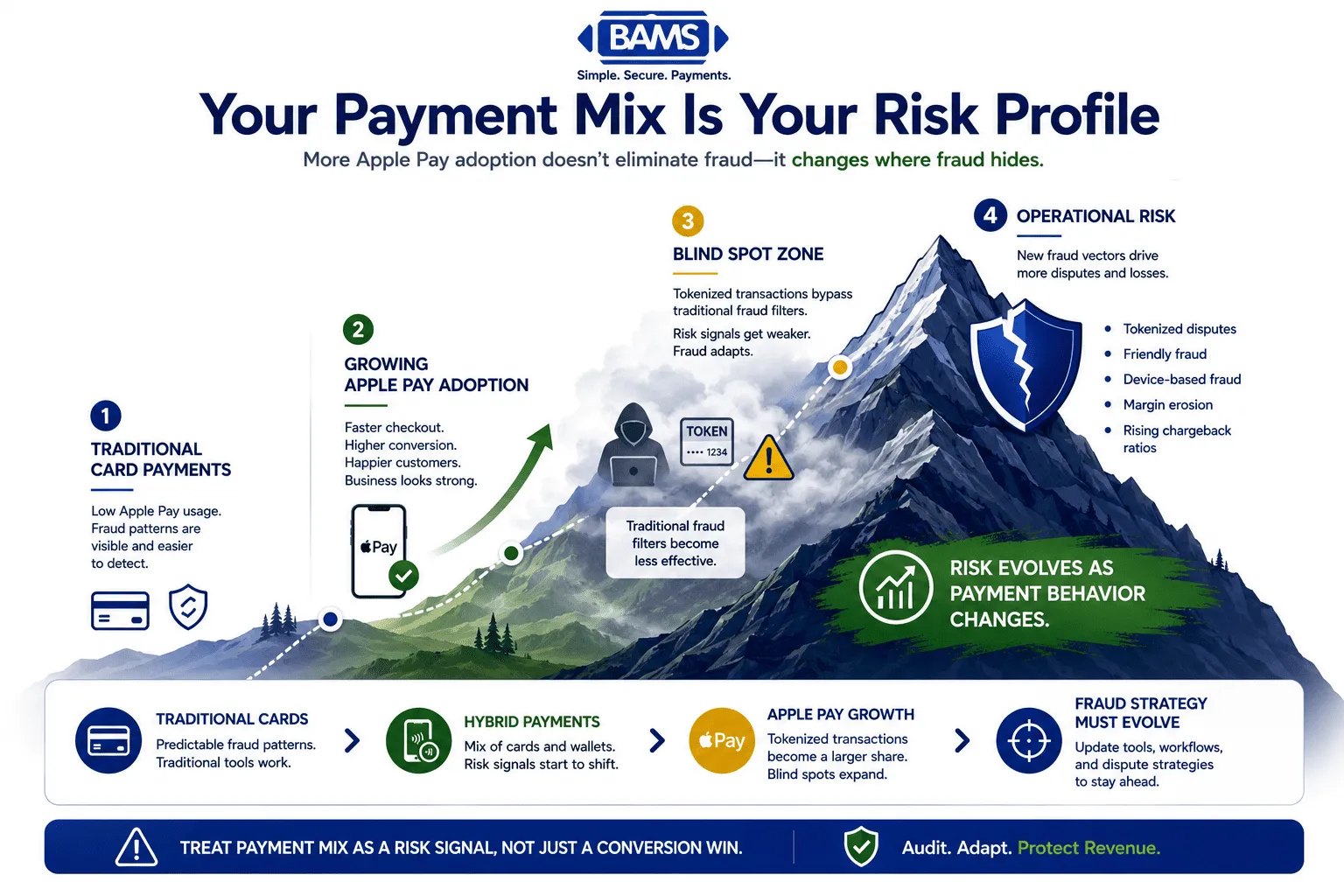
- Your payment mix is your risk profile – Every shift toward contactless payments requires recalibrating fraud detection, dispute workflows, and chargeback defense strategies.
- Segment chargeback data by payment method – Without this visibility, you can’t tell whether your margin compression is coming from Apple Pay disputes you aren’t tracking properly.
The Checkout Everyone Celebrates but Nobody Audits
Your checkout conversion rate ticked up last quarter. Apple Pay adoption is climbing. Your youngest customers are breezing through the funnel with a thumbprint. On paper, everything looks like progress. But here’s the friction nobody talks about: the same contactless payments driving those conversion gains are quietly reshaping your fraud exposure in ways your current defenses weren’t built to catch.
The “Tokenization Solves Everything” Myth
The prevailing wisdom around mobile wallets goes something like this: Apple Pay uses tokenization and biometric authentication, so it’s inherently safer than a manually typed card number. The token replaces the real card data. Face ID or Touch ID confirms the buyer. Fraud solved.
This narrative became gospel because it’s partially true. Tokenization does eliminate one attack vector (stolen card numbers in transit). And the data backs up the enthusiasm: around 65 million U.S. iPhone owners actively use Apple Pay, and the user base skews heavily toward younger, high-frequency shoppers. Merchants understandably rushed to enable it. About 59% of retailers found that customers abandon carts when their preferred payment method is missing.
So the logic was simple: accept Apple Pay, capture the sale, and enjoy the security benefits. That logic is now breaking down.
Apple’s Apple Pay documentation explains how tokenization and device-based authentication work together to secure digital wallet payments. Apple Pay has become a widely accepted payment option for eCommerce and in-store purchases, making digital wallet transactions an increasingly important part of many merchants’ payment mix.
What We Actually Believe
A shift in consumer payment preferences is not just a checkout UX event. It’s an operational risk signal. Merchants who treat mobile wallet growth as a conversion metric without adjusting their fraud posture are trading short-term revenue for long-term losses they won’t see coming until chargebacks start compounding.

Higher Apple Pay adoption improves checkout conversion but also changes how fraud appears. Merchants should update fraud detection and dispute workflows as payment behavior evolves.
Payment Fraud Risks Hiding Behind Biometric Trust
Here’s what we’ve seen play out. A merchant enables Apple Pay. Conversion improves, especially among 18-to-34-year-olds, who make up nearly three-quarters of the Apple Pay user base. The fraud team relaxes slightly because tokenized transactions feel secure. Then, three to six months later, chargeback rates start creeping upward on Apple Pay transactions specifically.
Why? Because tokenization protects the card number. PCI Security Standards Council guidance explains how tokenization protects payment credentials while reducing the exposure of sensitive cardholder data during transactions. It does not protect the merchant from friendly fraud, account takeover upstream of the wallet, or disputes filed by legitimate cardholders who authorized the purchase but later regret it.
The Device Account Number (DAN) that replaces the real PAN is secure in transit, yes. But once a fraudster provisions a stolen card into their own Apple Pay wallet (which requires only the card number and a one-time verification code), every subsequent purchase looks perfectly authenticated. Mastercard Developers explains how device-based payment credentials and tokenized payment data support secure digital wallet transactions.
The biometric confirmation proves the person holding the phone is the phone’s owner. It does not prove the phone’s owner is the cardholder.
This distinction matters enormously for eCommerce managers. In a card-not-present environment, an Apple Pay transaction arrives with a token, a cryptogram, and what appears to be strong authentication. Your gateway marks it low-risk. Your fraud filters, calibrated for traditional card entry patterns (mismatched AVS, velocity checks on raw PANs), don’t flag it. The order ships. Thirty days later, the actual cardholder disputes the charge.
Now you’re in a chargeback process where your evidence package looks thin. The token doesn’t match the card number the bank has on file in the same way a traditional dispute does. The transaction metadata is different. If your processor doesn’t help you translate tokenized transaction data into a defensible dispute response, you absorb the loss.
This is where a merchant services partner with proactive chargeback defense becomes critical, not optional. BAMS, for example, pairs dedicated account management with chargeback defense workflows designed to handle the nuances of tokenized disputes, helping merchants build evidence packages that actually hold up when Apple Pay transactions get contested.
Apple Pay’s global transaction volume hit approximately $8 trillion, up from $6 trillion just two years prior. That growth rate means the volume of tokenized disputes is scaling fast. Merchants who haven’t updated their dispute workflows for this reality are defending yesterday’s fraud with yesterday’s tools.
What Changes If This Is Right
If your payment mix is shifting toward Apple Pay (and for anyone selling to consumers under 35, it almost certainly is, given that around 70% of Gen Z wallet holders use Apple Pay weekly), then your fraud detection baseline is already drifting. The signals you relied on to catch bad transactions don’t apply the same way to tokenized payments.
This means your chargeback rate could be climbing for reasons that have nothing to do with product quality or shipping speed. It means your processing costs could increase as dispute ratios trigger threshold penalties. And it means the “conversion lift” you attributed to Apple Pay might be partially offset by losses you’re not yet attributing to it, because your reporting doesn’t segment fraud outcomes by payment method.
The cost of ignoring this isn’t dramatic. It’s erosive. It shows up as margin compression you can’t quite explain.
A Better Way to See Your Payment Mix
Stop thinking of contactless payments as a customer experience feature. Start thinking of every payment method shift as a change to your risk surface.
When your mix changes, your fraud playbook needs to change with it. That means segmenting chargeback data by payment method, auditing whether your fraud filters account for tokenized transaction patterns, and making sure your processor gives you visibility into DAN-level dispute data rather than just aggregated numbers.
The reframe is this: your payment mix is your risk profile. Every time it shifts, your defenses need to be recalibrated, not just your checkout buttons.

As Apple Pay adoption grows, merchants should monitor more than checkout conversion. Tracking payment mix, fraud trends, chargeback activity, and evidence readiness helps identify emerging risks before they impact profitability.
The Bottom Line
Enabling Apple Pay was the right call. Assuming it made you safer was not. The merchants who protect their revenue through the next wave of mobile wallet growth won’t be the ones with the smoothest checkout. They’ll be the ones who treated every payment method shift as a signal to re-examine what they’re exposed to, and partnered with processors who helped them see it clearly.
Frequently Asked Questions
How does tokenization enhance the security of Apple Pay transactions?
Tokenization replaces your actual card number with a Device Account Number (DAN) so the real PAN is never transmitted or stored by the merchant. This eliminates the risk of card data theft in transit, but it does not prevent upstream account takeover or friendly fraud disputes after the sale.
Which fraud patterns are commonly associated with Apple Pay transactions?
The most common patterns include stolen cards provisioned into a fraudster’s own wallet (which then pass biometric checks) and friendly fraud where legitimate buyers dispute charges after receiving goods. Both scenarios produce transactions that look fully authenticated, making them harder for traditional fraud filters to catch.
What should merchants do when Apple Pay chargebacks spike?
Segment your chargeback data by payment method to isolate whether tokenized transactions are driving the increase. Then work with your payment processor to ensure your dispute evidence packages include DAN-level transaction details, cryptogram data, and device metadata that banks require for tokenized chargeback defense.


