Financial Obligations: Why Fee Reduction Is the Wrong Fix
Last Updated on September 23, 2026 by Dimitri Akhrin
eCommerce brands obsess over processing costs while ignoring early-payment discounts that deliver multiples more margin
Learn why optimizing payment processing fees caps your upside while early-payment discounts on COGS unlock far greater margin. This piece reframes financial obligations as a system-level cash flow strategy, not a cost-center problem.
TL;DR
- Processing fee savings have a low ceiling – Shaving basis points off your rate saves far less than capturing 2/10 net 30 supplier discounts, which annualize at roughly 36%.
- Chargebacks destroy cash flow predictability – Elevated dispute ratios trigger rolling reserves and unpredictable deposits, which prevent you from timing supplier payments to capture discounts.
- Payment infrastructure is a margin lever, not a cost center – Next-day funding plus proactive chargeback defense creates the predictable cash position needed to reduce your effective cost of goods sold.
- Grade your payment stack on what it unlocks – The right question isn’t “what’s my rate?” but “can I reliably capture every early-payment discount my suppliers offer?”
You’re Optimizing the Wrong Line Item
Most eCommerce brands treat payment processing like a cost to minimize. They negotiate basis points, compare gateway pricing, and celebrate saving a fraction of a percent on interchange. Meanwhile, they’re leaving thousands on the table every month by paying suppliers at net 30 when they could be capturing early-payment discounts worth multiples of those processing savings.
The obsession with processing fees isn’t irrational. It’s just incomplete. And when chargebacks disrupt funding predictability on top of it, the real cost isn’t the dispute itself. It’s the cascade of missed financial obligations downstream.
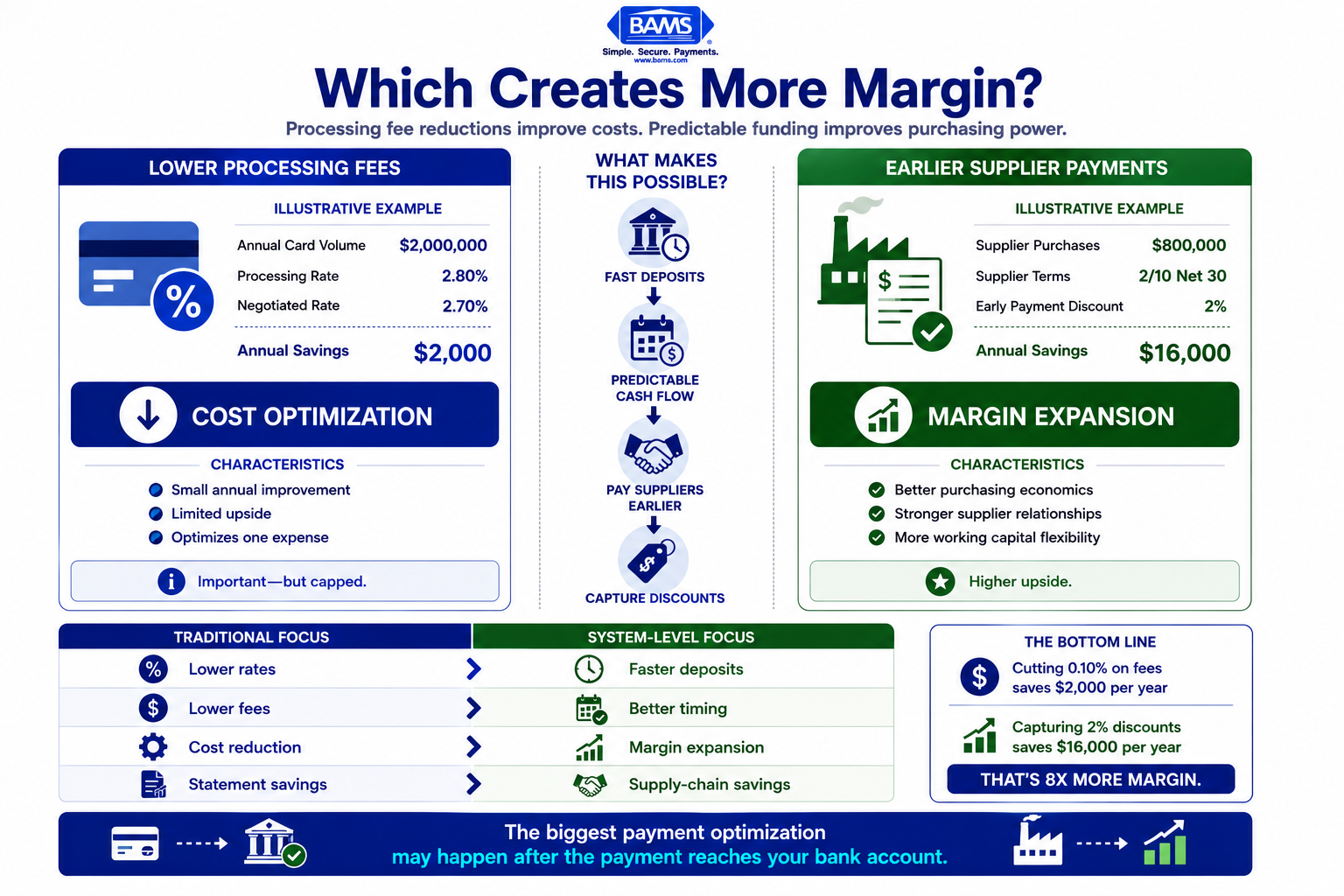
A fintech comparison illustrating how predictable cash flow unlocks supplier discounts that often outperform merchant processing fee savings.
The Fee-Reduction Trap in Merchant Services Optimization
Here’s how the conventional thinking goes. Transaction fees eat into eCommerce margins, so the smart move is to shop processors, optimize interchange categories, and reduce your effective rate. It’s tidy. It’s measurable. And it became the default playbook because processing fees are visible on every statement.
This approach made sense when margins were fat and supplier terms were rigid. But the landscape has shifted. Supply chains are tighter. Supplier relationships are more competitive. And the brands that win on unit economics aren’t the ones shaving 0.2% off their processing rate. They’re the ones using payment infrastructure to unlock margin that doesn’t show up on a processing statement.
Fee reduction is a cost-center optimization. It caps your upside at whatever your current rate minus the best available rate equals. That ceiling is low.
The Real Leverage Is on the Other Side of the Ledger
We believe the highest-value payment infrastructure decision an eCommerce brand can make isn’t about reducing what it costs to get paid. It’s about controlling when you get paid, so you can reduce what it costs to buy.
That’s the thesis. And it reframes everything.
Why Payment Flexibility Reshapes Supplier Economics
Consider a standard early-payment discount: 2/10 net 30. Your supplier offers a 2% discount if you pay within 10 days instead of 30. Sounds modest. Annualized, that works out to roughly a 36% return, illustrating why cash flow timing can have a much larger impact on profitability than small reductions in payment processing costs. Strong cash flow forecasting makes these opportunities easier to capture. See NetSuite’s guidance on cash flow forecasting.
Compare that to typical merchant processing fees per transaction. The math isn’t close.
Yet most eCommerce operators can’t capture those discounts. Why? Because their cash is stuck in a three to five day deposit cycle. Or worse, it’s locked in rolling reserves triggered by elevated chargeback ratios. By the time revenue from Monday’s sales hits their bank account on Friday, the 10-day window on last week’s supplier invoice is already closing.
This is where chargeback disruptions become a cash flow planning problem, not just a dispute management problem.
The Chargeback Cascade Nobody Talks About
When a chargeback hits, the obvious cost is the lost transaction plus the fee. But the hidden cost is what it does to your funding predictability. Elevated dispute ratios can trigger processor-imposed rolling reserves, where 5% to 10% of your daily volume gets held for 90 to 180 days. Suddenly, your next-day funding isn’t next-day anymore. Your deposit amounts become unpredictable. And your ability to time supplier payments evaporates.
We’ve seen this pattern repeatedly: a brand running at a 0.8% chargeback ratio doesn’t just risk monitoring programs. It loses the operational rhythm that makes early-payment discounts capturable. The cost of that lost rhythm dwarfs the chargeback fees themselves.
A brand doing $500,000 per month in revenue with a 40% cost of goods sold spends $200,000 on inventory and supplies. Capturing a 2% early-payment discount on even half of that spend saves $2,000 per month, or $24,000 per year. That’s real margin. Now compare it to the $300 you might save annually by negotiating your processing rate down by 0.05%. The leverage isn’t even in the same category.
From Cost Center to Cash Flow System
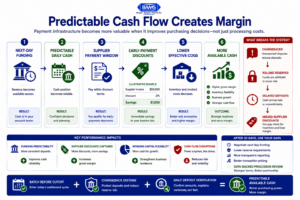
The greatest value of payment infrastructure isn’t simply getting paid faster—it’s creating a predictable cash position that improves purchasing decisions.
The brands getting this right don’t think about payments as a line item. They think about payments as infrastructure that enables a system. Visa also emphasizes that payment acceptance should be evaluated as part of a broader operational strategy, where authorization quality, settlement timing, and payment acceptance all influence business performance beyond the transaction itself. See Visa’s merchant success guidance.
The system works like this:
- Predictable, fast deposits (next-day funding) create a reliable cash position every morning
- A reliable cash position lets you commit to early-payment terms with suppliers
- Early-payment terms reduce your effective COGS, expanding gross margin
- Lower COGS means more cash available for inventory investment or growth
Break any link in that chain and the whole system degrades. Chargebacks break the first link. That’s why proactive chargeback prevention isn’t a fraud problem or a customer service problem. It’s a margin problem.
Partners like BAMS approach this systemically: next-day funding paired with proactive chargeback defense and dedicated account management. The point isn’t just faster deposits or fewer disputes in isolation. It’s that those capabilities together create the predictable cash flow that makes supplier discount capture possible. That’s merchant services optimization at the system level, not the statement level.
What Changes If You See Payments as a Margin Lever
If this framing is right, several things follow. First, the processor comparison conversation changes entirely. You stop asking “who has the lowest rate?” and start asking “who gives me the most predictable daily deposits with the fewest disruptions?” Those are different questions with different answers.
Second, chargeback prevention stops being a compliance exercise and becomes a treasury function. Every dispute you prevent protects not just the transaction amount but your ability to consistently execute your cash flow planning across your supplier base.
Third, you start evaluating payment flexibility as a competitive advantage. The brand that can reliably pay suppliers in 10 days gets better terms, stronger relationships, and priority allocation during supply crunches. The brand waiting on a five-day deposit cycle and fighting chargebacks doesn’t.
The cost of ignoring this isn’t dramatic. It’s quiet. It’s the margin you never captured, the supplier relationship that stayed transactional, the credit line you kept paying interest on because your cash was always three days away.
A New Way to Score Your Payment Stack
Stop grading your payment infrastructure on what it costs. Start grading it on what it unlocks.
The question isn’t “what’s my effective processing rate?” The question is: “Does my payment stack give me enough cash flow predictability to capture every early-payment discount my suppliers offer?” If the answer is no, you’re optimizing the wrong variable. You’re polishing the faucet while the pipe leaks.
Think of your payment infrastructure as a cash flow acceleration system, not a transaction cost. The brands that adopt this lens find margin in places their competitors aren’t even looking.
The Margin Is Upstream
Every eCommerce operator knows their processing rate to the hundredth of a percent. Very few know the annualized return on the early-payment discounts they’re currently missing. That gap in attention is where margin hides. Close it, and your payment stack stops being a cost center and starts being the reason your unit economics outperform everyone else’s.
Frequently Asked Questions
How does next-day funding improve cash flow planning for online retailers?
Next-day funding turns each day’s sales into available cash by the next business morning, giving you a predictable daily cash position. This predictability lets you commit to early-payment supplier terms, time inventory purchases precisely, and reduce reliance on short-term credit lines.
How do chargebacks affect funding speed beyond the dispute itself?
Elevated chargeback ratios can trigger rolling reserves, where your processor holds a percentage of daily deposits for months. This directly reduces the amount and predictability of your available cash, making it harder to meet financial obligations on time or capture supplier discounts.
When should a business consider switching to next-day funding?
If your suppliers offer early-payment discounts and you can’t consistently capture them because deposits arrive too slowly, the switch likely pays for itself. Compare the annualized return on missed discounts to any incremental cost of faster funding; for most eCommerce brands, the math strongly favors speed.