
Gift Card Program Scaling: A Guide for Small Businesses
Last Updated on November 16, 2026 by Dimitri Akhrin
The Fraud Signals Hiding in Your Gift Card Sales
Gift card programs are one of the most efficient revenue tools a small business can run. They shift cash flow forward, drive repeat visits and cost almost nothing to maintain once they’re live. But as programs grow, so does exposure. And the signals that something is wrong rarely show up where most owners are looking.
The problem is that small business operators tend to watch sales volume. A strong month feels like validation. But gift card transaction management requires a different kind of attention: watching how cards are purchased, how quickly they’re redeemed and whether patterns emerge that don’t match normal customer behavior. Scammers favor gift cards: the FTC Consumer Sentinel Network Data Book 2024 logged 41,120 fraud reports where a gift or reload card was the payment method.
However, most content on this topic points small businesses toward enterprise dashboards and security platforms they can’t afford and don’t need. This piece takes a different approach.
TL;DR
- Watch transactions, not just sales – Fraud hides in purchase patterns (same denominations, rapid redemptions, high-value buys from new customers) that are invisible in aggregate sales reports.
- Reconcile gift cards against settled funds monthly – Comparing gift card activity to your processor’s settlement data is the single most effective fraud detection habit and it takes less than an hour.
- Add temporary velocity limits before peak seasons – Fraudsters count on busy holidays and gifting occasions. Setting per-customer transaction caps during these windows catches abuse when you’re too busy to review manually.
- Secure physical cards and audit packaging – Tampered cards on open display racks can drain a customer’s gift. Moving cards behind the counter closes that gap at zero cost.
- Start with three controls – Monthly reconciliation, same-denomination alerts and rapid-redemption reviews cover the widest range of fraud patterns with the least operational burden.
What This List Covers (and What It Doesn’t)
This is for small business owners in retail, dining, or services who already have a gift card program running and want to grow it without adding headcount, expensive software, or operational complexity. If you’re evaluating enterprise fraud platforms or building a program from scratch, this isn’t the right starting point.
Each item below addresses a specific fraud signal that most small operators miss because they’re focused on top-line sales. More importantly, each item includes a low-cost control you can implement with existing tools and workflows. The goal is gift card financial control through visibility, not through buying another dashboard.
How These Items Were Selected
Every item was chosen based on three criteria: the signal is commonly overlooked by operators watching aggregate sales data, the associated fraud pattern compounds if left unchecked and the corrective control costs little to nothing to implement. Items that require dedicated security teams or enterprise-tier software were excluded.
Gift Card Transaction Management: 7 Fraud Signals Small Businesses Miss
1. Repeated Same-Denomination Purchases in a Single Shift
Why it matters: Legitimate customers rarely buy three $100 gift cards in one visit. Fraudsters testing stolen payment credentials do. When you’re watching daily sales totals, five identical gift card transactions blend into what looks like a good afternoon. But at the transaction level, the pattern is unmistakable.
What it looks like today: A customer (or someone posing as one) buys multiple cards of the same value within minutes, often at different registers or through different staff members. Busy gifting periods like Mother’s Day make these bursts even harder to spot.
How to apply it: Set a simple daily alert threshold. If more than two gift cards of the same denomination are sold within a single shift, flag the transactions for manual review. Most POS systems allow custom reporting filters. You don’t need a fraud platform. You need a rule and a habit.
2. Rapid Purchase-to-Redemption Windows
Why it matters: Normal gift card behavior involves a gap between purchase and redemption. Someone buys a card, gives it as a gift and the recipient uses it days or weeks later. When a card is purchased and fully redeemed within hours (or minutes), it often signals that the buyer and the redeemer are the same person converting stolen payment credentials into goods.
What it looks like today: Your sales report shows a $200 gift card sold at 11 a.m. and redeemed at 11:47 a.m. In isolation, this looks like a customer who decided to treat themselves. In a pattern, it looks like laundering. Proper gift card redemption tracking catches this before it compounds.
How to apply it: Run a weekly reconciliation comparing purchase timestamps against redemption timestamps. Any card redeemed within two hours of purchase should be reviewed. If your POS exports transaction data to a spreadsheet, this takes 15 minutes.
3. Gift Card Purchases That Never Get Redeemed
Why it matters: Unredeemed cards might look like free money on your balance sheet, but a growing pool of outstanding balances can also indicate that cards were purchased with stolen credentials and the fraudster moved on before redemption. You carry the liability. The original cardholder files a chargeback. You lose the sale and potentially the merchandise.
What it looks like today: Your gift card reconciliation report shows a cluster of cards purchased in a short window, none of which have been redeemed after 90 days. This pattern is especially common with online or phone orders. That’s because the buyer never sees the card in person, so stolen credentials are easier to use.
How to apply it: Quarterly, pull a report of all cards with balances outstanding beyond 60 days. Cross-reference the original purchase method. If a cluster of unredeemed cards shares a payment method or purchase date, investigate before chargebacks arrive.
4. High-Value Purchases from New or Unrecognized Customers
Why it matters: Your regulars don’t typically walk in and buy $500 in gift cards without context. New faces making large gift card purchases, especially with credit cards, deserve a second look. This isn’t about profiling customers. It’s about recognizing that gift cards are a preferred vehicle for converting stolen credentials because they’re anonymous and portable.
What it looks like today: A first-time customer pays by credit card for several high-value cards and seems in a hurry. Many losses start with a single high-value purchase that no one questioned. For small businesses, this is where gift card financial control starts: at the point of sale, with a simple question.
How to apply it: Train staff to flag (not block) gift card purchases above a set threshold, say $200 or $250. The flag triggers a brief note in the transaction log: new customer, regular, corporate buyer. This creates a lightweight audit trail that costs nothing and catches patterns over time.
5. Barcode or Packaging Tampering on Physical Cards
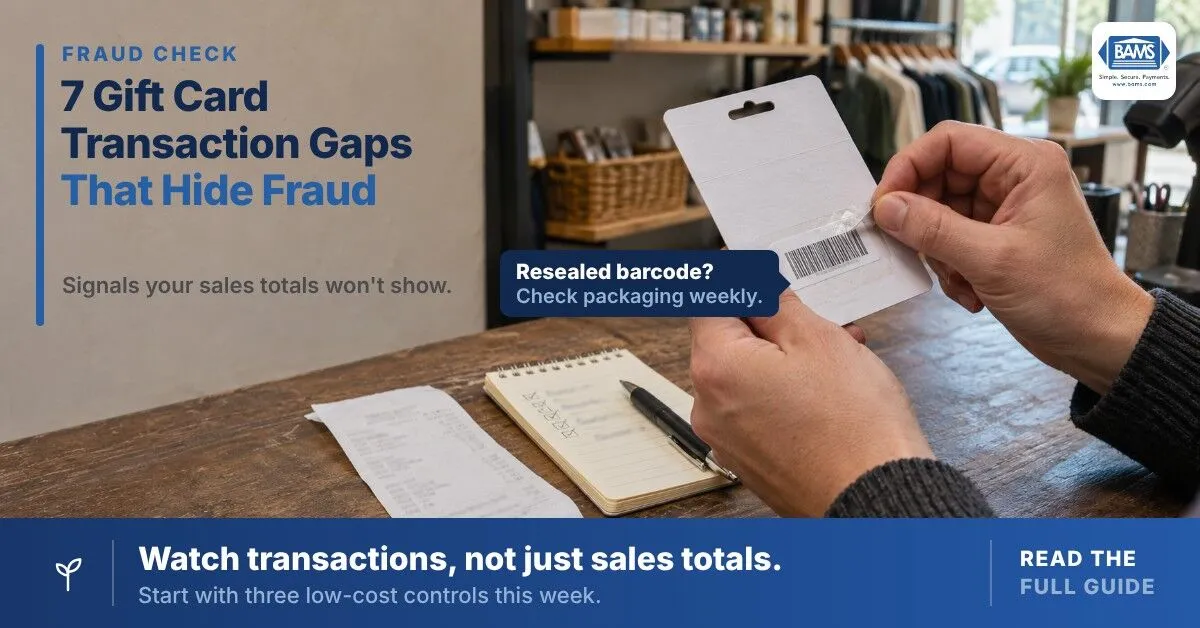
Why it matters: This is one of the most overlooked in-store fraud vectors. Criminals remove physical gift cards from display racks, copy or alter the barcode and return the unloaded cards. When a legitimate customer buys and loads one of these tampered cards, the funds route to a card the criminal controls.
What it looks like today: Your customer loads a $50 card, gives it as a gift and the recipient finds a zero balance. You get the complaint. You absorb the cost. The fraud happened weeks earlier, when the card was tampered with on your rack.
How to apply it: Move gift card displays behind the counter or near the register. Inspect card packaging weekly for signs of resealing. If you use closed-loop cards, ensure activation only happens at the POS, not through barcode scanning alone. This is a physical control, not a digital one and it’s free.
6. Lack of Gift Card Reconciliation Against Settled Funds
Why it matters: Many small businesses track gift card sales and gift card redemptions as separate line items but never reconcile them against actual settled funds. This gap means fraud losses can hide for months. A card purchased with a credit card that later triggers a chargeback disappears from your revenue, but the redeemed goods are already gone.
What it looks like today: Your monthly P&L shows gift card revenue, but you haven’t matched it against your processor’s settlement report. Faster deposits make that match easier. As a Payment Processing Company, BAMS offers next-day funding for qualifying merchants at no extra cost, so settled amounts show up quickly.
How to apply it: Monthly, compare your gift card sales total against the corresponding settled deposits from your payment processor. Investigate any discrepancy above a small threshold you set in advance. This is basic gift card reconciliation and it’s the single most effective fraud detection habit a small business can build.
7. No Velocity Limits During Peak Seasons
Why it matters: Seasonal demand creates noise. Holiday rushes, Mother’s Day, graduation season: these are exactly the periods when fraudsters increase activity because they know you’re too busy to scrutinize individual transactions. Running a gift card program strategy without seasonal controls is like leaving the register open during the busiest hour.
What it looks like today: Your busiest Saturday in December brings a run of gift card sales. During peak periods, high transaction volume masks anomalies, so a fraud burst looks like strong demand.
How to apply it: Before each major gifting season, set temporary velocity limits: a maximum number of gift card transactions per customer per day and a maximum total dollar value per transaction. Communicate these limits to staff. Remove them after the season ends. This is a temporary control that addresses a predictable risk window.

A good afternoon or a fraud burst? Same-denomination alerts tell the difference.
What These Signals Share
Every item on this list points to the same underlying gap: small businesses watch sales, not transactions. The difference matters. Sales data tells you volume. Meanwhile, transaction data tells you behavior. Fraud hides in behavior.
The second pattern is temporal. Specifically, fraud doesn’t distribute evenly across the calendar. It clusters around seasonal peaks, promotional windows and any period when staff attention is divided. Controls that flex with demand (velocity limits, review thresholds, reconciliation frequency) outperform static rules.
The third pattern is financial. Gift card transaction management is ultimately a cash flow discipline. Every unreconciled card, every unsettled transaction and every unredeemed balance represents a potential liability. Treating gift cards as a revenue line without treating them as a financial control point is how small losses become large ones.
Where to Start
Better gift card transaction management doesn’t require all seven controls at once. Start with three: monthly gift card reconciliation against settled funds (item 6), a same-denomination purchase alert (item 1) and a rapid-redemption review (item 2). These three habits cover the widest range of fraud patterns with the least operational burden.
If you run a seasonal business, add velocity limits (item 7) before your next peak period. If you display physical cards on open racks, move them behind the counter this week (item 5). Also, each control is independent. Each one reduces exposure. None of them require a budget line item.
Frequently Asked Questions
What is gift card transaction management and why does it matter for small businesses?
Gift card transaction management is the practice of monitoring individual gift card purchases, redemptions and balances at the transaction level rather than only tracking aggregate sales. It matters because fraud patterns (rapid redemptions, repeated same-value purchases, unredeemed card clusters) are invisible in summary reports. Small businesses that review transaction-level data catch abuse before it compounds into chargebacks and inventory loss.
How does gift card reconciliation work in practice?
Gift card reconciliation involves comparing your gift card sales and redemption totals against the actual funds settled by your payment processor. On a monthly basis, you pull your gift card activity report and match it against your processor’s deposit records. Discrepancies above a small threshold you set can indicate potential chargebacks, unprocessed returns, or fraudulent activity that needs investigation.
Why is it important to choose between closed-loop and open-loop gift card programs?
Closed-loop cards can only be used at your business, giving you full control over activation, redemption tracking and fraud monitoring. Open-loop cards (like Visa or Mastercard branded) work anywhere, which limits your visibility into how and where they’re used. For small businesses prioritizing fraud prevention and financial control, closed-loop programs offer much better transaction-level visibility. Our guide to closed-loop vs open-loop gift cards compares the two in detail.
What are the most common gift card fraud schemes targeting small businesses?
The most common schemes include purchasing cards with stolen credit card credentials (leading to chargebacks), tampering with physical card barcodes on display racks and rapid purchase-to-redemption cycles that convert stolen payment data into goods. Seasonal peaks amplify all of these patterns because higher transaction volumes make individual anomalies harder to spot.
When should a business consider migrating to a unified gift card processing system?
Consider migrating when your current setup makes it difficult to reconcile gift card sales against settled funds, when you can’t easily pull transaction-level reports (timestamps, denominations, purchase methods), or when you’re running gift card activity through a system that’s separate from your primary payment processor. A unified gift card management system reduces manual reconciliation work and improves visibility.
How can small businesses scale gift card programs without adding overhead?
Focus on controls rather than tools. For the growth side, see our guide to gift card program scaling. Implement alert thresholds for unusual purchase patterns, run monthly reconciliation using data you already have and train existing staff to flag (not block) high-value or unusual transactions. These habits scale with your program because they’re process-based, not platform-dependent. Adding digital gift cards through your existing POS can also expand distribution without adding inventory or staffing costs.


