Mobile Payment Security: A Chargeback Defense Guide
Last Updated on August 4, 2026 by Dimitri Akhrin
Why tokenized wallet transactions still leave your revenue exposed — and the operational steps to fix it
Learn why mobile wallet growth is creating new chargeback vulnerabilities that tokenization alone won’t solve. This guide covers the operational steps ecCmmerce merchants need to defend revenue as digital wallet transactions become the norm.
TL;DR
- Mobile wallets are becoming a larger share of eCommerce payments, but your chargeback defense may not have kept pace – Tokenized transactions introduce different operational challenges that require updated dispute workflows and fraud controls.
- Tokenization prevents unauthorized fraud, not all chargebacks – Most wallet chargebacks come from “item not received” and “not as described” disputes, which biometrics and tokens don’t address.
- Your records may not match chargeback notices – Wallet transactions use tokens instead of card numbers, so you need a reconciliation process that maps tokens to orders before a dispute arrives.
- Card-era fraud rules create false declines on wallet transactions – AVS and CVV checks don’t apply to wallet flows. Recalibrate to behavioral signals like shipping address velocity and device fingerprinting.
- Start with a 90-day audit – Segment your transaction and chargeback data by payment method to see whether your wallet chargeback rate is hiding inside a blended average, then work through the five-step framework to close the gap.
Guide Orientation: What This Covers and Who It’s For
This guide addresses a specific operational gap: your mobile payment security and chargeback defense strategy likely hasn’t kept pace with how quickly digital wallets have reshaped your transaction mix. If you manage eCommerce operations for a growing online business and you’ve noticed more Apple Pay, Google Pay, or other wallet-based transactions flowing through your store, this is for you.
By the end, you’ll understand how tokenized wallet transactions create new chargeback dynamics, why the “tokenization makes things safer” narrative only tells half the story, and what specific operational steps you can take to protect revenue as wallet adoption accelerates.
This guide does not cover the technical architecture of tokenization protocols or enterprise-level fraud engineering. It focuses on practical, merchant-operator-level decisions that directly affect your cash flow and dispute outcomes.
Why Mobile Payment Security Demands Your Attention Now
Digital wallets have become a mainstream payment method for eCommerce and mobile commerce, and their share of online payments continues to grow. For small-to-midsize eCommerce businesses, this shift happened quickly, requiring operational processes to evolve alongside changing customer payment preferences. Statista highlights the continued expansion of digital payment methods and mobile wallet usage worldwide.
The common narrative is reassuring: mobile wallets use tokenization and biometric authentication, so they’re inherently more secure. That’s true at the transaction authorization level. ACI Worldwide’s research confirms that fraud rates are measurably lower with mobile wallets compared to traditional card-on-file transactions.
But here’s what that narrative leaves out: chargebacks from wallet transactions still happen, and when they do, the dispute process is more confusing for merchants who haven’t adapted their operations. The token that replaced the card number in your system makes it harder to match transactions to dispute claims. Your existing fraud signals may not map cleanly to wallet-initiated purchases. And the cost of getting this wrong compounds quickly.
Even with stronger authentication and tokenization, merchants that don’t adapt their dispute workflows, evidence collection, and transaction monitoring for wallet-specific behaviors can still experience unnecessary revenue loss. The operational challenge has shifted from preventing unauthorized card use to managing post-purchase disputes effectively.
Core Concepts: What You Need to Understand Before Taking Action
Tokenization: Security for the Network, Complexity for You
When a customer pays with Apple Pay or Google Pay, their actual card number never touches your system. Instead, the wallet generates a Device Account Number (DAN), sometimes called a DPAN or token, that substitutes for the real card number. This is excellent for reducing data breach risk. But it also means the transaction identifier in your records won’t match the card number on a chargeback notice.
This mismatch is where operational problems begin. If your team can’t quickly connect a disputed token-based transaction to the original order, your response time suffers and your evidence package weakens.
Biometric Authentication: Strong but Not Absolute
Biometric authentication provides an additional layer of security by verifying the device user before payment credentials are released. While this significantly reduces unauthorized transaction risk, it does not eliminate post-purchase disputes such as “item not received” or “not as described.” A customer can authenticate a legitimate purchase with their fingerprint and still file a chargeback claiming they didn’t receive the item or that the product wasn’t as described.
The Chargeback Gap
The “chargeback gap” is the distance between what tokenization and biometrics prevent (unauthorized use) and what they don’t prevent (friendly fraud, service disputes, fulfillment complaints). For most eCommerce merchants, friendly fraud and service-related disputes represent the majority of chargebacks. Mobile wallets don’t solve these. Your fraud prevention strategies need to account for both categories.
The Framework: Operational Readiness for Wallet-Era Chargeback Defense
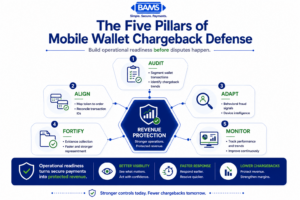
Effective mobile wallet security goes beyond tokenization. Merchants need operational processes that connect transaction data, fraud detection, dispute evidence, and continuous monitoring.
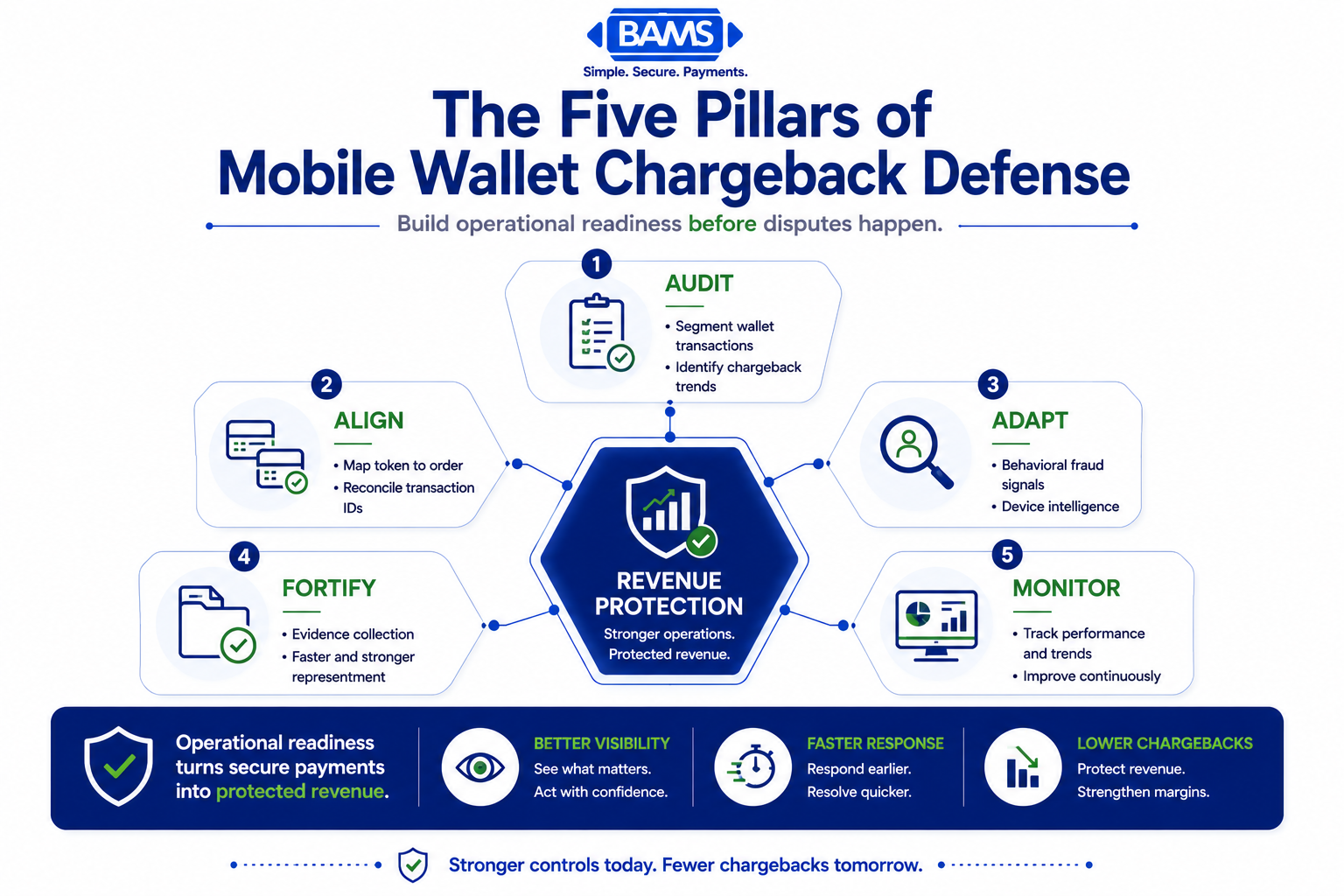
Protecting revenue as wallet adoption grows isn’t a single fix. It’s a five-stage operational readiness framework that aligns your team, tools, and processes with how wallet transactions actually flow through your business.
The five stages are:
- Audit your current wallet transaction mix and chargeback patterns
- Align your transaction records for token-based dispute matching
- Adapt your fraud detection signals for wallet-specific behaviors
- Fortify your evidence collection and dispute response workflow
- Monitor and iterate as wallet adoption patterns shift
Each stage builds on the previous one. Skipping the audit and jumping straight to fraud tools is the most common mistake merchants make. The sections below walk through each stage with specific actions, decision points, and indicators of progress.
Step-by-Step: Closing the Mobile Wallet Chargeback Gap
Step 1: Audit Your Wallet Transaction Mix and Chargeback Patterns
Objective: Establish a clear baseline of how much of your revenue flows through digital wallets and whether your chargeback rate differs by payment method.
As digital wallet adoption continues to increase, many merchants are surprised by how much of their payment volume now comes through Apple Pay, Google Pay, and other wallet providers. Segmenting transactions by payment method provides the visibility needed to understand how wallet adoption affects dispute patterns.
Next, cross-reference your chargeback data against these segments. You’re looking for two things: whether wallet transactions generate chargebacks at a different rate than card-on-file, and whether the reason codes on wallet chargebacks cluster differently. Most merchants find that wallet chargebacks skew toward “item not received” and “not as described” rather than “unauthorized transaction,” confirming that tokenization is doing its job on the fraud side while leaving service disputes wide open.
Anti-patterns to avoid: Don’t treat all chargebacks as a single bucket. Aggregating wallet and card chargebacks together masks the patterns you need to see. Also avoid assuming a low overall chargeback rate means you’re safe. If your wallet transaction volume is growing at 20-30% quarter over quarter, a stable-looking rate can hide accelerating absolute losses.
Success indicators: You can state, with specific numbers, what percentage of your revenue comes through digital wallets, what your chargeback rate is per payment method, and which reason codes dominate each segment.
Step 2: Align Transaction Records for Token-Based Dispute Matching
Objective: Ensure your team can quickly and accurately match any chargeback notice to its originating wallet transaction, including the token-to-order mapping.
When a chargeback arrives for a wallet transaction, the notice typically references the Device Account Number (token), not the customer’s actual card number. If your order management system only stores the last four digits of the card (which may be the token’s last four, not the card’s), matching becomes a manual, error-prone process that eats into your response window.
Work with your payment processor to confirm what transaction identifiers are available in your reporting. You need, at minimum: the token reference, the transaction ID, the order number, and a timestamp that matches across systems. Build (or request) a reconciliation view that lets your team search by any of these fields. If you’re on a platform like BigCommerce, check whether your gateway integration passes wallet-specific identifiers through to your order records. Some integrations strip this data, leaving you blind during disputes.
For merchants using Apple Pay on BigCommerce, this integration step is particularly important because the platform handles tokenized data differently depending on your gateway configuration.
Anti-patterns to avoid: Don’t assume your existing chargeback workflow handles wallet disputes automatically. Many merchants discover the gap only when they lose a dispute because they couldn’t produce matching evidence within the processor’s deadline. Also avoid relying solely on customer email address as a matching field; wallet transactions sometimes pass different customer identifiers than card-on-file orders.
Success indicators: Your team can locate the full transaction record for any wallet-based chargeback within 10 minutes of receiving the notice, using at least two independent identifiers.
Step 3: Adapt Your Fraud Detection Signals for Wallet-Specific Behaviors
Objective: Recalibrate your fraud screening to account for the different risk profile of wallet transactions, reducing both false positives and missed threats.
Traditional fraud signals (AVS mismatch, CVV failure, velocity checks on card numbers) don’t apply the same way to wallet transactions. Tokenized payments bypass AVS and CVV entirely because the wallet has already authenticated the cardholder via biometrics or device passcode. If your fraud rules flag transactions that skip AVS, you’ll generate false declines on legitimate wallet purchases, frustrating good customers and leaving revenue on the table.
Instead, focus on behavioral and contextual signals that remain meaningful regardless of payment method: shipping address velocity (how many orders ship to the same address across different accounts), device fingerprinting, order value anomalies relative to customer history, and mismatches between billing geography and IP location. These signals work across both card and wallet transactions.
Review your eCommerce fraud prevention tools to confirm they can distinguish between wallet and card transactions in their scoring models. If your current tools treat all transactions identically, you’re either over-screening wallet purchases or under-screening card purchases.
Anti-patterns to avoid: Don’t disable fraud screening for wallet transactions because “tokenization makes them safe.” The authentication layer is strong, but it doesn’t prevent account takeover at the wallet level, social engineering, or friendly fraud. Conversely, don’t apply card-era fraud rules to wallet transactions without modification; you’ll create unnecessary friction.
Success indicators: Your false decline rate on wallet transactions drops without a corresponding increase in chargebacks. Your fraud scoring model can articulate why it flagged (or cleared) a wallet transaction using signals beyond AVS and CVV.
Step 4: Fortify Your Evidence Collection and Dispute Response Workflow
Objective: Build a dispute response process that produces compelling evidence packages specifically tailored to wallet-transaction chargebacks.
Winning a chargeback dispute requires evidence that directly addresses the reason code. For wallet transactions, the most common disputes are “item not received” (INR) and “not as described” (NAD). Your evidence package for these needs to be stronger than for unauthorized-use disputes, because the issuer already knows the transaction was authenticated via biometrics.
For INR disputes, your evidence should include: carrier tracking with delivery confirmation (including signature if the order value warrants it), the delivery address matched to the customer’s account, and any post-purchase communication (delivery notifications, follow-up emails). For NAD disputes, include: product page screenshots at the time of purchase, return policy acknowledgment, and any customer service interaction logs that show the customer’s actual complaint.
This is where having a merchant services partner with proactive chargeback defense capabilities makes a measurable difference.
BAMS, for example, provides proactive chargeback defense and dedicated account management that helps merchants assemble and submit evidence packages before response deadlines expire, which is especially valuable when wallet-specific disputes require unfamiliar documentation.
Standardize your evidence templates by reason code and payment method. A team member handling a wallet-based INR dispute should be able to pull a pre-built checklist that specifies exactly what evidence to gather, where to find it, and how to format it for submission.
Anti-patterns to avoid: Don’t submit the same generic evidence package for every dispute regardless of reason code or payment method. Issuers review evidence against specific criteria; irrelevant documentation weakens your case. Also avoid waiting until a dispute arrives to figure out your process. Build the workflow before you need it.
Success indicators: Your dispute win rate for wallet-based chargebacks is equal to or higher than your win rate for card-based chargebacks. Your average response time from chargeback notice to evidence submission is under 48 hours.
Step 5: Monitor, Measure, and Iterate as Wallet Adoption Shifts
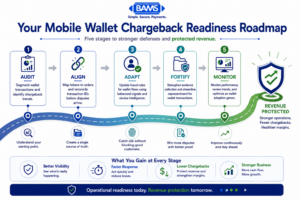
Improving wallet chargeback defense is an ongoing process. Building operational readiness one stage at a time creates stronger dispute outcomes and better revenue protection.
Objective: Establish ongoing measurement that catches emerging patterns before they become revenue problems.
PwC’s Future of Payments highlights the continued evolution of digital payment methods, making it important for merchants to regularly review wallet transaction patterns, dispute outcomes, and fraud controls as customer payment behavior changes.
A process that works when wallets represent 20% of your volume may break when they represent 40%. Build a monthly review cadence that tracks four metrics: wallet transaction share of total revenue, chargeback rate by payment method, dispute win rate by payment method, and average dispute response time.
Set threshold alerts.
- If your wallet chargeback rate exceeds your card chargeback rate by more than 0.15%, investigate immediately.
- If your dispute win rate for wallet transactions drops below 40%, your evidence process needs attention.
- If wallet transaction share jumps more than 5 percentage points in a single quarter, revisit your fraud screening calibration.
Also monitor for emerging fraud patterns specific to your business.
As more merchants accept Apple Pay and other wallets, fraudsters adapt. Account takeover at the wallet level (where a bad actor adds a stolen card to their own device wallet) is a growing vector that bypasses biometric authentication because the fraudster is using their own biometrics on their own device. Watch for clusters of chargebacks from wallet transactions where the shipping address doesn’t match the billing profile.
Anti-patterns to avoid: Don’t set up monitoring and then ignore it. Monthly reviews only work if someone is accountable for reading the data and escalating anomalies. Also avoid treating your current process as permanent. The payment landscape is shifting quickly; your defense strategy needs to shift with it.
Success indicators: You can identify chargeback pattern changes within 30 days of their emergence. Your team has a documented escalation path for when any monitored metric crosses its threshold.
Practical Examples: What This Looks Like in Action
Scenario A: The Invisible Spike
An online retailer selling home goods noticed their overall chargeback rate held steady at 0.8% for six months. But when they segmented by payment method (Step 1), they discovered wallet transactions had a 1.4% chargeback rate while card transactions sat at 0.5%. The blended number masked a serious problem. Wallet transactions had grown from 15% to 35% of their volume, meaning the absolute dollar amount at risk had more than tripled without triggering any alarms.
After segmenting, they found that 80% of wallet chargebacks carried “item not received” reason codes. The fix wasn’t a fraud tool; it was a fulfillment documentation upgrade. They added signature-required delivery for orders over $75 and automated delivery confirmation emails with tracking links. Within 60 days, their wallet chargeback rate dropped to 0.7%.
Scenario B: The False Decline Problem
A mid-size apparel brand running on BigCommerce enabled Apple Pay to reduce cart abandonment at checkout. Conversion rates improved, but their fraud screening tool began flagging 12% of Apple Pay transactions for manual review because those transactions lacked AVS data. Each flagged order sat in a review queue for 4-8 hours, delaying fulfillment and generating customer complaints.
By recalibrating their fraud rules (Step 3) to use device fingerprinting and shipping address velocity instead of AVS for wallet transactions, they reduced the manual review rate to 2% without increasing chargebacks. The result: faster fulfillment, happier customers, and no additional fraud losses.
Common Mistakes and Pitfalls
Treating tokenization as a complete solution. Tokenization prevents one category of fraud (unauthorized card use). It does nothing for friendly fraud, fulfillment disputes, or service complaints. Merchants who relax their defenses because “wallets are secure” are the ones most surprised when chargebacks climb.
Ignoring the token-to-order mapping problem. Many merchants don’t realize their records can’t match a chargeback notice to a wallet transaction until they’re already past the response deadline. Test your matching process with a simulated dispute before a real one arrives.
Applying card-era fraud rules to wallet transactions. AVS and CVV checks don’t exist in wallet flows. Fraud rules built around these signals will either flag legitimate purchases or miss wallet-specific threats entirely.
Waiting for a problem to build a process. Chargeback defense is cheaper and more effective when built proactively. Reactive merchants spend more time, lose more disputes, and absorb more revenue loss than those who prepare in advance.
These mistakes are common because the wallet transition happened faster than most merchant operations could adapt. Recognizing the gap is the first step toward closing it.
What to Do Next
Start with Step 1. Pull 90 days of transaction data and segment it by payment method. You may find that your wallet transaction mix is smaller than you expected, which gives you time to prepare. Or you may find it’s already a significant share of revenue, which means the remaining steps are urgent.
Either way, the audit gives you a factual foundation for every decision that follows. You don’t need to overhaul your entire operation at once. Work through the steps sequentially, validate each one, and revisit as your transaction mix evolves.
If you’re unsure whether your current payment processor gives you the data visibility you need for Steps 1 and 2, that’s worth a conversation with your account manager. The ability to segment chargebacks by payment method and access token-level transaction identifiers isn’t a luxury feature; it’s a baseline requirement for merchants operating in a wallet-first payment environment.
Use this guide as a reference, not a one-time checklist. The merchants who protect revenue most effectively are the ones who treat chargeback defense as an ongoing operational discipline rather than a problem to solve once and forget.
Frequently Asked Questions
How does Apple Pay work, and why does it change the chargeback process?
Apple Pay replaces your customer’s actual card number with a Device Account Number (token) and authenticates the transaction using biometrics like Face ID or fingerprint. This makes the transaction more secure at the point of sale, but it also means the identifiers in your system won’t match the card number on a chargeback notice. You need a reconciliation process that maps tokens to orders to respond to disputes effectively.
If mobile wallets are more secure, why am I still getting chargebacks?
Tokenization and biometric authentication primarily prevent unauthorized card use. They don’t prevent customers from filing disputes over items not received, products not matching descriptions, or other service-related complaints. These “friendly fraud” and fulfillment disputes make up the majority of chargebacks for most eCommerce merchants, and mobile wallets don’t address them.
Which fraud patterns are commonly associated with Apple Pay and other wallet transactions?
The most common wallet-related fraud pattern is account takeover at the wallet level, where a fraudster adds a stolen card to their own device and authenticates with their own biometrics. Other patterns include friendly fraud (legitimate purchases disputed after delivery) and “item not received” claims on orders with insufficient delivery documentation. Traditional unauthorized-use fraud is less common with wallets due to biometric authentication.
Should I adjust my fraud screening rules for digital wallet transactions?
Yes. Wallet transactions bypass AVS and CVV checks because authentication happens at the device level. If your fraud rules flag transactions missing AVS data, you’ll generate false declines on legitimate wallet purchases. Shift to behavioral signals like shipping address velocity, device fingerprinting, and order value anomalies, which work across both card and wallet payment methods.
When should merchants consider enabling Apple Pay as a payment option?
If a meaningful portion of your customers shop on mobile devices, enabling Apple Pay reduces checkout friction and can lower cart abandonment. However, enable it with operational preparation: ensure your systems can track tokenized transactions, your fraud rules account for wallet flows, and your dispute team knows how to handle wallet-specific chargebacks. The revenue benefit is real, but so is the need for updated processes. Learn more about accepting Apple Pay as a merchant.
How can biometric authentication reduce fraud but not eliminate chargebacks?
Biometric authentication confirms that the person holding the device is the device’s owner. It verifies possession and identity at the moment of purchase. But it can’t verify purchase intent after the fact, confirm that a package was delivered, or guarantee the customer will be satisfied with the product. Chargebacks driven by post-purchase disputes fall outside what biometrics can prevent.