Next-Day Funding: A Break-Even Guide for eCommerce
Last Updated on October 14, 2026 by Dimitri Akhrin
How to calculate when faster deposits cost less than the credit lines bridging your cash flow gaps
Learn how to quantify the real cost of delayed deposits, identify hidden borrowing habits created by deposit lag, and run a concrete break-even calculation on your own numbers. This guide helps eCommerce operators turn next-day funding into a strategic financial decision.
TL;DR
- Delayed deposits are hidden borrowing — A 4-day funding delay on $50,000/month in revenue leaves roughly $6,500 perpetually inaccessible, forcing you onto credit lines that carry real interest costs.
- Run the break-even calculation — Multiply your average daily revenue by your deposit delay to find your trapped capital, then compare the borrowing cost against any incremental cost of next-day funding. Most eCommerce businesses are already paying more for slow deposits than fast ones would cost.
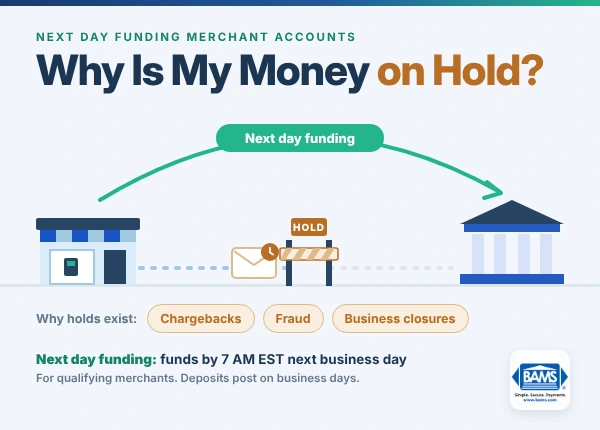
- Chargebacks disrupt deposits, not just revenue — Each chargeback reduces your next deposit amount and can trigger reserve holds that compound the cash flow impact for weeks or months.
- Batch timing is free speed — Aligning your platform’s batch close time with your processor’s settlement cutoff can recover a full day of deposit speed at zero cost.
- Redeploy freed capital deliberately — Use recovered working capital to capture supplier early-payment discounts, restock faster, or eliminate credit lines entirely rather than letting it sit idle.
Guide Orientation: What This Covers and Who It’s For
This guide examines how chargeback disruptions and delayed deposits erode predictable cash flow for eCommerce businesses, and how to fix both problems with a structured approach. It frames next-day funding not as a convenience upgrade but as a borrowing-elimination decision, complete with a break-even calculation you can run on your own numbers.
It’s written for eCommerce managers at established online businesses (roughly 10 to 50 employees) who are already processing meaningful transaction volume but feeling the squeeze of deposit timing gaps, chargeback unpredictability, and the quiet cost of credit lines used to bridge both.
By the end, you’ll understand how to quantify the real cost of delayed deposits, identify the hidden borrowing habits that deposit lag creates, optimize batch timing for your platform, and build a cash flow planning framework that makes chargebacks a manageable variable rather than a destabilizing event. This guide does not cover fraud detection tooling, dispute letter templates, or processor selection criteria beyond funding speed.
Why Predictable Cash Flow Is Now a Survival Metric
eCommerce operators have always cared about revenue. But the operational gap between earning revenue and accessing it has widened as transaction complexity grows. Multi-currency orders, subscription billing, marketplace payouts, and cross-border refunds all introduce timing variability that didn’t exist a decade ago.
Cash flow uncertainty ranks among the top three concerns for 72% of small businesses, and the problem intensifies during flat-revenue periods. 46% of businesses expecting flat revenues named cash flow as their foremost challenge, meaning slower growth doesn’t reduce the pressure; it amplifies it.
When deposits arrive unpredictably, you start making reactive decisions. You delay a supplier payment. You push back an ad spend increase. You draw on a credit line “just for a few days.” Each of those decisions carries a cost, and those costs compound. The credit line you opened to cover a three-day deposit gap becomes a permanent fixture. The supplier discount you missed because funds hadn’t landed becomes a recurring margin loss.
The cost of inaction isn’t dramatic. It’s incremental. That’s what makes it dangerous. Most eCommerce operators never calculate the actual break-even point where faster funding costs less than the credit they’re already carrying. This guide gives you the framework to do exactly that.
Core Concepts: The Mechanics Behind Cash Flow Disruption
The Deposit Delay Tax
Every day your processor holds funds is a day you can’t deploy that capital. A standard 4-day funding delay can leave roughly $6,500 in working capital inaccessible for a business processing $50,000 per month. That’s not a fee on your statement. It’s an invisible tax on your operating capacity.
This “delay tax” doesn’t show up in your P&L. It shows up in your borrowing behavior, your missed early-payment discounts, and your inability to restock fast-moving inventory before momentum fades.
Chargebacks as Cash Flow Disruptors
Chargebacks are commonly discussed as a fraud or customer service problem. They’re also a funding problem. When a chargeback is filed, your processor withholds the disputed amount (and often a fee) from your next deposit. If you’re on a 2 to 4 day funding cycle, that withdrawal can cascade. One $200 chargeback doesn’t just cost $200. It alters the timing and amount of your next several deposits, making your cash position harder to predict.
Borrowing as a Symptom, Not a Strategy
72% of small business owners report bypassing bank loans in favor of alternative lenders, often because they need capital faster than traditional institutions can deliver. But the root cause is frequently a deposit timing problem, not a revenue problem. Research from Intuit QuickBooks shows that structured business financing is linked to healthier cash flow and a higher likelihood of profit than relying on personal funds. The implication: if you can eliminate the need for bridge borrowing by accelerating deposits, you remove a cost center entirely.
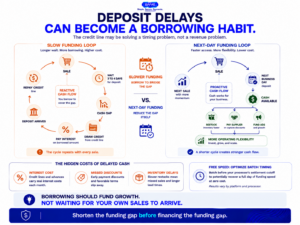
A deposit delay can quietly become a permanent borrowing habit. Shortening the funding cycle reduces the gap that credit lines are often used to cover.
Key Distinction: Deposit Speed vs. Deposit Predictability
Speed matters, but predictability matters more. A processor that delivers funds in one day, every day, is more valuable than one that delivers same-day sometimes and three-day other times. Your cash flow planning framework depends on consistency, not just velocity.
The Framework: From Reactive Borrowing to Predictable Operations
This guide follows a five-stage framework designed to move your business from reactive cash management to proactive cash flow planning. Each stage builds on the previous one.
- Stage 1: Audit — Quantify your current deposit delay and its real cost
- Stage 2: Calculate — Run the break-even analysis on faster funding vs. current borrowing
- Stage 3: Stabilize — Reduce chargeback-driven deposit disruptions
- Stage 4: Optimize — Align batch timing with your platform and operating cycle
- Stage 5: Redeploy — Use recovered capital for growth instead of gap-filling
These stages are sequential for first implementation but become cyclical as you refine. You’ll revisit the audit and calculation stages quarterly, especially around peak seasons when transaction volume and chargeback rates both spike.
Step-by-Step Breakdown: Building Predictable Cash Flow
Step 1: Audit Your True Deposit Timeline
Objective: Establish the actual number of days between transaction authorization and fund availability in your bank account, across all payment types and channels.
Most eCommerce managers know their processor’s stated funding timeline. Few have measured the real one. Start by pulling 90 days of deposit records from your bank and matching them against your daily transaction batches. Look for the gap between when a batch closes and when funds appear.
Track this separately for credit card transactions, debit transactions, and any marketplace or platform payouts. You’ll often find that the stated “2-day funding” is actually 3 to 4 days when weekends, holidays, and batch cutoff times are factored in. Document the average, the best case, and the worst case.
Anti-patterns: Don’t rely on your processor’s dashboard alone. It often shows when funds are “released” rather than when they’re available in your account. Don’t average across all payment types; the variance between them is where the problem hides.
Success indicators: You have a spreadsheet or document showing the real average deposit delay for each payment type, with at least 60 data points. You can state with confidence: “Our average deposit delay is X.X days, costing us $Y in inaccessible capital on any given day.”
Step 2: Run the Break-Even Calculation
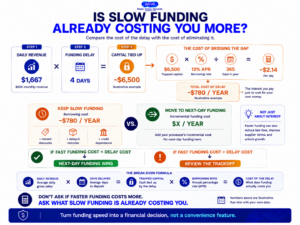
Faster funding should be evaluated against the cost of the cash gap it replaces. If borrowing to bridge delayed deposits costs more than faster funding, slow deposits are already the more expensive option.
Objective: Determine the exact point where the cost of faster funding is less than the cost of credit you’re currently carrying to bridge deposit gaps.
This is the calculation most eCommerce operators skip, and it’s the most important one. Here’s the framework:
- A: Your average daily revenue
- B: Your current average deposit delay (in days)
- C: A × B = capital inaccessible at any given time
- D: The annual interest rate on your credit line or short-term borrowing
- E: (C × D) / 365 = daily cost of borrowing to bridge the gap
- F: The incremental cost of next-day funding (if any fee difference exists)
If E exceeds F, you’re already paying more for slow deposits than you would for fast ones. For a business processing $50,000/month with a 4-day delay and a 12% credit line, the daily borrowing cost to bridge that gap is roughly $2.14/day, or about $780/year. That’s before you factor in the opportunity cost of missed supplier discounts or delayed inventory restocks.
Anti-patterns: Don’t ignore “informal” borrowing. If you’ve ever used a personal credit card, delayed a vendor payment, or skipped an early-payment discount because funds hadn’t landed, that’s borrowing. Include it. Don’t assume faster funding always costs more; many processors bundle it at no additional charge.
Success indicators: You have a concrete dollar figure for your annual “delay cost” and can compare it directly against any incremental cost of faster funding. The decision becomes arithmetic, not intuition.
Step 3: Reduce Chargeback-Driven Deposit Disruptions
Objective: Minimize the frequency and financial impact of chargebacks on your deposit predictability, not just your dispute win rate.
Chargebacks disrupt cash flow in three ways: the disputed amount is withheld, a fee is deducted, and your processor’s risk assessment of your account may shift (potentially triggering rolling reserves or longer hold times). Addressing chargebacks purely as a customer service issue misses the funding dimension.
Start by categorizing your chargebacks by reason code. Most eCommerce businesses find that 60 to 70% of their chargebacks fall into two or three categories: “product not as described,” “subscription not canceled,” or “transaction not recognized.” Each category has a different prevention strategy. Product description disputes require better pre-purchase content. Subscription disputes require clearer cancellation flows and billing descriptors. “Not recognized” disputes require recognizable merchant descriptors on customer statements.
Proactive chargeback defense tools, like alert systems that notify you before a dispute is formally filed, can intercept chargebacks before they affect your deposits. BAMS offers proactive chargeback defense as part of its merchant services, which pairs well with their next-day funding to keep both sides of the cash flow equation stable.
Anti-patterns: Don’t treat all chargebacks equally. A $15 chargeback and a $500 chargeback have very different impacts on your next deposit. Don’t focus exclusively on win rates; preventing the chargeback from being filed is far more valuable than winning the dispute 45 days later. Don’t ignore the downstream effect on your authorization rates, which can decline as your chargeback ratio rises.
Success indicators: Your chargeback ratio stays below 0.65% (well under the 1% threshold that triggers processor scrutiny). You can predict within 10% accuracy how much your next deposit will be, because chargeback deductions are rare and small.
Step 4: Optimize Batch Timing for Your Platform
Objective: Align your transaction batch close time with your processor’s cutoff to shave hours (or a full day) off your deposit timeline.
Every processor has a daily cutoff time for batch settlement. Transactions batched before the cutoff enter that day’s settlement cycle. Transactions batched after it wait until the next day’s cycle. If your eCommerce platform auto-batches at 11:59 PM but your processor’s cutoff is 5:00 PM, you’re adding a full day to every evening transaction’s deposit timeline.
Check your platform’s batch settings. Shopify, WooCommerce, BigCommerce, and most major platforms allow you to configure batch close times or at least understand when they occur. WooCommerce merchants in particular can benefit from gateway-level batch timing adjustments that align with next-day funding cutoffs.
For businesses with significant international traffic, consider that cross-border transactions often settle on different timelines. Segment your reporting to understand how international orders affect your overall deposit predictability.
Anti-patterns: Don’t assume your platform’s default batch time is optimal. It almost never is. Don’t change batch timing without confirming the new cutoff with your processor; getting it wrong by 30 minutes can add a full day. Don’t batch multiple times per day unless your processor explicitly supports it and your volume justifies the complexity.
Success indicators: Your batch close time is confirmed to fall at least 60 minutes before your processor’s daily cutoff. You’ve verified the improvement by tracking deposit timing for two weeks post-change.
Step 5: Redeploy Recovered Capital Into Growth
Objective: Convert the working capital freed by faster, more predictable deposits into measurable business advantages rather than letting it sit idle.
Once you’ve shortened your deposit timeline and stabilized it against chargeback disruptions, you’ll have capital available that was previously trapped in transit or consumed by bridge borrowing. The question becomes: where does it go?
Three high-impact deployment options for eCommerce operators:
- Inventory timing: Use predictable daily deposits to restock fast-moving SKUs within 24 to 48 hours of sell-through instead of waiting for weekly or bi-weekly cash availability. This is especially powerful during peak seasons when stockouts directly equal lost revenue.
- Supplier discounts: Many suppliers offer 2% to 5% discounts for payment within 10 days (“2/10 net 30” terms). If your deposits arrive next-day, you can consistently capture these discounts. On $200,000 in annual supplier spend, a 2% early-payment discount is $4,000 in margin recovered.
- Credit line reduction: If you’re carrying a revolving credit line primarily to bridge deposit gaps, faster deposit timing can eliminate the need for that credit entirely. Closing or reducing the line removes interest expense and improves your debt-to-equity ratio.
Anti-patterns: Don’t redeploy all freed capital into growth spending immediately. Maintain a buffer equivalent to at least 5 days of operating expenses. Don’t assume the savings are permanent without quarterly re-auditing; processor terms, chargeback rates, and transaction mix all shift over time.
Success indicators: You can point to a specific line item (reduced interest expense, captured supplier discount, or faster inventory turn) that directly resulted from improved deposit timing. The improvement is measurable in dollars, not just days.
Practical Example: The Break-Even in Action
Scenario: Mid-Size eCommerce Apparel Brand
Consider an online apparel business processing $120,000/month with an average deposit delay of 3.5 days. Their daily revenue averages $4,000, meaning roughly $14,000 in working capital is perpetually inaccessible. To cover supplier payments and ad spend during the gap, they carry a $20,000 revolving credit line at 14% APR.
Annual interest on the portion used to bridge deposit gaps: approximately $1,960. They also miss early-payment discounts from two key suppliers, costing an additional $2,400/year. Total annual cost of the deposit delay: $4,360.
If switching to a next-day funding processor costs $0 in additional fees (as it does with several merchant services providers, including BAMS), the break-even is immediate. Even if the switch carried a modest per-transaction cost increase, the break-even would occur well within the first quarter.
Scenario: Seasonal Electronics Retailer
A consumer electronics eCommerce store does 40% of its annual volume in a 45-day holiday window. During peak season, daily revenue jumps from $3,000 to $12,000. Their 3-day deposit delay means $36,000 is inaccessible during the period when they most need capital for restocking and expedited shipping.
They typically draw $30,000 from a line of credit during this window. At 15% APR over 45 days, that costs roughly $555 in interest. Switching to next-day funding would free $24,000 of the $36,000 gap (reducing the delay from 3 days to 1), potentially cutting their credit draw to $6,000 and saving over $400 in interest during peak season alone. Across the full year, the savings compound as they also capture off-season supplier discounts they previously couldn’t access.
The comparison between same-day and next-day funding becomes relevant here: same-day funding would eliminate the gap entirely, but next-day funding captures the vast majority of the benefit at lower complexity.
Common Mistakes and Pitfalls
Treating deposit speed as a “nice to have.” eCommerce managers often evaluate processors on rate and features first, with funding speed as a tiebreaker. This inverts the priority. Funding speed directly affects your cost of capital, which affects every other financial decision.
Ignoring the chargeback-to-funding connection. Many operators manage chargebacks and cash flow as separate workstreams. They’re deeply connected. A spike in chargebacks can trigger reserve requirements or extended hold times that persist for months after the chargebacks themselves are resolved.
Optimizing batch timing once and forgetting it. Platform updates, processor policy changes, and shifts in your customer time-zone mix can all alter the optimal batch close time. Review it quarterly.
Failing to quantify the cost of the status quo. The break-even calculation in Step 2 is the single most important exercise in this guide. Without it, faster funding feels like an expense. With it, slower funding is revealed as the more expensive option.
Over-indexing on dispute win rates. Winning a chargeback dispute 60 days after it was filed doesn’t fix the cash flow disruption it caused. Prevention is worth ten times more than resolution.
What to Do Next
Start with the audit. Pull 90 days of deposit records, match them against your batch data, and calculate your real average deposit delay. This takes about two hours and requires no changes to your current setup.
Then run the break-even calculation from Step 2 using your actual numbers. If the math shows you’re paying more in borrowing costs than you would for faster funding, you have a clear, data-driven case for change.
You don’t need to overhaul everything at once. Even optimizing your batch timing (Step 4) can recover a full day of deposit speed with zero cost. Layer in chargeback prevention and capital redeployment as you build confidence in the framework.
Revisit this guide quarterly, especially before and after peak seasons when your transaction volume, chargeback exposure, and capital needs all shift. Treat it as a reference for ongoing cash flow planning, not a one-time checklist.
Frequently Asked Questions
What is next-day funding in merchant services?
Next-day funding means your payment processor deposits the previous day’s settled transactions into your bank account by the next business day. Instead of waiting 2 to 4 days (or longer) for funds to clear, you receive them within roughly 24 hours of batch settlement. The exact timing depends on when your batch closes relative to your processor’s daily cutoff and your bank’s ACH processing schedule.
How does next-day funding improve cash flow planning for online retailers?
Predictability is the key benefit. When you know funds will arrive every business morning, you can time supplier payments, inventory purchases, and ad spend with confidence. You stop making reactive decisions based on when deposits might land and start making proactive decisions based on when they will. This consistency also reduces or eliminates the need for short-term credit to bridge deposit gaps.
How do chargebacks affect my deposit timing and cash flow?
When a chargeback is filed, your processor typically deducts the disputed amount (plus a fee) from your next deposit. This reduces the deposit amount you were expecting and can cascade across multiple days if chargebacks cluster. High chargeback ratios can also trigger rolling reserves, where your processor holds back a percentage of every deposit as a risk buffer, further reducing deposit predictability.
When should a business consider switching to next-day funding?
Run the break-even calculation described in this guide. If you’re carrying any form of credit (line of credit, credit card, delayed vendor payments) specifically to cover gaps caused by deposit delays, you likely have a financial case for switching now. Businesses with seasonal revenue spikes, high daily transaction counts, or tight supplier payment windows benefit the most.
How can I optimize my batch timing for faster funding?
Check your eCommerce platform’s batch close time and compare it to your processor’s daily settlement cutoff. If your batch closes after the cutoff, you’re adding a full business day to your deposit timeline. Adjust your batch close to fall at least 60 minutes before the cutoff. Confirm the change with your processor and monitor deposit timing for two weeks to verify the improvement.
Why is next-day funding better for eCommerce businesses than same-day funding?
Same-day funding sounds faster, but it often comes with higher fees, limited availability windows, and processor restrictions that reduce consistency. Next-day funding captures the majority of the cash flow benefit (eliminating 2 to 3 days of delay) with fewer constraints and broader availability. For most ecommerce operations, the marginal value of same-day over next-day doesn’t justify the added cost or complexity.
Sources
- https://www.ocrolus.com/blog/smb-trends-growth-optimism-amid-challenges-q2-2025/
- https://www.bams.com/blog/how-delayed-funding-hurts-your-ecommerce-business/
- https://www.enova.com/newsroom/key-insights-from-the-q2-2025-cash-flow-index-report-from-ondeck-and-ocrolus/
- https://quickbooks.intuit.com/r/small-business-data/financing-report-2025/
- https://bams.com
- https://www.bams.com/blog/payment-optimization-for-ecommerce-and-faster-deposits/
- https://www.bams.com/blog/payment-gateway-for-woocommerce-faster-deposits/
- https://www.bams.com/blog/6-fee-triggers-that-spike-processing-costs-after-peak-season/
- https://www.bams.com/blog/same-day-funding-vs-next-day-impact-on-ecommerce/