Merchant Account Fees: The Processor Switch Trap
Last Updated on June 1, 2026 by Dimitri Akhrin
Why chasing faster deposits by switching processors costs more than fixing the eligibility gaps you already have
Learn why switching payment processors for faster funding often increases merchant account fees without solving the real problem. Discover how account-level transparency and pipeline optimization deliver better results than migration.
TL;DR
- Switching processors for speed is expensive – Migration costs, higher per-transaction rates, and integration disruptions often outweigh the funding speed gains.
- Slow deposits are usually a pipeline problem, not a processor problem – Gateway batch timing, bank ACH cutoffs, and chargeback ratios control your funding speed more than your provider does.
- Interchange-plus pricing saves real money – Moving from blended rates to interchange-plus can save $200 to $400 per month on $80K in volume, often more impactful than shaving a day off deposits.
- Audit before you migrate – A dedicated account review that examines your fees, risk profile, and settlement configuration should always come before a processor switch.
The Processor Switch That Costs More Than It Saves
Every eCommerce manager has had the moment. You’re staring at a weekend’s worth of sales sitting in limbo, payroll is Thursday, and you start Googling “fastest payment processor.” The instinct is understandable: if the money moved faster, the problem would disappear. But chasing same-day funding by switching processors is one of the most expensive decisions in cost-effective payment processing, and most merchants make it without ever examining why their deposits are slow in the first place.
Why “Faster Funding” Became the Default Fix
The payments industry has done an excellent job marketing speed. Same-day funding, instant deposits, real-time payouts. These features sound like pure upside, and for years, merchants have been trained to treat deposit timing as a processor problem with a processor solution.
It makes sense. When you see competitors advertising same-day deposits and you’re waiting 48 to 72 hours, the conclusion feels obvious: you picked the wrong processor. And the switching cost seems low. Sign up, integrate, done.
But this framing hides a critical truth. Funding speed is not primarily a feature of your processor. It’s a function of your entire payment pipeline: your gateway configuration, your bank’s ACH cutoff times, your risk profile, your chargeback history, and even the days your customers tend to buy. Treating funding speed as a toggle you flip by changing providers is like replacing your car engine because you’re stuck in traffic.
The Real Problem Is Upstream
Here’s what we actually believe: most merchants who feel stuck on slow funding are already eligible for faster deposits with their current setup, and the gap is visibility, not technology. NACHA ACH Network resources continue to emphasize how gateway timing, ACH submission windows, and settlement configuration directly affect how quickly merchants gain access to cleared funds.
Inside the Merchant Account Fees You Don’t See Coming
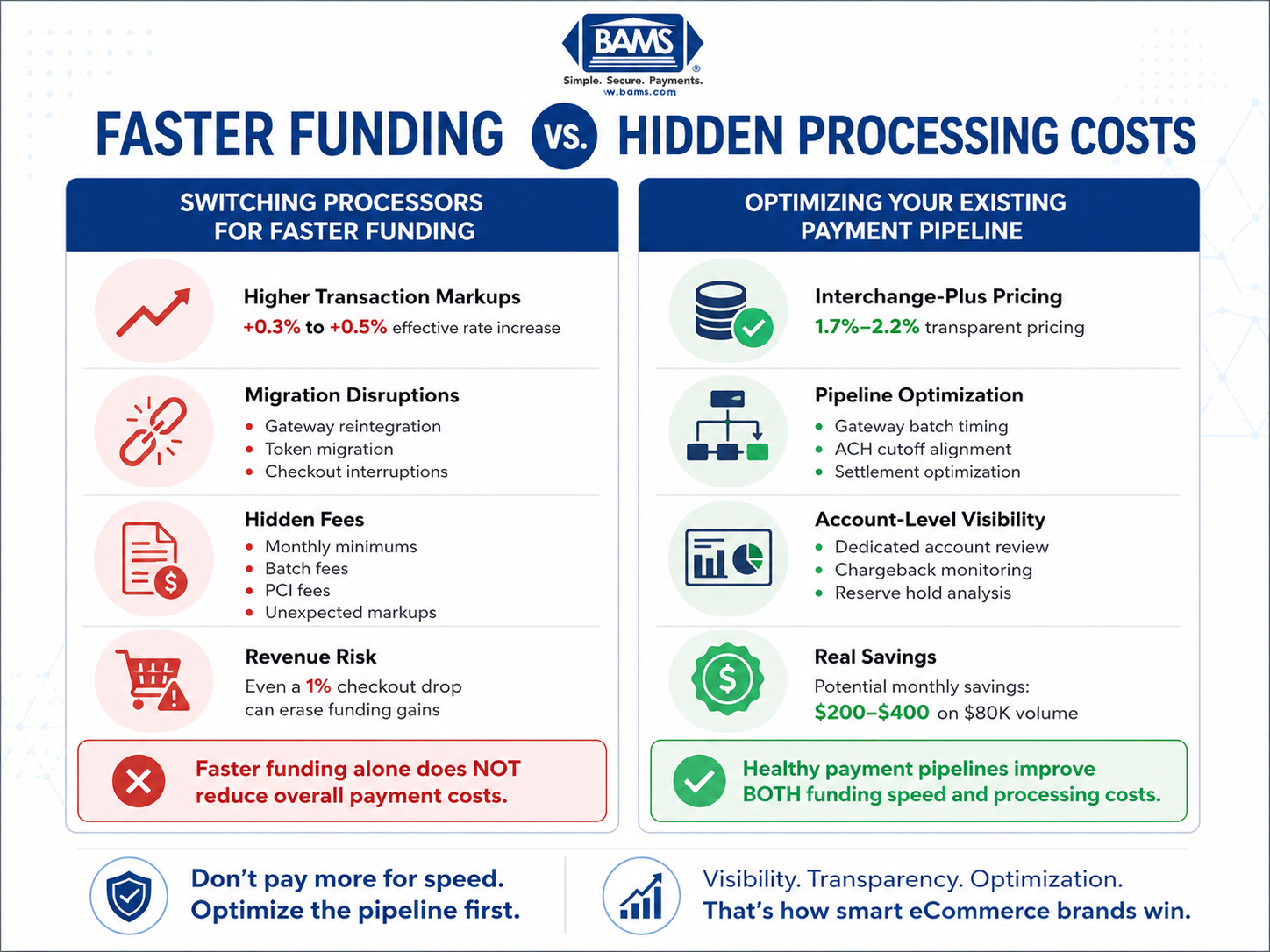
Many merchants switch processors chasing faster deposits, only to increase their effective processing costs without solving the real funding bottlenecks.
We’ve watched this pattern repeat across hundreds of eCommerce businesses. A merchant processes $80,000 a month, gets frustrated with two-day settlement, and migrates to a new provider advertising next-day or same-day funding. Six months later, their effective processing rate has climbed by 0.3% to 0.5%, and they’re not entirely sure why.
The math is straightforward but rarely disclosed upfront. Credit card processing costs typically range from 1.5% to 3.5% per transaction, but the variance within that range is enormous. Processors that lead with speed often recoup the cost through higher per-transaction markups, monthly minimums, or batch fees that only appear on your second or third statement. Federal Reserve interchange fee data continues to show how small differences in processing structure and interchange qualification materially affect effective merchant costs over time.
Consider what “cheaper” actually looks like. Even established banks layer in fixed costs that add up. Many merchant agreements still layer fixed monthly fees, batch charges, and markup structures that obscure the true effective processing rate merchants actually pay .Flat-rate processors simplify the math but charge a premium for the convenience, which compounds fast at higher volumes.
Meanwhile, interchange-plus pricing models provide significantly more transparency than blended or tiered pricing structures, helping merchants identify unnecessary markups and fee inflation. The difference on $80,000 a month? Potentially $200 to $400 in monthly savings, just from pricing model transparency. That’s money most merchants leave on the table because they’re focused on deposit speed instead of understanding their merchant account fees.
Then there’s the disruption cost nobody budgets for. Switching processors means re-integrating your gateway, updating your recurring billing tokens, potentially losing stored customer payment methods, and spending weeks in underwriting. For an eCommerce business doing 10,000 transactions a month, even a 1% cart abandonment bump during migration can wipe out months of funding speed gains.
And here’s the part that really stings: many merchants who switch discover their new “fast funding” comes with the same delays they had before.
Why? Because the bottleneck was never the processor. It was their chargeback ratio flagging them for extended holds, or their bank’s same-day ACH cutoff sitting at 11 AM Eastern, or their gateway batching transactions at midnight instead of 6 PM.
What Changes If You Fix the Pipeline First
If this thesis is right, the implications are significant. It means the first step for any eCommerce manager frustrated with funding speed is not a payment processor comparison. It’s an account-level audit.
What’s your current chargeback ratio, and is it triggering reserve holds? What time does your gateway batch close, and does it align with your bank’s ACH submission window? Are you on interchange-plus pricing, or is a blended rate hiding $300 a month in unnecessary markup? Do you even have a dedicated account manager who can answer these questions, or are you submitting tickets into a queue?
These are the questions that actually determine your deposit timing. And they’re the questions most merchants never ask because nobody prompts them to. The cost of skipping this step isn’t just the processor migration headache. It’s locking yourself into a new contract that’s more expensive, without solving the original problem. With U.S. swipe fees hitting a record $187.2 billion in 2024, every fraction of a percent matters more than it used to.
Funding Speed Is an Output, Not an Input
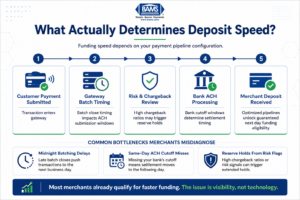
Funding speed is the output of a properly configured payment pipeline, not simply a feature offered by a processor.
The reframe is simple: stop treating deposit timing as a feature you shop for and start treating it as a metric you optimize. Funding speed is the output of a well-configured payment pipeline, not the input that creates one.
This is where a partner like BAMS plays a different role than most processors. Rather than leading with a speed promise, BAMS pairs next-day funding with dedicated account management and interchange-plus pricing, so merchants can see exactly where their money goes and why it moves at the pace it does. The funding gets faster because the underlying account gets healthier.
Think of it like this: you wouldn’t switch gyms because you’re not losing weight. You’d look at your program first. Same logic applies to your payment stack.
Before You Switch, Look Closer
The merchants who pay the least and get funded the fastest are rarely the ones who chased the flashiest processor. They’re the ones who understood their own pipeline well enough to demand transparency from their payment setup and got it.
Your deposits aren’t slow because you picked the wrong provider. They’re slow because nobody showed you the levers. Find the levers first. Then decide if you need to move.
Frequently Asked Questions
What is next-day funding in merchant services?
Next-day funding means your processed transactions settle into your bank account by the following business day. Eligibility depends on factors like your chargeback ratio, gateway batch timing, and your bank’s ACH cutoff windows.
How can a business qualify for next-day funding?
Most processors require a clean chargeback history, consistent processing volume, and proper gateway configuration. A dedicated account review can often unlock next-day eligibility without switching providers.
When should a business consider same-day funding services?
Same-day funding makes sense when cash flow timing directly impacts operations (like daily inventory purchasing), but only after confirming that faster funding fees don’t exceed the cost of optimizing your current settlement pipeline.
Sources