Cash Flow Management: How Deposit Timing Fuels Growth
Last Updated on June 15, 2026 by Dimitri Akhrin
Why settlement delays create compounding problems—and how to fix your funding pipeline
Learn how payment processing speed creates system-level consequences for eCommerce businesses. This guide breaks down settlement mechanics, hidden delay causes, and how to evaluate same-day vs. next-day funding for your operations.
TL;DR
- Deposit timing is a system, not a feature – Four stages (batch submission, network clearing, processor transfer, bank availability) each introduce potential delays. Optimizing one stage while ignoring others won’t solve your cash flow gap.
- Cut-off times matter more than funding speed labels – A “next-day funding” processor with a 5 PM cut-off is materially slower for evening-heavy eCommerce businesses than one with a 9 PM cut-off. Check the mechanics, not the marketing.
- Quantify your “delay tax” before deciding – Calculate the actual cost of deposit delays across missed restock windows, paused ad spend, and unnecessary credit. This number, not the funding speed label, should drive your decision.
- Next-day funding beats same-day for most eCommerce businesses – Same-day ACH requires earlier cut-offs and often carries higher fees. Next-day funding with a late cut-off captures more daily revenue and costs less, delivering the majority of the benefit.
- Align spending to your deposit calendar – Map your weekly outflows (supplier payments, ad budgets, payroll) to your actual deposit schedule. This eliminates artificial cash flow gaps caused by timing mismatches, not revenue shortfalls.
Guide Orientation: What This Covers and Who It’s For
This guide breaks down how payment processing speed (specifically the difference between same-day and next-day funding) creates system-level consequences for eCommerce businesses. It goes beyond surface-level definitions to examine the mechanics behind deposit timing, the compounding effects of settlement delays, and how to optimize your funding pipeline.
It’s written for eCommerce managers at established online businesses (roughly 10 to 50 employees) who already process meaningful transaction volume and feel the friction of delayed deposits. If you’ve ever paused ad spend, missed a restock window, or taken on short-term debt because funds hadn’t landed yet, this is for you.
By the end, you’ll understand exactly how settlement mechanics work, why your specific business setup creates hidden delays, and how to evaluate whether same-day or next-day funding better fits your operational rhythm. This guide does not cover invoice factoring, revenue-based financing, or general small business lending.
Why Cash Flow Management Timing Matters More Than You Think
Funding speed is rarely treated as a strategic lever. Most eCommerce operators evaluate their payment processor on rates and integrations, then accept whatever deposit schedule comes with it. That’s a mistake, because deposit timing doesn’t just affect when you see money. It affects what you can do with it.
Federal Reserve Small Business Survey data continues to show that cash flow predictability and access to working capital remain major operational concerns for growing businesses. For eCommerce operators, delayed deposits compound quickly into inventory, marketing, and supplier payment friction.
The cost of delayed deposits isn’t just the delay itself. It’s the cascade of reactive decisions it forces: conservative ad budgets during peak windows, emergency supplier negotiations, short-term credit lines to cover gaps that shouldn’t exist.
Modern Treasury payment operations resources continue to emphasize how settlement timing, reconciliation visibility, and operational cash flow forecasting directly affect eCommerce decision-making and payment infrastructure efficiency.
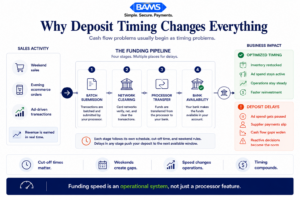
Deposit timing affects far more than when money arrives. It determines how quickly your business can react.
Core Concepts: Understanding the Funding Pipeline
Settlement vs. Funding: The Distinction That Matters
Settlement is the process of moving money between the cardholder’s bank, the card network, and your merchant account. Funding is when that money actually lands in your business bank account. These are separate events, and the gap between them is where most confusion (and frustration) lives.
A common misconception: many eCommerce managers assume their payment processor controls the entire timeline. In reality, deposit timing depends on a chain of handoffs involving your payment gateway, your processor, the card networks (Visa, Mastercard), the acquiring bank, and your business bank. A delay at any point in that chain pushes your deposit back.
The Payment Rails Behind Your Deposits
Two infrastructure systems matter here. ACH (Automated Clearing House) is the traditional rail. Standard ACH batches process overnight, which is why “next-day” is often the fastest option for most merchants. Same-day ACH, introduced by NACHA, allows funds to clear within the same business day, but it requires your processor to submit batches before specific cut-off windows (typically early morning, midday, or late afternoon).
FedNow, the Federal Reserve’s real-time payment service, enables instant settlement 24/7/365. However, adoption among merchant processors and business banks remains limited. For most eCommerce businesses today, the practical choice is between standard two-to-three-day funding, next-day funding, and same-day ACH.
What “Business Day” Actually Means
This is where eCommerce-specific patterns collide with banking infrastructure. Weekends and federal holidays are not business days. If your biggest sales volume hits Friday evening through Sunday (common for most online retailers), those transactions don’t begin settlement until Monday. With standard funding, that money may not arrive until Wednesday or Thursday. Next-day funding compresses this, but the weekend gap still exists unless your processor offers weekend batch submissions.
The Framework: Deposit Timing as a System, Not a Feature
Instead of evaluating funding speed as a single checkbox, think of it as a four-stage system where each stage introduces potential delay:
- Stage 1: Batch Submission — When your processor collects and submits the day’s transactions for settlement. Cut-off times vary dramatically (some processors cut off at 5 PM, others at 9 PM or later).
- Stage 2: Network Clearing — The card networks and issuing banks authorize and clear funds. This is largely standardized but adds 12 to 24 hours.
- Stage 3: Processor-to-Bank Transfer — Your processor initiates the ACH transfer to your business bank account. Same-day ACH, next-day ACH, or standard ACH determines the speed here.
- Stage 4: Bank Availability — Your bank receives the deposit and makes it available. Some banks hold incoming ACH deposits for additional review, adding another half-day or full day.
Optimizing funding speed means examining each stage independently. A processor offering “next-day funding” with a 3 PM cut-off time effectively gives you two-day funding on any transaction processed after mid-afternoon. The label matters less than the mechanics.
Step-by-Step: Optimizing Your Funding Timeline
Step 1: Map Your Current Settlement Timeline
Objective: Establish a precise, documented understanding of how long it actually takes for funds to move from customer payment to available cash in your bank account.
Start by tracking 20 to 30 transactions across different days of the week, including weekends. For each transaction, record the timestamp of the sale, the batch submission time (available in your processor’s dashboard), and the exact time the deposit appears as available in your bank account. Calculate the actual elapsed time, not the “business days” your processor quotes.
Most eCommerce managers discover their real funding timeline is 12 to 36 hours longer than they assumed. Weekend transactions are the biggest offenders. A Saturday afternoon sale might not become available cash until Wednesday morning, a gap of nearly four full days.
Anti-pattern: Don’t rely on your processor’s stated funding timeline as your actual timeline. Their clock starts at batch submission. Yours starts at the moment of sale. Those are different clocks.
Success indicator: You have a spreadsheet or dashboard showing average deposit delay by day of week, and you can identify your worst-case funding gap (typically weekend-to-weekday transitions).
Step 2: Identify Your Cut-Off Time Exposure
Objective: Determine how much revenue falls outside your processor’s batch submission window each day.
Every processor has a daily cut-off time. Transactions processed before the cut-off go into that day’s batch. Transactions after the cut-off roll into the next day’s batch, adding a full 24 hours (or more) to your deposit timeline. If your processor’s cut-off is 5 PM Eastern and 40% of your daily sales happen between 5 PM and midnight, those sales are automatically delayed by an extra day.
Pull your sales data by hour and overlay it against your processor’s cut-off time. For many eCommerce businesses, evening hours (6 PM to 11 PM) represent a disproportionate share of revenue. A processor with a 9 PM cut-off captures significantly more of that volume in the same-day batch than one cutting off at 5 PM. This single variable can be worth an entire day of funding speed without changing anything else about your setup.
Anti-pattern: Assuming all “next-day funding” offers are equivalent. A next-day promise with a 3 PM cut-off is materially worse than one with a 9 PM cut-off for most eCommerce businesses.
Success indicator: You know exactly what percentage of daily revenue falls after your current cut-off time and can calculate the dollar value of the resulting delay.
Step 3: Quantify the Downstream Cost of Your Current Gap
Objective: Translate deposit delays into concrete business costs so you can make an informed decision about whether faster funding justifies any associated fees or operational changes.
Deposit delays cost money in three primary ways. First, missed restock windows: if your supplier offers a 48-hour ordering window for a popular SKU and your weekend revenue hasn’t landed yet, you either miss the window or use credit. Second, paused ad spend: performance marketing platforms require funded accounts. If your ad budget depends on deposited revenue and there’s a two-day gap, you’re either overfunding your ad account (tying up capital) or pausing campaigns during high-conversion windows. Third, unnecessary short-term debt: Federal Reserve economic and payment system resources continue to highlight the importance of liquidity access and working capital availability for small and mid-sized businesses operating in tighter cash flow environments.
Calculate your cost by examining each category. How many times in the last quarter did you delay a purchase order, reduce ad spend, or draw on a credit line because deposits hadn’t arrived? Assign dollar values. This number is your “delay tax,” and it’s almost always larger than the cost difference between standard and accelerated funding.
Anti-pattern: Treating funding speed as a “nice to have” without quantifying the actual cost of your current timeline. This leads to underinvestment in a high-leverage operational improvement.
Success indicator: You have a quarterly dollar figure representing the cost of deposit delays, broken into restock, marketing, and financing categories.
Step 4: Evaluate Same-Day vs. Next-Day for Your Business Pattern
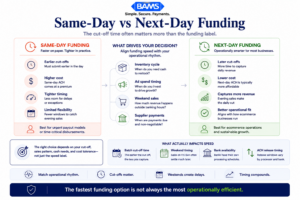
The best funding option is not the fastest one. It is the one that matches your operational rhythm.
Objective: Determine which funding speed aligns with your operational cadence, rather than defaulting to “faster is always better.”
Same-day funding sounds ideal, but it comes with trade-offs. Same-day ACH requires earlier batch cut-off times (often before 2 PM) to hit the clearing window. It may carry higher per-transaction fees. And for many eCommerce businesses, the marginal benefit over next-day funding is smaller than expected.
The decision framework is straightforward. Choose same-day funding if: you operate in a business where inventory turns daily (perishables, limited-drop merchandise), your supplier payment terms are measured in hours rather than days, or you run a marketplace model where you need to pay out sellers quickly. Choose next-day funding if: your restock cycle is weekly or biweekly, your primary need is eliminating the weekend gap rather than shaving hours off weekday deposits, and you want the latest possible cut-off time to capture evening sales.
For most established eCommerce businesses processing steady volume, next-day funding with a late cut-off time delivers the best balance of speed, cost, and operational fit. BAMS, for example, offers next-day funding with a 9 PM cut-off and no additional fees, which captures the majority of evening eCommerce transactions without the constraints of same-day ACH windows.
Anti-pattern: Paying a premium for same-day funding when your operational rhythm doesn’t actually require intra-day access. Faster isn’t better if it doesn’t change your decision-making timeline.
Success indicator: You’ve matched your funding speed choice to your actual restock cycle, ad budget cadence, and supplier payment terms rather than choosing based on the label alone.
Step 5: Optimize Your Bank-Side Availability
Objective: Ensure your business bank account isn’t adding hidden delays after your processor has done its job.
This is the most overlooked stage in the funding pipeline. Your processor can submit a next-day ACH transfer on schedule, but if your bank holds incoming ACH deposits for review or doesn’t process them until end of day, you’ve lost the advantage. Some banks make ACH deposits available immediately upon receipt. Others impose a half-day or full-day hold, particularly on accounts that are newer, have lower average balances, or receive irregular deposit amounts.
Contact your bank and ask specifically: “When an incoming ACH credit arrives, what time does it become available for withdrawal or transfer?” If the answer is anything other than “immediately upon receipt” or “by 9 AM on the deposit date,” you have a bank-side bottleneck. Consider whether a different business banking relationship would serve your funding needs better. Many digital-first business banks (Mercury, Relay, Novo) offer faster ACH availability than traditional banks.
Anti-pattern: Blaming your payment processor for slow deposits when the delay is actually on the banking side. Diagnose before you switch processors.
Success indicator: You’ve confirmed your bank’s ACH availability policy in writing and verified it matches your operational needs.
Step 6: Build a Weekly Cash Flow Rhythm Around Your Deposit Schedule
Objective: Align your spending decisions (restocking, ad budgets, payroll, vendor payments) with your actual deposit calendar rather than fighting against it.
Even with optimized funding speed, eCommerce cash flow is inherently cyclical. Sales volume peaks on certain days. Deposits arrive on a predictable schedule. Supplier invoices and ad platform billing cycles have their own rhythms. The goal is to synchronize these cycles rather than treating each one independently.
A weekly cash flow budget is one of the most effective tools for this. Map your expected deposits by day of week (using the data from Step 1), then schedule your outflows to align. If your heaviest deposit day is Tuesday (reflecting weekend sales with next-day funding), schedule supplier payments and ad account top-ups for Tuesday afternoon or Wednesday morning. This eliminates the need for buffer capital or credit lines to bridge timing gaps.
For high-volume sale events (Black Friday, flash sales, seasonal peaks), build a separate deposit projection. Your normal weekly rhythm won’t hold when volume spikes 3x to 5x. Know in advance how your processor handles surge volume and whether batch sizes affect settlement timing. Some processors throttle large batches or split them across multiple settlement cycles.
Anti-pattern: Setting fixed spending schedules (e.g., “we restock every Monday”) without aligning them to your deposit calendar. This creates artificial cash flow gaps that have nothing to do with revenue and everything to do with timing.
Success indicator: Your weekly spending calendar is explicitly mapped to your deposit schedule, and you can identify in advance any weeks where timing gaps require pre-funding.
Practical Examples: How Deposit Timing Plays Out
Scenario A: The Weekend Gap Problem
An online home goods retailer generates 45% of weekly revenue between Friday 6 PM and Sunday midnight. Their processor has a 5 PM cut-off and standard two-day funding. Friday evening sales batch on Monday, arrive Wednesday. Saturday and Sunday sales batch on Monday (same batch), also arrive Wednesday. The result: $38,000 in weekend revenue isn’t available until midweek, but their supplier requires payment by Tuesday for the weekly shipment. They’ve been using a $15,000 credit line to bridge this gap every week, paying interest on money they’ve already earned.
By switching to a processor with next-day funding and a 9 PM cut-off, Friday evening sales (before 9 PM) batch Friday night and arrive Monday. Saturday and Sunday sales still batch Monday but arrive Tuesday. The credit line becomes unnecessary. Annual savings on interest alone: roughly $2,400, plus the elimination of credit utilization that was affecting their borrowing capacity for actual growth investments.
Scenario B: The Ad Spend Stall
A DTC skincare brand runs performance ads on Meta and Google with daily budgets that flex based on ROAS. When deposits lag by two to three days, the marketing manager can’t confirm available cash to increase spend during high-performing windows. They’ve been capping daily budgets at conservative levels to avoid overdrawing their ad account. During a product launch week, this meant leaving an estimated $12,000 in profitable ad spend on the table because the previous week’s deposits hadn’t fully cleared.
With next-day funding, the previous day’s revenue is available each morning. The marketing manager can make same-day budget decisions based on actual deposited funds rather than projections. The reinvestment cycle compresses from “earn Friday, spend Wednesday” to “earn Friday, spend Monday.”
Scenario C: Cross-Border Complexity
An eCommerce brand selling internationally processes transactions in multiple currencies. Cross-border transactions involve additional clearing steps (currency conversion, international network routing) that add one to two days beyond domestic settlement times. Their domestic next-day funding doesn’t apply to international orders, which represent 25% of revenue. The solution isn’t faster funding for international transactions (the rails don’t support it yet). It’s building a separate cash flow projection for international revenue with longer deposit assumptions, so domestic deposits aren’t subsidizing international timing gaps.
Common Mistakes and Pitfalls
Treating all processors’ “next-day” claims as identical. The label “next-day funding” has no standardized definition. One processor means next business day from batch submission. Another means next calendar day. A third means next day but only for transactions under $5,000. Read the fine print, and test with real transactions before committing.
Ignoring the gateway layer. Your payment gateway sits between your storefront and your processor. Some gateways introduce their own batching delays, particularly when connected through middleware or third-party integrations. If you’re using a multi-layer tech stack (Shopify to third-party gateway to processor), each handoff is a potential delay point.
Over-optimizing for speed at the expense of cost. Same-day funding with a per-transaction surcharge can erode margins on low-ticket items. Calculate the net benefit, not just the speed improvement. For many businesses, next-day funding without additional fees delivers 90% of the benefit at a fraction of the cost.
Forgetting seasonal adjustment. Your funding needs during Q4 holiday season are fundamentally different from a slow February. Build flexibility into your processor relationship so you can handle volume spikes without settlement surprises.
What to Do Next
Start with Step 1. Map your actual settlement timeline for the next two weeks. Track 20 to 30 transactions across different days and times. The data will likely surprise you, and it will give you the foundation to evaluate every other decision in this guide.
Once you have that baseline, calculate your “delay tax” from Step 3. If the number is meaningful (and for most eCommerce businesses processing over $50,000 monthly, it will be), you have a clear business case for optimizing your funding pipeline.
This isn’t a one-time fix. Revisit your funding setup quarterly, especially before high-volume seasons. As your business grows, your cash flow management needs will evolve. What works at $100,000 in monthly revenue may create bottlenecks at $500,000. Treat your deposit timeline as a system to maintain, not a problem to solve once.
Frequently Asked Questions
What is next-day funding in merchant services?
Next-day funding means your payment processor deposits the previous day’s credit and debit card transactions into your business bank account by the next business day. The key variables are the processor’s batch cut-off time (when they stop collecting transactions for that day’s batch) and your bank’s ACH availability policy. A processor with a 9 PM cut-off will capture more of your daily sales in the same batch than one with a 5 PM cut-off, making the “next-day” promise meaningfully faster in practice.
What are the differences between next-day funding and standard funding?
Standard funding typically takes two to three business days from batch submission to deposit availability. Next-day funding compresses that to one business day. The difference comes down to which ACH processing window your processor uses and whether they front the funds before full interbank settlement completes. For eCommerce businesses, the practical impact is most visible over weekends: standard funding can create a four-day gap between a Saturday sale and available cash, while next-day funding reduces that to two days.
When should a business consider same-day funding services?
Same-day funding makes sense when your business requires intra-day access to revenue, typically in industries with daily inventory turns (perishable goods, event-based sales) or marketplace models requiring rapid seller payouts. For most eCommerce businesses with weekly or biweekly restock cycles, next-day funding with a late cut-off time provides sufficient speed without the higher fees or earlier batch deadlines that same-day funding often requires.
Which factors affect approval for next-day funding?
Processors evaluate several factors: your monthly processing volume, average transaction size, chargeback ratio, business tenure, and industry risk category. Established eCommerce businesses with consistent volume, low chargeback rates, and at least six months of processing history typically qualify without difficulty. Higher-risk categories (travel, digital goods, subscription services) may face additional requirements or delayed eligibility.
How do weekend sales affect deposit timing for eCommerce businesses?
Weekend transactions don’t begin settlement until Monday because ACH processing doesn’t operate on weekends or federal holidays. With standard funding, Saturday and Sunday sales may not arrive until Wednesday or Thursday. With next-day funding, those transactions batch Monday and typically arrive Tuesday. This weekend gap is the single largest source of cash flow friction for eCommerce businesses, since online shopping volume often peaks during evenings and weekends.
Can my business bank account slow down deposits even if my processor is fast?
Yes. Your bank’s ACH availability policy determines when incoming deposits become usable funds. Some banks make ACH credits available immediately upon receipt. Others impose holds of several hours or even a full business day, particularly for newer accounts or irregular deposit amounts. If you’ve optimized your processor’s funding speed but still experience delays, contact your bank to confirm their specific ACH availability timeline.
Sources
- Federal Reserve Small Business Survey Report
- Modern Treasury Payment Operations Resources
- NACHA Same-Day ACH Resources