Payment Gateway Integration: The Hidden Cost Decision
Last Updated on July 1, 2026 by Dimitri Akhrin
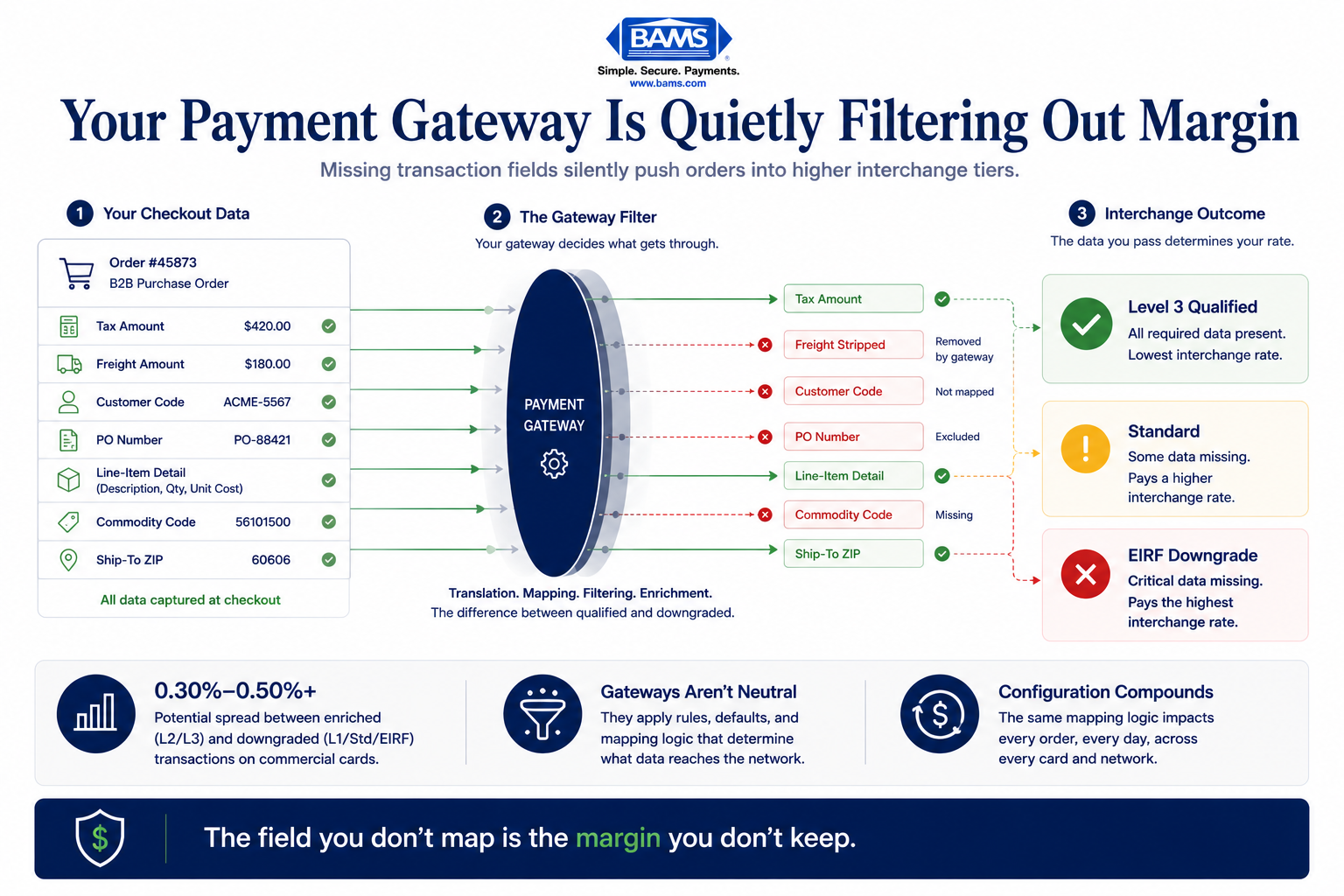
Your gateway actively strips the data fields that qualify transactions for lower interchange rates
Learn how payment gateway configurations silently determine interchange fees by controlling which data fields reach card networks. Discover why treating integration as a one-time setup leaves money on the table with every transaction.
TL;DR
- Your gateway isn’t neutral – It actively decides which data fields (tax, freight, line-item detail) reach the card network, and missing fields push transactions to the most expensive interchange tiers.
- Level 2/3 data qualification saves real money – The spread between basic and enriched data rates can be 0.30% to 0.50%+ per transaction, adding up to thousands annually on commercial card volume.
- Most eCommerce platforms have the data but don’t pass it – Your cart calculates tax and shipping already. The gap is in how your gateway plugin maps (or fails to map) those fields downstream.
- Treat your gateway as a cost lever, not plumbing – Audit field mapping after every platform update, plugin change, or checkout redesign. The field you don’t map is the margin you don’t keep.
Your Gateway Is Quietly Costing You Money
Every eCommerce transaction you process passes through a gateway. Most merchants treat that gateway like plumbing: invisible, passive, and not worth thinking about after the initial setup. But here’s the friction. Your payment gateway integration is making active decisions about which data fields travel with each transaction, and those decisions directly determine what you pay in interchange fees.
The fields that get stripped or left blank on the way to the card network? They’re the same fields that would have qualified your transactions for lower rates. That’s not a bug. It’s a configuration problem hiding in plain sight.
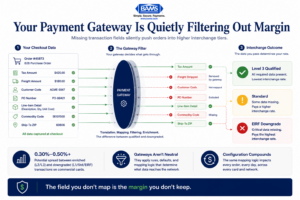
The data exists in your checkout already. The gateway decides whether the card network ever sees it.
The “Set It and Forget It” Myth of Payment Gateway Integration
The dominant approach to gateway setup goes something like this: pick a platform, connect the gateway plugin, test a few transactions, move on. Most eCommerce managers treat the integration as a one-time technical task. The gateway works. Orders flow. Money arrives. Done.
This made sense when gateways were simple pipes. But the payment processing landscape has changed dramatically. Modern Treasury payment operations resources continue to emphasize how orchestration layers, reconciliation visibility, and enriched transaction data now directly affect payment economics at the transaction level.
Yet most merchants are still running a 2015 configuration in a market that rewards precision. The gateway “works,” sure. But working and working optimally are very different things when you’re processing thousands of orders a month.
The Real Determinant of Your Processing Costs
Here’s what we actually believe: your gateway configuration is not a technical detail. It’s a recurring cost decision that compounds on every single transaction.
The difference between a gateway that passes enriched transaction data and one that doesn’t can mean the difference between qualifying for Level 2 or Level 3 interchange rates and defaulting to the most expensive tier. That’s not a one-time hit. It’s a margin leak that runs 24/7.
The Hidden Economics of Tax and Freight Fields
Let’s get specific about what’s happening under the hood.
Card networks like Visa and Mastercard operate a tiered interchange system. The more data you provide about a transaction, the lower the rate you can qualify for.
- Level 1 is the bare minimum: card number, expiration, transaction amount.
- Level 2 adds tax amount, merchant postal code, and customer code.
- Level 3 goes further with line-item detail, product codes, freight amounts, unit costs, and more.
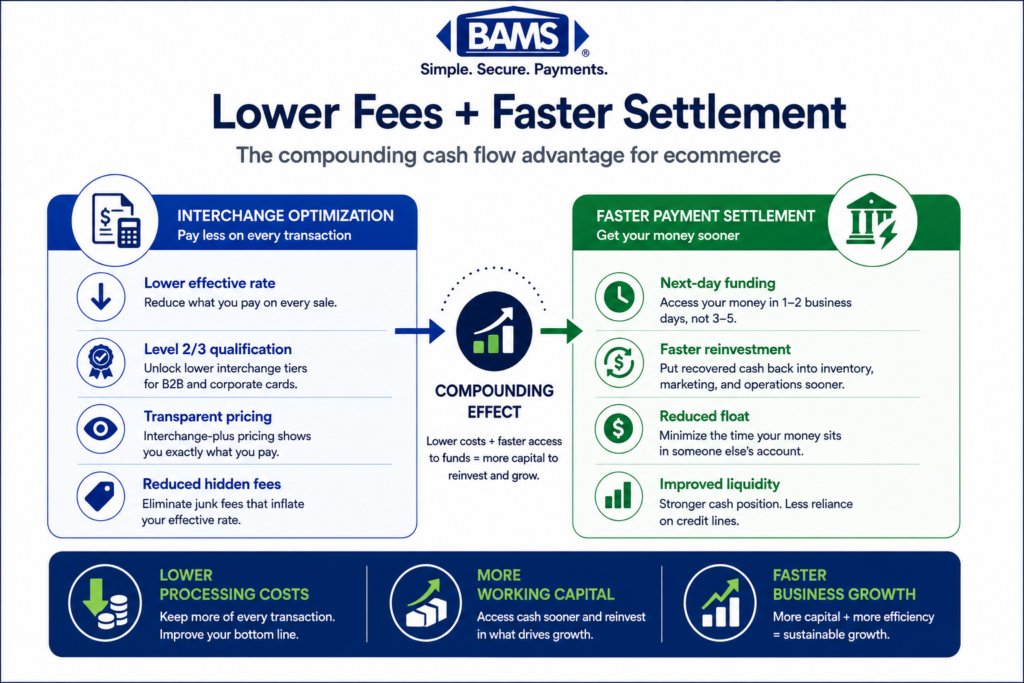
The rate spread between Level 1 and Level 3 can be significant, often 0.30% to 0.50% or more per transaction on commercial and purchasing cards. For a merchant processing $500,000 annually in B2B or mixed-channel orders, that’s $1,500 to $2,500 left on the table every year. Not because of bad negotiation. Because of empty fields. Federal Reserve interchange fee data continues to demonstrate how qualification differences materially affect merchant processing costs over time.
Here’s where it gets interesting. Most eCommerce platforms have the data. Your cart already calculates tax and your shipping module already knows the freight cost. Your product catalog already contains item-level detail. The data exists. The question is whether your gateway integration is configured to pass it downstream.
Many default gateway plugins don’t map these fields. They capture what’s needed to authorize and settle the transaction, and nothing more. Tax gets lumped into the total. Freight disappears. Line-item data never leaves your platform. The card network sees a bare transaction, assigns it to the highest interchange tier, and you pay the premium without ever knowing a lower rate was available.
We’ve seen this pattern across platforms.
Shopify’s native checkout, for example, handles tax calculation but doesn’t automatically pass Level 3 fields through every gateway connector. WooCommerce merchants face similar gaps depending on which payment plugin they use. Even Adobe Commerce (Magento), which offers more granular control, requires deliberate configuration to ensure enriched data reaches the processor.
The gateway isn’t neutral. It’s a filter. And most merchants have never audited what it’s filtering out.
What Qualifies and What Gets Stripped
Consider a typical B2B order: $2,400 total, including $180 in tax and $45 in shipping. If your gateway passes only the $2,400 total, the network sees a generic transaction. If it passes the tax amount, freight amount, customer PO number, and line-item detail separately, the same transaction can qualify for Level 3 rates.
Same order, same customer and same card. Different cost to you, simply because of how fields were mapped in your integration.
This is where working with a merchant services partner that understands these dynamics matters. BAMS, for instance, pairs interchange-plus pricing with the kind of account-level guidance that helps merchants identify when their gateway configuration is leaving money behind. It’s not just about getting a better rate on paper. It’s about making sure your transactions actually qualify for the rates you’re paying for.
What Changes When You Treat Your Gateway as a Rate Lever
If this thesis is right, the implications reshape how eCommerce managers should think about their payment processing strategies.
First, gateway selection becomes a cost optimization decision, not just a compatibility checkbox. When choosing an eCommerce merchant services provider, the question isn’t just “does it connect to my platform?” It’s “does it preserve the data fields that qualify my transactions for lower rates?”
Second, every platform migration, plugin update, or checkout redesign is a moment of risk. Fields that were mapped before might not be mapped after. A single update can silently push your entire transaction volume back to the most expensive interchange tier.
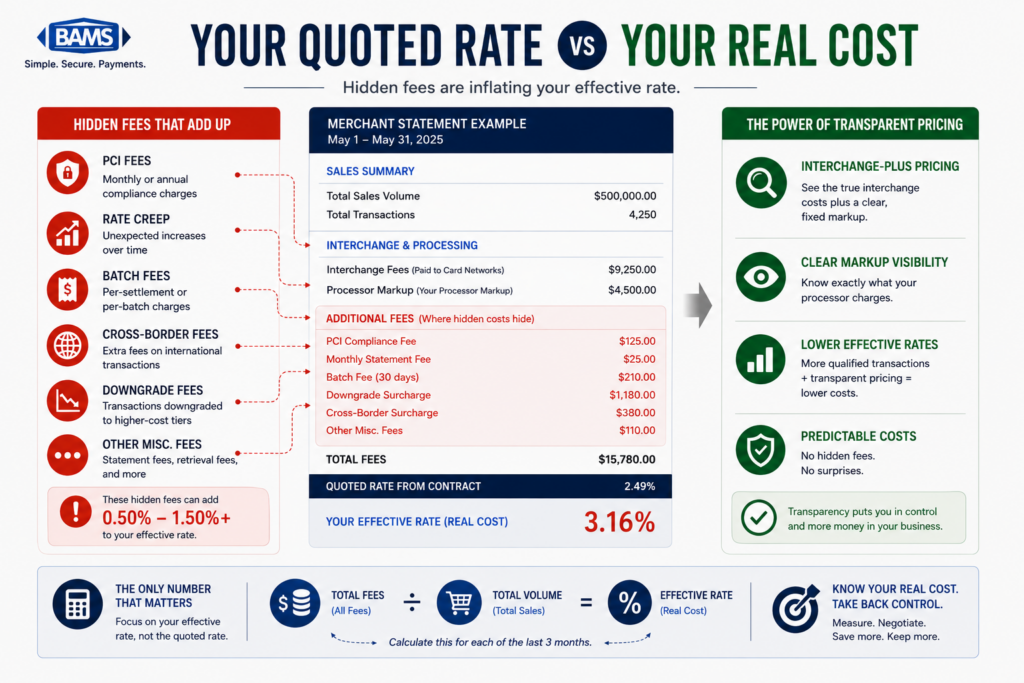
Third, your effective processing rate becomes something you can actively manage, not just passively accept. Auditing your statements for hidden fees is important. But auditing your gateway for missing fields is where the real leverage lives.
A New Way to Think About Transaction Routing
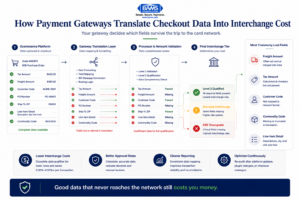
Your gateway is not just moving transactions. It is translating them for the card networks.
Stop thinking of your gateway as a pipe. Start thinking of it as a translator.
Your eCommerce platform speaks one language (cart data, tax calculations, shipping rules). The card network speaks another (interchange qualification tiers, data element requirements, field-level validation). Your gateway sits between them, and its job is to translate accurately and completely.
When the translation is lossy, you pay more. When it’s precise, you pay less. The most expensive thing in payment processing isn’t a bad rate. It’s good data that never reaches the network. Visa payment rules and merchant guidance continue to emphasize the importance of complete and accurate transaction-level data for qualification and payment optimization.
That reframe changes the conversation entirely. You stop asking “what’s my rate?” and start asking “what’s my qualification rate?” One is a number your processor gives you. The other is a number your configuration earns you.
The Field You Don’t Map Is the Margin You Don’t Keep
Every blank field in your gateway configuration is a small, silent tax on your business. Not from the government. Not from the card networks. From your own setup.
The merchants who optimize transaction routing and data pass-through aren’t doing anything exotic. They’re just refusing to treat their gateway as a finished project. They audit, they map and they verify. And they keep more of every dollar that flows through their checkout.
Your gateway has an opinion about what your transactions are worth. Make sure it’s the right one.
Frequently Asked Questions
How does optimizing transaction data affect processing fees?
Card networks offer lower interchange rates when transactions include enriched data like tax amounts, freight costs, and line-item details. If your gateway doesn’t pass these fields, your transactions default to the most expensive tier, regardless of your negotiated rate.
What are the best strategies to reduce payment processing fees?
Start by ensuring your gateway maps all available Level 2 and Level 3 data fields. Then pair that with interchange-plus pricing so you can see exactly where each transaction qualifies and where qualification gaps are costing you money.
Why is interchange-plus pricing more beneficial than flat-rate pricing?
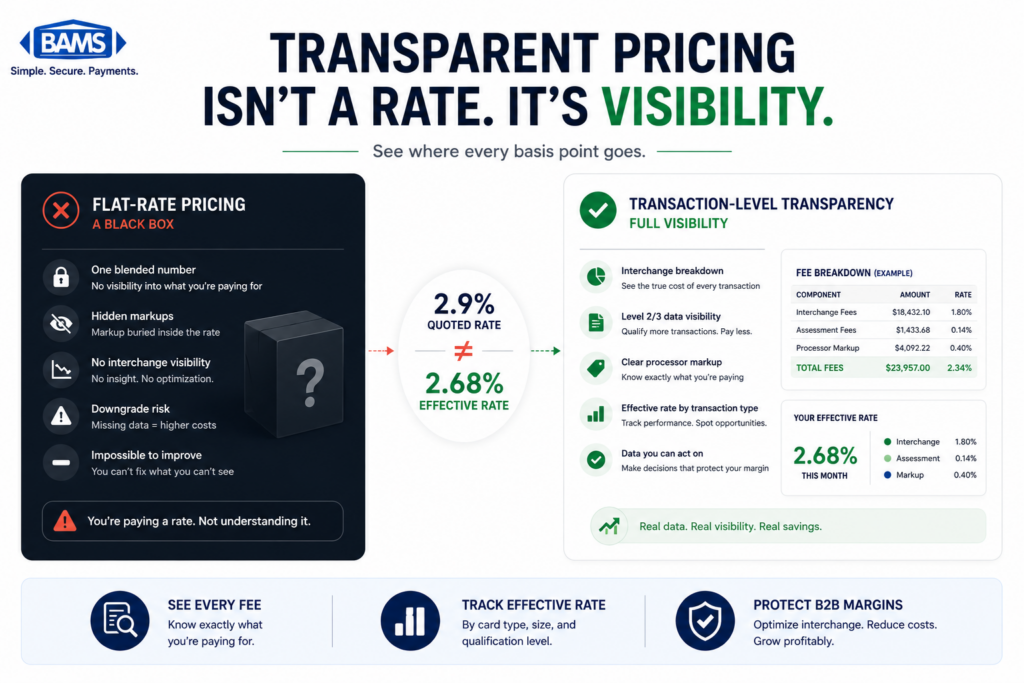
Flat-rate pricing hides the actual interchange tier your transactions qualify for, so you never know if you’re overpaying. Interchange-plus pricing gives you visibility into each transaction’s qualification level, making it possible to identify and fix costly configuration gaps.