The Real Cost of Capital: Private Lending Q&A | We Lend
Last Updated on July 27, 2026 by Dimitri Akhrin
The Real Cost of Capital: Why Investors Should Read a Term Sheet Like a Merchant Statement
Most business owners learn to distrust the headline number eventually, usually after paying it.The difference between the rate you were quoted and the money that actually leaves your account often lives in fees nobody explained at signing. Real estate investors face a version of the same problem, and the gap between the quoted rate and the true cost of capital can decide whether a deal makes money at all.
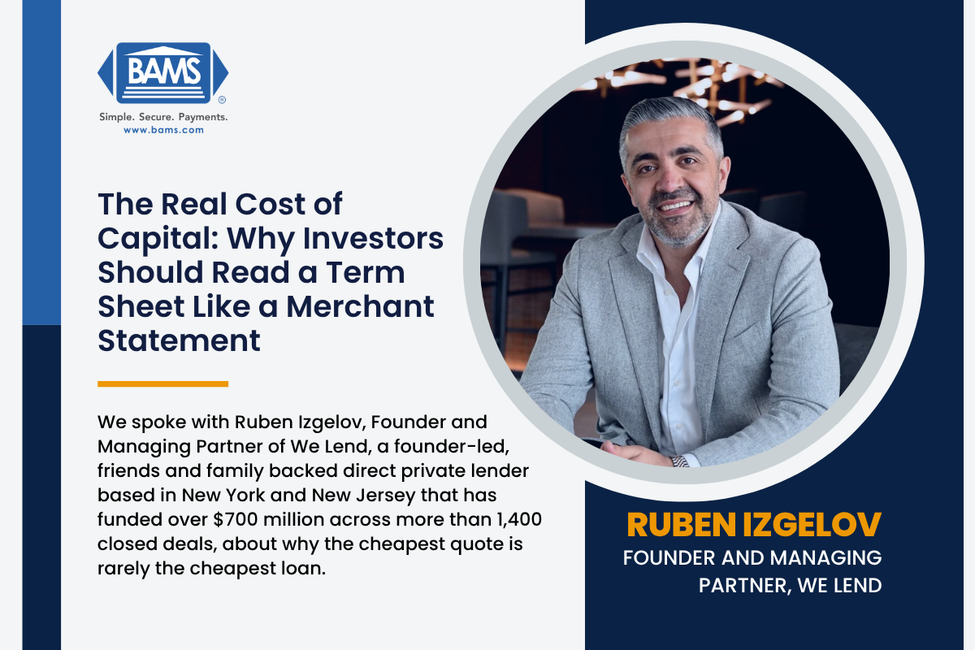
We spoke with Ruben Izgelov, Founder and Managing Partner of We Lend, a founder-led, friends and family backed direct private lender based in New York and New Jersey that has funded over $700 million across more than 1,400 closed deals, about why the cheapest quote is rarely the cheapest loan.
Q: Most merchants know a quoted rate rarely matches the statement. Does the same gap show up for real estate investors shopping financing?
Ruben Izgelov: It shows up in the same way. Rate is one line on a page. Points, junk fees, draw fees, extension terms, prepayment language, and how the lender handles rehab disbursements all move the real number. An investor can take a loan a full point cheaper and still pay more by the time they exit, if the draw process adds three weeks to the project. Time is a cost, and it rarely appears on the quote.
Q: How should a real estate investor compare two offers properly?
Ruben: Line by line, the same way a good processor reads a merchant statement. Put both term sheets side by side and total everything you will actually pay from closing to payoff, including the carry for however long the lender realistically takes to fund and to release rehab draws. Then ask what happens if the project runs long, because it probably will. The lender who is straight with you about the extension fee up front is usually the one telling the truth about everything else.
Q: What separates a private lender from a bank on that math?
Ruben: Speed changes the math. A bank may quote less and take weeks to months. In a competitive market that timeline loses the deal, and the cheapest capital you never got is worth nothing. We close in days. We turn around term sheets in two to four hours. For an investor buying at auction or under a tight contract, that difference is the whole business.
Q: You fund with friends and family capital. Does that change how you underwrite?
Ruben: It changes how we approach every deal. That money belongs to people I know. There is no committee to hide behind, so I look at files myself and I say no when the deal does not work. That is also why we have zero principal loss across 1,400 deals and a 68% repeat borrower rate. Borrowers come back to a lender who was honest about the numbers the first time.
Q: What is the most common mistake you see from otherwise experienced operators?
Ruben: Underwriting the property and not the financing. They will spend two weeks on comps and rehab budgets, then take the first term sheet that lands because they are tired. The financing is a line item with as much impact on the return as the purchase price. It deserves the same scrutiny.
Q: What should someone do before they accept a quote?
Ruben: Ask the lender to walk you through every cost from application to payoff, in order, with numbers. If they cannot do it on a phone call, that tells you what the relationship will be like when something goes wrong on the project.
About Ruben Izgelov
Ruben Izgelov is the Founder and Managing Partner of We Lend, a direct private real estate lender based in New York and New Jersey. We Lend has funded over $700 million across more than 1,400 closed deals with zero principal loss and a 68% repeat borrower rate, backed by a $20 million Webster Bank credit facility. Learn more at welendllc.com.