Digital Wallets and Chargebacks: A Merchant Guide
Last Updated on July 28, 2026 by Dimitri Akhrin
How tokenized payment methods create dispute blind spots—and what your team can do to close them now
Learn how digital wallet transactions create hidden gaps in your chargeback evidence trail. This guide shows eCommerce operators how to strengthen dispute documentation and connect faster funding to smarter revenue protection.
TL;DR
- Digital wallets dominate online payments, but your dispute process probably hasn’t caught up — Tokenization replaces card numbers with Device Account Numbers, creating evidence gaps that weaken your chargeback responses if you don’t adapt your templates and data capture.
- Friendly fraud is the primary wallet dispute threat — Biometric authentication reduces true fraud but doesn’t prevent legitimate cardholders from filing disputes over unrecognized charges, non-receipt claims, or product dissatisfaction.
- Segment your transaction and dispute data by payment method — You can’t fix what you can’t see. Wallet transactions carry different risk profiles and dispute patterns than traditional card payments, and blending them into one metric hides emerging problems.
- Speed on two fronts protects your cash flow — Pre-stage dispute evidence at the time of transaction (not at the time of dispute) and secure next-day funding so non-disputed revenue keeps flowing while you fight chargebacks.
- Build the process now while volumes are manageable — Wallet adoption is growing rapidly, with users projected to reach 6 billion by 2030. Establishing wallet-specific review cadences and evidence workflows today is far easier than retrofitting under pressure later.
Guide Orientation: What This Covers and Who It’s For
This guide addresses a specific operational gap: the disconnect between growing digital wallets adoption and the evidence trail your business needs to defend revenue against chargebacks. It is written for eCommerce managers at established online businesses (roughly 10 to 50 employees) who already accept or plan to accept mobile wallet payments like Apple Pay, Google Pay, and similar services.
By the end, you’ll understand how tokenized wallet transactions create blind spots in your dispute documentation, how to close those gaps before they cost you money, and how to connect faster funding access to stronger chargeback defense. This guide does not cover the technical architecture of tokenization in depth, nor does it address enterprise-level payment orchestration. It focuses on what you, as a merchant operator, need to do differently right now.
Why Protecting Revenue from Digital Wallet Disputes Matters Now
Digital wallets have become a mainstream payment method for both eCommerce and in-store purchases. As more customers choose Apple Pay, Google Pay, and similar payment methods, merchants need dispute processes that reflect how tokenized transactions differ from traditional card payments. Visa highlights the continued expansion of digital wallet usage and the growing importance of preparing payment operations for tokenized transactions.
The problem isn’t that digital wallets are unsafe. Tokenization and biometric authentication genuinely reduce certain types of payment fraud risks. The problem is that the security architecture that protects the consumer also obscures the data you need when a dispute lands on your desk. Your processor sees a Device Account Number (DAN), not the actual card number. Your fraud filters may not correlate wallet-initiated transactions with your existing risk signals. And when a chargeback arrives, the evidence package you’ve relied on for traditional card disputes may be incomplete.
Payment card fraud is forecast to grow by roughly $10 billion between 2023 and 2028. As wallet adoption accelerates, the merchants who haven’t adapted their dispute workflows will absorb a disproportionate share of those losses. The cost of inaction isn’t theoretical. It’s measurable in lost disputes, tied-up funds, and eroded margins.
Core Concepts: Tokenization, DANs, and the Evidence Gap
What Tokenization Actually Changes for You
When a customer pays with Apple Pay or Google Pay, the card network replaces the real card number (the FPAN, or Funding Primary Account Number) with a token called a Device Account Number (DAN). This token is unique to the device and merchant combination. It means the real card number never touches your system, which reduces your PCI exposure and makes stolen data less useful to attackers.
But here’s the trade-off: your transaction records now contain a DAN instead of the card number your processor, your fraud tools, and your chargeback response templates expect. When you try to match a disputed transaction to your order records, the identifiers may not align. This is the evidence gap.
Why “Safer” Doesn’t Mean “Dispute-Proof”
A common misconception is that because Apple Pay uses biometric authentication (Face ID, Touch ID), chargebacks from wallet transactions should be rare. In practice, friendly fraud (where the legitimate cardholder disputes a charge they authorized) remains fully possible. The biometric step verifies device possession, not purchase intent. Customers can still claim they didn’t recognize a charge, didn’t receive goods, or that the transaction was unauthorized by someone else using their device.
The Distinction That Matters: Fraud vs. Disputes
Fraud prevention and dispute defense are related but separate disciplines. Tokenization and biometric authentication help with fraud prevention. But dispute defense requires documentation, evidence correlation, and response speed. This guide focuses on the second category, because that’s where the operational gap is widest for SMB merchants navigating wallet growth.
The Revenue Protection Framework for Digital Wallet Transactions
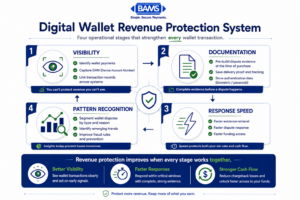
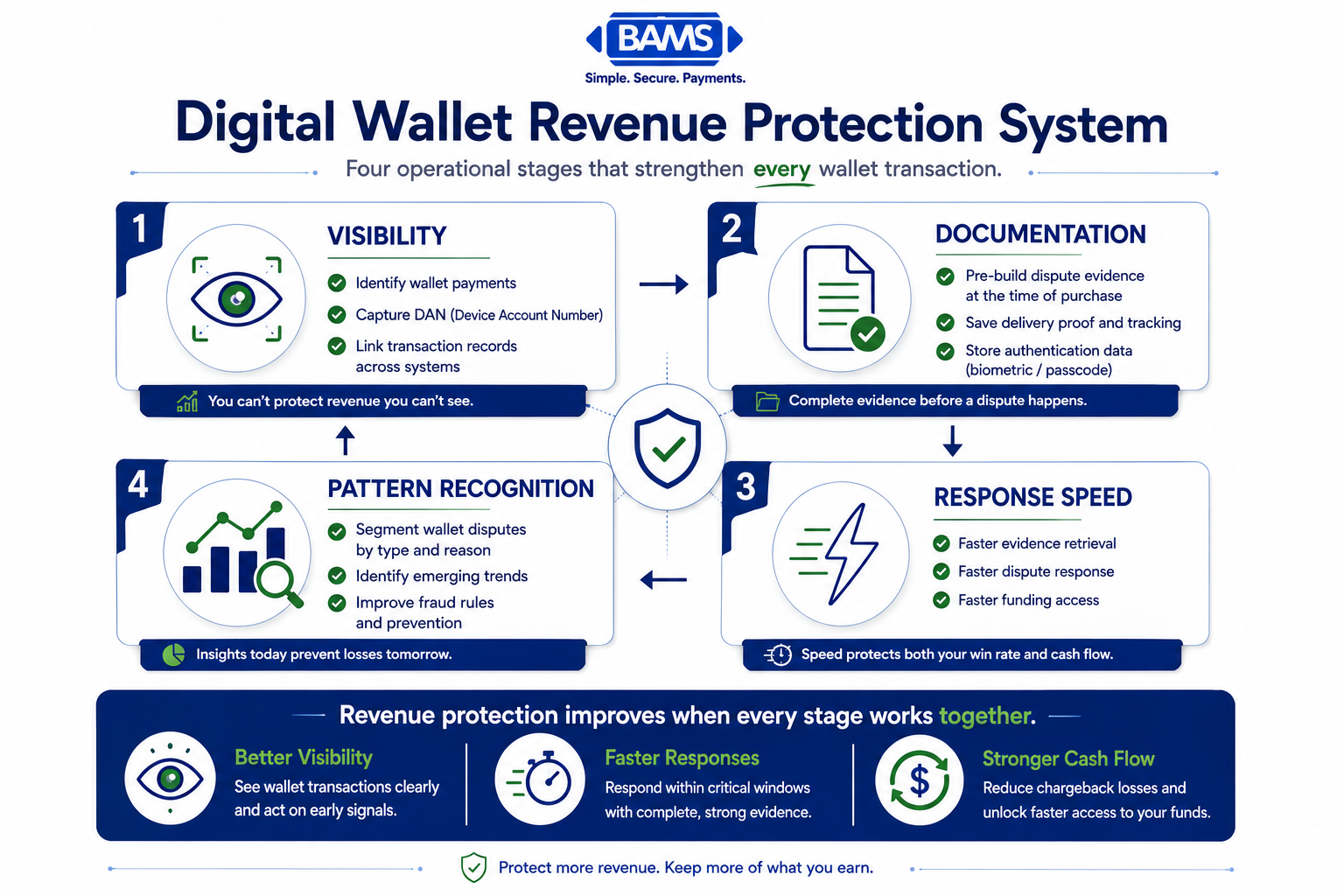
Strong dispute outcomes begin long before a chargeback arrives. A structured revenue protection system helps merchants prepare evidence, improve response times, and protect cash flow as digital wallet adoption grows.
Protecting revenue as wallet adoption grows requires a four-stage approach. Each stage builds on the previous one, creating a system rather than a set of disconnected tactics.
- Stage 1: Visibility — Ensure your systems capture and correlate wallet-specific transaction data.
- Stage 2: Documentation — Build dispute evidence packages that account for tokenized identifiers.
- Stage 3: Speed — Compress your response windows and funding cycles to minimize cash flow exposure.
- Stage 4: Pattern Recognition — Identify recurring dispute patterns specific to wallet transactions and adjust proactively.
These stages are sequential for initial setup but cyclical in practice. Pattern recognition feeds back into visibility improvements, which sharpen documentation, which accelerates response speed. Let’s break each one down.
Step-by-Step: Closing the Evidence Gap on Wallet Transactions
Step 1: Audit Your Transaction Data for Wallet Visibility
Objective: Confirm that your payment system, order management platform, and fraud tools can identify, flag, and store wallet-specific transaction attributes alongside standard order data.
Start by pulling a sample of recent wallet transactions from your processor dashboard and your order management system. Look for whether the payment method is recorded as “Apple Pay,” “Google Pay,” or a generic “card” entry. Check whether the DAN is stored and whether it’s linked to the order ID, customer profile, and fulfillment record. Many eCommerce platforms default to treating wallet payments identically to card-on-file transactions in their logs, which creates problems downstream.
If your system doesn’t distinguish wallet transactions, work with your payment gateway or merchant services provider to enable wallet-type flags. Most modern gateways support this through their API or dashboard settings, but it often requires explicit activation. You also want to confirm that your fraud screening tools receive the wallet type as a data field. If your fraud tool doesn’t know a transaction came from Apple Pay, it can’t apply wallet-specific risk rules.
Anti-patterns: Don’t assume your platform handles this automatically. Don’t rely solely on your processor’s portal for dispute evidence; it often strips context your order system retains. Don’t ignore in-app purchase flows, which may route through different payment rails than your web checkout.
Success indicators: You can filter transactions by wallet type in both your processor dashboard and your order management system. Each wallet transaction record includes the DAN, order ID, customer identifier, and fulfillment status in a single view. Mastercard Developers explains how Device Primary Account Numbers (DPANs) replace funding card numbers during digital wallet transactions while maintaining secure payment processing.
Step 2: Rebuild Your Dispute Evidence Templates for Tokenized Payments
Objective: Create chargeback response packages that address the specific evidence requirements of wallet-initiated disputes, not just traditional card disputes.
Standard chargeback response templates typically include the card number (last four digits), transaction amount, date, AVS match, and CVV verification result. For wallet transactions, some of these fields behave differently. There’s no CVV in a tokenized transaction. AVS may not apply the same way for NFC payments. The card number on file with the issuer won’t match the DAN your processor recorded.
Your updated templates should include: the DAN and its association with the customer’s device, the biometric authentication confirmation (if available from your gateway), IP address and device fingerprint data for online wallet payments, delivery confirmation tied to the specific order ID, and any customer communication (order confirmations, shipping notifications, support interactions). Aggressive chargeback dispute management depends on assembling this evidence before a dispute arrives, not scrambling after.
Anti-patterns: Don’t submit the same evidence template for wallet disputes that you use for traditional card disputes. Don’t omit device-level data, which is often the strongest evidence that the legitimate cardholder authorized the transaction. Don’t wait until you receive a chargeback notification to gather fulfillment records.
Success indicators: You have a separate, documented evidence template for wallet-initiated disputes. Your team can assemble a complete response package within 24 hours of receiving a chargeback notification. Your win rate on wallet disputes is tracked independently from traditional card disputes.
Step 3: Compress Response Windows and Secure Faster Funding Access
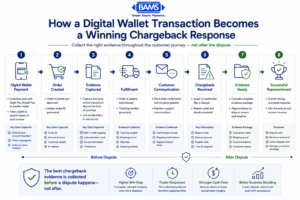
Winning wallet disputes depends on collecting evidence throughout the customer journey—not after a chargeback notification arrives.
Objective: Reduce the time between a dispute filing and your response submission, while ensuring that disputed funds don’t create cash flow gaps that compound the revenue impact.
Chargeback response deadlines are typically 20 to 45 days depending on the card network, but the merchants who win disputes consistently respond within the first week. Speed matters because evidence degrades (logs rotate, customer memory fades, fulfillment records archive), and because tied-up funds during the dispute window directly affect your operating cash.
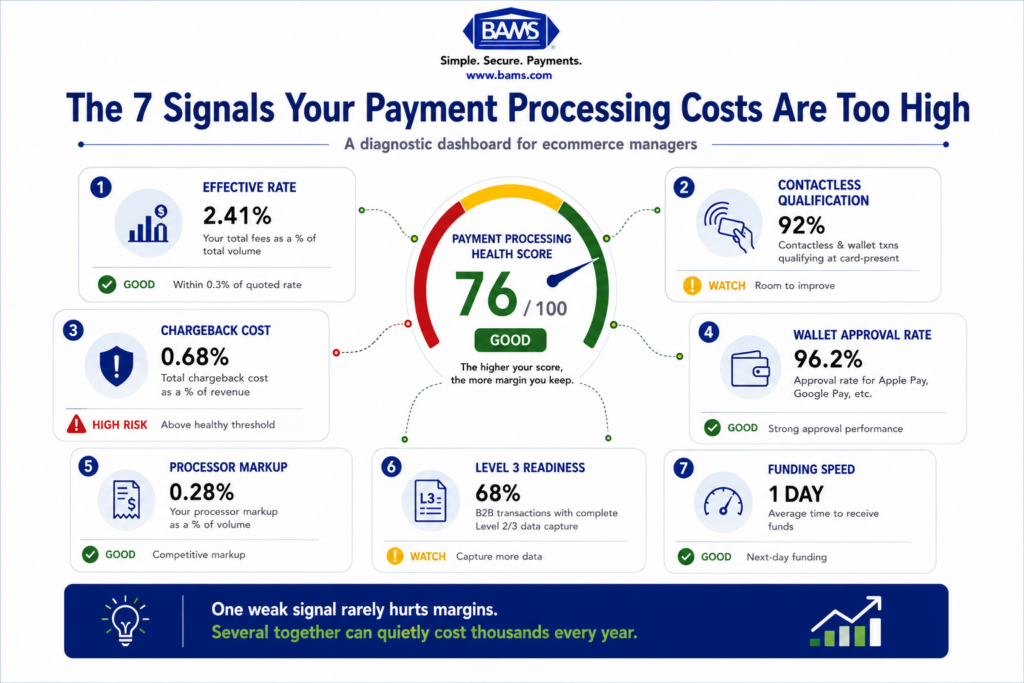
Two operational levers work together here. First, pre-stage your evidence. The templates from Step 2 should be partially populated at the time of transaction, not at the time of dispute. Automate the capture of device data, fulfillment status, and customer communication logs into a dispute-ready format. Second, ensure your funding cycle doesn’t amplify the damage. If your processor holds funds for 48 to 72 hours under normal conditions, a disputed transaction on top of that delay creates a compounding cash gap. BAMS offers next-day funding alongside proactive chargeback defense, which means your non-disputed revenue keeps flowing while you fight the disputed amount. This combination turns what’s usually two separate vendor conversations into a single operational advantage.
Anti-patterns: Don’t treat the chargeback deadline as your target response date. Don’t separate your funding timeline from your dispute strategy; they affect the same cash flow. Don’t assume that a low dispute volume today means you can defer process improvements.
Success indicators: Average dispute response time is under 7 days. You have next-day access to non-disputed funds. Your cash flow projections account for dispute hold periods as a known variable, not a surprise.
Step 4: Map Wallet-Specific Fraud Patterns and Adjust Prevention Rules
Objective: Identify whether your wallet transactions show different dispute or fraud patterns than your traditional card transactions, and tune your prevention rules accordingly.
Wallet transactions carry different risk profiles than card-on-file or manually entered card transactions. Because biometric authentication reduces true fraud (stolen card numbers used by unauthorized parties), the disputes you see from wallet payments tend to skew toward friendly fraud: legitimate customers claiming they didn’t authorize a purchase, didn’t receive an item, or were charged incorrectly. AI is increasingly used in payments primarily for fraud detection, but your fraud tools need wallet-specific data inputs to generate useful signals.
Pull your dispute data for the last 6 to 12 months and segment it by payment method. Look for: dispute rate differences between wallet and non-wallet transactions, the most common reason codes on wallet disputes (unauthorized vs. product/service disputes), average transaction value on disputed wallet payments versus non-disputed ones, and whether specific product categories or customer segments correlate with higher wallet dispute rates.
Use these patterns to adjust your fraud screening thresholds. For example, if wallet disputes cluster around high-value orders from new customers, you might add a secondary verification step (order confirmation email requiring reply, or SMS confirmation) for wallet transactions above a certain dollar amount. If disputes concentrate on specific product categories, tighten your fulfillment documentation for those items.
Anti-patterns: Don’t apply the same fraud rules to wallet and non-wallet transactions without testing whether the patterns differ. Don’t ignore friendly fraud because it feels less urgent than true fraud. Don’t over-tighten rules to the point of declining legitimate wallet transactions, which damages conversion rates.
Success indicators: You have segmented dispute data by payment method. Your fraud rules include at least one wallet-specific threshold or trigger. Your dispute rate trend for wallet transactions is stable or declining quarter over quarter.
Step 5: Establish a Wallet Transaction Review Cadence
Objective: Create a recurring review process that catches emerging issues before they become systemic revenue leaks.
Wallet payment adoption is still growing. Mobile wallet payments increased by around 105% from 2019 to 2024, and the trajectory continues upward. That means the patterns you identify today will shift as your wallet transaction volume grows and as wallet providers update their authentication and tokenization protocols. A one-time audit isn’t sufficient.
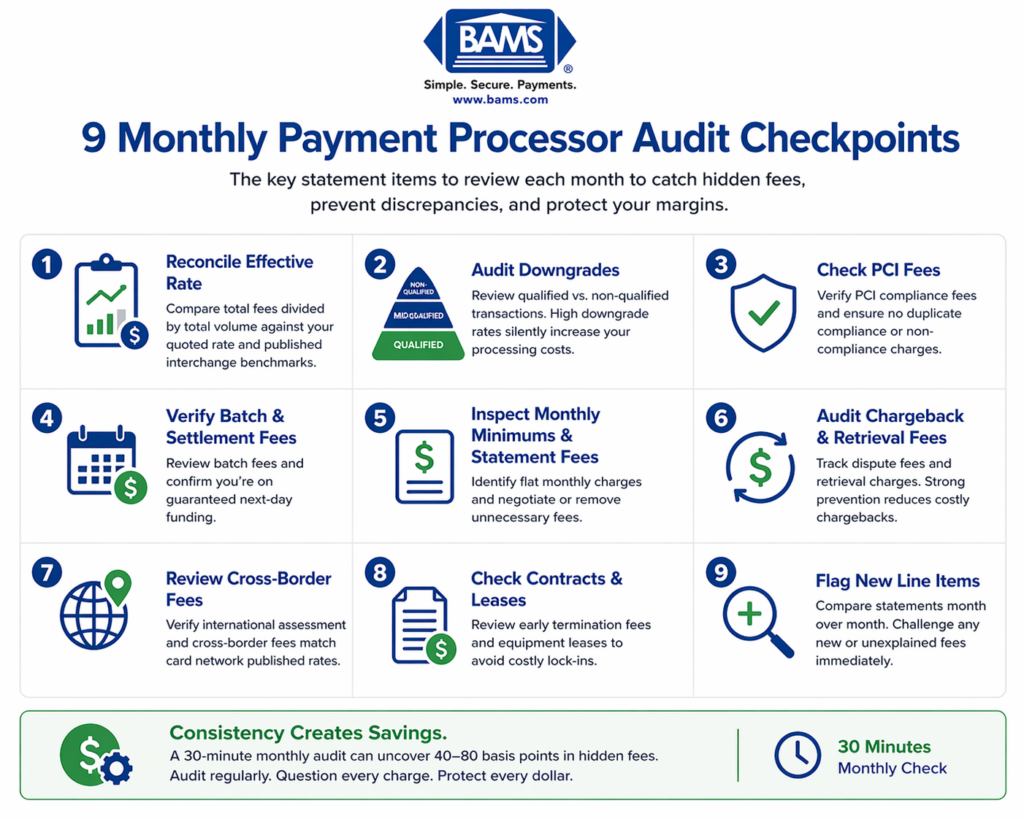
Set a monthly review (or bi-weekly if your transaction volume is high) that covers: wallet transaction volume as a percentage of total transactions, dispute rate by payment method, average response time on wallet-specific disputes, win/loss ratio on wallet disputes compared to overall disputes, and any new wallet types appearing in your transaction logs (Samsung Pay, PayPal wallet, etc.). Assign ownership of this review to a specific team member. If you work with a dedicated account manager at your payment processor, include them in the review. This is where having a merchant services partner that understands wallet-specific challenges makes a measurable difference.
Anti-patterns: Don’t treat this as a set-and-forget process. Don’t aggregate wallet data into your general payment metrics without a separate breakout. Don’t skip the review during low-dispute months; that’s when you have bandwidth to improve processes proactively.
Success indicators: You have a documented review schedule with a named owner. Wallet-specific metrics are tracked in a dashboard or spreadsheet that’s updated on cadence. Trends are identified and acted on within one review cycle.
Practical Examples: What This Looks Like in Action
Scenario A: The Apparel Brand with Rising Apple Pay Disputes
A mid-size online apparel retailer noticed that their chargeback rate had climbed 0.3% over two quarters. When they segmented by payment method, they discovered that Apple Pay transactions accounted for 40% of their disputes despite being only 25% of total volume. The reason codes were overwhelmingly “product not as described” and “merchandise not received.”
Their fix was operational, not technical. They added photo-on-delivery confirmation for orders over $75, included a direct customer service link in their Apple Pay order confirmation emails, and rebuilt their dispute response template to include device authentication data from their gateway. Within three months, their wallet-specific dispute rate dropped by half, and their overall chargeback rate returned to its previous baseline.
Scenario B: The Subscription Service with Tokenization Confusion
A subscription-based eCommerce business selling specialty food products found that recurring charges through Google Pay were generating “unrecognized transaction” disputes. The root cause: the DAN on the customer’s bank statement didn’t match anything the customer recognized, and the merchant descriptor was truncated differently for wallet transactions than for direct card charges.
They worked with their processor to standardize their merchant descriptor across all payment methods and added a pre-charge notification email for each renewal. They also updated their dispute evidence template to include the subscription agreement, renewal notification timestamp, and prior successful charges under the same DAN. Their dispute win rate on subscription renewals went from 35% to 72%.
Common Mistakes and Pitfalls
The most predictable failure is treating wallet payments as “just another card transaction.” They aren’t. The data is different, the evidence requirements are different, and the dispute patterns are different. Merchants who don’t segment their data by payment method will miss trends until they become costly.
A second common mistake is over-investing in fraud prevention technology while under-investing in dispute response processes. Prevention tools reduce true fraud, but they don’t eliminate friendly fraud, which is the dominant dispute type for wallet transactions. You need both.
Third, many merchants delay operational changes because their current dispute volume feels manageable. But wallet transaction value is projected to rise from $7.5 trillion in 2022 to $12 trillion in 2026. As your wallet volume grows, so will your exposure. Building the process now, while volumes are lower, is significantly easier than retrofitting under pressure.
What to Do Next
Start with Step 1. Pull a sample of your last 30 days of transactions and check whether you can identify which ones came through a digital wallet. If you can’t, that’s your first gap to close. If you can, move to Step 2 and assess whether your dispute response templates account for tokenized payment data.
You don’t need to overhaul everything at once. Each step in this framework produces a standalone improvement. But the compounding effect of all five steps, working together over time, is what turns wallet adoption from a revenue risk into a revenue advantage. Revisit this guide quarterly as your wallet transaction mix evolves, and use it as a reference point for conversations with your payment processor about what data and support you need.
Frequently Asked Questions
What is Apple Pay and how does it work for online merchants?
Apple Pay is a digital wallet that lets customers pay using tokenized card credentials stored on their Apple device. Instead of transmitting the actual card number, Apple Pay generates a Device Account Number (DAN) unique to the device and merchant. For online merchants, this means the transaction is authenticated via biometric verification (Face ID or Touch ID) on the customer’s device, and the tokenized payment data flows through your payment gateway. The key difference from traditional card payments is that the card number your processor records won’t match the customer’s actual card number, which affects how you document and defend disputes.
Why do chargebacks still happen with biometric-authenticated wallet payments?
Biometric authentication confirms that the person holding the device is its registered owner. It does not confirm purchase intent, product satisfaction, or that the cardholder won’t later dispute the charge. Friendly fraud (where the legitimate cardholder files a dispute despite having authorized the transaction) is the most common dispute type for wallet payments. Customers may not recognize the charge on their statement, may claim non-receipt of goods, or may dispute product quality. The biometric step protects against unauthorized device use but doesn’t prevent these dispute categories.
How does tokenization affect my ability to fight chargebacks?
Tokenization replaces the real card number with a Device Account Number in your transaction records. When a chargeback arrives, your standard evidence package (which typically references the last four digits of the card) may not match what the issuing bank has on file. You need to include the DAN, device authentication data, and correlated order information in your dispute response. Without these wallet-specific data points, your evidence package may be incomplete, reducing your win rate on disputes from wallet transactions.
Which fraud patterns are most common with digital wallet transactions?
True fraud (stolen credentials used by unauthorized parties) is less common with wallet transactions because of biometric authentication barriers. The dominant pattern is friendly fraud: legitimate cardholders disputing charges they actually authorized. Common reason codes include “transaction not recognized,” “product not as described,” and “merchandise not received.” These disputes often cluster around higher-value orders, subscription renewals, and transactions where the merchant descriptor appears differently for wallet payments than for traditional card charges.
When should my business start accepting digital wallets like Apple Pay?
If you sell online, the answer is likely now. Digital wallets account for 77% of online payments globally, and not offering them creates friction that reduces conversion. The operational question isn’t whether to accept wallets but whether your dispute and documentation processes are ready for the shift. Accept wallets to meet customer expectations, but simultaneously update your evidence templates, data capture, and review cadence to protect your revenue from the dispute patterns that wallet transactions generate.
How can I tell if my processor gives me enough data to defend wallet disputes?
Run a simple test: pull a recent wallet transaction from your processor dashboard and check whether it shows the payment method (Apple Pay, Google Pay, etc.), the Device Account Number, and any device authentication signals. Then check whether your order management system links that same transaction to the customer profile, fulfillment record, and communication history. If either system has gaps, you have a visibility problem that will weaken your dispute responses. Raise this with your processor or merchant services partner and ask specifically about wallet-type data fields available through their reporting tools.