
Settlement Timing: The Growth Lever You Keep Ignoring
Last Updated on October 14, 2026 by Dimitri Akhrin
Why the gap between your dashboard revenue and your bank balance is silently throttling reinvestment speed
Learn why settlement timing is a strategic growth variable, not a back-office detail. This piece reveals how unpredictable deposit windows create compounding drag on restocking, ad spend, and reinvestment velocity.
TL;DR
- Your dashboard and bank balance disagree because of settlement timing – The gap between gross sales and net deposits contains processor fees, refund deductions, chargeback holds, and variable settlement windows that most eCommerce operators overlook.
- Settlement timing is a growth lever, not an accounting detail – Every day your revenue sits in transit is a day you can’t reinvest in inventory, ads, or operations. Predictable next-day funding can unlock tens of thousands in additional working capital at any given moment.
- Processor selection should prioritize funding speed, not just rates – A slightly lower interchange rate means nothing if slower deposits force you onto credit lines or cause you to miss supplier windows.
- Daily reconciliation is a decision-making tool, not a bookkeeping chore – Knowing exactly where your money is each morning lets you commit to growth spending with confidence instead of guesswork.
The Number You Trust Is Lying to You
Your dashboard says you made $47,000 yesterday. Your bank account says otherwise. The gap between those two numbers isn’t a rounding error. It’s a symptom of something most eCommerce operators treat as background noise: settlement timing. And that background noise is costing you more than you think.
Every day your revenue sits in transit, it’s revenue you can’t spend. You can’t restock with it. You can’t fund your next ad campaign with it. It just sits there, technically yours but practically useless, while your business waits.
The “It’ll Sort Itself Out” School of Cash Flow
Here’s the conventional wisdom: deposit timing is an accounting detail. It’s something your bookkeeper handles. The money always shows up eventually, so why stress about a day or two of lag?
That logic made sense when eCommerce was simpler. When you ran one payment processor, had predictable order volumes, and didn’t need to make daily reinvestment decisions. But today, most established online businesses are running multiple payment methods, processing refunds and chargebacks in real time, and making inventory commitments based on yesterday’s revenue.
The “it sorts itself out” approach breaks down the moment your business depends on when money arrives, not just whether it arrives. And for growing eCommerce operations, that moment arrived a long time ago.
Settlement Timing Is a Growth Lever, Not a Ledger Line
Here’s what we actually believe: the speed at which your deposits land isn’t a back-office detail. It’s the single variable that determines how fast your business can compound.
Every day of deposit delay is a day of deferred growth. Not in theory. In practice.

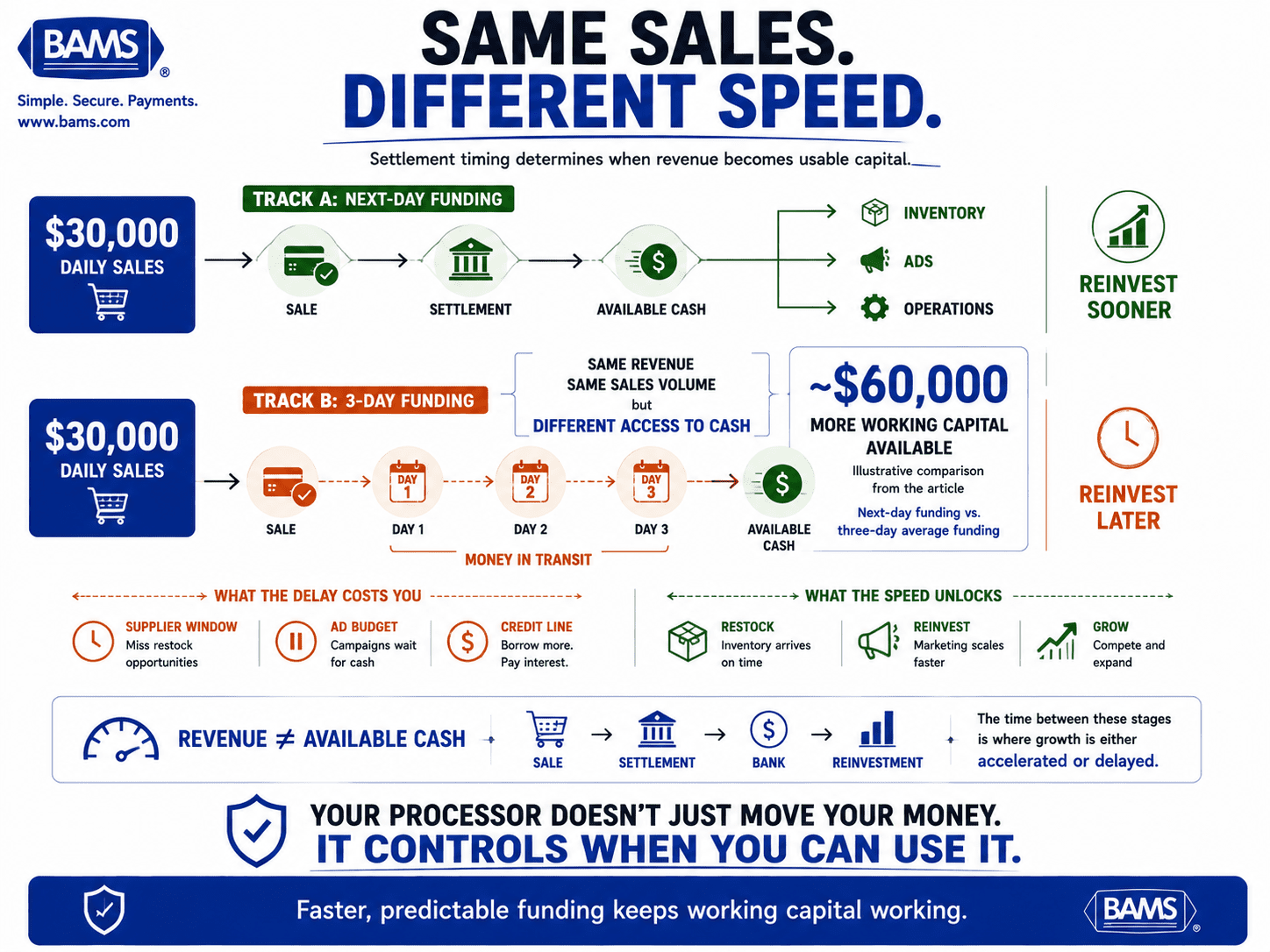
Two businesses can generate the same revenue and still have very different amounts of cash available to reinvest. Settlement speed determines when yesterday’s sales become usable working capital.
The Compounding Drag Nobody Talks About
Think about what happens inside a typical eCommerce operation when settlement timing is unpredictable.
You sell $12,000 worth of product on Monday. Your processor batches that evening. The exact funding timeline depends on your processor, bank and merchant agreement. If merchant deposits are sent through ACH, Nacha notes that ACH payments can settle within hours on the same banking day or on the following banking day, while weekends and federal holidays can affect settlement timing.
Meanwhile, your supplier needs a deposit by Wednesday to hold your next shipment. Your ad spend is pulling from the same operating account. And you’re staring at a dashboard that says you’re profitable while your bank balance says you can’t cover payroll without dipping into a credit line.
This isn’t a cash flow “problem” in the traditional sense. Your revenue is real. Your margins are healthy. The issue is purely temporal. But temporal issues have real costs: interest on credit lines, missed supplier discounts, delayed restocks that cost you sales velocity.
The reinvestment math
Consider two identical businesses doing $30,000 per day in revenue. Business A gets next-day funding. Business B waits three days on average. Over a month, Business A has access to roughly $60,000 more in working capital at any given moment. That’s not a rounding error. That’s an entire product launch, a month of ad spend, or the difference between hitting a seasonal window and missing it.
Speed matters, but predictability matters just as much. Knowing when funds will become available gives you more control over working capital and makes it easier to plan the next inventory purchase, advertising commitment or operating expense.
When you know exactly when your deposits will land, you can plan inventory purchases with confidence. You can commit to ad budgets without a buffer. You can negotiate supplier terms from a position of liquidity rather than anxiety. That predictability is what turns timing gaps from a cash flow problem into a competitive advantage.
Why your dashboard and bank balance disagree
The mismatch between your dashboard and your bank isn’t a bug. It’s a feature of how payment processing works. Your dashboard shows gross sales in real time. Your bank reflects net deposits after processor fees, refund deductions, chargeback holds, and settlement windows.
The gap between those two numbers contains several distinct variables: processor fees, timing variances between batch settlement and bank posting, refund activity and reserve or holdback arrangements. OCC guidance recognizes merchant reserves and holdbacks as risk-management tools and notes that settlement timing can vary across the merchant-processing flow.
Reconciliation gives you a structured way to explain that gap. Modern Treasury describes account reconciliation as resolving the variance between an internal ledger balance and a balance reported by a bank or vendor. Waiting until month-end means you may already have made spending decisions using incomplete information. The more useful daily question is not just “do my numbers match?” but “which funds are actually available to use today?”
This is where merchant services optimization becomes strategic, not administrative. Tools like BAMS, which offers next-day funding and transparent fee structures, eliminate the guesswork by compressing that gap between dashboard revenue and bank-available cash. When your deposits land predictably the next business day, the reconciliation problem largely solves itself.
What Changes When You Stop Tolerating the Lag
Settlement timing sits between making the sale and putting that revenue back to work. The shorter and more predictable that window becomes, the easier it is to plan inventory, advertising and operating expenses.
If deposit predictability is truly a growth lever, then several things follow.
First, your choice of payment processor is no longer just about rates. A processor that saves you 0.1% on interchange but delays funding by two extra days might actually be costing you more in deferred reinvestment and credit line interest than the rate difference saves.
Second, your payment gateway’s transparency becomes a strategic asset. If you can’t see exactly when a batch settles, what fees were deducted, and why a deposit was held, you’re flying blind on the most important number in your business: available cash.
Third, daily reconciliation stops being optional. Not as an accounting exercise, but as a decision-making input. The businesses that grow fastest are the ones that know, every morning, exactly where their money is and when it’s arriving.
A Better Way to Think About Your Money in Transit
Stop thinking of settlement timing as “how long until I get paid.” Start thinking of it as the cost of your money sitting in someone else’s account.
Every dollar in transit is a dollar earning zero return for your business. It’s not invested in inventory. It’s not funding customer acquisition. It’s not earning interest. It’s just… waiting. And waiting has a compounding cost that grows with your revenue.
The mental model shift is simple: your payment processor isn’t just a pipe that moves money. It’s a partner that either accelerates or decelerates your ability to reinvest. Choose accordingly.
Your Dashboard Isn’t Wrong. Your Timing Is.
The number on your dashboard is accurate. The number in your bank is accurate. The problem was never accuracy. It was always timing. And timing, unlike transaction fees or interchange rates, is something you can solve completely by choosing the right settlement structure.
The businesses that figure this out don’t just reconcile better. They grow faster. Because they stopped treating their deposits as an accounting problem and started treating them as the growth capital they actually are.
Frequently Asked Questions
What is deposit reconciliation in merchant services?
Deposit reconciliation is the process of matching your payment processor’s reported transactions against the actual deposits in your bank account. It helps you identify timing variances, fee deductions, and exceptions like chargebacks or holds that explain the gap between dashboard revenue and bank-available cash.
Which factors can affect the timing of merchant service deposits?
Key factors include your processor’s batch settlement schedule, weekends and bank holidays, reserve holds, chargeback deductions, and whether your merchant agreement includes next-day or multi-day funding terms. Transaction testing procedures can help you predict these variables before they cause surprises.
How can I optimize my merchant services for better reconciliation?
Choose a processor with next-day funding and transparent fee deduction, then build a daily reconciliation habit that tracks timing variances separately from genuine exceptions. This turns reconciliation from a monthly headache into a daily decision-making tool.


