Apple Pay Fraud: A Chargeback Defense Guide
Last Updated on September 10, 2026 by Dimitri Akhrin
How tokenized transactions create hidden liability gaps that cost merchants revenue at the dispute level
Learn how Apple Pay tokenization obscures the evidence trail you need to win chargeback disputes. This guide maps specific blind spots in merchant liability, shifted dispute windows, and operational fixes for ecommerce teams without payments engineering resources.
TL;DR
- Tokenization protects card data, not your revenue – Apple Pay’s Device Account Numbers and biometric authentication reduce card theft but do not eliminate chargebacks or guarantee liability shift to the issuer.
- Liability shift is conditional – It depends on authentication method, SCA exemption requests, card network rules, and region. Many merchants unknowingly retain liability on transactions they assumed were protected.
- Your dispute process needs a mobile wallet version – Standard card-not-present evidence (AVS, CVV, card number matching) doesn’t apply to tokenized transactions. Build a template around DANs, cryptograms, and authentication method data.
- Fraud screening must account for provisioning attacks – Criminals can authenticate with their own biometrics on stolen cards provisioned to their devices. Add shipping address velocity checks and new-account flags independent of payment authentication.
- Segment your chargeback monitoring by payment method – As mobile wallet volume grows, a stable overall chargeback ratio can mask a dangerous trend in your fastest-growing channel. Track and alert on mobile wallet chargebacks separately.
Guide Orientation: What This Covers and Who It’s For
This guide addresses a specific, growing problem: Apple Pay fraud chargebacks that catch eCommerce merchants off guard because tokenized transactions obscure the evidence trail needed to win disputes. It is written for eCommerce managers at established online businesses (roughly 10 to 50 employees) who already accept mobile wallet payments but haven’t yet adapted their chargeback defense workflow to account for how tokenization changes the data they receive, the liability rules that apply, and the dispute windows they must meet.
By the end, you’ll understand exactly where tokenization creates blind spots in your chargeback rates, how merchant liability shifts depending on authentication and exemption handling, and what operational steps protect your revenue without requiring a payments engineering team. This guide does not cover the technical architecture of tokenization in depth or enterprise-level fraud modeling. It focuses on the practical consequences you experience at the transaction and dispute level.
Why Protecting Revenue from Mobile Wallet Chargebacks Matters Now
Mobile wallet adoption is no longer an emerging trend. It is a default payment method for a growing share of online buyers, particularly younger demographics who expect Apple Pay, Google Pay, and similar options at checkout. As volume through these channels grows, so does your exposure to a category of chargebacks that behaves differently from traditional card-not-present disputes.
The core issue is a perception gap. Tokenization is marketed (accurately) as more secure than raw card numbers. Apple reports it prevented more than $7 billion in potentially fraudulent transactions between 2020 and 2023. That security is real. But “more secure” does not mean “no chargebacks,” and it definitely does not mean “the issuer always absorbs the loss.”
When a chargeback lands on a tokenized transaction, many merchants discover for the first time that their transaction records contain a Device Account Number (DAN) instead of the actual card number, that their fraud-screening tools may not have flagged the transaction because biometric authentication appeared to validate it, and that the evidence package they normally assemble for disputes is missing key data points. The cost of learning this after the fact is measured in lost revenue, higher chargeback ratios, and potentially elevated processing fees.
The window to respond is tight. Most card networks give you 20 to 45 days to submit a representment. If you spend the first week figuring out why your transaction data looks different, you’ve already lost ground. This guide works backward from that moment to help you build defenses before the chargeback arrives.
Core Concepts: What Tokenization Actually Changes for Your Dispute Process
Device Account Numbers vs. Real Card Numbers
When a customer pays with Apple Pay, the transaction does not use their actual card number (the FPAN, or Funding Primary Account Number). Instead, Apple generates a Device Account Number (DAN), sometimes called a DPAN, which is unique to that device and that card. This means your payment processor receives and stores a token, not the real card number.
For fraud prevention, this is genuinely valuable. If your system is breached, attackers get tokens that are useless elsewhere. But for chargeback defense, it creates a problem: you cannot easily cross-reference the DAN against other transactions from the same cardholder, and your historical fraud data may not connect to the token the way it connects to a traditional card number.
Liability Shift Is Conditional, Not Automatic
A common misconception is that Apple Pay transactions automatically shift fraud liability to the card issuer. In practice, liability shift depends on whether strong customer authentication (SCA) was performed and whether the merchant requested any exemptions. As our merchant liability guide for Apple Pay explains, when Apple Pay payments pass biometric authentication (Face ID, Touch ID, or device passcode), liability typically shifts to the issuer. But if you request an SCA exemption (for low-value transactions, for example), liability can remain with you.
The “Safe Transaction” Blind Spot

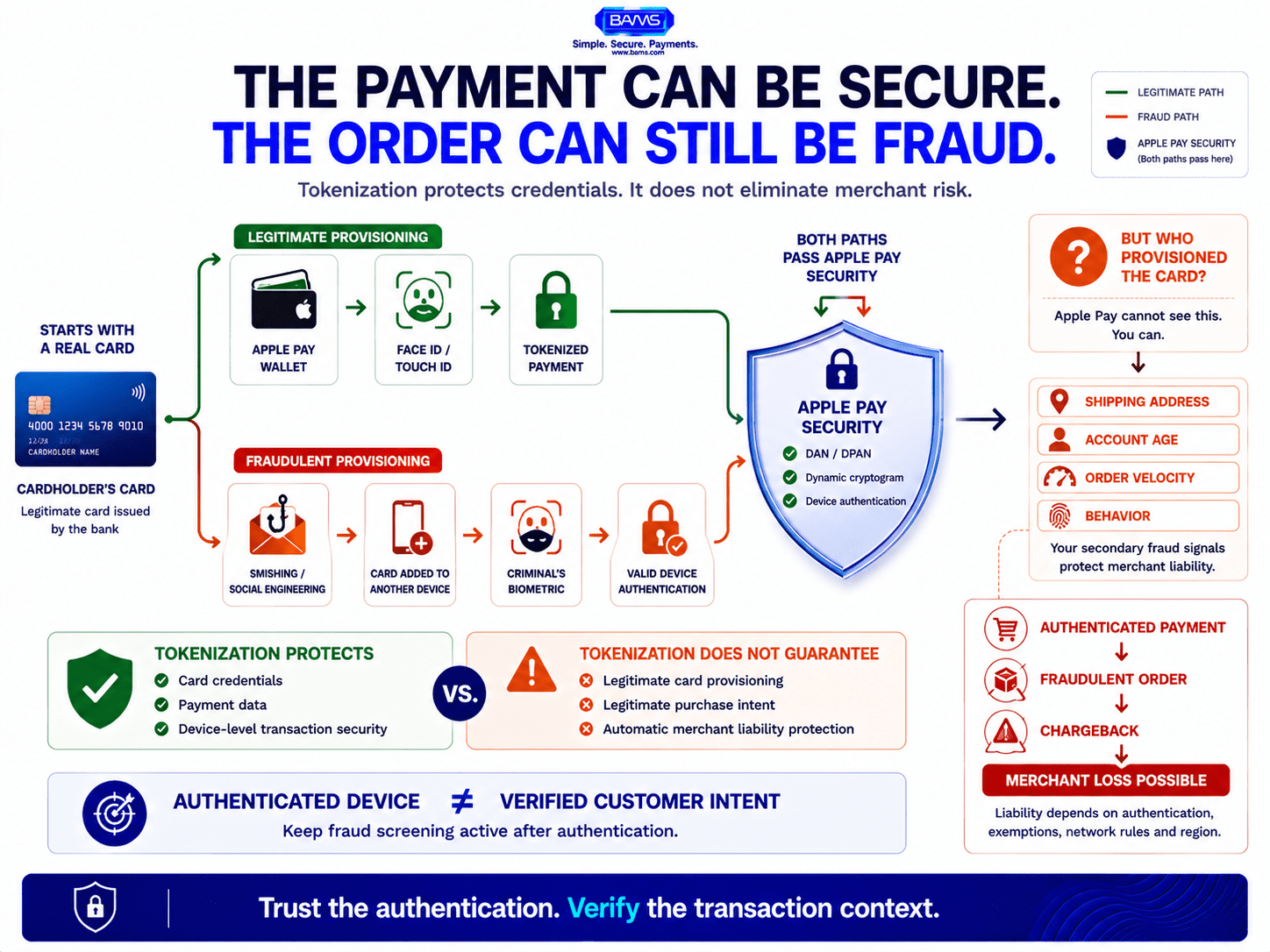
Apple Pay can strongly authenticate the device making a payment without proving that the person who provisioned the card was its legitimate owner.
Because tokenized, biometrically authenticated transactions appear highly secure, many fraud-screening tools assign them lower risk scores. This means legitimate-looking fraudulent transactions (such as those originating from compromised cards provisioned to attacker-controlled devices through smishing campaigns) can pass through your defenses undetected. The fraud is real; the authentication just happened on the wrong person’s device.
The Framework: Working Backward from the Chargeback
Most guides on payment security start with architecture and work forward toward outcomes. This guide reverses that sequence. We start with the worst-case scenario (a chargeback you can’t win) and work backward through five operational stages to identify where your defenses need reinforcement.
The five stages are:
- Stage 1: Dispute Response Readiness (ensuring you can respond with the right evidence, fast)
- Stage 2: Transaction Data Capture (collecting the specific data points tokenized transactions require)
- Stage 3: Fraud Signal Calibration (adjusting your screening to account for mobile wallet behavior)
- Stage 4: Liability Routing Awareness (knowing which transactions shift liability and which don’t)
- Stage 5: Volume Monitoring and Threshold Management (keeping chargeback ratios below network thresholds as mobile wallet volume grows)
Each stage feeds the one before it. Better monitoring (Stage 5) informs your liability awareness (Stage 4), which sharpens your fraud signals (Stage 3), which improves your data capture (Stage 2), which makes your dispute responses (Stage 1) faster and more effective.
Step-by-Step Breakdown: Protecting Revenue Across Five Operational Stages
Stage 1: Build Your Dispute Response Before You Need It
Tokenized transactions change the evidence trail. A chargeback workflow built around card numbers, CVV and AVS alone can leave important Apple Pay authentication data out of the representment package.
Objective: Assemble a chargeback response template specifically for tokenized mobile wallet transactions so you can submit representment within days, not weeks.
The single biggest reason merchants lose Apple Pay chargebacks is not that the case is unwinnable. It’s that they run out of time assembling evidence that looks different from what they’re used to. A traditional card-not-present dispute response relies on matching the card number to AVS data, CVV verification, and order details. With tokenized transactions, the card number in your system is a DAN, AVS may not apply the same way, and CVV is replaced by a dynamic cryptogram.
Execution guidance: Create a dispute response template that includes the DAN, the transaction cryptogram, device authentication method (Face ID, Touch ID, passcode), IP address, shipping address, delivery confirmation, and any customer communication. Store this template in your chargeback management workflow so any team member can populate it quickly. Our Apple Pay chargeback defense guide walks through the four-phase dispute process in detail.
Anti-patterns: Do not use your standard card-not-present dispute template without modification. Submitting a response that references a card number your processor doesn’t recognize (because it’s a DAN) signals to the issuer that you don’t understand the transaction, which weakens your case. Do not wait for a chargeback to arrive before figuring out what data you need.
Success indicators: You can assemble a complete representment package for a tokenized transaction within 48 hours of receiving a chargeback notification. Your win rate on mobile wallet disputes is within 10 percentage points of your overall dispute win rate.
Stage 2: Capture the Right Data at the Point of Transaction
Objective: Ensure your payment system records and retains the specific data fields that tokenized transaction disputes require.
Many eCommerce platforms log transaction data in a way that was designed for traditional card payments. When a mobile wallet transaction comes through, certain fields may be blank, truncated, or populated with token-specific values that your team doesn’t recognize. The gap between what your system captures and what you need for a dispute is where revenue leaks.
Execution guidance: Work with your payment processor to confirm that your transaction logs capture the Device Account Number (distinct from the FPAN), the payment network’s transaction identifier, the authentication method used, and the cryptogram. Verify that your order management system links these payment-level details to order-level details (shipping address, customer account history, fulfillment status). If your processor provides webhook or API data for each transaction, ensure the mobile wallet fields are being stored, not discarded.
This is an area where your payment processor’s capabilities matter significantly. BAMS provides dedicated account management that can help you audit your transaction data capture and identify gaps specific to mobile wallet payments before they become chargeback losses.
Anti-patterns: Do not assume that because your checkout page accepts Apple Pay, your backend automatically captures all the data you need. Many integrations pass the minimum required fields for authorization but omit fields useful for disputes. Do not store only the last four digits of the DAN; store the full token as permitted by PCI guidelines.
Success indicators: For any mobile wallet transaction in the past 90 days, you can pull the DAN, authentication method, cryptogram, and linked order details within 15 minutes.
Stage 3: Recalibrate Fraud Signals for Mobile Wallet Behavior
Objective: Adjust your fraud detection rules so that biometric authentication doesn’t automatically suppress risk scoring for transactions that warrant review.
This is the most counterintuitive stage. Apple Pay’s biometric authentication is strong, and it does reduce fraud. Apple reports preventing over $9 billion in fraudulent transactions over the last five years. But criminals have adapted. Smishing campaigns and social engineering attacks trick cardholders into provisioning their card onto a criminal’s device. Once provisioned, the criminal authenticates with their own biometrics. The transaction looks perfectly legitimate to your fraud tools.
Execution guidance: Add secondary fraud signals that are independent of the payment authentication method. These include: shipping address mismatches with billing address, new customer accounts placing high-value first orders, multiple orders to the same address from different Apple Pay tokens, and velocity checks on shipping addresses (not just card numbers, since each compromised card produces a unique DAN). Review your fraud rules quarterly to ensure mobile wallet transactions aren’t being auto-approved at rates significantly higher than traditional card transactions.
Anti-patterns: Do not treat biometric authentication as a guarantee of legitimate intent. Do not disable manual review queues for Apple Pay transactions. Do not rely solely on card-number-based velocity checks, since tokenization means each device generates a unique number even for the same underlying card.
Success indicators: Your manual review rate for mobile wallet transactions is proportional to their share of total volume. You can identify and flag provisioning-based fraud patterns (same shipping address, different DANs) within your existing tools.
Stage 4: Map Your Liability Exposure by Transaction Type
Objective: Know, for each category of mobile wallet transaction you process, whether liability sits with you or the issuer, and act accordingly.
Liability shift is not binary. It varies by card network, by region, by authentication method, and by whether you requested an exemption. Visa, for instance, has historically limited liability shift for Apple Pay on certain older iOS versions. Mastercard handles it differently. If you process international transactions, the rules vary again.
Execution guidance: Build a simple reference matrix that maps your transaction categories against liability outcomes. The columns should be: payment method (Apple Pay, Google Pay, traditional CNP), authentication type (biometric, passcode, SCA exemption requested), card network (Visa, Mastercard, Amex), and liability holder (issuer or merchant). Populate this matrix by reviewing your processor’s documentation and, if needed, asking your account manager directly. For transactions where liability remains with you, apply stricter fraud screening and ensure your data capture is complete.
Understanding how interchange fees interact with Apple Pay transaction categories is also important here, since transactions that don’t qualify for liability shift often also incur interchange downgrades, compounding your cost exposure.
Anti-patterns: Do not assume all Apple Pay transactions carry liability shift. Do not ignore SCA exemption requests in your checkout flow. If your platform automatically requests low-value exemptions, understand that you are accepting liability for those transactions. Do not treat liability shift as a reason to skip fraud screening entirely.
Success indicators: You can identify, for any given transaction, whether liability shifted to the issuer or remained with you. Your team knows which transaction categories carry the highest merchant liability exposure and applies appropriate controls.
Stage 5: Monitor Volume and Chargeback Ratios as Mobile Wallet Share Grows
Objective: Prevent your overall chargeback ratio from breaching card network thresholds as mobile wallet transaction volume increases.
Here’s the math that catches merchants off guard. If mobile wallet transactions represent 15% of your volume today and grow to 30% over the next year, and if those transactions carry a chargeback rate even slightly higher than your baseline, your overall ratio rises. Card networks (Visa’s Dispute Monitoring Program, Mastercard’s Excessive Chargeback Program) set thresholds at 0.9% to 1.0%. Breaching those thresholds triggers fines, increased monitoring, and potentially account termination.
Execution guidance: Segment your chargeback reporting by payment method. Track mobile wallet chargeback rates separately from traditional card-not-present rates. Set internal alert thresholds at 0.65% (well below network thresholds) so you have time to respond. If mobile wallet chargebacks are trending upward, investigate whether the cause is fraud (Stage 3), data capture gaps (Stage 2), or liability misunderstanding (Stage 4). BAMS offers proactive chargeback defense that includes this kind of segmented monitoring, alerting you to ratio trends before they become network violations.
Anti-patterns: Do not monitor chargeback ratios only at the aggregate level. A healthy overall ratio can mask a dangerous trend in a growing payment channel. Do not wait until you receive a network notification to investigate. By that point, you’re already in a remediation program with associated costs and restrictions.
Success indicators: You have a monthly report that breaks chargeback rates down by payment method. Your mobile wallet chargeback rate is stable or declining. You have never been surprised by a network threshold notification.
Practical Example: How a Tokenized Chargeback Plays Out
Scenario: A Mid-Size Apparel eCommerce Store
An online clothing retailer processing $400,000 per month enables Apple Pay to improve checkout conversion. Within three months, Apple Pay accounts for 22% of transactions. The store’s fraud tools auto-approve most Apple Pay orders because biometric authentication passes. Chargeback rates appear stable.
Then, over a two-week period, the store receives 14 chargebacks on Apple Pay transactions. All are coded as “unauthorized transaction” (reason code 10.4 on Visa). The store’s chargeback team pulls transaction records and finds DANs instead of card numbers, no AVS match data, and no CVV verification (because tokenized transactions use cryptograms instead). Their standard dispute template is useless.
What Went Wrong
- The store’s fraud screening treated biometric authentication as sufficient validation, missing that the cards had been provisioned to fraudulent devices through smishing campaigns that may have compromised between 12.7 million and 115 million US payment cards.
- Transaction logs captured the DAN but not the cryptogram or authentication method, leaving the dispute team without key evidence.
- The team assumed liability had shifted to the issuer on all Apple Pay transactions. In fact, several orders had triggered low-value SCA exemptions, keeping liability with the merchant.
- The 14 chargebacks pushed the store’s monthly ratio from 0.7% to 1.1%, triggering a Visa Dispute Monitoring Program notification.
What the Fix Looked Like
The store implemented the five-stage framework above. They built a mobile-wallet-specific dispute template (Stage 1), audited their data capture with their processor (Stage 2), added shipping-address velocity checks independent of card number (Stage 3), mapped their liability exposure and disabled automatic SCA exemptions for orders over $50 (Stage 4), and began tracking mobile wallet chargebacks separately (Stage 5). Within 60 days, their mobile wallet chargeback rate dropped below their traditional CNP rate.
Common Mistakes and Pitfalls in Mobile Wallet Chargeback Defense
Treating tokenization as a complete fraud solution. Tokenization protects card data in transit and at rest. It does not validate the identity of the person holding the device. These are different problems, and conflating them leaves you exposed.
Using the same dispute process for all payment types. Mobile wallet chargebacks require different evidence than traditional CNP chargebacks. A one-size-fits-all approach leads to weak representments and lower win rates.
Ignoring the SCA exemption question. If your checkout flow requests exemptions (and many platforms do by default for certain transaction sizes), you may be accepting liability without realizing it. Review your gateway settings.
Monitoring chargebacks only in aggregate. As mobile wallet volume grows, a stable overall ratio can hide a deteriorating trend in your fastest-growing payment channel. Segment your data.
Assuming your processor handles everything. Your payment processor authorizes and settles transactions. Chargeback defense, fraud signal calibration, and liability mapping require merchant-side action. The best processors support you in this work, but they cannot do it for you.
What to Do Next
Start with Stage 2. Pull the transaction record for your most recent Apple Pay chargeback (or any recent Apple Pay transaction) and check what data your system actually captured. Can you find the DAN, the authentication method, and the cryptogram? Can you link those to the order details, shipping confirmation, and customer communication?
If the answer is yes, move to Stage 4 and verify your liability exposure map. If the answer is no, that gap is your first priority. Talk to your payment processor about what fields are available and ensure your system is storing them.
This is not a one-time project. As mobile wallet adoption grows and card networks update their dispute rules, revisit this framework quarterly. Use it as a reference, not a checklist. The merchants who protect their revenue are the ones who treat chargeback defense as an ongoing operational practice, not a reaction to a problem that already happened.
For a deeper look at the dispute process specific to Apple Pay, review our guide on Apple Pay fraud chargebacks and merchant defense. And if you’re evaluating whether your current processor gives you the data and support you need, that’s a conversation worth having sooner rather than later.
Frequently Asked Questions
Does Apple Pay automatically shift fraud liability away from the merchant?
Not always. Liability shift typically applies when strong customer authentication (biometric or passcode) is completed without the merchant requesting an exemption. If your checkout flow requests an SCA exemption (common for low-value orders), liability can remain with you. The rules also vary by card network and region, so you need to verify your specific exposure rather than assuming blanket protection.
Why are Apple Pay chargebacks harder to dispute than traditional card-not-present chargebacks?
Tokenized transactions replace the actual card number with a Device Account Number (DAN) and use a dynamic cryptogram instead of a CVV. This means the evidence you normally rely on for disputes (AVS match, CVV verification, card number cross-referencing) either doesn’t exist or looks different. Without a dispute template built for these data points, your representment package will be incomplete.
Can fraud still occur on Apple Pay if biometric authentication is required?
Yes. The most common method involves criminals tricking cardholders into provisioning their card onto the criminal’s device through smishing or social engineering. Once the card is on the criminal’s phone, the criminal authenticates with their own Face ID or fingerprint. The transaction appears fully authenticated, but the person making the purchase is not the cardholder.
How does Apple Pay fraud affect my chargeback ratio with card networks?
Apple Pay chargebacks count toward your overall chargeback ratio just like any other dispute. As mobile wallet volume grows as a percentage of your total transactions, even a modest chargeback rate on those transactions can push your overall ratio toward or past card network thresholds (typically 0.9% to 1.0%), triggering monitoring programs and potential fines.
What data should I capture on Apple Pay transactions to prepare for potential disputes?
At minimum, capture the full Device Account Number, the transaction cryptogram, the authentication method (Face ID, Touch ID, or passcode), the payment network’s transaction identifier, and link all of these to your order-level data (shipping address, delivery confirmation, customer communication). Confirm with your payment processor that these fields are being passed and stored, not discarded by your integration.
Should I treat Apple Pay transactions differently in my fraud screening?
Yes. Add fraud signals that are independent of the payment authentication method, such as shipping address velocity checks, new-account behavior flags, and billing-to-shipping address mismatches. Do not let biometric authentication automatically suppress risk scores, since the authentication may be legitimate on the wrong person’s device.
Sources
- https://www.apple.com/newsroom/2024/05/app-store-stopped-over-7-billion-usd-in-potentially-fraudulent-transactions/
- https://www.apple.com/newsroom/2025/05/the-app-store-prevented-more-than-9-billion-usd-in-fraudulent-transactions/
- https://www.secalliance.com/blog/the-evolution-of-chinese-smishing-syndicates-and-digital-wallet-fraud


