
Apple Pay Security: A Chargeback Defense Guide
How tokenized transactions create unique evidence gaps and what merchants must do to win disputes
Learn why Apple Pay chargebacks follow different evidence rules than standard card disputes. This guide covers tokenized representment packages, evidence gaps, and settlement strategies for eCommerce managers.
TL;DR
- Tokenization protects the transaction, not the merchant — Apple Pay’s security features prevent fraud at checkout but don’t prevent chargebacks. Dispute defense is a separate, merchant-side problem requiring Apple Pay-specific evidence.
- Apple Pay disputes need different evidence — The Device Account Number, biometric authentication proof, device fingerprint, and IP address are critical fields that standard card dispute templates don’t include. Missing these fields means losing winnable cases.
- Every uncontested dispute slows your deposits — Chargeback ratios directly affect your funding speed. Even small, ignored disputes compound into slower settlement terms, higher reserves, and cash flow disruption across all your transactions.
- Classify before you respond — Different reason codes require different evidence strategies. “Product not received” needs delivery proof; fraud codes need device-level data; friendly fraud needs both plus engagement records. Generic templates lose cases.
- Faster deposits are earned, not requested — A clean chargeback ratio and strong dispute win rate give you leverage to negotiate next-day funding and reduced reserves with your processor. Fix the dispute process first, and deposit speed follows.
Guide Orientation: What This Covers and Who It’s For
This guide addresses a specific post-transaction problem: when customers pay with Apple Pay, the dispute and chargeback process follows different evidence rules than standard card transactions. Most content about Apple Pay security stops at tokenization and biometric authentication. This guide picks up where that conversation ends.
It’s built for eCommerce managers at established online businesses who already accept (or plan to accept) Apple Pay and need to understand how deposit timelines, dispute evidence requirements, and chargeback defense differ for mobile wallet sales. If you manage payment operations for a team of 10 to 50 people, this is your territory.
By the end, you’ll understand why tokenized transactions create unique evidence gaps during disputes, how to assemble Apple Pay-specific representment packages, and what funding and settlement structures you can pursue to eliminate deposit delays. This guide does not cover Apple Pay device setup, consumer-facing features, or NFC hardware configuration.
Why Apple Pay for Business Demands a Post-Transaction Strategy

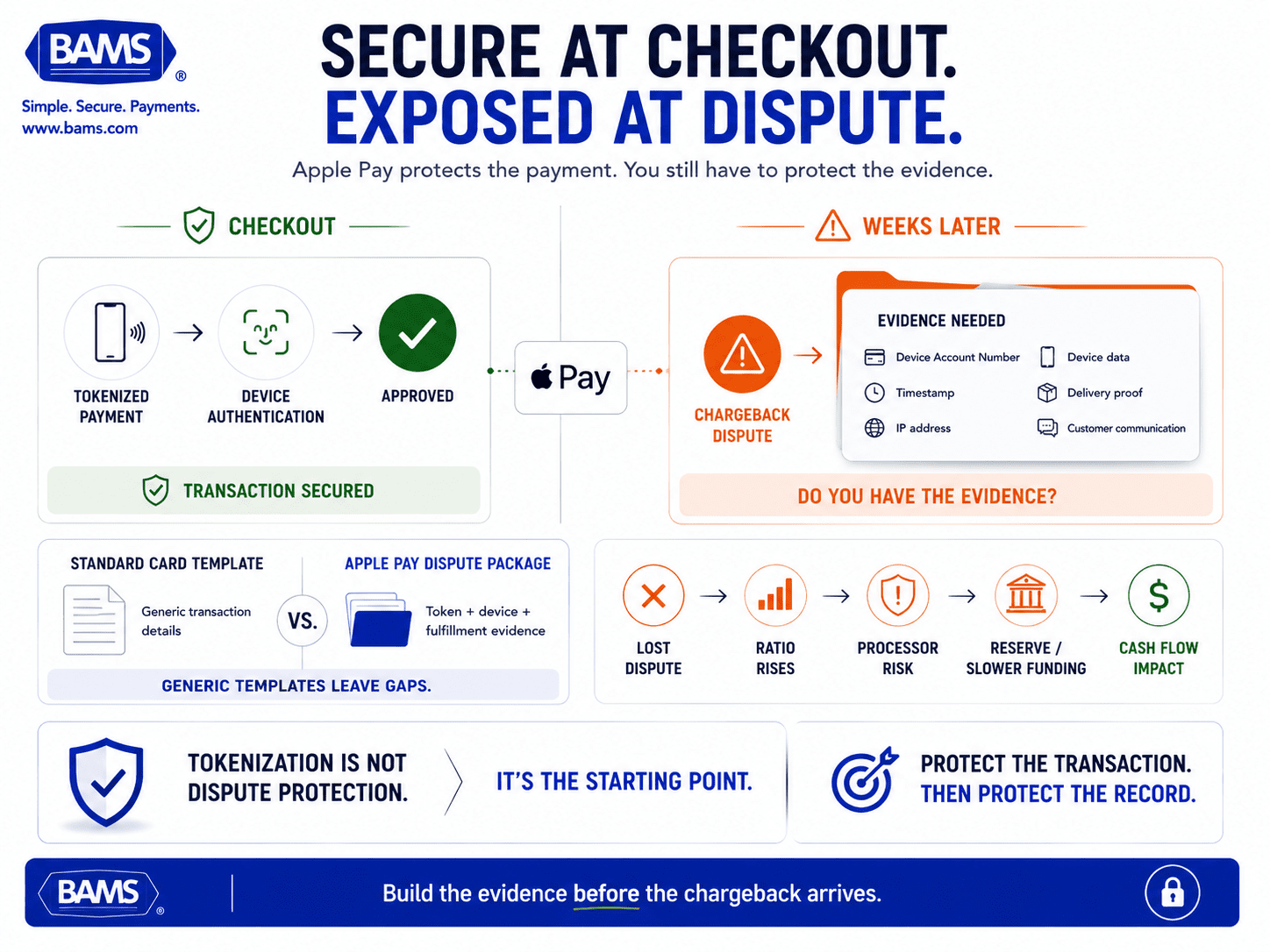
Apple Pay can secure the transaction at checkout, but dispute defense is a separate merchant-side process. The evidence you capture after approval determines whether a later chargeback is defendable.
Apple Pay adoption is accelerating across eCommerce. More customers expect contactless payments and digital wallet checkout options, and merchants who offer them see higher conversion rates and fewer abandoned carts. But the operational reality after the sale tells a different story.
Mastercard estimated that chargebacks cost merchants $117.47 billion in 2023. A meaningful share of those disputes now originate from mobile wallet transactions, where the evidence trail looks fundamentally different from a traditional card swipe or manual entry. Tokenization replaces the card number with a Device Account Number. Biometric authentication replaces a signature or PIN. These security layers protect the consumer and the network, but they don’t automatically protect you.
The cost of inaction is measurable. U.S. merchants faced chargeback volumes estimated at $8 billion to $11 billion in 2023, with projections reaching up to $15 billion by 2026. If your dispute response process treats Apple Pay chargebacks identically to standard card disputes, you’re submitting evidence that doesn’t match what issuers need to see. You lose cases you should win, and every lost dispute compounds into delayed deposits, higher reserve requirements, and degraded processor relationships.
The merchants who get this right don’t just reduce losses. They unlock faster funding, lower effective processing costs, and turn Apple Pay into a cash flow advantage rather than a liability.
Core Concepts: How Tokenized Disputes Differ from Standard Card Disputes
Tokenization Is Not Dispute Protection
Apple has described Apple Pay as extremely secure, and it is, from a transaction-authentication perspective. The card number never touches your server. Biometric verification (Face ID, Touch ID) confirms the cardholder’s identity at the moment of purchase. But when a customer files a dispute weeks later, the issuing bank doesn’t evaluate whether the transaction was authenticated. It evaluates whether the merchant can prove the goods or services were delivered as described.
This is the core misconception: security and dispute defense are separate systems. Tokenization prevents fraud at the point of sale. It does nothing to prevent friendly fraud, buyer’s remorse, or “item not received” claims after fulfillment.
The Device Account Number vs. the Card Number
In a standard card dispute, the merchant references the primary account number (PAN) throughout the evidence package. In an Apple Pay dispute, the transaction is tied to a Device Account Number (DAN), a token unique to the customer’s device. Your payment processor may or may not surface this number clearly in your transaction records. If your evidence package references the wrong identifier, the issuer may reject your representment on a technicality.
Evidence Fields Are Wider, Not Narrower
For Apple Pay dispute triage, merchants should collect the Device Account Number, transaction timestamp, IP address, device fingerprint, shipping address, delivery confirmation, and customer-service history as core evidence fields. This is a broader evidence set than most standard card disputes require, and it demands that your systems capture and retain this data from the moment of checkout.
Deposit Delays Are a Symptom, Not the Root Problem
When chargeback ratios climb, processors respond by holding funds longer. Deposit delays on mobile wallet sales often trace back to unresolved or poorly defended disputes, not to the wallet technology itself. Fix the dispute process, and the deposit timeline improves as a direct consequence.
The Framework: Four Phases of Apple Pay Deposit Optimization

Apple Pay dispute defense works best when evidence capture starts at checkout. Build the transaction record first, then classify the dispute, assemble the right package and use stronger outcomes to support better funding terms.
Eliminating deposit delays on mobile wallet sales requires a system, not a single fix. The framework operates across four phases that build on each other:
- Phase 1: Evidence Architecture — Configure your checkout, fulfillment, and CRM systems to capture Apple Pay-specific dispute data automatically.
- Phase 2: Dispute Triage — Classify incoming chargebacks by reason code and apply the correct evidence strategy for each type.
- Phase 3: Representment Execution — Assemble and submit evidence packages that meet issuer requirements within the response window.
- Phase 4: Funding Optimization — Leverage a clean chargeback ratio to qualify for faster settlement terms, including next-day funding.
Each phase reduces a specific source of friction. Together, they transform Apple Pay from a checkout feature into a predictable revenue channel with minimal deposit lag.
Step-by-Step: Building Your Apple Pay Chargeback Defense and Funding Pipeline
Step 1: Audit Your Transaction Data Capture at Checkout
Objective: Ensure every Apple Pay transaction automatically records the data fields you’ll need if a dispute arrives 30, 60, or 90 days later.
Start by mapping your current checkout flow against the evidence fields issuers require for tokenized disputes. The minimum set includes: Device Account Number, transaction timestamp (with timezone), IP address, device fingerprint, billing and shipping addresses, and order confirmation details. Most payment gateways capture some of these by default, but rarely all of them.
Work with your payment processor and development team to verify that your Apple Pay integration passes the DAN (not just a truncated PAN) into your transaction records. Apple’s merchant token notification system supports this for recurring and deferred transactions, but one-time purchases may require additional configuration depending on your gateway.
Anti-patterns: Don’t assume your processor stores everything you need. Many eCommerce managers discover gaps only after losing a dispute because the Device Account Number wasn’t logged or the IP address wasn’t retained past 30 days. Don’t rely on manual data pulls from multiple dashboards; automate the capture into a single record per transaction.
Success indicators: Pull 10 recent Apple Pay transactions and verify you can locate every required evidence field within two minutes per transaction. If you can’t, your architecture has gaps that will cost you during representment.
Step 2: Classify Disputes by Reason Code Before Responding
Objective: Stop treating all chargebacks the same. Match each dispute to the correct evidence strategy based on its reason code.
Apple Pay merchants should treat disputes differently by reason code: proof of delivery for “product not received” claims, and product-page screenshots plus return-policy evidence for “not as described” claims. Fraud-coded disputes require biometric authentication proof and device-level data. Friendly fraud (where the cardholder made the purchase but claims otherwise) demands a combination of all three evidence categories.
Build a simple triage matrix. When a dispute notification arrives, the first action is classification, not evidence gathering. The reason code determines which evidence fields are mandatory, which are supporting, and which are irrelevant. Submitting irrelevant evidence doesn’t help your case; it clutters the review and signals that you’re using a generic template.
Anti-patterns: Generic dispute templates lose cases. Sending the same boilerplate response for a “product not received” claim and a “fraudulent transaction” claim is the fastest way to lose both. Also avoid waiting until the dispute deadline approaches to begin classification. Merchants are commonly given about 30 days to respond, but effective triage should happen within the first 48 hours.
Success indicators: Your team can classify any incoming Apple Pay dispute into one of three to four response categories within one business day, and each category has a pre-built evidence checklist ready to execute.
Step 3: Assemble Representment Packages in Under 15 Minutes
Objective: Reduce the time and effort required to build a compelling, issuer-ready evidence package for each dispute type.
A merchant defense playbook for Apple Pay disputes recommends assembling order confirmation, shipping tracking, delivery proof, and communication logs in under 15 minutes. This is achievable only if Step 1 (data capture) and Step 2 (triage classification) are already in place.
For each dispute category in your triage matrix, create a response template that specifies exactly which documents to attach, in what order, and with what annotations. For “product not received” disputes, lead with carrier tracking showing delivery to the address on file, followed by the order confirmation email and any post-delivery communication. For fraud-coded disputes on Apple Pay transactions, lead with the biometric authentication confirmation (available through your processor’s transaction detail), the Device Account Number match, and the IP/device fingerprint data.
This is where your choice of merchant services partner matters significantly. Processors that offer proactive chargeback defense, like BAMS, surface dispute alerts early, provide pre-populated evidence fields, and assign dedicated account managers who can review your representment before submission. That support structure is the difference between a 15-minute assembly and a two-hour scramble.
Anti-patterns: Don’t submit evidence without annotations. A tracking number alone doesn’t tell the story; pair it with a brief narrative explaining that the item was delivered to the verified shipping address on the specified date. Don’t omit customer communication logs, even if the customer never responded to your outreach. Showing that you attempted contact strengthens your case.
Success indicators: Your average representment assembly time drops below 15 minutes. Your win rate on Apple Pay disputes exceeds your win rate on standard card disputes (a sign that your evidence is properly tailored to tokenized transaction requirements).
Step 4: Monitor Your Chargeback Ratio as a Funding Lever
Objective: Connect dispute outcomes directly to deposit speed by maintaining a chargeback ratio that qualifies you for preferred settlement terms.
Most processors set funding speed based partly on risk assessment, and your chargeback ratio is a primary input. Visa and Mastercard both monitor merchant chargeback ratios, with thresholds typically around 0.9% to 1.0% of transactions. Exceed that threshold and you face monitoring programs, higher reserves, and slower deposits. Stay well below it and you become eligible for accelerated funding.
Track your Apple Pay chargeback ratio separately from your overall ratio. If mobile wallet disputes are disproportionately high, it signals a gap in your evidence architecture or triage process, not a problem with the payment method itself. Use this metric as a diagnostic tool, not just a compliance checkbox.
Anti-patterns: Don’t ignore chargebacks you consider small or inconsequential. Every uncontested dispute counts toward your ratio, regardless of dollar amount. Don’t assume that winning a dispute removes it from your ratio calculation; timing and reporting windows vary by network. Consult your processor on how won disputes affect your standing.
Success indicators: Your Apple Pay chargeback ratio trends downward over three consecutive months. Your processor confirms eligibility for next-day or same-day funding based on your improved risk profile.
Step 5: Negotiate Settlement Terms Based on Your Track Record
Objective: Convert your improved chargeback defense into concrete deposit speed improvements and lower effective processing costs.
Once your chargeback ratio is consistently below threshold and your dispute win rate demonstrates operational competence, you have leverage. This is the moment to revisit your settlement terms with your processor. Many eCommerce managers don’t realize that deposit timing is negotiable, or that it’s directly tied to the quality of your chargeback management.
Request a formal review of your funding schedule. Present your chargeback ratio trend, your dispute win rate, and your average response time as evidence of low risk. Ask specifically about next-day funding eligibility, reserve reductions, and Apple Pay transaction fee optimization. Processors that serve established eCommerce businesses, including BAMS with its next-day funding structure, often have tiered programs that reward merchants who demonstrate strong dispute management.
If your current processor can’t offer competitive settlement terms despite your improved metrics, that’s a signal to evaluate alternatives. The goal is to turn your Apple Pay acceptance into a cash flow advantage, not just a customer convenience feature.
Anti-patterns: Don’t negotiate settlement terms before you’ve established a track record. Asking for next-day funding while your chargeback ratio is above threshold will be declined and may flag your account for additional scrutiny. Don’t accept vague promises; get specific terms in writing, including the funding timeline, any reserve holdback percentages, and conditions that could trigger a reversion to slower settlement.
Success indicators: You receive written confirmation of improved settlement terms. Your average deposit delay on Apple Pay transactions decreases by at least one business day. Your effective processing cost (fees plus chargeback losses plus reserve opportunity cost) declines quarter over quarter.
Practical Examples: How This Plays Out in Real Scenarios
Scenario A: “Product Not Received” on an Apple Pay Order
A customer purchases a $180 item through your BigCommerce store using Apple Pay at checkout. Three weeks later, they file a “product not received” dispute. Your carrier tracking shows delivery to the address on file, signed by a resident at that address.
With a standard card dispute, you’d submit the tracking number and delivery confirmation. For an Apple Pay dispute, you strengthen the case by also including the Device Account Number from the transaction, the IP address (which geolocates to the same city as the shipping address), and a screenshot of the order confirmation email that was opened (via your email platform’s tracking). This layered evidence addresses both the delivery question and the identity question, which is critical when the issuer knows the transaction was biometrically authenticated but the cardholder still claims non-receipt.
Scenario B: Friendly Fraud on a Digital Product
A customer buys a $95 digital course using Apple Pay. Two months later, they dispute the charge as “unauthorized.” You have no shipping data because the product is digital. In a standard card dispute, this is difficult to win.
With Apple Pay-specific evidence, you submit the biometric authentication confirmation (the customer used Face ID to authorize), the Device Account Number tied to their personal device, login records showing the customer accessed the course content 14 times after purchase, and a screenshot of your terms of service (accepted at checkout) that outlines your refund policy. The biometric proof is uniquely powerful here because it establishes that the device owner, not a thief, authorized the transaction.
Scenario C: The Deposit Delay Cascade
An eCommerce manager notices that Apple Pay deposits are arriving two days later than standard card deposits. Investigation reveals that three uncontested chargebacks in the previous quarter triggered a processor risk review, which automatically shifted the merchant to a slower funding tier. The chargebacks were all under $50 and were ignored as “not worth fighting.” The deposit delay on all subsequent Apple Pay transactions, including hundreds of legitimate sales, cost far more in cash flow disruption than the original $150 in disputed charges.
This is the cascade effect: small, uncontested disputes compound into systemic deposit delays. Defending every dispute, regardless of dollar amount, is a funding strategy as much as a revenue recovery tactic.
Common Mistakes and Pitfalls
- Treating Apple Pay disputes like standard card disputes. The evidence requirements are different. Submitting a generic response package is the most common reason merchants lose winnable cases.
- Ignoring low-dollar disputes. Every uncontested chargeback affects your ratio, and your ratio affects your deposit speed. There is no safe amount to write off.
- Failing to capture the Device Account Number. If your system only logs a truncated PAN, you’re missing the primary transaction identifier for tokenized disputes.
- Waiting until the deadline to respond. Early responses signal operational competence to issuers and give your processor time to review before submission.
- Assuming tokenization prevents chargebacks. It prevents certain types of fraud. It does not prevent disputes, friendly fraud, or buyer’s remorse claims. These are merchant-side problems that require merchant-side solutions.
These mistakes are common because the industry’s contactless payment narrative focuses almost entirely on security and convenience. The post-transaction reality is less glamorous but far more consequential for your bottom line.
What to Do Next
Start with the audit in Step 1. Pull 10 recent Apple Pay transactions from your system and check whether you can locate every evidence field listed in this guide within two minutes per transaction. That single exercise will reveal whether your data architecture is dispute-ready or whether you have gaps that need immediate attention.
If the gaps are significant, prioritize the Device Account Number and IP address capture first. These two fields are the most common missing elements in lost Apple Pay disputes, and they’re the easiest to configure with most modern payment gateways.
From there, build your triage matrix and response templates. You don’t need to overhaul your entire operation at once. One well-defended dispute teaches you more about the process than any amount of planning. Use this guide as a reference each time a new Apple Pay chargeback arrives, refine your templates based on outcomes, and revisit your settlement terms with your processor once your metrics improve.
The goal isn’t perfection. It’s a system that gets incrementally better with each dispute, steadily reducing your chargeback ratio and unlocking the faster deposits your cash flow depends on.
Frequently Asked Questions
Why do Apple Pay chargebacks require different evidence than standard card disputes?
Apple Pay replaces the card number with a Device Account Number (a token unique to the customer’s device) and uses biometric authentication instead of signatures or PINs. When a dispute occurs, the issuing bank evaluates evidence tied to these tokenized identifiers. Submitting a standard PAN-based evidence package may not match the transaction record the issuer holds, leading to automatic rejection regardless of the dispute’s merit.
Does Apple Pay’s biometric security eliminate chargebacks for merchants?
No. Biometric authentication (Face ID, Touch ID) confirms the cardholder’s identity at the moment of purchase, which reduces true fraud. But it does not prevent friendly fraud, “product not received” claims, or “not as described” disputes. These post-transaction issues require merchant-side evidence and defense, independent of the wallet’s security layer.
How long do merchants have to respond to an Apple Pay chargeback?
Merchants are commonly given about 30 days to respond to an Apple Pay dispute. However, effective triage should happen within the first 48 hours to allow time for evidence assembly, internal review, and submission well before the deadline. Late responses reduce your chances of winning and signal poor operational readiness to issuers.
What specific evidence should I collect for Apple Pay dispute representment?
Core evidence fields include the Device Account Number, transaction timestamp with timezone, IP address, device fingerprint, shipping and billing addresses, delivery confirmation, order confirmation, and any customer service communication logs. The exact combination depends on the dispute reason code. “Product not received” claims prioritize delivery proof, while fraud-coded disputes prioritize biometric authentication and device-level data.
Can improving my chargeback defense actually speed up my deposits?
Yes. Processors set funding timelines partly based on your chargeback ratio and risk profile. A high ratio can trigger slower settlement, higher reserves, and monitoring programs. By defending disputes effectively and reducing your ratio, you qualify for faster funding tiers, including next-day deposit options offered by processors like BAMS.
Are Apple Pay transaction fees higher than standard card processing fees?
Apple Pay transactions typically process at the same interchange rates as card-not-present transactions, though the exact fee depends on your processor’s pricing structure. The real cost difference comes from chargebacks and deposit delays. Poorly managed Apple Pay disputes increase your effective processing cost far more than any marginal fee difference at the point of sale.
Sources
- https://merchantriskcouncil.org/learning/resource-center/member-news/news/2024/2024-chargeback-field-report-merchant-survey-reveals-latest-trends-impacts-of-friendly-fraud
- https://merchantriskcouncil.org/learning/resource-center/member-news/news/2024/chargeback-gurus-releases-comprehensive-suite-of-industry-reports
- https://developer.apple.com/news/?id=2x8awlvm


