
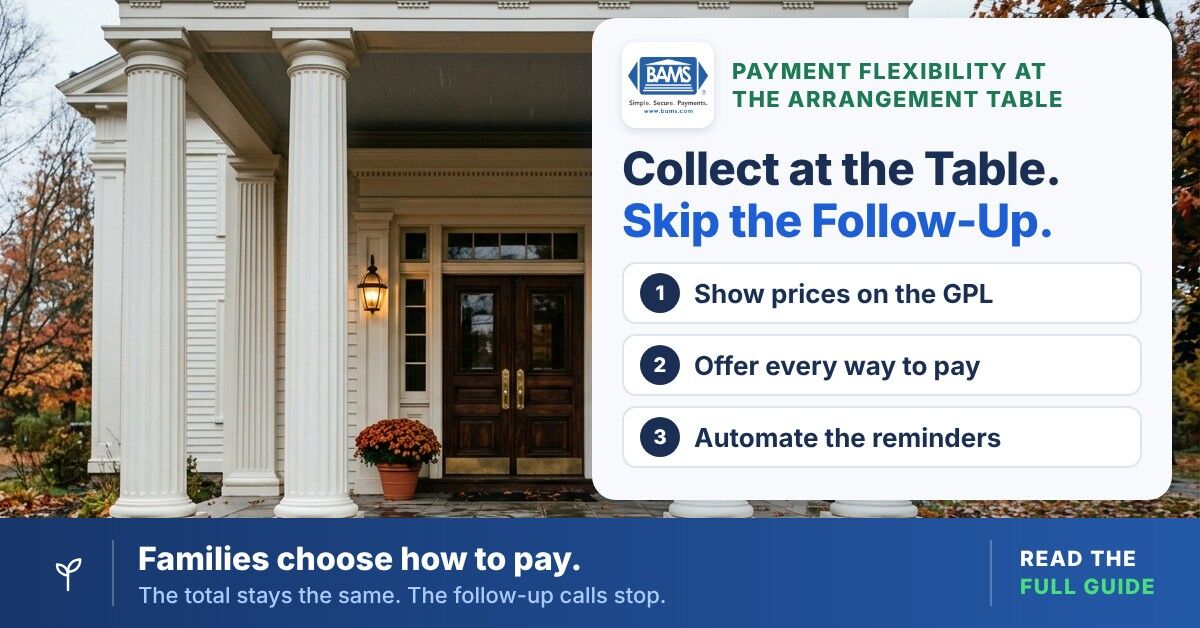
Payment Flexibility at the Arrangement Table
TL;DR
- Collect at the arrangement table, not after the service – Presenting payment options during the arrangement conference, alongside service selections, reduces the need for follow-up calls and resolves balances while families are engaged and supported.
- Payment flexibility is about method, not discount – Offering multiple ways to pay (card, ACH, digital wallet, installment plans) keeps the total the same while removing friction that delays collection.
- Transparency reduces disputes – A clear General Price List with line-item costs and stated payment options removes the surprise factor that causes families to resist paying later.
- Automate the follow-up, reserve staff for exceptions – Automated receipts and installment reminders can handle routine post-arrangement communication, so your team contacts families only when there’s an actual payment issue.
- Audit your processing costs annually – High-ticket, low-frequency funeral transactions don’t always fit standard merchant services pricing and small rate differences add up across a year of services.
Guide Orientation: What This Covers and Who It’s For
This guide is for family-owned funeral home operators who want to stop making uncomfortable collection calls to grieving families. If you run one to ten locations and regularly handle transactions above $15,000, the payment flexibility strategies here will change how you collect, when you collect and how families feel about the process.
By the end, you’ll understand how to structure payment options at the arrangement table so that balances are resolved before a service concludes, not weeks after. You’ll have a step-by-step framework for presenting pricing, accepting multiple payment methods and building automated safeguards that protect both your cash flow and your reputation.
This guide does not cover insurance assignment workflows, preneed trust fund structures, or third-party financing programs. It focuses exclusively on what happens at the arrangement conference and in the days immediately following, where most collection friction originates.
Why Payment Flexibility Matters in Funeral Service
No one in this industry went to mortuary school to become a debt collector. Yet for many independent funeral homes, part of every month’s revenue sits in accounts receivable for 30, 60, or 90 days after services are rendered. The follow-up calls that result are painful for staff and damaging to family relationships.
The problem is not that families refuse to pay. More often, funeral homes defer the payment conversation to a moment when clarity is lowest and emotional weight is highest, then compound the issue by offering too few ways to settle the balance. In the Federal Reserve’s 2024 Small Business Credit Survey, 38% of firms said they collect payment in full at the time of service or purchase. Another 28% collect after delivery, for example by invoice. In funeral service, that gap creates a backlog of outstanding balances that someone on your team has to chase.
The cost of inaction goes beyond cash flow. Every awkward phone call to a widow or grieving parent erodes the trust you built during the arrangement. Staff members burn out. Online reviews suffer. And the longer a balance sits unpaid, the less likely it is to be collected at all.
Payment habits are shifting on the business side too. The Federal Reserve’s 2024 business payments study reported a 10% increase in ACH use and 16% of businesses said they had used instant payments in the first year the survey asked. Funeral homes that offer payment flexibility at the front end of the relationship reduce the need for collection efforts on the back end.
Core Concepts: Understanding the Collection Problem
The Arrangement Table Is the Collection Point
Most funeral operators treat the arrangement conference as a service planning meeting and the payment conversation as a separate, later event. This separation is the root cause of follow-up friction. When you present pricing and payment together, in the same sitting, families make financial decisions while they’re engaged and supported, not after they’ve gone home and the emotional fog has thickened.
Payment Flexibility Is Not a Discount
A common misconception is that offering flexible payment options means reducing your prices or absorbing risk. It does not. Payment flexibility means giving families multiple ways to pay the full amount: credit card, debit card, ACH transfer, digital wallet, or a structured short-term plan. The total stays the same. The path to getting there adapts to the family’s situation.
Transparency Eliminates Surprise
Families who are surprised by a balance are families who resist paying it. Surprise comes from unclear pricing, undisclosed fees, or vague language during the arrangement. A well-structured General Price List that shows exact costs, including any difference between cash and credit pricing, removes ambiguity before it can create conflict.
Cash Flow Is a Compassion Issue
Funeral homes that struggle with cash flow cut corners. They delay facility maintenance, reduce staffing, or skip continuing education. Predictable revenue from timely collections allows you to invest in the service quality that families deserve. Framing cash flow improvement as a compassion issue is not a rationalization. It is an operational truth.
The Framework: Front-Load, Don’t Follow Up
The method in this guide follows a four-stage process designed to resolve payment at or near the arrangement conference, rather than creating a receivable that requires collection. Each stage builds on the previous one.
- Stage 1: Prepare – Configure your pricing, payment infrastructure and staff scripts before any family walks through the door.
- Stage 2: Present – Introduce costs and payment options together during the arrangement conference, using structured language and visual aids.
- Stage 3: Collect – Accept payment (full or first installment) before the family leaves, using the method they prefer.
- Stage 4: Safeguard – Automate confirmation receipts, remaining-balance reminders and escalation triggers so no staff member has to manually chase a family.

Each stage builds on the one before it, so balances resolve before the service ends.
These stages are sequential. Skipping Stage 1 makes Stage 2 awkward. Skipping Stage 3 makes Stage 4 a collection operation instead of a confirmation process. The system works when each stage is fully executed.
Step-by-Step: Building a Collection-Free Payment Process
Step 1: Audit Your Current Payment Infrastructure
Objective: Confirm that your payment processing setup supports payment flexibility, with every method a family might want to use, at a cost structure that doesn’t erode your margin on high-ticket transactions.
Start by listing every payment method you currently accept. Then compare that list against how families actually want to pay. Credit and debit cards accounted for 62% of consumer payments in the Federal Reserve’s 2024 Diary of Consumer Payment Choice. If your terminal only handles basic card swipes and you’re not set up for contactless, digital wallets, or ACH, you’re creating friction at the exact moment you need frictionless resolution.
Next, examine your processing fees. Funeral transactions are low-frequency and high-ticket, which means a merchant services agreement built for retail volume may not fit your transaction profile. Even a half-point difference in your effective rate on a $15,000 service is $75 per family. Audit your processing cost signals to identify where you’re overpaying.
Anti-patterns: Do not assume your current processor is optimized for your transaction profile simply because you’ve used them for years. Do not ignore the difference between debit and credit interchange on large transactions.
Success indicators: You can accept card (chip, tap, keyed), ACH and at least one digital wallet. Your effective processing rate is documented and benchmarked. You know your per-transaction cost on a $15,000 charge.
Step 2: Restructure Your General Price List for Payment Clarity
Objective: Ensure that every family sees exact costs and understands their payment options before making service selections.
Your General Price List (GPL) is not just a compliance document. It is the foundation of payment transparency. When a family reviews a GPL that shows precise line-item costs and clearly states available payment methods, the financial conversation becomes a natural extension of service planning rather than an uncomfortable addendum.
If you use dual pricing (different rates for cash and credit), this must be embedded at the line-item level on the GPL, not disclosed as a surprise surcharge at checkout. A clear dual pricing structure keeps your itemized GPL consistent with what families pay and gives them the information they need to choose a payment method. Card network rules don’t allow surcharging debit cards and state rules vary, so review the structure with your processor and legal advisor before you change your GPL.
Consider adding a simple payment options summary to the bottom or back of your GPL: “We accept Visa, Mastercard, American Express, debit, ACH bank transfer and digital wallet payments. Payment plans are available for balances over $5,000.” This single line signals payment flexibility and sets expectations before the arrangement conference begins.
Anti-patterns: Do not present pricing verbally without a written reference. Avoid waiting until the family has selected services to mention payment terms. Do not bury payment method information in a separate document that families may not read.
Success indicators: Every family receives a GPL with line-item pricing and a payment options summary before selecting services. Staff can point to the document rather than improvising financial conversations.
Step 3: Script the Payment Conversation Into the Arrangement Conference
Objective: Make the transition from service planning to payment selection feel natural, respectful and expected.
The reason most funeral directors dread the payment conversation is that they treat it as a separate topic, introduced with an awkward pivot like “Now, about the financial side…” Instead, weave payment into the arrangement flow. After each major service selection (casket, ceremony type, transportation), briefly confirm the running total. This normalizes the financial dimension and prevents sticker shock at the end.
When you reach the summary, use language that frames payment as a next step rather than a request. For example: “The total for everything we’ve discussed is $12,400. Most families settle this today with a card or bank transfer and we also have a structured option that splits the balance into three payments over 60 days. Which works best for your family?” This compassionate communication approach gives the family agency without making them feel pressured. That is payment flexibility in practice: the family chooses the path and the total stays the same.
Train every staff member who conducts arrangements to use this language. Consistency matters. If one director handles payment smoothly and another avoids it, your collection rate can vary widely by who’s working that day.
Anti-patterns: Do not apologize for discussing money. Never present a single payment option and wait for the family to ask about alternatives. Do not leave the payment conversation for “later” or “when you’re ready.”
Success indicators: Payment method is selected and at least a partial payment is collected during 80% or more of arrangement conferences. Staff report reduced anxiety about financial discussions.
Step 4: Accept Payment Before the Family Leaves
Objective: Collect full payment or a committed first installment at the arrangement table, using the family’s preferred method.
This is where infrastructure meets execution. With Steps 1 and 3 done, your system can take whatever method the family has already chosen.
For families paying in full, run the transaction immediately. Faster settlement means you’re not floating operational expenses while waiting for a check to clear. If you qualify for next-day funding, a card payment batched on Monday can reach your account the next business day.
For families who need a structured plan, collect the first installment on the spot and document the remaining schedule in writing. Have the family sign a simple payment agreement that includes dates, amounts and their consent to charge the card or account on file. Store that card as a token through your processor, not on paper. This is not aggressive. It is clear. Families appreciate knowing exactly what to expect and your staff never has to make a “just checking in” call.
For operators processing high-ticket transactions regularly, a merchant services partner configured for your transaction profile makes a measurable difference. BAMS, for example, offers next-day funding for qualifying merchants, dedicated account representatives and tokenized storage for recurring payments. That matters because about 80% of small firms report payments-related challenges, with processing fees the most common. Firms paid through third parties report settlement delays most often.
Anti-patterns: Do not let a family leave with a verbal promise to “send a check.” Avoid processing a large transaction without confirming the card or account can handle the amount (request authorization first). Do not store payment information on paper or in unsecured systems.
Success indicators: 90% or more of arrangements result in same-day payment or a signed installment agreement with first payment collected. Average days-to-full-collection drops below 14.
Step 5: Automate Confirmation and Remaining-Balance Communication
Objective: Replace manual follow-up calls with automated, tone-appropriate messages that confirm payments received and remind families of upcoming installments.
Once payment is collected or an installment plan is in place, your system should handle the rest. Set up automated receipts that go out immediately after every transaction. For installment plans, schedule reminder emails or texts 5 to 7 days before each payment date. The tone should be informational, not demanding: “This is a reminder that your next payment of $2,400 is scheduled for March 15. No action is needed if your card on file is current.”
A well-designed automated reminder workflow typically follows a four-stage cadence: a gentle reminder before the due date, a confirmation after successful processing, a second notice if the payment fails and an escalation to a personal call only if the second attempt also fails. This means your staff only contacts families who have an actual payment issue, not every family with an outstanding balance.
Anti-patterns: Do not rely on a staff member’s memory to follow up. Avoid automated messages that read like collection notices. Do not use the same communication template for a first reminder and a failed-payment notice.
Success indicators: Zero manual follow-up calls for families on active installment plans with valid payment methods on file. Staff time previously spent on collection calls is redirected to service preparation or family care.
Step 6: Build a Feedback Loop to Refine the Process
Objective: Track collection metrics monthly and adjust your approach based on what the data shows.
Measure three numbers every month: the percentage of arrangements that result in same-day payment, the average number of days to full collection and the number of manual follow-up calls your staff makes. If same-day collection drops below 80%, revisit your arrangement conference scripts. If days-to-collection creeps above 21, examine whether your installment terms are too long or your automated reminders are misconfigured.
Ask your staff for qualitative feedback too. Which families pushed back on payment at the arrangement table? What language felt awkward? What questions came up that the script didn’t address? These insights are more valuable than any dashboard metric because they reveal the human friction points that data alone can’t capture.
Faster payment methods help, but speed alone doesn’t solve the problem. The feedback loop ensures your process stays aligned with how families actually behave, not how you assume they will.
Anti-patterns: Do not set up this system and then ignore the data. Avoid changing scripts or terms based on a single difficult family interaction. Do not treat metrics as a performance evaluation for individual directors.
Success indicators: Monthly review meetings happen consistently. At least one process adjustment is made per quarter based on data or staff feedback. Year-over-year, manual follow-up calls decrease and same-day collection increases.
Practical Examples: What This Looks Like in Operation
Scenario A: Full Payment at Arrangement
A family selects a traditional service package totaling $9,800. The director reviews the itemized costs on the GPL throughout the conversation, so the total is not a surprise. At the summary, the director says: “Most families take care of this today. We accept all major cards, debit and bank transfer. Which would you prefer?” The family pays by credit card. The receipt is emailed within minutes. No follow-up is needed. With next-day funding, the funeral home can receive the funds the next business day.
Scenario B: Installment Plan With Automated Follow-Up
A family selects services totaling $16,500 and cannot pay in full. The director offers a three-payment plan: $5,500 today, $5,500 in 30 days and $5,500 in 60 days. The family agrees and provides a card to keep on file. The first payment is processed immediately. Automated reminders go out 7 days before each subsequent payment. Both remaining payments process successfully without any staff involvement. Total staff time spent on collection: zero minutes.
Scenario C: The Contrast (What Happens Without This System)
A family selects services totaling $12,000. The director mentions the total but says, “We can figure out payment later.” The family leaves. Two weeks pass. A staff member calls to ask about the balance. The call goes to voicemail. Another week passes. A second call reaches the family, who is now emotionally distant from the arrangement and frustrated by the contact. The balance is partially paid at 45 days. The remaining $3,000 is never collected. Total staff time spent: multiple hours across several calls, plus the emotional toll on both sides.
Common Mistakes and Pitfalls
Treating payment as optional at the arrangement. If your staff views the payment conversation as something that can be skipped when a family seems upset, you will always have a collection problem. Every family is upset. That is the nature of the business. Compassion and financial clarity are not in conflict.
Offering too many options without guidance. Presenting five payment methods without a recommendation overwhelms families. Lead with your most common method (“Most families use a card”), then mention alternatives. Payment flexibility works best when families get a default, not a menu.
Using collection language in automated messages. Words like “overdue,” “delinquent,” or “final notice” have no place in communication with bereaved families. Your automated messages should read like they come from a caring professional, not an accounts receivable department.
Ignoring processing costs on large transactions. A 0.5% difference in your effective processing rate on a $15,000 transaction is $75. Across 200 services per year, that’s $15,000 in unnecessary cost. Audit your rates at least annually.
What to Do Next
Start with Step 1. Pull your most recent processing statement and list every payment method you currently accept. Compare that list against the methods described in this guide to see where your payment flexibility falls short. Any missing method is your first action item.
Then pick one arrangement conference this week and try the scripted payment language from Step 3. You don’t need to overhaul your entire operation at once. Test the approach with a single family, note what felt natural and what didn’t and adjust from there.
This guide is a reference, not a checklist to complete in a single day. Revisit it as your process matures. The goal is incremental progress toward a system where no one on your staff ever has to make an awkward follow-up call again and no grieving family ever feels pursued for a balance they didn’t know they owed.
Frequently Asked Questions
Which payment options should funeral homes offer to encourage timely payment?
Payment flexibility starts with the basics. At minimum, accept all major credit cards, debit cards and ACH bank transfers. Digital wallets (Apple Pay, Google Pay) are increasingly expected. Credit and debit cards made up 62% of consumer payments in 2024, so card acceptance is essential. The key is presenting these options proactively during the arrangement conference, not waiting for families to ask.
How can funeral homes discuss payment with grieving families without seeming insensitive?
Integrate the financial conversation into the service planning process rather than treating it as a separate, uncomfortable topic. Confirm running totals as families make selections, then present payment as a natural next step: “Most families take care of this today. Which method works best for you?” A structured communication framework removes improvisation and reduces anxiety for both staff and families.
What is the best way to handle families who cannot pay in full at the arrangement?
Offer a short-term installment plan (two to three payments over 30 to 60 days) with the first payment collected on the spot. Have the family sign a simple written agreement and keep a card on file for automatic processing of remaining installments. This approach respects the family’s financial situation while protecting your cash flow.
How do automated payment reminders work for funeral home balances?
Automated reminders are scheduled messages (email or text) sent before each installment due date. A typical workflow sends a reminder 5 to 7 days before the payment, a confirmation after successful processing and a second notice only if the payment fails. Staff intervention is needed only when automated attempts are unsuccessful. Learn more in this automated reminder workflow tutorial.
How does next-day funding help funeral home cash flow?
Funeral homes carry significant upfront costs for caskets, facilities and staff before receiving payment. For qualifying merchants, next-day funding means a card batch settled on Monday can be deposited by Tuesday. That shortens the window in which you float expenses. In the Federal Reserve’s 2024 survey, about 80% of small firms reported payments-related challenges, including delays in settlement or availability of funds.
Should funeral homes charge different prices for cash and credit payments?
Dual pricing (offering a lower price for cash or debit and a standard price for credit) is a legitimate strategy to offset processing fees on high-ticket transactions. However, it should be shown at the line-item level on your General Price List so your itemized prices stay clear. Card network rules don’t allow surcharging debit and state rules vary, so confirm your approach with your processor and legal advisor. Review the dual pricing compliance guide before implementing this approach.


