Apple Pay Integration: Your Processor Sets the Price
Last Updated on October 7, 2026 by Dimitri Akhrin
Why the payment gateway you sign with matters more than Apple’s fee structure — and how markup hiding in contracts inflates every transaction
Learn why your payment processor, not Apple, determines the real cost of Apple Pay integration. This breakdown reveals how markup structures and contract terms create hidden fees that most ecommerce managers only discover after signing.
TL;DR
- Apple charges you nothing – Your entire Apple Pay cost comes from interchange fees, network assessments, and your processor’s markup. The markup alone can vary by 0.6% or more between processors.
- Processor selection is a margin decision – Interchange qualification, token passthrough, and markup structure determine your real cost. Feature checklists miss all of this.
- Fraud savings only materialize with the right processor – Apple Pay cuts fraud 50%–70%, but you only save money if your processor has proactive chargeback defense instead of per-dispute fees.
- Funding speed is a hidden cost – Every day your processor holds deposits costs you working capital. Next-day funding turns Apple Pay transactions into usable cash within one business day.
The Cost Nobody Told You About
Most eCommerce managers spend weeks evaluating Apple Pay integration for their stores. They compare digital wallets, read developer docs, and debate checkout button placement. Then they sign a payment processor contract in an afternoon.
That’s backwards. The processor you choose determines more of your Apple Pay cost than Apple ever will. And by the time most businesses figure that out, they’re locked into a three-year agreement with markup structures they never questioned.
The “Apple Pay Is Free” Myth Everyone Repeats
Here’s the line you’ll find on nearly every payments blog: Apple charges merchants nothing. That’s technically true. Apple collects roughly 0.15% from issuing banks per credit transaction, not from you. So the narrative became “Apple Pay is free for merchants,” and most eCommerce teams stopped investigating.
But “free” only describes Apple’s slice. Your actual cost per Apple Pay transaction still lands somewhere between 2.4% and 2.9% of the transaction value, composed of interchange fees, network assessments, and your processor’s markup. The first two are largely fixed. The third? That’s where the real money leaks. Apple confirms that merchants do not pay Apple directly to accept Apple Pay, with merchant costs continuing to flow through the existing payment processing ecosystem.
The industry spent years explaining why Apple Pay is worth accepting. Almost nobody explains how to stop overpaying for it.
Your Payment Processor Is the Pricing Decision
We believe processor selection is the single highest-leverage cost decision in any Apple Pay setup, and treating it as a technical afterthought is the most expensive mistake eCommerce managers make today.
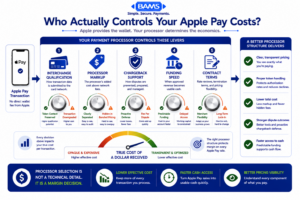
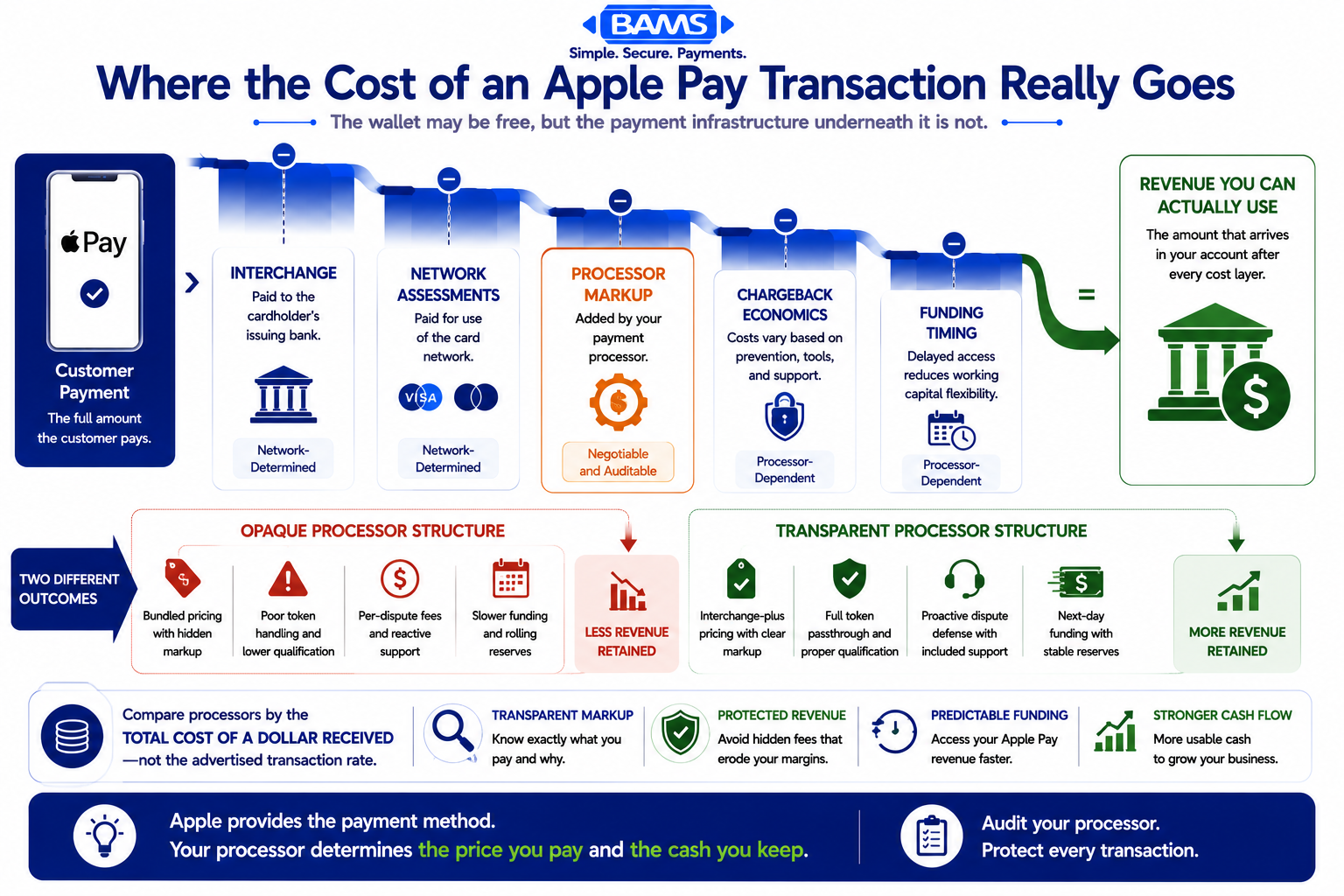
Apple does not charge merchants directly for Apple Pay, but processors still determine how each transaction qualifies, how much markup is added, and how quickly revenue reaches the merchant.
Where the Money Actually Goes (and How to Keep More of It)
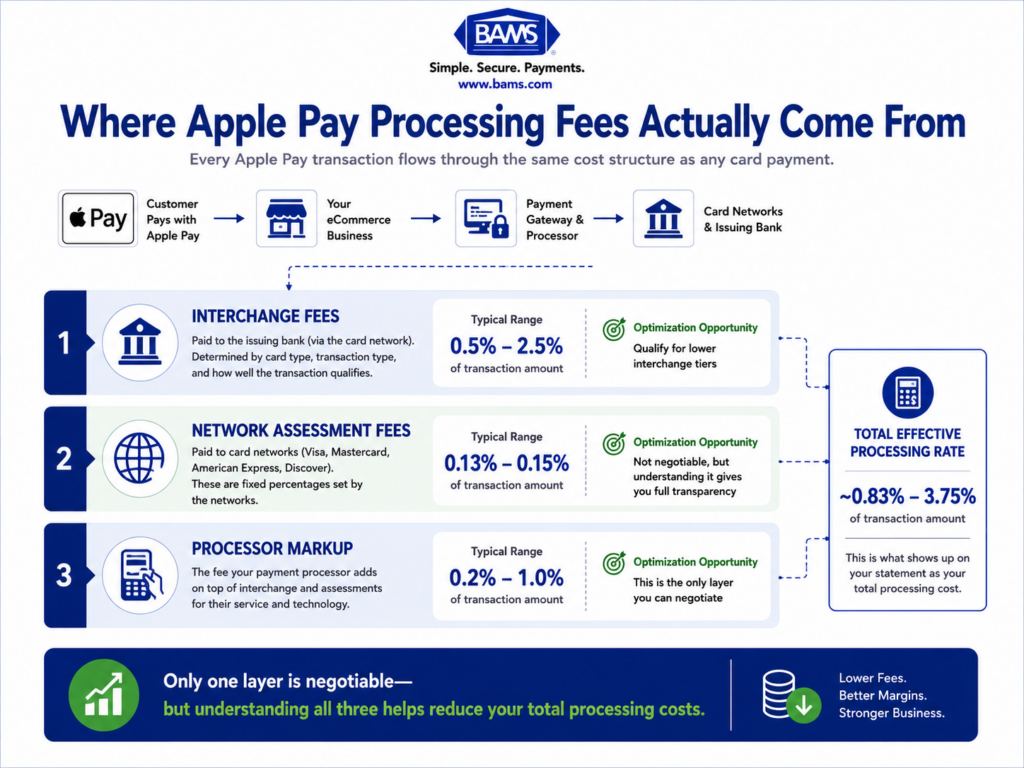
Let’s break the cost into its three layers. Interchange fees go to the cardholder’s bank, typically 0.5% to 2.5% per transaction. Network assessment fees go to Visa or Mastercard, usually 0.13% to 0.15%. And the processor markup covers everything your payment gateway and processor charge on top, ranging from 0.2% to a full 1.0%. Visa explains how interchange and network fees are structured within card payments.
That processor markup range is enormous. On $500,000 in annual Apple Pay volume, the difference between a 0.25% markup and a 0.85% markup is $3,000. Scale that to $2 million and you’re looking at $12,000 a year, vanishing into a line item most managers never audit.
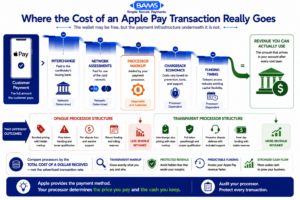
Apple Pay may carry no direct merchant wallet fee, but every transaction still passes through multiple cost layers. Processor markup, dispute handling, and funding terms determine how much revenue the merchant ultimately keeps.
Interchange Qualification: The Hidden Tier Game
Not all transactions qualify for the same interchange rate. When your payment gateway properly passes network tokens (DPAN/MPAN) through to the processor without re-encrypting card numbers, Apple Pay transactions can qualify for lower interchange tiers. When it doesn’t, you pay a higher rate on every single transaction, and you’ll never see a line item that says “downgrade surcharge.” Visa’s Token Service documentation explains how network tokens are used throughout the payment authorization process.
This is a technical detail that lives entirely in how your processor and gateway handle tokenized data. Most feature comparison checklists don’t cover it. But it directly affects what you pay.
Fraud Reduction You’re Already Paying For (But Might Not Be Getting)
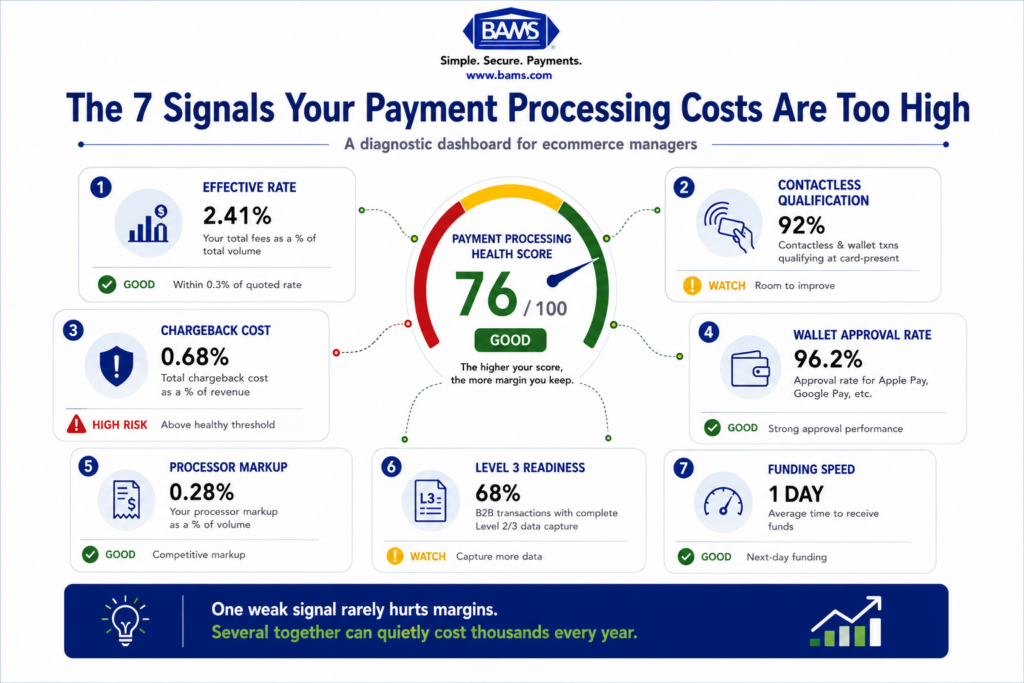
Apple Pay transactions use device-level biometric authentication and one-time-use tokens. That combination can reduce fraud rates by 50% to 70% compared to traditional card-not-present payments, and boost authorization rates by 2% to 3%.
Fewer fraudulent transactions should mean fewer chargebacks. Fewer chargebacks should mean lower costs. But “should” only becomes “does” when your processor has proactive chargeback defense built into the relationship, not bolted on as a $25-per-dispute fee.
This is where the chargeback-to-savings pipeline breaks down for most businesses. They adopt Apple Pay, fraud drops, but their chargeback costs don’t move because the processor treats every dispute as a revenue event rather than a problem to prevent.
Cash Flow Timing Is a Cost, Too
Here’s something no Apple Pay integration guide mentions: when you actually get your money matters as much as how much you keep. A processor holding your Apple Pay deposits for 48 to 72 hours is borrowing your cash interest-free. Multiply that delay across hundreds of daily transactions and the working capital impact is real, especially for businesses managing inventory or running paid acquisition.
Next-day funding turns every Apple Pay transaction into usable cash within one business day. That’s not a feature. It’s a financial position. BAMS offers next-day funding as a standard part of their merchant services, paired with dedicated account management that actually reviews your interchange qualification and markup structure, not just your transaction volume.
What Changes If You Treat Processor Choice as Strategy
If this framing is right, several things follow. First, your annual Apple Pay cost review should start with your processor statement, not your gateway dashboard. The gateway routes transactions. The processor prices them.
Second, the ROI of switching processors could dwarf the ROI of any checkout optimization you run this quarter. A 0.3% markup reduction across all Apple Pay volume is a permanent, compounding savings. A button color test might lift conversions by 0.1% for a month.
Third, chargeback defense and funding speed aren’t “nice to have” add-ons. They’re core economics. A processor with proactive chargeback prevention and next-day funding changes your effective cost of accepting payments in ways that the per-transaction rate alone never captures.
A Better Way to Think About Payment Costs
Stop comparing processors on features. Start comparing them on total cost of a dollar received.
That means asking: what’s my blended interchange qualification rate? What’s the processor markup, separated from interchange? How fast do I get funded? What happens when a chargeback hits, and who’s working to prevent the next one?
Most eCommerce managers can answer zero of those questions today. That’s not a knowledge gap. It’s a transparency gap, created by processors who benefit from your confusion. The mental model shift is simple: your payment processor isn’t a utility bill. It’s a margin decision disguised as infrastructure.
The Contract You Already Signed Is Costing You More Than You Think
Apple built a payment method that reduces fraud, speeds up checkout, and charges merchants nothing directly. Then the payments industry wrapped it in the same opaque pricing it uses for everything else.
You don’t need a better Apple Pay integration. You need a better deal on the infrastructure underneath it. And that conversation starts the moment you stop treating your payment processor like a technical decision and start treating it like the financial partner it actually is.
Frequently Asked Questions
What fees do merchants actually pay when accepting Apple Pay?
Apple charges merchants nothing directly. Your costs come entirely from your payment processor and include interchange fees (0.5%–2.5%), network assessments (0.13%–0.15%), and your processor’s markup (0.2%–1.0%). The processor markup is the only component you can negotiate.
How does Apple Pay help reduce chargeback costs?
Apple Pay uses biometric authentication and one-time-use tokens, which can cut fraud rates by 50%–70% compared to traditional card-not-present methods. However, turning that fraud reduction into real savings depends on whether your processor offers proactive chargeback defense or simply charges you per dispute.
How does Apple Pay compare to traditional credit card processing fees?
The per-transaction rate is similar, but Apple Pay transactions often qualify for better interchange tiers when your gateway properly passes network tokens. Combined with lower fraud and higher authorization rates (2%–3% higher), the total cost of ownership can be 10%–15% lower than traditional card-not-present processing.
Sources