Brooklyn Merchant Services: A Guide to Support You Can Count On
Last Updated on October 14, 2026 by Dimitri Akhrin
How to evaluate payment partners by accountability and dedicated access, not just features and pricing
Learn how to assess a payment provider’s support infrastructure before signing a contract. This guide covers what dedicated account access looks like in practice and how to structure onboarding so accountability gaps surface early.
TL;DR
- Accountability beats availability – A named account manager who knows your business is worth more than a 24/7 call center where you re-explain your setup every time.
- Use onboarding as a stress test – How a provider handles questions and timelines during setup predicts how they’ll perform during a real crisis. Document everything.
- Verify funding and fees with real data – Track your first 20 transactions against promised timelines and compare your effective rate to the quoted rate line by line.
- Test escalation paths before you need them – Call after hours, email on a Friday afternoon, and see what actually happens. If the system fails during a test, it will fail during an emergency.
- Build accountability into your contract – Written SLAs for response times, funding speed, and fee dispute resolution protect you. Verbal promises do not.
Guide Orientation: What This Guide Covers and Who It’s For
This guide helps eCommerce managers at established online businesses (roughly 10-50 employees) evaluate payment partners based on accountability, not just features. If you’ve ever waited on hold during a funding delay or struggled to reach a real person during a chargeback dispute, this is written for you.
By the end, you’ll understand how to assess a payment provider’s support infrastructure before you sign, what dedicated account access looks like in practice versus marketing copy, and how to structure your onboarding so gaps in accountability surface early rather than mid-crisis.
This guide does not compare specific processors feature by feature. It does not cover PCI compliance requirements or gateway architecture. Instead, it focuses entirely on the human and operational side of choosing Brooklyn merchant services or any payment partner you can actually reach when something breaks.
Why Choosing an Accountable Payment Partner Matters Now
The payment processing landscape has grown more complex, not simpler. Mastercard reported more than 50% growth in global transaction value processed through Tap on Phone between 2023 and 2024. Mobile payment solutions are standard, not optional. And as transaction volumes grow across more channels, the surface area for things to go wrong expands with them.
For eCommerce managers specifically, ask how they handle chargeback notifications. Do they alert you proactively, or do you discover chargebacks in a monthly statement? Proactive chargeback defense, where the provider flags disputes in real time and helps you respond before deadlines, is a concrete differentiator. BAMS, for example, pairs proactive chargeback defense with dedicated account management, so the person alerting you to a dispute already understands your transaction history and can help build a response immediately.
The cost of inaction is compounding. Every month you operate with a provider that lacks transparent escalation paths, you accumulate risk. You normalize delayed responses. You build workarounds instead of demanding answers. And when a genuine crisis hits (a batch processing failure on a high-volume weekend, a sudden hold on your merchant account), you discover exactly how little leverage you have.
The shift happening now isn’t about technology. It’s about the expectation gap between what providers promise during the sales process and what they deliver once you’re onboarded. Closing that gap starts with knowing what to look for before you commit.
Core Concepts: Accountability vs. Availability
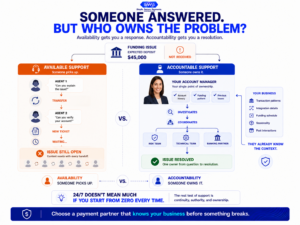
Good payment support is not measured by whether someone answers. It is measured by whether the person helping you has context, authority and ownership until the issue is resolved.
What “Support” Actually Means in Payment Processing
Most payment providers advertise 24/7 support. Few define what that support includes. There’s a critical distinction between availability (someone answers the phone) and accountability (someone owns your problem until it’s resolved). A call center agent reading from a script at 2 AM is available. A dedicated account manager who knows your transaction patterns, your integration stack, and your business seasonality is accountable.
The Difference Between Remote-Only and Dedicated Access
Remote-only support means tickets, chatbots, and queues. You explain your issue to a new person every time. Dedicated access means a named contact who carries context from interaction to interaction. This distinction matters most during disputes, funding holds, and integration troubleshooting, situations where re-explaining your setup wastes hours you don’t have.
Common Misconceptions
Bigger providers have better support” is the most persistent myth in merchant services. Scale often works against support quality. Larger processors serve millions of merchants with tiered support models that prioritize enterprise accounts. If your business processes $500K annually, you’re unlikely to get the same escalation speed as a $50M account, even though the impact of downtime on your operations is proportionally greater.
Another misconception: “Integration is the hard part; support is secondary.” In practice, integration is a one-time effort. Support quality determines your experience for the entire duration of the relationship. The framework in this guide treats support continuity as the primary evaluation criterion, not an afterthought.
The Accountability Framework: Four Phases of Evaluation
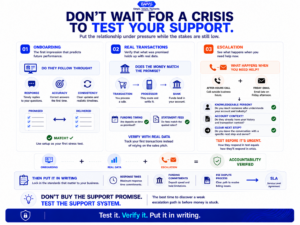
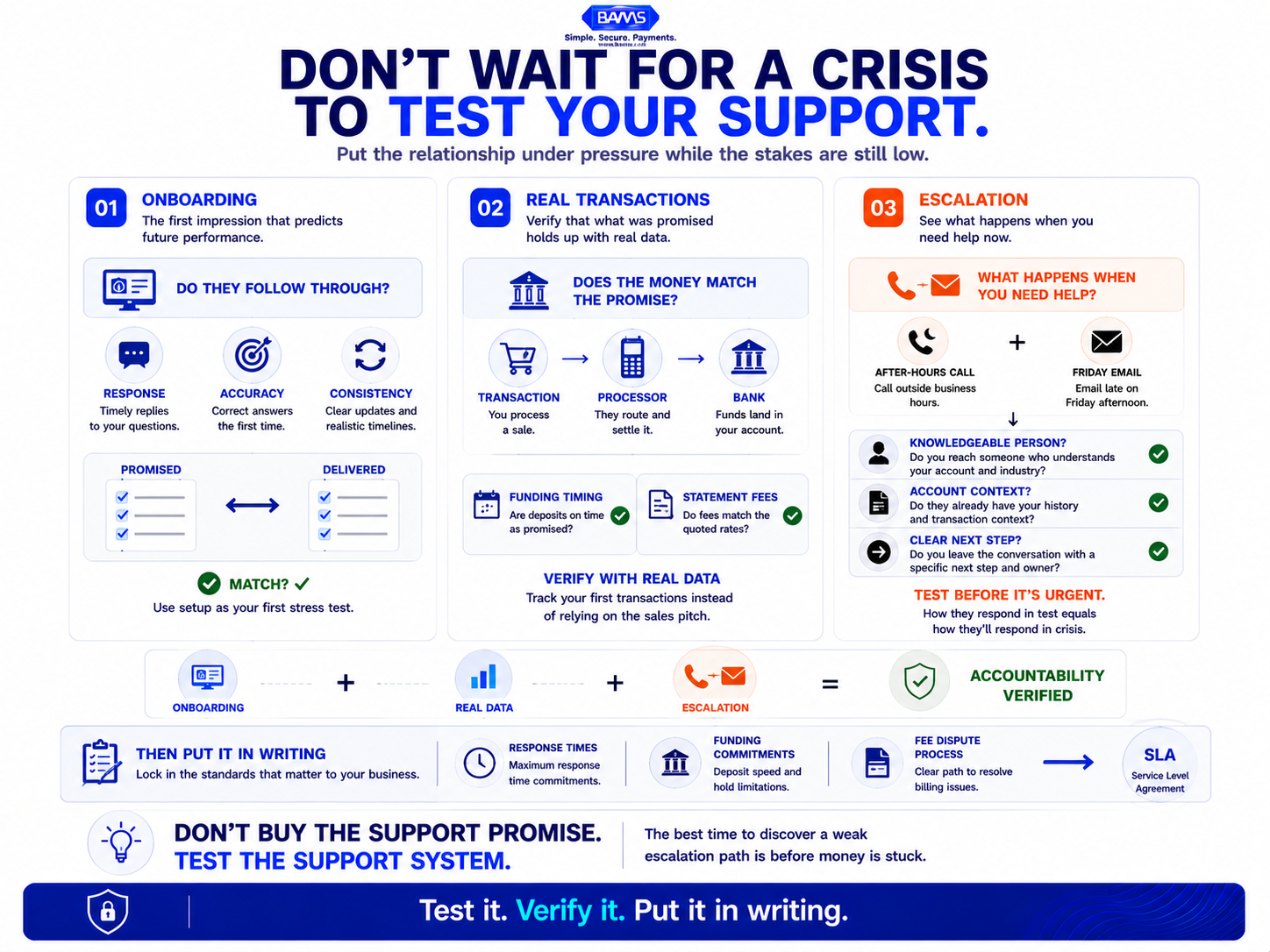
Sales promises tell you what a provider says it can do. Onboarding, real deposits and escalation tests show you how the support system actually performs.
Evaluating a payment partner for accountability follows four phases. Each phase builds on the previous one, and skipping any of them creates blind spots that surface during the worst possible moments.
- Phase 1: Pre-Commitment Diligence — Evaluating support infrastructure before signing any agreement
- Phase 2: Onboarding Stress Testing — Using the setup process to reveal how the provider handles friction
- Phase 3: Operational Verification — Confirming accountability during normal operations
- Phase 4: Crisis Simulation — Testing escalation paths before you need them in a real emergency
These phases are sequential but not one-time. Revisit Phase 3 and Phase 4 quarterly. Provider support quality can degrade after mergers, staff turnover, or platform migrations. What worked six months ago may not work today.
Step-by-Step Breakdown: How to Evaluate and Select an Accountable Payment Partner
Step 1: Map Your Support Requirements Before You Shop
Objective: Define what “accountable support” means for your specific business before evaluating any provider.
Start by listing every scenario in the past 12 months where you needed to contact your current payment provider. Categorize them: funding delays, chargeback disputes, integration errors, rate questions, POS systems for local businesses or in-store issues (if applicable), and compliance questions. Note the time of day each issue occurred, how long resolution took, and how many people you spoke with before reaching someone who could actually help.
This exercise produces your support requirements document. It should include your peak transaction hours, your acceptable resolution time for critical issues (funding holds, processing outages), and the communication channels you actually use. If your team operates across time zones, note that. If your busiest sales period is Q4 weekends, note that too.
Anti-patterns: Don’t start by asking providers what they offer. That lets them frame the conversation around their strengths. Start with your needs, then measure providers against them. Don’t assume your current frustrations are industry-standard. They may be specific to your provider’s support model.
Success indicators: You have a written document listing 8-15 specific support scenarios ranked by frequency and business impact. You can hand this document to any prospective provider and ask, “Walk me through exactly how your team handles each of these.”
Step 2: Audit the Provider’s Support Structure, Not Their Sales Pitch
Objective: Distinguish between marketed support and actual support infrastructure before signing.
Request specifics that go beyond the sales deck. Ask for the name and direct contact information of the account manager who would be assigned to your account. Ask what happens when that person is on vacation, sick, or leaves the company. Ask for the average tenure of their support staff. High turnover in support teams is a leading indicator of poor service continuity.
Ask for their escalation matrix in writing. This should show exactly who handles Tier 1 issues (password resets, basic questions), Tier 2 issues (funding delays, integration bugs), and Tier 3 issues (account holds, processing outages). If they can’t produce this document, their escalation process is informal, which means it’s unreliable.
For ecommerce managers specifically, ask how they handle chargeback notifications. Do they alert you proactively, or do you discover chargebacks in a monthly statement? Proactive chargeback defense, where the provider flags disputes in real time and helps you respond before deadlines, is a concrete differentiator. BAMS, for example, pairs proactive chargeback defense with dedicated account management, so the person alerting you to a dispute already understands your transaction history and can help build a response immediately.
Anti-patterns: Don’t accept “we have 24/7 support” as a complete answer. Press for what that support can actually do at 9 PM on a Saturday. Don’t skip the reference check. Ask for two or three current clients in your revenue range and call them.
Success indicators: You have a named account manager, a written escalation matrix, and at least one reference conversation with a current client who has tested the provider’s support under pressure.
Step 3: Use Onboarding as a Diagnostic, Not Just a Setup Process
Objective: Treat the onboarding period as a live test of the provider’s responsiveness, accuracy, and communication quality.
Onboarding reveals more about a provider’s true support culture than any sales conversation. Pay attention to response times during integration setup. If it takes 48 hours to get an answer to a technical question during onboarding (when they’re motivated to impress you), expect longer delays once you’re a signed client.
Document every interaction during onboarding. Note who you’re communicating with, whether it’s consistent (same person or team) or fragmented (different person every time). Track whether commitments made during the sales process (pricing, funding speed, integration timelines) match what’s delivered during setup. Discrepancies here are early warning signals.
For businesses using mobile payment solutions, onboarding is where you verify that the provider’s mobile stack integrates cleanly with your existing systems. Test edge cases: What happens when a mobile transaction fails mid-process? How does the system handle refunds initiated from a mobile device? These aren’t theoretical questions. They’re scenarios your customers will encounter.
Anti-patterns: Don’t rush onboarding to “get it over with.” A compressed timeline hides problems. Don’t let the provider control all communication during setup. Initiate contact on your terms (off-hours, via different channels) to test their responsiveness outside of scheduled calls.
Success indicators: Onboarding completes within the promised timeline. Your primary contact remains consistent. Technical questions receive substantive answers (not redirects) within one business day. Pricing and terms match the signed agreement exactly.
Step 4: Verify Funding Speed and Transparency in the First 30 Days
Objective: Confirm that funding timelines and fee structures match what was promised, using real transaction data.
Funding speed is where promises meet reality. If a provider offers next-day funding, verify it with your first 20 transactions. Track the exact time deposits hit your account. Note any transactions that take longer than promised and document the reason given. Legitimate delays (weekends, bank holidays) are expected. Unexplained delays are a red flag.
Review your first statement line by line. Compare the effective rate you’re paying against the rate quoted during sales. Look for fees that weren’t disclosed: batch fees, statement fees, PCI non-compliance fees, and minimum processing fees. Understanding what merchant services should actually deliver helps you identify when you’re being charged for things that should be included.
For eCommerce businesses processing high volumes, even small discrepancies in per-transaction fees compound quickly. A $0.03 difference on 10,000 monthly transactions is $300 per month, or $3,600 annually. That’s not a rounding error. It’s a budget line item.
Anti-patterns: Don’t wait for your first quarterly review to examine fees. By then, you’ve already absorbed months of overcharges. Don’t assume the rate on your contract is the rate you’re paying. Interchange-plus pricing can shift based on card types, and some providers add markups that only appear on statements.
Success indicators: Deposits arrive within the promised window for 95%+ of transactions. Your effective processing rate matches the quoted rate within 0.05%. No undisclosed fees appear on your first statement.
Step 5: Test Escalation Paths Before You Need Them
Objective: Confirm that the provider’s escalation process works under realistic conditions, not just during business hours with advance notice.
Within your first 60 days, deliberately test the escalation path. Call the support line after hours with a non-urgent but specific question (“I need to understand how a particular chargeback reason code applies to my account”). Note how long it takes to reach a human, whether that person can actually answer your question, and whether they have access to your account history.
Send an email on a Friday afternoon about a funding discrepancy. Track the response time and quality. If the response is a template asking you to “provide more details” rather than a substantive answer referencing your account, the support team lacks the tools or training to handle your issues efficiently.
This step feels adversarial, but it’s not. You’re verifying the infrastructure you’re paying for. Visa reported a 200% year-over-year increase in Tap to Phone adoption in 2025, and as mobile payment adoption grows, so does the likelihood that you’ll need urgent support. Testing now prevents surprises later.
Anti-patterns: Don’t skip this step because “everything is working fine.” The point is to test the system before a crisis forces you to rely on it. Don’t accept a failed escalation test as a one-time anomaly. If the system fails during a test, it will fail during a real emergency.
Success indicators: After-hours calls reach a knowledgeable human within 15 minutes. Email inquiries receive substantive responses within 4 hours during business days. Your account manager follows up proactively after any support interaction.
Step 6: Establish Accountability Checkpoints in Your Contract
Objective: Build measurable accountability into the contractual relationship so performance expectations are documented, not assumed.
Before signing (or during your next renewal), negotiate specific service-level commitments. These should include maximum response times for critical issues, guaranteed funding timelines, and a defined process for fee disputes. If the provider won’t commit to specific metrics in writing, that tells you everything about how they view accountability.
Request a quarterly business review as a contract term. This isn’t a sales upsell meeting. It’s a structured review of processing volume, effective rates, chargeback ratios, and support ticket resolution times. Having this data in a regular cadence prevents the slow drift where fees increase and service quality decreases without anyone formally acknowledging it.
For businesses that also operate physical locations using mobile merchant services, ensure your contract covers support for both online and in-person payment channels. Some providers treat these as separate support queues, which means your account manager for eCommerce can’t help with a POS issue, and vice versa. Unified support across channels is a meaningful operational advantage.
Anti-patterns: Don’t sign multi-year contracts without cancellation provisions tied to service failures. Don’t accept verbal commitments about support quality. If it’s not in the contract, it doesn’t exist. Don’t overlook early termination fees, which some providers use to trap merchants in underperforming relationships.
Success indicators: Your contract includes written SLAs for response times and funding speed. Quarterly reviews are scheduled and occur on time. You have a documented process for disputing fees, with a defined resolution timeline.
Practical Examples: What Accountability Looks Like (and Doesn’t)
Scenario A: The Friday Evening Funding Hold
Your eCommerce store processes $45,000 in orders on Thursday. Friday morning, you check your bank account and the deposit isn’t there. With an accountable provider, you text or call your dedicated account manager directly. They investigate within 30 minutes, identify a risk flag triggered by an unusually large single order, verify the transaction, and release the hold. Funds arrive by end of day.
With a remote-only provider, you submit a support ticket. You receive an automated acknowledgment. By Monday, you’ve sent two follow-up emails. Tuesday, a support agent asks you to “verify your identity and provide documentation.” Your funds arrive Wednesday, five days late. Payroll was due Monday.
Scenario B: The Chargeback Cluster
You receive four chargebacks in one week, all from the same card issuer, all citing “product not received.” An accountable provider flags this pattern proactively, alerts you before the response deadline, and helps you compile shipping confirmations and tracking data into a formatted response. Two of the four chargebacks are reversed.
A provider without proactive chargeback defense sends you a monthly statement showing the four losses. The response window has closed. The revenue is gone, and your chargeback ratio just moved closer to the threshold where your account gets flagged or terminated.
Scenario C: The Integration Break After a Platform Update
Your eCommerce platform pushes an update that breaks the payment gateway integration. Checkout fails for all customers. With a dedicated support relationship, you call your account manager, who connects you with a technical specialist within 20 minutes. The specialist has access to your integration configuration and identifies the conflict. A workaround is deployed within two hours.
With generic support, you wait in a phone queue for 40 minutes, explain your entire setup to someone who asks you to “try clearing your cache,” get transferred twice, and eventually receive an email suggesting you “contact your platform provider.” Checkout remains broken for 14 hours.
Common Mistakes and Pitfalls
Choosing based on rate alone. The lowest processing rate means nothing if funding delays cost you more in cash flow disruption than you save per transaction. Evaluate total cost of the relationship, including the operational cost of poor support.
Assuming onboarding quality reflects ongoing support. Some providers front-load their best people during onboarding, then transition you to a lower-tier support queue. Ask explicitly: “Will my onboarding contact remain my ongoing contact?”
Ignoring contract lock-in. Early termination fees of $500 or more are common. They create a financial barrier to leaving a provider that isn’t meeting your needs. Negotiate these terms before signing, not after.
Not documenting support interactions. Without records, you have no evidence when service quality degrades. Keep a simple log: date, issue, who you spoke with, resolution time, outcome. This log becomes your leverage during contract renewals.
Treating payment processing as a “set and forget” decision. Your business changes. Transaction volumes shift. New sales channels open. Review your provider relationship at least twice a year to ensure it still fits.
What to Do Next
Start with Step 1. Spend 30 minutes listing every support interaction you’ve had with your current provider in the past year. Categorize them by type and severity. This exercise alone will clarify whether your current relationship is working or whether you’ve been normalizing poor service.
If the list reveals patterns of slow responses, unexplained fees, or inability to reach a decision-maker, use the framework in this guide to evaluate alternatives. Bring your support requirements document to conversations with prospective providers and watch how they respond. Providers who welcome specificity are the ones who can deliver on it.
This guide is a reference, not a checklist. Return to it during contract renewals, after provider transitions, or whenever your payment operations feel less reliable than they should. Accountability isn’t a feature you buy once. It’s a standard you maintain.
Frequently Asked Questions
What should I ask a payment provider about their support before signing a contract?
Ask for the name and direct contact information of your assigned account manager. Request their escalation matrix in writing, showing who handles each tier of issue. Ask about average support staff tenure, after-hours capabilities, and whether your onboarding contact will remain your ongoing point of contact. If they can’t provide specific answers, their support structure is likely informal and unreliable.
How do I know if my current payment processor’s fees are too high?
Compare the effective rate on your monthly statement against the rate quoted in your contract. Look for undisclosed line items like batch fees, statement fees, PCI non-compliance fees, and minimum processing charges. Even a $0.03 per-transaction discrepancy on 10,000 monthly transactions adds up to $3,600 annually. If your provider can’t explain every fee on your statement clearly, that’s a problem worth investigating.
What is the difference between dedicated account management and standard customer support?
Standard customer support connects you with whichever agent is available. You re-explain your business and issue every time. Dedicated account management assigns a named contact who knows your transaction patterns, integration setup, and business seasonality. The practical difference shows up during crises: a dedicated manager can investigate a funding hold in 30 minutes because they already have context, while a generic agent starts from scratch.
How important is next-day funding for eCommerce businesses?
For eCommerce businesses managing inventory, payroll, and ad spend, funding speed directly impacts cash flow. A two-day delay on a $45,000 deposit can force you to defer supplier payments or pause marketing campaigns. Next-day funding turns revenue into usable capital faster, reducing reliance on credit lines and improving your ability to reinvest in growth.
Can I negotiate service-level agreements with a payment processor?
Yes, and you should. Request written commitments for maximum response times on critical issues, guaranteed funding timelines, and a defined process for fee disputes. Include quarterly business reviews as a contract term. If a provider refuses to commit to measurable service standards in writing, they’re signaling that accountability isn’t part of their operating model.
When should a business consider switching payment processors?
Consider switching when you experience repeated funding delays without clear explanations, when support interactions consistently fail to resolve issues on first contact, when undisclosed fees appear on statements, or when you can’t reach a knowledgeable human during critical issues. Review your provider relationship at least twice a year to ensure it still matches your business needs and transaction volume.