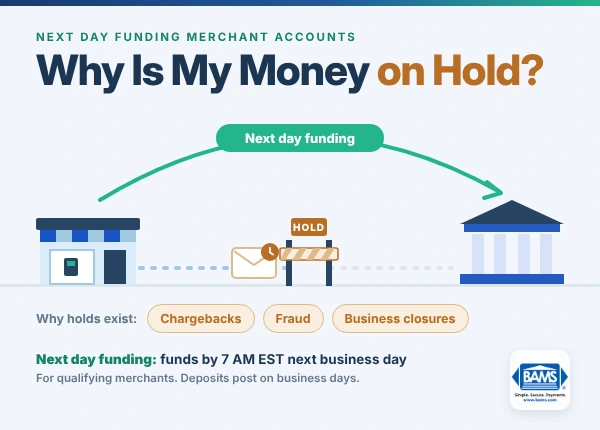
Rolling Reserves: A Cash Flow Planning Guide
Last Updated on October 6, 2026 by Dimitri Akhrin
How eCommerce operators can forecast reserve holds, optimize release schedules, and unlock better terms
Learn how rolling reserves actually work, what drives your reserve percentage up or down, and how to build a processor relationship that improves your terms. This guide treats reserves as a plannable cash flow variable for growing eCommerce teams.
TL;DR
- Rolling reserves can be planned around — They temporarily withhold a portion of transaction proceeds based on your merchant agreement, creating a pool of locked capital that you can incorporate into your cash flow forecast.
- Your chargeback ratio is the biggest lever — Keeping disputes below 0.5% is the single most effective way to qualify for lower reserve percentages and shorter hold periods.
- Proactive communication reduces risk perception — Processors increase reserves when they’re surprised by volume changes. Sharing your growth plans in advance prevents unnecessary holds.
- Reserve terms are negotiable — After six to twelve months of clean processing, request a formal review with documented data. Many merchants never ask, so they never get a reduction.
- Treat reserves as a cash flow line item — Build a simple forecast model that tracks funds entering and leaving the reserve each month so held funds never cause a surprise shortfall.
Guide Orientation: What This Covers and Who It’s For
This guide explains how rolling reserves work, why they change as your eCommerce business grows, and how to actively reduce them over time. It treats reserve management as a forecastable cash flow variable, not an opaque penalty you absorb in silence.
It’s written for eCommerce managers at established online businesses (roughly 10 to 50 employees) who have encountered payout holds or reserve withholdings during growth phases and want to plan around them rather than be blindsided. If you’ve ever opened your merchant dashboard and wondered why a chunk of your revenue is sitting in limbo, this is for you.
By the end, you’ll understand how reserve release schedules work, what factors drive your reserve percentage up or down, and how to build a processor relationship that rewards your track record with better terms. We won’t cover high-risk industry compliance or gateway-specific technical integrations. The focus is operational planning and merchant cash flow.
Why Rolling Reserves Matter More Than You Think
Most eCommerce operators first encounter rolling reserves during a growth spike. Revenue climbs, transaction volume surges, and suddenly the processor withholds a percentage of every sale. The timing feels punitive, but it isn’t random. Processors use reserves as a financial buffer against chargebacks, fraud exposure, and refund liability. The problem is that most merchants never learn the mechanics well enough to plan around them.
The Office of the Comptroller of the Currency notes that acquirers may establish merchant reserve or holdback accounts to limit exposure to chargebacks and other merchant risks. A bank may fund that reserve by withholding a portion of the merchant’s proceeds. That means a meaningful portion of your working capital can remain unavailable for payroll, inventory, or ad spend.
The cost of ignoring this is real. Businesses that treat payouts as fully available cash run into shortfalls during seasonal peaks, product launches, or supplier payment windows. Businesses that understand the reserve release schedule can forecast around held funds, negotiate better terms proactively, and free up capital faster. The difference isn’t luck. It’s literacy.
As eCommerce grows more competitive, merchant cash flow management becomes a strategic advantage, not just an accounting task. The operators who treat reserves as a manageable variable outperform those who treat them as a fixed tax.
Core Concepts: How Reserves Actually Work
What a Rolling Reserve Is
A rolling reserve is a percentage of your transaction revenue that your payment processor withholds temporarily. It acts as a safety net against financial exposure from chargebacks, refunds, or fraud. Unlike a fixed reserve (a lump sum held indefinitely), a rolling reserve cycles: funds withheld today are released after a set period, while new funds continue to be withheld from incoming transactions.
The Reserve Release Schedule
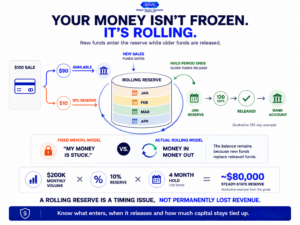
A rolling reserve is a moving pool of capital. New transactions add funds while older withheld funds become available after their scheduled hold period.
The reserve release schedule defines when withheld funds become available to you. If your processor holds 10% on a 90-day rolling basis, every dollar withheld on January 1 is released on April 1. This creates a predictable pattern once you understand it, but it also means there’s always a pool of locked capital. The size of that pool depends on your processing volume, the withholding percentage, and the hold duration.
Key Distinctions Most Merchants Miss
Rolling reserves are not the same as payment processing freezes, though they can feel similar. A payment processing freeze stops all payouts. A rolling reserve reduces them. They also differ from chargeback penalties, which are reactive fees. Reserves are proactive risk mitigation.
Another common misconception: reserves are not permanent. They are tied to your risk profile, which changes as your business matures. The percentage can go down, the hold period can shorten, and in some cases, reserves can be removed entirely. Understanding this distinction is the foundation for everything that follows.
The Framework: Four Levers for Reducing Reserves
Reducing your reserve requirements is not a single action. It’s an ongoing process built on four interconnected levers. Each lever influences how your processor assesses your risk, and therefore how much of your revenue they hold.
- Lever 1: Transaction Pattern Stability — Demonstrate consistent, predictable processing volume and ticket sizes.
- Lever 2: Chargeback Ratio Management — Keep dispute rates well below processor thresholds.
- Lever 3: Transparent Communication — Proactively share business context with your processor before changes happen.
- Lever 4: Structured Negotiation — Use your track record to request formal reserve reviews at defined intervals.
These levers work together. Strong transaction patterns without low chargebacks won’t move the needle. Low chargebacks without communication won’t trigger a review. The system rewards merchants who manage all four simultaneously. Here’s how to execute on each one.
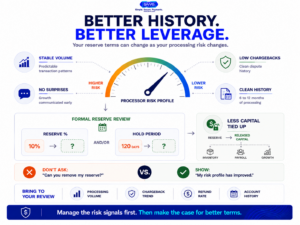
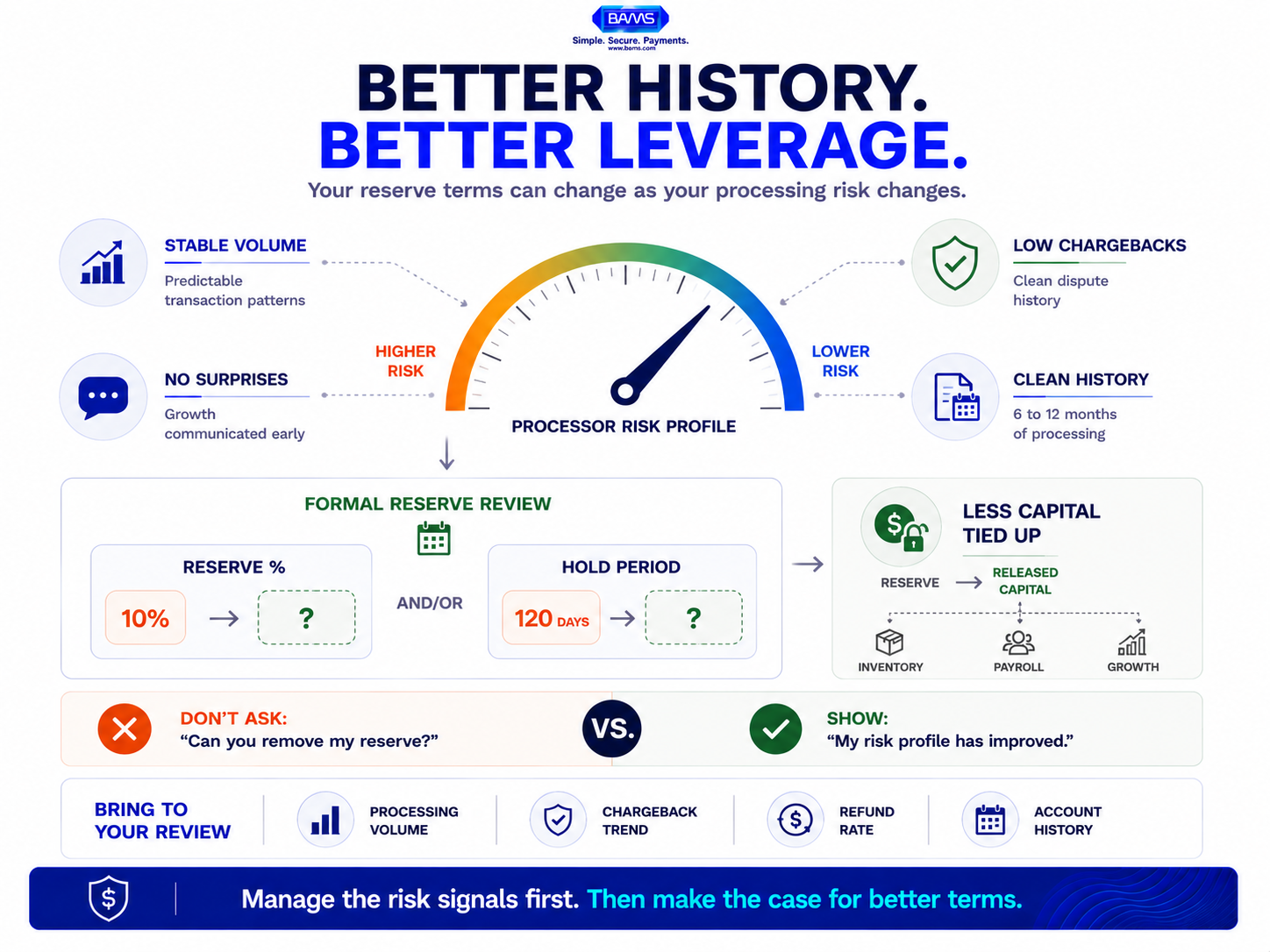
Reserve terms reflect risk. A stronger processing history gives merchants better evidence when asking a processor to review the percentage withheld or the length of the hold.
Step-by-Step: How to Reduce Your Rolling Reserve Requirements
Step 1: Map Your Current Reserve Position
Objective: Know exactly how much capital is locked, for how long, and under what terms.
Before you can reduce reserves, you need to quantify them. Pull your merchant agreement and identify three numbers: the withholding percentage, the hold duration, and your average monthly processing volume. Multiply those together to calculate your steady-state reserve balance, the amount that’s effectively locked at any point in time.
For example, if your agreement requires a 10% rolling reserve with a 120-day hold and you process $200,000 per month, roughly $80,000 can be sitting in reserve at any given time. Write that number down. It’s the baseline you’re working to reduce.
Next, map the release schedule to your cash flow calendar. When do reserve releases hit your account relative to payroll, inventory orders, and ad spend cycles? This mapping turns an opaque hold into a forecastable line item. Build it into your working-capital model the same way you’d model accounts receivable.
Anti-patterns: Don’t assume your reserve terms match what your sales rep quoted verbally. Read the merchant agreement. Don’t treat the withheld amount as “lost” money; it’s deferred, and knowing the release date changes how you plan.
Success indicators: You can state your exact reserve balance, release dates, and the impact on your monthly cash position without checking your dashboard.
Step 2: Stabilize Your Transaction Patterns
Objective: Remove volatility signals that trigger higher risk assessments from your processor.
Processors use dynamic risk scoring to evaluate your account continuously. Sudden spikes in transaction volume, dramatic shifts in average ticket size, or new product categories all register as risk signals. These signals can increase your reserve percentage or extend your hold period, sometimes without warning.
Stabilization doesn’t mean limiting growth. It means making growth legible to your processor. If you’re planning a product launch that will double your weekly volume, that’s fine. But if your processor sees a 200% volume spike with no context, their risk models flag it. The result is often a higher reserve or a temporary funding hold.
Align your merchant account configuration to your actual sales data. Review your processing limits, approved product categories, and expected volume ranges quarterly. If your business has seasonal peaks (holiday, back-to-school, summer), document those patterns and share them with your processor in advance. Predictability is your best argument for lower reserves.
Anti-patterns: Don’t add high-ticket items or new product lines without updating your merchant profile. Don’t ignore processing limit warnings, as exceeding approved volumes is one of the fastest ways to trigger a reserve increase.
Success indicators: Your monthly processing volume stays within 20% of your approved range, or you’ve proactively updated your limits before exceeding them. No surprise holds triggered by volume spikes.
Step 3: Drive Your Chargeback Ratio Below Threshold
Objective: Maintain a chargeback ratio well below 1%, ideally under 0.5%, to qualify for reserve reductions.o
Your dispute and fraud activity is one of the most influential factors in your reserve terms. Processors monitor it continuously, and Visa’s current Visa Acquirer Monitoring Program evaluates fraud and disputes at both the acquirer and merchant levels. Elevated activity can increase risk scrutiny and may affect how your processor evaluates your account.
Reducing chargebacks is a cash flow lever, not just a compliance task. Every chargeback you prevent removes a data point that your processor uses to justify holding your funds. Focus on three areas: clear product descriptions and shipping timelines (to prevent “item not as described” disputes), recognizable billing descriptors (to prevent “I don’t recognize this charge” disputes), and responsive customer service (to resolve issues before they become formal disputes).
Track your chargeback ratio monthly. If it’s above 0.65%, treat it as urgent. Build a refund-first policy for legitimate complaints. A $50 refund costs far less than a $50 chargeback plus the $25 to $100 dispute fee, the hit to your ratio, and the potential reserve increase that follows.
Anti-patterns: Don’t ignore chargeback alerts or let disputes go unresponded. Don’t assume a low dollar amount means a chargeback doesn’t matter, as processors care about the ratio (count of chargebacks to total transactions), not the dollar value.
Success indicators: Your chargeback ratio stays below 0.5% for three consecutive months. You have a documented dispute response process with response times under 48 hours.
Step 4: Build a Communication Cadence with Your Processor
Objective: Establish a proactive relationship where your processor views your account as low-risk because they understand your business.
Most merchants interact with their processor only when something goes wrong: a funding delay, a fee dispute, or a reserve increase. This reactive pattern ensures your processor’s risk team has no context beyond raw transaction data. And raw data, without context, always looks riskier than it is.
Set up a quarterly review cadence. Share your business trajectory: upcoming promotions, seasonal forecasts, new product launches, and changes in fulfillment timelines. When your processor understands why your volume is changing, they’re less likely to treat the change as a risk signal. This is where working with a merchant services partner that offers dedicated account management makes a measurable difference. BAMS, for example, assigns dedicated account managers who can advocate for reserve adjustments on your behalf because they understand your business context, not just your transaction data.
Document every communication. When you request a reserve review (Step 5), you’ll want a record showing consistent, transparent engagement. Processors reward merchants who reduce their information burden.
Anti-patterns: Don’t go silent for months and then call only when you want something reduced. Don’t withhold information about business changes thinking it will “fly under the radar.” It won’t, and the surprise will cost you.
Success indicators: You have a named contact at your processor or merchant services partner. You’ve had at least two proactive conversations in the last six months that weren’t triggered by a problem.
Step 5: Request a Formal Reserve Review
Objective: Use your documented track record to negotiate a lower reserve percentage, shorter hold period, or both.
Reserve terms are not permanent. They are set based on your risk profile at the time of account approval, and that profile changes as you build history. After six to twelve months of stable processing with low chargebacks, you have standing to request a formal review.
Prepare a brief case that includes: your average monthly volume over the review period, your chargeback ratio trend, your refund rate, and any documentation of proactive communication with your processor. Frame the request around data, not frustration. You’re not complaining about the reserve. You’re demonstrating that your risk profile has improved and requesting terms that reflect that improvement.
If your first request is declined, ask what specific metrics would trigger a reduction. Get the criteria in writing. Then meet those criteria and request again. Persistence, backed by data, works.
Anti-patterns: Don’t make emotional appeals. Don’t threaten to switch processors as a negotiation tactic (it rarely works and can backfire). Don’t request a review during a month when your chargeback ratio spiked.
Success indicators: You receive a written response to your review request with either updated terms or specific criteria for future reduction. Your reserve percentage or hold period decreases within two review cycles.
Step 6: Integrate Reserve Forecasting into Treasury Management
Objective: Make reserves a permanent, predictable line item in your financial planning rather than a surprise that disrupts operations.
Even as you work to reduce reserves, you’ll likely have some level of withholding for the foreseeable future. The goal isn’t to eliminate reserves overnight. It’s to make them predictable enough that they never cause a cash flow crisis.
Build a simple reserve forecast model. For each month, calculate: (monthly processing volume × reserve percentage) as the amount entering the reserve, and (processing volume from X months ago × reserve percentage at that time) as the amount being released. The difference between inflows and releases tells you whether your locked capital is growing, shrinking, or stable.
Layer this model into your broader cash flow forecast alongside accounts receivable, inventory commitments, and operating expenses. When you can see that $40,000 in reserves will release on March 15 while $45,000 enters the reserve during March, you can plan around the $5,000 net drag instead of being surprised by it.
For businesses with strong fraud protection measures and low dispute rates, this net drag shrinks over time as reserve terms improve. The forecast model lets you track that improvement quarter over quarter.
Anti-patterns: Don’t build a forecast once and forget it. Update it monthly with actual processing data. Don’t ignore the compounding effect of volume growth on reserve balances, as a 10% reserve on $100,000/month is very different from 10% on $300,000/month.
Success indicators: Your CFO or financial lead can project reserve balances three months forward with less than 10% variance. Reserve releases are accounted for in cash flow planning before they arrive.
Practical Examples: Reserves at Different Growth Stages
Scenario A: Early Growth (Processing $50,000/month)
A skincare brand starts processing $50,000 per month through a new merchant account. The processor sets a 10% rolling reserve with a 180-day hold. After six months at steady state, roughly $30,000 is locked in reserves at any given time. The founder didn’t model this and runs short on inventory capital heading into a holiday promotion.
The fix: Map the reserve position (Step 1) and build it into the cash flow forecast (Step 6) immediately. After six months of clean processing, request a review (Step 5) to reduce the hold period from 180 to 90 days. That single change cuts the steady-state reserve balance from $30,000 to $15,000, freeing $15,000 in working capital.
Scenario B: Scaling Phase (Processing $250,000/month)
An electronics accessories company scales from $100,000 to $250,000 per month over a quarter. The processor increases the reserve from 5% to 12% because the volume spike triggered a risk review. The company now has over $90,000 locked at steady state on a 120-day hold.
The fix: This was preventable. If the company had communicated the growth trajectory in advance (Step 4) and updated their approved processing limits (Step 2), the volume increase would have been expected, not alarming. After stabilizing at the new volume for 90 days with a chargeback ratio under 0.4%, they request a review and negotiate back to 7% with a 90-day hold. Steady-state reserve drops to roughly $52,500.
Scenario C: Mature Operations (Processing $500,000/month)
A home goods brand with 18 months of processing history, a 0.3% chargeback ratio, and quarterly processor reviews has negotiated their reserve down to 3% on a 60-day hold. Their steady-state reserve is approximately $30,000 on $500,000/month in volume, a manageable and fully forecasted line item. They treat reserve releases as a predictable cash inflow and time inventory purchases accordingly.
Common Mistakes and Pitfalls
The most common mistake is treating reserves as a fixed cost rather than a negotiable term. Merchants who never ask for a review never get a reduction. It’s that simple.
A close second is failing to connect chargeback management to reserve terms. Disputes create costs beyond the original transaction. Mastercard reports that merchants average $82 in internal costs and $46 in third-party fees per chargeback. A cleaner dispute history also gives you stronger data when discussing reserve terms with your processor.
Other predictable failures include: surprising your processor with volume spikes, ignoring the merchant agreement’s reserve clauses until funds are withheld, and treating reserve discussions as adversarial rather than collaborative. Processors want low-risk merchants. Your job is to prove you are one.
Finally, don’t over-optimize. Spending months negotiating a 1% reserve reduction on low volume isn’t worth the effort. Focus your energy where the dollar impact is meaningful, usually when your steady-state reserve balance exceeds $20,000.
What to Do Next
Start with Step 1. Pull your merchant agreement, calculate your steady-state reserve balance, and map release dates to your cash flow calendar. This single action transforms reserves from an abstract deduction into a concrete number you can plan around.
If you’ve been processing for six months or more with a clean track record, consider requesting a formal reserve review this quarter. Prepare your data first: chargeback ratio, processing volume trend, and refund rate. Let the numbers make your case.
Revisit this guide quarterly as your business grows. Reserve management isn’t a one-time project. It’s an ongoing relationship between your transaction history, your communication habits, and your processor’s risk models. Each quarter you build clean history is another data point in your favor.
The merchants who treat reserves as a forecastable, reducible variable are the ones who free up capital when it matters most. Start with one step. Build from there.
Frequently Asked Questions
What is reserve and hold management in merchant services?
Reserve and hold management refers to how payment processors withhold a percentage of your transaction revenue as a financial buffer against chargebacks, fraud, and refunds. Managing it means understanding your withholding percentage, hold duration, and release schedule so you can forecast the impact on your cash flow and work to reduce the terms over time.
Why do payment processors withhold reserves from merchants?
Processors use reserves as a safety net against financial exposure. If a merchant generates chargebacks or refunds after funds have been deposited, the processor is liable. The reserve ensures there’s money available to cover those costs. The withholding percentage and duration are tied to the processor’s assessment of your risk profile, which includes factors like your industry, chargeback history, processing volume, and time in business.
How do rolling reserves work in payment processing?
<p>A rolling reserve withholds a set percentage of each transaction and holds it for a defined period specified in your merchant agreement. Funds withheld on any given day are released after that hold period expires. This creates a continuous cycle: new funds enter the reserve daily while older funds are released on their scheduled date. The result is a steady-state balance of locked capital that scales with your processing volume.
When can a merchant expect to have their reserves released?
Release timing depends on your reserve terms. With a 90-day rolling reserve, funds withheld from January transactions are released in April. With a 180-day hold, those same funds wouldn’t be available until July. Check your merchant agreement for the specific hold period. Once you know it, you can map release dates to your cash flow calendar and plan accordingly.
Which factors influence the percentage of reserves withheld by payment processors?
The primary factors are your chargeback ratio, refund rate, processing volume stability, average ticket size, industry category, and time in business with the processor. Sudden volume spikes, high dispute rates, or operating in categories with elevated return rates all push reserve percentages higher. Conversely, a long track record of stable processing with low chargebacks gives you leverage to negotiate lower percentages.
How can merchants reduce their reserve requirements over time?
Build a clean processing history (six to twelve months minimum), keep your chargeback ratio below 0.5%, maintain stable transaction patterns, communicate proactively with your processor about business changes, and then request a formal reserve review with documented data. Many merchants don’t realize reserves are negotiable. They are. But the negotiation works best when it’s backed by data showing your risk profile has improved.