Cash Flow Acceleration Strategies: The 3-Day Delay Tax
Last Updated on May 28, 2026 by Dimitri Akhrin
Why the standard settlement window is a compounding growth penalty, not a minor operational friction
Learn why the 3-to-5-day payment settlement window costs more than you think. This piece reframes funding speed as a strategic reinvestment lever and shows how cash flow acceleration strategies start at the moment of sale.
TL;DR
- The 3-to-5-day settlement window is a compounding penalty, not a standard – Every day your revenue sits in transit is a missed reinvestment cycle that your faster-funded competitors are capturing.
- Funding speed is your reinvestment clock – Next-day funding collapses float, frees working capital, and lets you make operational decisions based on real deposits instead of projections.
- Your forecasting model changes completely – When cash arrives daily, you stop padding timelines with buffers and start tying spend directly to yesterday’s revenue, making forecasts more accurate and operations leaner.
- The gap widens over time – Faster settlement means more optimization cycles per quarter, which compounds into a structural advantage that slower-funded competitors can’t close with better tactics alone.
Your Revenue Is Sitting in Someone Else’s Account Right Now
Here’s something eCommerce managers rarely calculate: the cost of money you’ve already earned but can’t touch. Every sale processed yesterday that won’t land in your account for three to five days isn’t just delayed. It’s revenue you can’t reinvest, inventory you can’t restock, and a marketing campaign you can’t scale. Cash flow acceleration strategies don’t start with chasing invoices or tightening payment terms. For eCommerce businesses, they start at the moment of sale, with how fast your processor actually pays you.
The 3-to-5-Day Hold Became “Normal” Because Nobody Questioned It
The standard settlement window in payment processing exists for real reasons. Processors need time to verify transactions, manage fraud risk, and move money through banking networks. That was genuinely necessary infrastructure a decade ago.
But the industry kept the timeline even after the technology caught up. NACHA ACH Network resources continue to emphasize how settlement timing and ACH processing efficiency directly impact business liquidity and operational flexibility. Merchant funding hold periods became an accepted cost of doing business, like processing fees. Ecommerce managers built their forecasting models around the delay, padded their cash reserves, and stopped asking whether it had to be this way.
It didn’t. And treating it as inevitable has a measurable price.
The Delay Isn’t a Minor Friction. It’s a Compounding Growth Penalty.
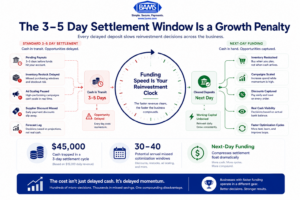
Why slower funding cycles quietly reduce reinvestment speed, forecasting accuracy, and operational momentum.
We believe this: waiting 3-5 days to access your own revenue isn’t a payment industry standard worth accepting. It’s a competitive disadvantage with a price that compounds every single cycle.
The businesses that figure this out first don’t just “have better cash flow.” They operate in a fundamentally different gear than competitors who are still forecasting around a delay that no longer needs to exist.
What the Gap Between Slow and Fast Settlement Actually Costs You
Let’s make this concrete. Say your eCommerce brand does $15,000 in daily revenue. Under a standard 3-day settlement, you’re carrying roughly $45,000 in float at any given time. That’s $45,000 of your money that you can see on a dashboard but can’t deploy.
Now run that through your actual operations. Your supplier offers a 2% early payment discount on a $20,000 inventory order, but the cash won’t clear until Thursday. You miss the window. That’s $400 gone. Multiply that across 30 or 40 restock cycles per year, and you’re looking at $12,000 to $16,000 in lost savings alone.
Or consider paid media. Your best-performing ad set is hitting a 4x ROAS on Tuesday, but you can’t increase spend because Monday’s revenue hasn’t settled. By the time the cash arrives, the algorithm has moved on. The moment is gone. You didn’t lose money. You lost momentum, which is harder to recover.
Next-day funding collapses that float from $45,000 to $15,000. That’s $30,000 freed up on any given day. Not borrowed. Not leveraged. Just yours, available when you need it.
The data backs this up at scale. 83% of finance leaders say real-time payments improve cash flow management, and 72% of businesses using faster payment access report it helps them avoid borrowing or using credit entirely.
Federal Reserve Small Business Employer Firms Report findings continue to show that liquidity pressure and uneven cash positioning remain major operational concerns for growing businesses. The settlement window isn’t a technicality. It’s the bottleneck.
This is where the compounding penalty lives.
It’s not one missed discount or one delayed ad buy. It’s the accumulated drag of hundreds of micro-decisions constrained by money that’s technically yours but practically inaccessible. Over a year, the business running on next-day settlement doesn’t just save money. It makes different (and better) decisions because the cash is there when the opportunity is.
Tools like BAMS offer next-day funding with a 9 PM EST cutoff, which means revenue from a full business day can land in your account the following morning. For eCommerce managers forecasting cash flow, this shifts the model from “predict what you’ll have in 3-5 days” to “plan with what you earned yesterday.” That’s a different forecasting exercise entirely, and a far more accurate one.
If This Is Right, Your Forecasting Model Needs to Change
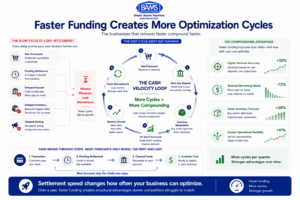
How faster settlement timing compounds into stronger inventory, advertising, and forecasting decisions over time.
Most eCommerce cash flow forecasts are built around a buffer: pad the timeline, assume delays, keep a reserve. That’s not forecasting. That’s guessing with guardrails.
When settlement compresses to one day, your forecast becomes almost real-time. You can tie ad spend to yesterday’s revenue and you can trigger restock orders based on actual deposits, not projected ones. You can run leaner without running scared. Modern Treasury payment operations resources also emphasize how faster settlement visibility improves reconciliation accuracy and short-term forecasting reliability.
The implication cuts deeper than operations. If your competitor gets paid daily and you get paid every three to five days, they’re making reinvestment decisions 3-5x faster. Over a quarter, that’s dozens of additional optimization cycles. Over a year, it’s a structural advantage that widens with every turn of inventory.
The question isn’t whether faster funding is “nice to have.” It’s whether you can afford to let your competitor have it while you don’t.
Stop Forecasting Around the Delay. Eliminate It.
Here’s the reframe: settlement speed isn’t a feature of your payment processor. It’s the clock speed of your entire business.
Every operational decision downstream, from inventory purchasing to marketing spend to supplier negotiations, is gated by when cash becomes available. Speed up the gate, and you speed up every decision that follows. The right way to think about cash flow acceleration strategies for eCommerce isn’t “how do we manage the delay better?” It’s “why are we tolerating a delay at all?”
Funding speed is your reinvestment clock. The faster it ticks, the more cycles you get. More cycles mean more compounding. More compounding means the gap between you and slower-funded competitors grows every single day.
The Businesses That Win Aren’t Waiting
You don’t need a better spreadsheet and you don’t need a more sophisticated forecasting tool. You need your money faster. The eCommerce brands pulling ahead right now aren’t doing it with secret strategies. They’re doing it by refusing to accept that a 3-to-5-day wait for their own revenue is just how things work. It’s not. And the cost of believing otherwise gets more expensive every day you leave it unchallenged.
Frequently Asked Questions
What is a cash flow acceleration strategy?
A cash flow acceleration strategy is any approach that gets revenue into your hands faster so you can reinvest sooner. For eCommerce businesses, the highest-leverage version is reducing settlement time from your payment processor, since every sale already represents earned revenue sitting in transit.
How can businesses improve cash flow forecasting with real-time data?
When your processor offers next-day funding, your forecast shifts from projecting deposits days out to planning with yesterday’s actual revenue. This lets you tie spending decisions to real numbers instead of estimates, which dramatically reduces the need for cash buffers and guesswork.
Which payment solutions help reduce processing fees and improve liquidity?
Look for processors that combine transparent pricing with faster settlement. Next-day funding providers like BAMS compress the float between sale and deposit, which improves liquidity directly and can eliminate the need for short-term borrowing that 72% of faster-funded businesses report avoiding.