
How to Build a Chargeback Defense Program for Funeral Homes
Last Updated on October 29, 2026 by Dimitri Akhrin
Guide Orientation: What This Guide Covers and Who It’s For
A single disputed high-ticket transaction can freeze thousands of dollars and most funeral home operators don’t find out until the damage is done. This guide walks you through building a chargeback defense program and implementing secure payment integration practices. It’s designed for businesses that routinely process transactions above $15,000 in emotionally sensitive contexts.
This is written for family-owned funeral service operators managing one to ten locations. If you handle high-value payments, rely on steady cash flow to cover operational costs and want to stop chargebacks before they drain revenue, this guide is for you.
By the end, you’ll know how to structure your payment environment to prevent disputes. You’ll also build documentation habits that win representment cases and choose fraud prevention tools that match the realities of your business. We focus on proactive defense systems rather than reactive dispute paperwork.
TL;DR
- Chargebacks are a revenue-continuity threat, not just a fraud issue – A single disputed $15,000+ transaction can tie up funds for weeks or months. Nearly half of surveyed merchants say friendly fraud (legitimate customers disputing real charges) drives at least half of their chargebacks.
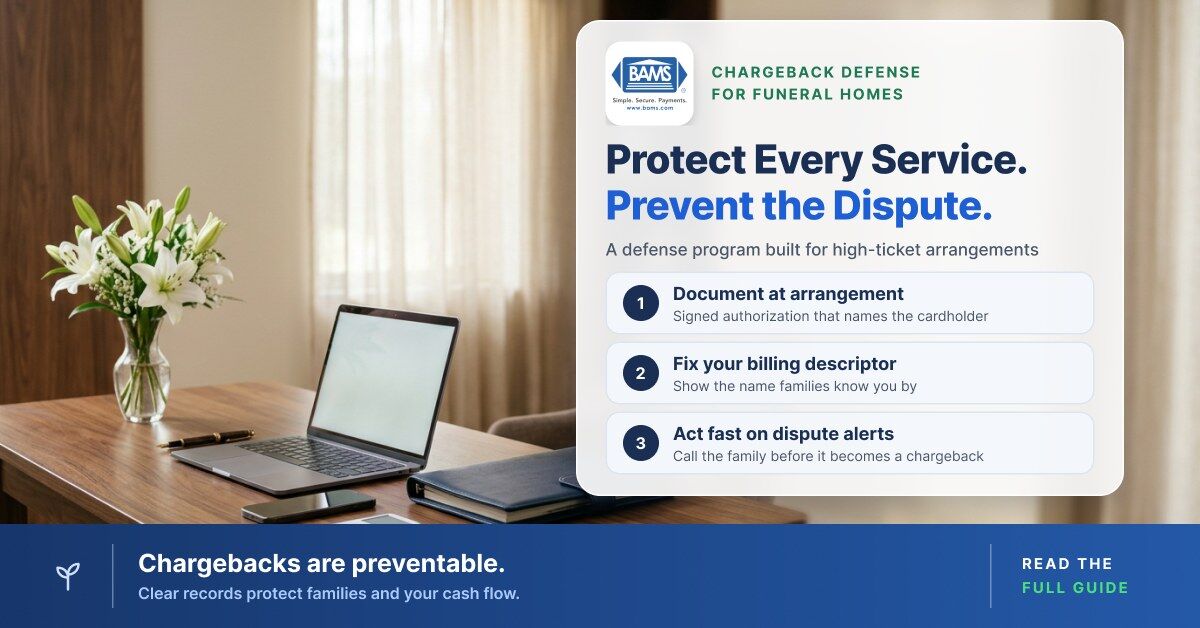
- Documentation at the point of sale is your strongest defense – Signed cardholder authorizations, itemized receipts and email confirmations create the evidence you need to win representment cases and prevent confusion-driven disputes.
- Fix your billing descriptor immediately – If your credit card statement shows a legal entity name instead of your funeral home’s public name, you’re inviting disputes. It’s one of the simplest, lowest-cost fixes available.
- Enroll in dispute alert programs – Alert services from Verifi (a Visa company) and Ethoca (a Mastercard company) can give you a short window, often 24 to 72 hours, to resolve disputes before they become formal chargebacks. That saves you fees, ratio damage and frozen funds.
- Train staff and audit quarterly – Systems fail when people skip steps. Twice-yearly training and quarterly transaction audits keep documentation compliance above 90% and your chargeback ratio well below penalty thresholds.
Why Chargeback Defense Matters for High-Ticket Service Businesses
Chargebacks are not just an eCommerce problem. Mastercard estimated that chargebacks cost merchants $117.47 billion in 2023. For a funeral home processing a $20,000 service package, a single chargeback doesn’t just erase the sale. It can trigger fees and tie up capital for weeks while the dispute runs its course.
The nature of funeral services makes this worse. Families make purchasing decisions under extreme emotional stress. Weeks or months later, a surviving spouse or family member may not recognize the charge, may experience buyer’s remorse, or may dispute the transaction without ever calling your office. 53% of cardholders dispute transactions with their bank without first contacting the merchant, cutting you out of the resolution process entirely.
The cost of inaction compounds quickly. 79% of organizations experienced attempted or actual payments fraud in 2024 and recovery rates are declining. Only 22% of organizations recovered at least 75% of funds lost to payments fraud, down from 41% the year prior. If you’re waiting for chargebacks to happen before responding, you’re already losing money you’ll never get back.
For a business where average transaction values are high and volume is relatively low, every disputed charge has an outsized impact on monthly cash flow. This isn’t a fraud topic. It’s a revenue-continuity issue and it’s why a chargeback defense program belongs in your daily operations.
Core Concepts: Understanding the Chargeback Landscape
Chargebacks vs. Refunds
A refund is a voluntary return of funds you initiate. A chargeback is a forced reversal initiated by the cardholder’s bank. Chargebacks carry additional fees (often $20 to $100 per incident) and count toward your dispute ratio. Sustained high ratios can lead to card network monitoring programs, fines or even losing the ability to accept cards. For card-not-present sales such as phone and online payments, Visa’s VAMP program flags U.S. merchants at 1.5% from April 1, 2026. Many processors set internal limits well below that.
Friendly Fraud: The Primary Threat
True criminal fraud (stolen cards, identity theft) gets the most attention, but it’s not your biggest risk. Nearly half of surveyed merchants said friendly fraud accounted for at least 50% of their chargebacks. Friendly fraud occurs when a legitimate customer disputes a charge they actually authorized. In funeral services, this often happens when the person who arranged services isn’t the cardholder, when family members disagree about the purchase after the fact, or when the billing descriptor on the credit card statement doesn’t match the business name the family remembers.
Representment: Your Right to Fight Back
When a chargeback is filed, you have the right to submit evidence proving the transaction was legitimate. This process is called representment. Success depends largely on the quality of your documentation: signed agreements, itemized receipts, proof of service delivery and communication records. Without a system for collecting this evidence at the point of sale, representment becomes nearly impossible.
PCI Compliance: The Security Foundation
PCI DSS (Payment Card Industry Data Security Standard) is the baseline requirement for any business that accepts card payments. PCI compliance protects cardholder data through encryption, access controls and network security. For funeral homes, compliance isn’t just about avoiding fines. It’s about ensuring your payment integration doesn’t create vulnerabilities that invite disputes or data breaches.
The Proactive Defense Framework for Secure Payment Integration
An effective chargeback defense program isn’t a single tool or policy. It’s a system with five interconnected layers that work together to prevent disputes, catch problems early and win the cases you can’t prevent.
The five layers are:
- Transaction Documentation – Capture evidence at the point of sale that proves authorization and service delivery.
- Payment Environment Security – Configure your payment stack to minimize vulnerabilities and meet PCI compliance standards.
- Billing Clarity – Ensure every charge is recognizable and transparent to the cardholder.
- Early Detection and Alerts – Intercept disputes before they become formal chargebacks.
- Representment Readiness – Maintain organized, submission-ready evidence for every high-ticket transaction.
Each layer reinforces the others. Strong documentation makes representment effective. Clear billing reduces friendly fraud. Secure payment integration protects against true fraud. The steps below walk you through building each layer.

Documentation, payment security, billing clarity, early alerts and representment, held together by training and quarterly audits.
Step-by-Step: Building Your Chargeback Defense Program
Step 1: Establish Ironclad Transaction Documentation
Objective: Create a complete evidence package for every transaction above $5,000 that can be submitted for representment within 24 hours of a dispute notification.
For funeral service operators, the documentation challenge is unique. Services are arranged during moments of grief, often by someone other than the cardholder. This creates gaps that friendly fraud exploits. Your goal is to close those gaps at the point of arrangement, not after a dispute arrives.
Build a standard documentation packet. It should include a signed service agreement with the cardholder’s name and signature (digital signatures are acceptable and often preferable) and an itemized breakdown of all services and merchandise. Add a clear cancellation and refund policy acknowledged by the signer, plus a record of the card authorization method (chip, swipe, keyed, or online). If the person arranging services is not the cardholder, document this relationship explicitly and obtain written authorization from the cardholder when possible.
Anti-patterns to avoid: Don’t rely on verbal agreements for high-ticket items. Don’t assume that a signed general contract covers payment authorization. Avoid storing documentation in scattered locations (email, paper files, different computers) where retrieval takes days.
Success indicators: You can produce a complete evidence packet for any transaction within one business day. Every transaction above $5,000 has a signed authorization that names the cardholder. Your staff follows the same documentation process at every location.
Step 2: Secure Your Payment Environment for PCI Compliance
Objective: Configure your payment stack so that cardholder data is protected at every point, reducing both fraud risk and compliance liability.
PCI compliance is not a one-time checkbox. It’s an ongoing operational practice. For funeral homes with multiple locations, the most common vulnerabilities are outdated POS terminals, shared login credentials for payment systems and staff who manually write down card numbers for phone orders.
Start with your payment terminal hardware. Every terminal should support EMV chip reading and contactless payments. Under the EMV liability shift, counterfeit card fraud on a chip transaction at a chip-capable terminal generally becomes the issuer’s responsibility. That makes a fraud dispute on a chip sale easier to defend than one on a keyed-in sale. For phone orders (common in funeral services when family members call from out of state), use a payment gateway that tokenizes card data at entry rather than storing raw numbers.
Implement unique user credentials for every staff member who accesses your payment system. Shared logins make it impossible to audit who processed a transaction, which weakens your position in any dispute. Review your network security quarterly: ensure your payment terminals are on a segmented network, not shared with general office computers or guest Wi-Fi.
Anti-patterns to avoid: Don’t write card numbers on paper forms, even temporarily. Don’t use the same password across POS systems at multiple locations. Never skip your annual PCI Self-Assessment Questionnaire.
Success indicators: All terminals accept EMV chip payments. No raw card numbers are stored anywhere in your facility. Each staff member has unique payment system credentials. You complete your PCI SAQ annually and address any flagged items within 30 days.
Step 3: Make Every Charge Instantly Recognizable
Objective: Eliminate confusion-driven disputes by ensuring your billing descriptor, receipts and communication match what the cardholder expects to see.
This is the simplest and most overlooked step in chargeback prevention. When a grieving family member reviews their credit card statement three weeks later and sees “ACME HOLDINGS LLC” instead of “Riverside Memorial Funeral Home,” they may not recognize the charge. The result is a dispute filed in good faith that costs you revenue and time.
Contact your payment processor and verify your billing descriptor. It should match the name families know you by, not your legal entity name or a parent company. Include a phone number in the descriptor if your processor supports it. This gives confused cardholders a direct path to call you before calling their bank.
At the point of sale, provide an itemized receipt that clearly lists each service and product. The FTC’s Funeral Rule already requires an itemized statement of the goods and services a family selects, so build your receipt from that same document. Email a copy to the cardholder (not just the arranger, if they’re different people). Follow up with a brief, empathetic confirmation message within 48 hours that includes the total charged, the date and your contact information. This creates a paper trail that both prevents confusion and serves as evidence if a dispute occurs.
Anti-patterns to avoid: Don’t assume your billing descriptor is correct without checking. Don’t send receipts only to the person who arranged services if someone else’s card was used. Avoid vague line items like “services rendered” on receipts.
Success indicators: Your billing descriptor matches your public-facing business name. Every cardholder receives an itemized receipt via email. You have a post-transaction confirmation process that runs within 48 hours.
Step 4: Implement Early Detection and Dispute Alerts
Objective: Intercept disputes during the pre-chargeback window so you can resolve them directly with the cardholder or issue a strategic refund before the chargeback is formalized.
Alert services owned by Visa and Mastercard (Verifi and Ethoca) notify merchants when a cardholder initiates a dispute, before it becomes a formal chargeback. This window, often 24 to 72 hours, gives you the chance to contact the cardholder, clarify the charge, or issue a refund that avoids the chargeback fees and ratio impact.
For funeral home operators, this early warning is critical. A $18,000 chargeback doesn’t just cost you the revenue. It can trigger a $25 to $100 fee, counts against your chargeback ratio and can tie up the funds for weeks while the dispute is resolved. A proactive refund during the alert window costs you the sale but avoids the chargeback itself (alert services may charge their own fee per alert). In some cases, a phone call during this window resolves the confusion entirely and you keep the revenue.
Ask your processor about enrolling in these alert programs. BAMS, for example, offers Dispute Responder, which provides immediate notification of a dispute and a clear action plan, along with dedicated account representatives. The key is a process where someone on your team responds to each alert within hours, not days.
Anti-patterns to avoid: Don’t ignore dispute alerts or treat them as low-priority emails. Don’t issue automatic refunds on every alert without first attempting to contact the cardholder. Never rely solely on your payment processor to handle alerts; designate an internal point person.
Success indicators: You’re enrolled in Verifi, Ethoca or equivalent alert programs, directly or through your processor. A designated team member reviews and responds to alerts within 24 hours. You track alert outcomes (resolved, refunded, escalated) monthly.
Step 5: Build a Representment-Ready Evidence System
Objective: Organize your transaction documentation so that compelling representment cases can be assembled and submitted within the card network’s response deadline (often 20 to 45 days and your processor may set a shorter one).
When a chargeback can’t be prevented, representment is your only path to recovering the funds. The process requires submitting a rebuttal letter and supporting evidence to the issuing bank, arguing that the transaction was legitimate and properly authorized. Chargeback prevention strategies reduce your dispute volume, but representment readiness determines how much revenue you recover from the disputes that still occur.
Create a digital filing system (cloud-based, backed up) where every high-ticket transaction’s documentation is stored in a single folder: signed agreement, itemized receipt, cardholder authorization, email confirmations and any relevant communication. When a chargeback notification arrives, your response should be assembly, not research.
Tailor your evidence to the reason code. If the dispute claims “services not received,” your evidence should include delivery confirmation, service completion records and any post-service communication. If the reason code is “not authorized,” your evidence should focus on the signed authorization, EMV chip data and identity verification steps. Generic responses usually lose. Targeted, reason-code-specific responses stand a better chance.
Anti-patterns to avoid: Don’t submit the same boilerplate response for every chargeback regardless of reason code. Don’t wait until the deadline approaches to start gathering evidence. Never skip representment on high-ticket chargebacks because the process feels burdensome.
Success indicators: Every transaction above $5,000 has a complete digital evidence folder created at the time of sale. Your representment response template is customized for the three to five most common reason codes you encounter. You submit representment for 100% of chargebacks on legitimate transactions.
Step 6: Train Your Team and Audit Quarterly
Objective: Ensure every staff member who handles payments understands the documentation, security and communication standards and verify compliance through regular audits.
A chargeback defense program only works when people follow it. In a funeral home setting, staff are focused on serving families during difficult moments. Payment processing procedures can feel secondary. But a single skipped signature or unverified card can cost your business thousands.
Conduct a 30-minute training session for all staff who handle payments at least twice per year. Cover the documentation checklist, proper card handling (never write down numbers, always use chip when present), billing descriptor awareness and how to handle situations where the arranger and cardholder are different people. Role-play the most common scenarios: a family member calling from out of state to pay by phone, a split payment across multiple cards, a request to charge a card that belongs to someone not present.
Quarterly, audit a random sample of 10 to 15 transactions across each location. Verify that documentation is complete, that receipts were sent to cardholders and that all transactions used chip or tokenized entry when possible. Track your chargeback ratio monthly and investigate any upward trend immediately.
Anti-patterns to avoid: Don’t assume experienced staff don’t need refresher training. Don’t audit only after a chargeback occurs. Avoid treating training as a one-time onboarding event.
Success indicators: All payment-handling staff complete training twice annually. Quarterly audits show 90%+ documentation compliance. Your chargeback ratio stays below an internal target such as 0.5%, well under card network and processor limits.
Practical Examples: Applying the Framework
Scenario 1: The Out-of-State Family Member
A son in California calls your funeral home in Ohio to arrange services for his mother. He provides his credit card over the phone for a $16,500 package. Three months later, his wife sees the charge on their statement and disputes it with their bank, claiming it’s unauthorized.
Without the framework: You have a phone log noting the call and a generic contract. The representment fails because you can’t prove the cardholder authorized the specific charge. You lose $16,500 plus fees.
With the framework: During the call, your staff processed the payment through a secure payment gateway that tokenized the card data. You emailed the son an itemized agreement, which he signed digitally. You sent a receipt to his email address and followed up with a confirmation message two days later. When the dispute alert arrives, you call the son, who clarifies the charge with his wife. The dispute is withdrawn before it becomes a chargeback. Revenue preserved, no chargeback recorded.
Scenario 2: The Billing Descriptor Confusion
A widow pays $8,200 for her husband’s services at “Greenfield Family Funeral Home.” Her credit card statement shows “GFH ENTERPRISES INC.” She doesn’t recognize it and files a dispute.
Without the framework: The chargeback processes. You submit a generic rebuttal. The bank may side with the cardholder because the descriptor mismatch supports her claim of non-recognition. You lose the revenue.
With the framework: You already corrected your billing descriptor to read “Greenfield Family Funeral” with your phone number included. The widow sees the charge, recognizes it and never files a dispute. Problem prevented at little or no cost.
Common Mistakes and Pitfalls
The most common mistake funeral home operators make before building a chargeback defense program is treating chargebacks as rare, unavoidable events rather than predictable, preventable ones. Global chargeback volume exceeded 237 million transactions in 2023. This is an industry-wide pattern, not a fluke.
Other frequent pitfalls include relying on the arranger’s signature alone when someone else’s card is being charged. Some operators assume good customer relationships eliminate dispute risk (they reduce it, but grief and family dynamics are unpredictable). Others fail to respond to chargebacks at all because the process feels too complex or time-consuming.
Some operators also over-invest in fraud prevention tools designed for eCommerce while ignoring the basics: clear billing descriptors, signed authorizations and staff training. Two-thirds of surveyed merchants were already using or planned to use AI-powered fraud prevention tools, but technology without process discipline produces marginal results. Get the fundamentals right first.
What to Do Next
You don’t need to implement all six steps simultaneously. Start with the action that addresses your most immediate vulnerability.
If you’ve experienced a chargeback in the past six months, begin with Step 1 (documentation) and Step 5 (representment readiness). Build the evidence system around your most common transaction types and reason codes. If you haven’t checked your billing descriptor recently, do that today. It usually takes one phone call to your processor.
If you’re evaluating your payment processing setup more broadly, consider whether your current processor offers dispute tools, dedicated account representatives and the kind of hands-on support that makes chargeback defense practical rather than theoretical. BAMS provides Dispute Responder, dedicated account representatives and next-day funding for qualifying merchants, which help when cash flow predictability is essential.
Revisit your chargeback defense program quarterly as you refine your process. Chargeback defense is not a project with a finish line. It’s an ongoing operational discipline that protects your revenue one transaction at a time.
Frequently Asked Questions
What is a chargeback defense program and why does my funeral home need one?
A chargeback defense program is a structured system of documentation, payment security, dispute alerts and representment processes designed to prevent chargebacks and recover revenue when they occur. Funeral homes need one because high-ticket transactions ($10,000 to $25,000+) create outsized financial risk from even a single dispute. The emotional context of funeral purchases also increases the likelihood of friendly fraud, where legitimate customers dispute charges they actually authorized.
How can I ensure PCI compliance when processing phone payments?
Use a payment gateway that tokenizes card data at the point of entry, so raw card numbers are never stored in your systems. Never write card numbers on paper or store them in spreadsheets. Ensure each staff member who processes payments has unique login credentials and keep your payment terminals and software updated. Complete your PCI Self-Assessment Questionnaire annually and address any flagged vulnerabilities promptly.
What is friendly fraud and how does it affect funeral service businesses?
Friendly fraud occurs when a legitimate cardholder disputes a charge they actually authorized. In funeral services, this often happens when the person who arranged services used someone else’s card, when family members disagree about the purchase after the emotional moment passes, or when the billing descriptor on the statement doesn’t match the funeral home’s name. Nearly half of surveyed merchants report that friendly fraud accounts for at least 50% of their chargebacks.
What fraud prevention tools should a small funeral home prioritize?
Prioritize EMV chip-enabled terminals (which shift counterfeit fraud liability to the card issuer), dispute alert enrollment (Verifi or Ethoca) and a secure payment gateway with tokenization for phone and online payments. These three tools address the most common vulnerabilities. Advanced AI-powered fraud tools can add value later, but the fundamentals of documentation, billing clarity and staff training deliver the highest return for small operations.
How do I win a chargeback representment case?
Success depends on submitting evidence tailored to the specific reason code. For “unauthorized transaction” disputes, provide signed cardholder authorization, EMV chip transaction data and identity verification records. For “services not received” disputes, provide service completion records, delivery confirmations and post-service communication. Organize evidence at the time of sale, not after the dispute arrives. Generic, one-size-fits-all responses rarely succeed.
When should I consider switching payment processors to improve chargeback defense?
Consider switching if your current processor doesn’t offer dispute alert enrollment or can’t help you customize your billing descriptor. Other signs include lacking a dedicated account representative who understands your business, or not receiving next-day funding (which matters for cash flow in high-ticket businesses). A processor that treats chargeback defense as a core service, rather than an afterthought, can help reduce your dispute-related losses.
Sources
- Merchant Risk Council: 2024 Chargeback Field Report Merchant Survey Reveals Latest Trends, Impacts of Friendly Fraud
- Association for Financial Professionals: Survey, 79% of Organizations Were Victims of Attempted or Actual Payments Fraud Activity in 2024
- Equifax: Digital Fraud Trends 2024
- Visa: Visa Acquirer Monitoring Program Fact Sheet 2025
- Federal Trade Commission: Complying with the Funeral Rule

