Mobile Payment Security: A Chargeback Prevention Guide
Last Updated on July 30, 2026 by Dimitri Akhrin
How Apple Pay and digital wallets quietly increase your chargeback exposure—and what to do about it
Learn why tokenized mobile payments create a false sense of security and how shifting payment mixes drive unexpected chargeback losses. This guide covers fraud prevention strategies built for your actual transaction data.
TL;DR
- Tokenization protects card data, not your revenue — Apple Pay’s security layer prevents card number theft but does nothing to stop friendly fraud, product disputes, or service-related chargebacks that make up most merchant losses.
- Your payment mix shift is a risk profile shift — As mobile wallets become a larger share of your payment mix, your dispute patterns, fraud controls, and evidence requirements should evolve alongside them.
- Build wallet-specific dispute processes — Generic chargeback response templates miss critical mobile wallet evidence (DAN matching, biometric verification, device data) that can win cases you’re currently losing.
- Monitor in real time, not monthly — Mobile wallet chargeback spikes can push you past processor thresholds before a monthly report catches the problem. Establish automated alerts that notify your team when chargeback activity begins trending above your normal operating baseline so issues can be investigated before they become larger problems.
- Start with your data — Pull six months of transactions, break them down by payment method, overlay chargeback data, and identify where your actual exposure sits before investing in new tools or processes.
Guide Orientation: What This Covers and Who It’s For
This guide addresses a specific revenue management challenge: how to protect your cash flow as mobile wallets like Apple Pay become a larger share of your payment mix. It covers mobile payment security from the merchant operator’s perspective, not the technical architecture that payment engineers debate.
If you manage eCommerce operations for a business with 10 to 50 employees, this is for you. You’ve likely already enabled (or are considering enabling) Apple Pay and similar digital wallets. You may have noticed your chargeback rates shifting in ways that don’t match your expectations.
By the end of this guide, you’ll understand why tokenized transactions create a false sense of security, how to build fraud prevention strategies that match your actual payment mix, and what operational steps to take when mobile wallet chargebacks start eating into your margins. This guide does not cover in-store NFC terminal setup, enterprise-scale fraud modeling, or cryptocurrency payments.
Why Mobile Payment Security Matters to Your Bottom Line
Digital wallets continue to become a larger share of eCommerce and mobile commerce transactions. As more customers choose Apple Pay and other wallet-based payment methods, merchants need operational processes that account for tokenized transactions and evolving dispute patterns.
PwC’s Future of Payments highlights the continued evolution of digital payment methods and the growing importance of adapting merchant operations to changing consumer payment preferences.
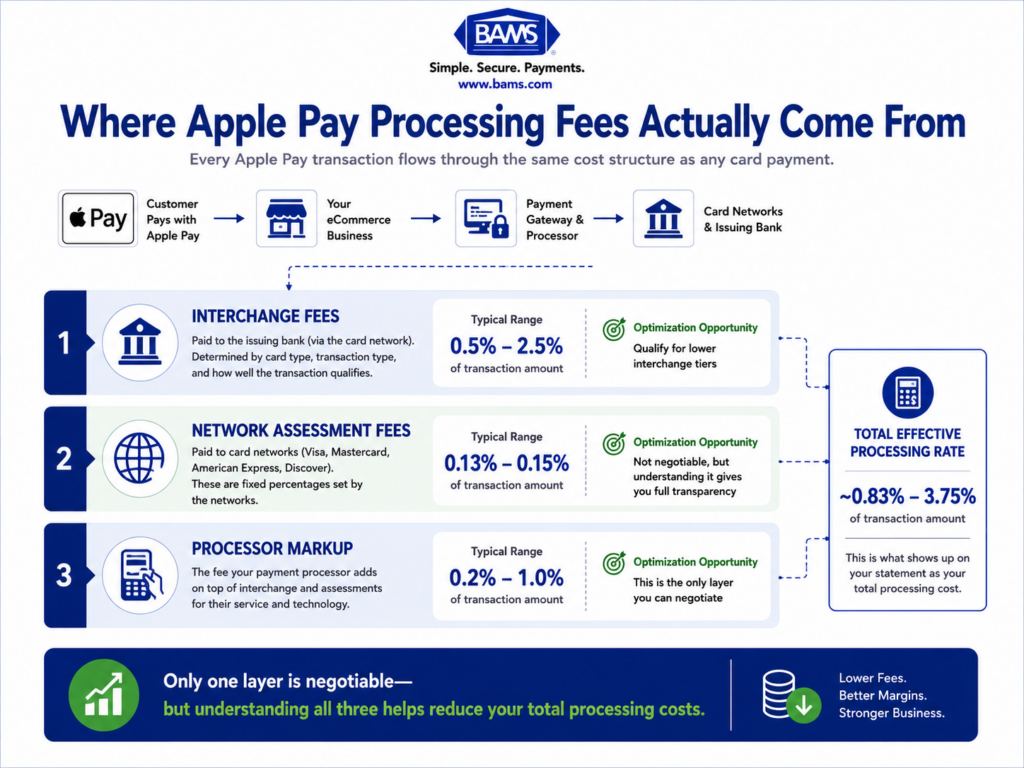
Here’s the problem most merchants miss: tokenization (the security layer that makes Apple Pay work) does reduce certain types of card fraud. But it doesn’t eliminate chargebacks. It doesn’t stop friendly fraud. And it introduces new complexity into your dispute process that can cost you money if you’re not prepared.
Although tokenized mobile payments significantly strengthen payment security, merchants still face disputes related to fulfillment, billing, customer misunderstandings, and friendly fraud. These operational risks require different controls than traditional payment fraud. It’s happening because fraud is adapting faster than merchant defenses. Consumers feel confident they can spot fraud (Visa’s research shows 97% believe they can), but that confidence doesn’t protect your revenue when a legitimate-looking tokenized transaction turns into a chargeback 60 days later.
The cost of inaction is concrete: higher chargeback ratios, processor penalties, and in severe cases, losing your merchant account entirely. This isn’t an abstract security concern. It’s a direct cash flow problem that compounds as your mobile wallet transaction volume grows.
Core Concepts: What You Need to Understand First
Tokenization Is Not a Fraud Shield for Merchants
When a customer pays with Apple Pay, their actual card number never touches your system. Instead, a Device Account Number (DAN) is created and stored on their device. Each transaction generates a unique, one-time token. This is genuinely good security. It virtually eliminates the risk of card number theft from your servers.
Mastercard Developers explains how Device Primary Account Numbers (DPANs) and network tokenization replace sensitive payment credentials while maintaining secure transaction processing.
But here’s the distinction that matters: tokenization protects the card data, not the transaction. A customer can still claim they didn’t authorize a purchase. They can still dispute a charge because the product wasn’t as described. The token doesn’t prove intent, satisfaction, or even that the right person was holding the phone.
Chargebacks vs. Fraud: Different Problems, Different Solutions
True fraud (a stolen device used to make purchases) accounts for a portion of mobile wallet losses. But friendly fraud (legitimate customers disputing valid charges) is the larger and faster-growing threat for most eCommerce merchants. Tokenization addresses the first category well. It does almost nothing for the second.
The Visibility Gap
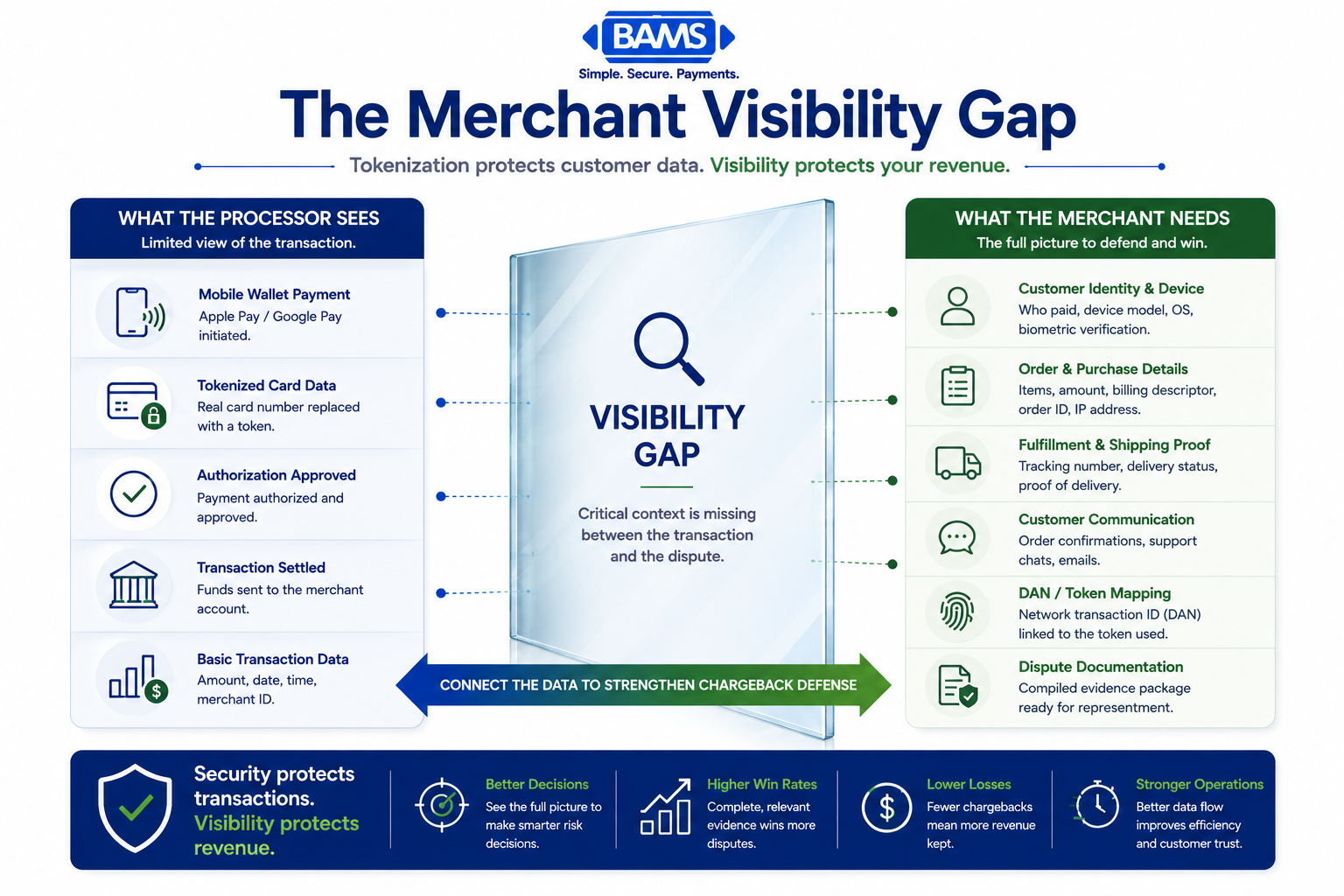
Tokenized transactions can be harder to match to specific customers in your system. The DAN that appears in your transaction records isn’t the card number your customer service team recognizes. This creates a visibility gap that slows dispute response times and weakens your evidence when fighting chargebacks. Many merchants don’t discover this gap until they’re already losing disputes they should have won.
Payment Mix as a Risk Variable
Your chargeback ratio is calculated against your total transaction volume. As mobile wallet transactions grow as a percentage of your sales, the chargeback patterns associated with those transactions have an outsized impact on your overall ratio. A payment mix shift is a risk profile shift, and it requires a deliberate response.
The Revenue Protection Framework for Mobile Wallet Growth
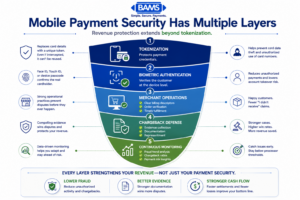
Tokenization protects payment credentials, but protecting revenue requires multiple operational layers beyond payment security alone.
Protecting revenue as your mobile wallet volume grows requires a five-stage approach. Each stage builds on the previous one, moving from understanding your current exposure to building sustainable, automated defenses.
- Stage 1: Audit — Map your current payment mix and chargeback sources
- Stage 2: Align — Match your fraud prevention tools to your actual risk profile
- Stage 3: Fortify — Build operational processes for mobile wallet dispute defense
- Stage 4: Monitor — Establish real-time tracking that catches problems early
- Stage 5: Adapt — Create feedback loops that evolve your defenses as your payment mix changes
These stages aren’t a one-time project. They form a cycle you revisit as your business grows, as consumer payment preferences shift, and as fraud tactics evolve. The goal is to make mobile wallet acceptance a revenue driver, not a liability.
Step-by-Step: Building Your Mobile Wallet Revenue Defense
Step 1: Audit Your Payment Mix and Chargeback Sources
Objective: Know exactly how much of your revenue flows through mobile wallets and where your chargebacks are actually coming from.
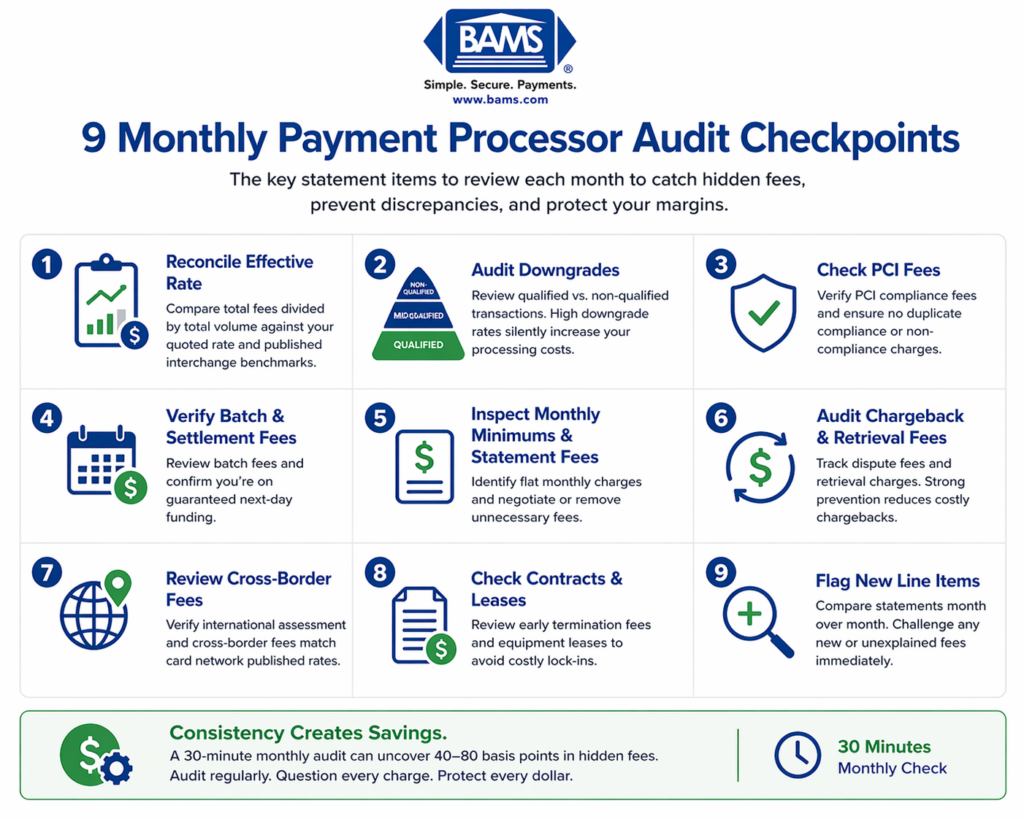
Pull your transaction data for the last six months. Break it down by payment method: traditional card-present, card-not-present, Apple Pay, Google Pay, PayPal, and any other digital wallets you accept. Then overlay your chargeback data on the same timeline, tagged by payment method and reason code.
Most merchants are surprised by what they find. You may discover that your Apple Pay chargeback rate is lower than traditional card-not-present transactions (tokenization working as intended), but that the chargebacks you do receive from mobile wallets are harder to win because your evidence is weaker. Or you may find that a specific product category generates disproportionate mobile wallet disputes.
What to avoid: Don’t aggregate all digital wallets into a single category. Apple Pay, Google Pay, and PayPal have different dispute processes, different evidence requirements, and different fraud patterns. Treating them as interchangeable will blind you to the specific risks each one carries.
How to verify progress: You should be able to answer three questions: What percentage of your revenue comes from each mobile wallet? What is the chargeback rate for each wallet compared to your overall rate? And which reason codes appear most frequently for mobile wallet disputes?
Step 2: Align Your Fraud Prevention Tools to Your Actual Risk Profile
Objective: Ensure your fraud prevention strategies address the specific threats your payment mix creates, not generic risks.
If 30% or more of your transactions come through digital wallets, your fraud stack needs to account for tokenized transaction patterns. This means your tools should be able to correlate Device Account Numbers with customer accounts, flag velocity anomalies specific to mobile wallet transactions, and distinguish between true fraud and friendly fraud signals.
Apple’s official Apple Pay documentation explains how Face ID, Touch ID, and device passcodes authenticate Apple Pay transactions before payment credentials are released for processing. This is a strength you can leverage in dispute responses by documenting that biometric authentication was required for each purchase.
Review your current fraud filters. Many eCommerce fraud tools were designed for traditional card-not-present transactions and may not effectively analyze tokenized payment data. If your fraud detection system can’t differentiate between a mobile wallet transaction and a standard card transaction, it’s missing context that matters.
What to avoid: Don’t add friction to the checkout process to compensate for mobile wallet risk. The entire value proposition of accepting digital wallets is speed and convenience. Adding extra verification steps defeats the purpose and drives cart abandonment.
How to verify progress: Your fraud tools should flag mobile wallet transactions with the same specificity they flag traditional card transactions. Test this by reviewing a sample of 50 recent mobile wallet transactions and confirming your system captured device data, biometric verification status, and behavioral signals for each one.
Step 3: Build Operational Processes for Mobile Wallet Dispute Defense
Objective: Create a repeatable process your team can follow when a mobile wallet chargeback arrives, so you respond faster and with stronger evidence.
Mobile wallet chargebacks require different evidence than traditional card disputes. For Apple Pay transactions, you need to document the DAN used, confirm biometric authentication occurred, and match the transaction to shipping and delivery records. If you’re selling digital goods, you need access logs showing the purchased content was accessed from the same device that initiated the payment.
Build a dispute response template specifically for mobile wallet chargebacks. Include fields for: DAN or token reference, biometric verification confirmation, device and IP data, order fulfillment records, customer communication history, and any prior transaction history from the same customer or device.
This is where your merchant services partner matters significantly. A processor with proactive chargeback defense capabilities can alert you to disputes before they escalate and help you compile evidence in the format card networks require. BAMS, for example, provides proactive chargeback defense that catches disputes early and gives merchants the window they need to respond effectively, which is especially valuable when mobile wallet dispute timelines are tight.
What to avoid: Don’t use the same dispute response template for mobile wallet chargebacks that you use for traditional card disputes. The evidence requirements differ, and submitting irrelevant or incomplete documentation is the fastest way to lose a winnable case.
How to verify progress: Track your mobile wallet dispute win rate separately from your overall win rate. Within 90 days of implementing dedicated templates, your mobile wallet dispute win rate should approach or exceed your traditional card dispute win rate.
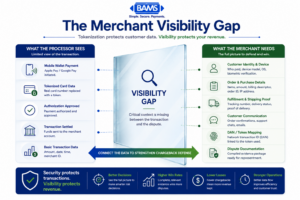
Tokenized transactions protect customer data, but merchants still need visibility into authentication, fulfillment, and customer activity to defend disputes effectively.
Step 4: Establish Real-Time Monitoring That Catches Problems Early
Objective: Detect chargeback spikes and fraud pattern shifts before they threaten your merchant account standing.
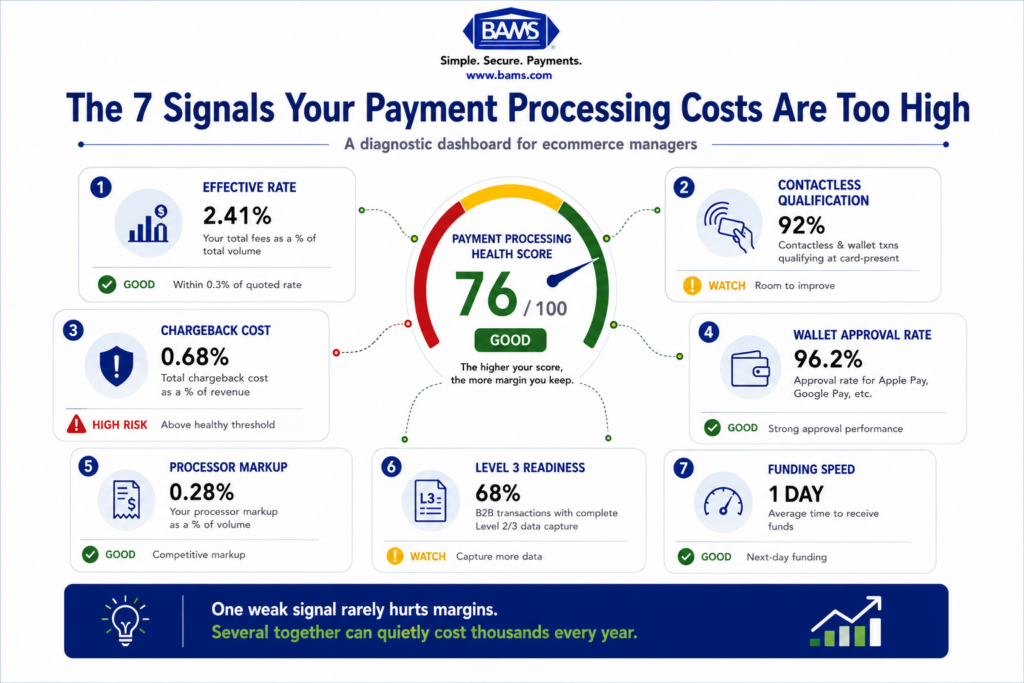
Your chargeback ratio thresholds don’t care where the chargebacks come from. Visa and Mastercard monitor your total ratio, and if mobile wallet chargebacks push you past 1%, you face monitoring programs, fines, and potential account termination. As digital wallet usage grows, merchants should monitor wallet-specific chargeback patterns alongside overall chargeback ratios so they can identify operational issues before they affect payment performance.
Set up automated alerts for three metrics: your overall chargeback ratio (with a warning threshold at 0.65%), your mobile wallet chargeback rate as a standalone metric, and the ratio of friendly fraud to true fraud in your mobile wallet disputes. The third metric is the most important because it tells you whether your problem is security (stolen devices, account takeover) or customer experience (unclear billing descriptors, delivery issues, product dissatisfaction).
Review your billing descriptor as it appears on Apple Pay transaction receipts. A confusing or unfamiliar descriptor is one of the most common triggers for friendly fraud chargebacks. Customers see a charge they don’t recognize, panic, and file a dispute instead of contacting your support team.
What to avoid: Don’t rely on monthly reports to catch chargeback spikes. By the time a monthly report reveals a problem, you may have already crossed a threshold. Real-time or daily monitoring is essential when your payment mix is shifting.
How to verify progress: You should receive automated alerts within 24 hours of any chargeback ratio movement above your warning threshold. Your team should be able to identify the payment method, reason code, and customer segment driving any spike within one business day of the alert.
Step 5: Create Feedback Loops That Evolve Your Defenses
Objective: Build a system that learns from every dispute and continuously improves your fraud prevention strategies and revenue protection.
Every chargeback contains information. The reason code tells you the category of dispute. The payment method tells you the channel. The customer history tells you whether this is a first-time buyer or a repeat customer. The outcome (won or lost) tells you whether your evidence was sufficient. Capture all of this data in a structured format and review it monthly.
Look for patterns. Are mobile wallet chargebacks concentrated in a specific product category? A specific price range? A specific customer demographic? Do they spike after promotional periods when you acquire new customers who may have different expectations? Use these patterns to refine your fraud filters, adjust your customer communication, and modify your fulfillment processes.
Connect your chargeback data to your payment option expansion strategies. If you’re planning to add new digital wallet options or expand into new markets, use your historical chargeback patterns to predict where new risks will emerge and pre-build your defenses.
AI-powered fraud detection is identified as the primary use of artificial intelligence in payments for combating rising cyber incidents. As these tools mature, they become more accessible to mid-size merchants. Evaluate whether your current fraud detection can incorporate machine learning models trained on your specific transaction patterns, not just industry averages.
What to avoid: Don’t treat chargeback defense as a set-it-and-forget-it system. Fraud tactics evolve quarterly. Consumer behavior shifts seasonally. Your defenses need to keep pace, or they become increasingly ineffective over time.
How to verify progress: Your mobile wallet chargeback rate should trend downward over two consecutive quarters. Your dispute win rate should trend upward. And your fraud prevention costs should stabilize as your system becomes more efficient at distinguishing real threats from false positives.
Practical Examples: How This Plays Out
Scenario 1: The Billing Descriptor Problem
An online retailer selling specialty kitchen equipment enabled Apple Pay and saw a 22% increase in mobile checkout conversions within 60 days. But chargebacks also increased by 35% over the same period. Investigation revealed that the billing descriptor displayed on Apple Pay receipts showed the merchant’s parent company name, not the storefront name customers recognized. Customers saw unfamiliar charges, couldn’t match them to a purchase, and filed disputes.
The fix was simple: update the billing descriptor to match the customer-facing brand name. Chargeback rates returned to baseline within 45 days. No new fraud tools were needed. The problem was operational, not technical.
Scenario 2: The Friendly Fraud Escalation
A mid-size fashion eCommerce brand noticed that Apple Pay chargebacks were disproportionately coded as “item not as described” rather than “unauthorized transaction.” The tokenization and biometric layers were working. True fraud was minimal. But customers were using the dispute process as a return mechanism, especially for final-sale items.
The response combined clearer product photography, updated size guides, a more visible return policy at checkout, and a post-purchase email sequence that encouraged customers to contact support before filing disputes. The merchant also worked with their processor to implement proactive chargeback defense alerts that gave them a window to resolve complaints before they became formal chargebacks. Within one quarter, friendly fraud chargebacks dropped by 40%.
Scenario 3: The Payment Mix Tipping Point
An eCommerce business selling subscription boxes saw mobile wallet transactions grow from 15% to 48% of total volume over 18 months. Their fraud tools, calibrated for traditional card-not-present transactions, started generating excessive false positives on mobile wallet orders, declining legitimate customers. Simultaneously, their chargeback defense team was using generic dispute templates that didn’t include tokenization-specific evidence.
They recalibrated their fraud filters to account for mobile wallet behavioral patterns (faster checkout times, different device fingerprints) and built dedicated dispute templates. Decline rates dropped, legitimate revenue recovered, and their chargeback win rate for mobile wallet disputes improved from 28% to 61%.
Common Mistakes and Pitfalls in Mobile Wallet Chargeback Rates
Assuming tokenization eliminates chargeback risk. This is the most common and most expensive mistake. Tokenization reduces card data theft. It does not reduce disputes over product quality, delivery failures, or buyer’s remorse.
Ignoring the visibility gap. If your customer service team can’t quickly match a DAN to a customer account, your dispute response times suffer. Every hour of delay weakens your case.
Treating all mobile wallets identically. Apple Pay, Google Pay, and PayPal have different security architectures, different dispute flows, and different evidence requirements. A one-size-fits-all approach leaves money on the table.
Over-tightening fraud filters. Responding to mobile wallet fraud by simply declining more transactions can reduce legitimate sales and create unnecessary checkout friction. Merchants should balance fraud prevention with customer experience rather than relying on overly aggressive screening rules.
Waiting for a crisis. Most merchants don’t address mobile wallet chargeback exposure until their ratio is already elevated. By then, the options are more limited and more expensive. Build your defenses while your ratios are healthy.
What to Do Next
Start with Step 1. Pull your last six months of transaction data and break it down by payment method. This single action will tell you whether your mobile wallet exposure is growing, stable, or already a problem. It takes less than an hour and gives you the foundation for every decision that follows.
If your mobile wallet transactions already exceed 25% of your volume, prioritize Step 3 (building dedicated dispute response templates) alongside your audit. You likely have chargebacks in process right now that could benefit from stronger, wallet-specific evidence.
Revisit this guide quarterly as your payment mix evolves. The merchants who protect their revenue most effectively aren’t the ones with the most sophisticated tools. They’re the ones who treat payment mix management as an ongoing operational discipline, not a one-time technical decision.
If you’re evaluating whether your current processor gives you the visibility and support you need for mobile wallet dispute defense, explore how Apple Pay integration works with platforms like BigCommerce and consider whether your processor provides the proactive alerts and dedicated support that make timely dispute response possible.
Frequently Asked Questions
What is Apple Pay and how does it work for online merchants?
Apple Pay is a digital wallet that lets customers pay using their iPhone, iPad, or Mac. When a customer adds their card to Apple Pay, the actual card number is replaced with a Device Account Number (DAN) stored securely on their device. Each transaction generates a unique token, so your systems never see the real card number. For online merchants, this means faster checkout and reduced card data liability, but it also means your transaction records show tokens and DANs instead of familiar card numbers.
Does Apple Pay’s tokenization protect merchants from chargebacks?
No. Tokenization protects card data from being stolen or intercepted, which reduces true fraud from compromised card numbers. However, it does not prevent chargebacks caused by product dissatisfaction, delivery disputes, or friendly fraud (where a legitimate customer disputes a valid charge). These categories represent the majority of chargeback volume for most eCommerce merchants, and tokenization has no effect on them.
Why are my Apple Pay chargeback rates different from my traditional card chargeback rates?
Several factors contribute. Biometric authentication (Face ID, Touch ID) reduces unauthorized use, so true fraud chargebacks tend to be lower. But friendly fraud and service-related disputes may be higher because mobile wallet users often have different expectations around speed and convenience. Additionally, the visibility gap (DANs instead of card numbers in your records) can make disputes harder to fight, leading to more losses on cases you might otherwise win.
Which fraud patterns are most common with Apple Pay transactions?
Account takeover (where a fraudster adds a stolen card to their own Apple Pay) is the primary true fraud risk. Friendly fraud (legitimate customers filing disputes instead of requesting returns) is the larger operational risk for most merchants. Promotional abuse, where new customers acquired during sales events use disputes to get refunds on final-sale items, is also increasingly common with mobile wallet transactions.
When should a merchant consider enabling Apple Pay as a payment option?
Enable Apple Pay when your customer base includes significant mobile traffic and you’re prepared to handle the operational requirements. This means having clear billing descriptors, dispute response templates that account for tokenized transactions, and a processor that provides proactive chargeback alerts. The conversion benefits are real (reduced cart abandonment, faster checkout), but they should be paired with revenue protection measures from day one.
How can small-to-midsize merchants afford AI-powered fraud detection?
AI-powered fraud detection is increasingly accessible through merchant services providers and payment platforms that include it as part of their processing services, rather than requiring standalone enterprise software. Many processors now offer fraud detection tools calibrated for mid-size transaction volumes. The key is choosing a processor whose fraud tools can distinguish between mobile wallet and traditional card transactions, so you get relevant risk scoring without paying for enterprise-scale infrastructure.