

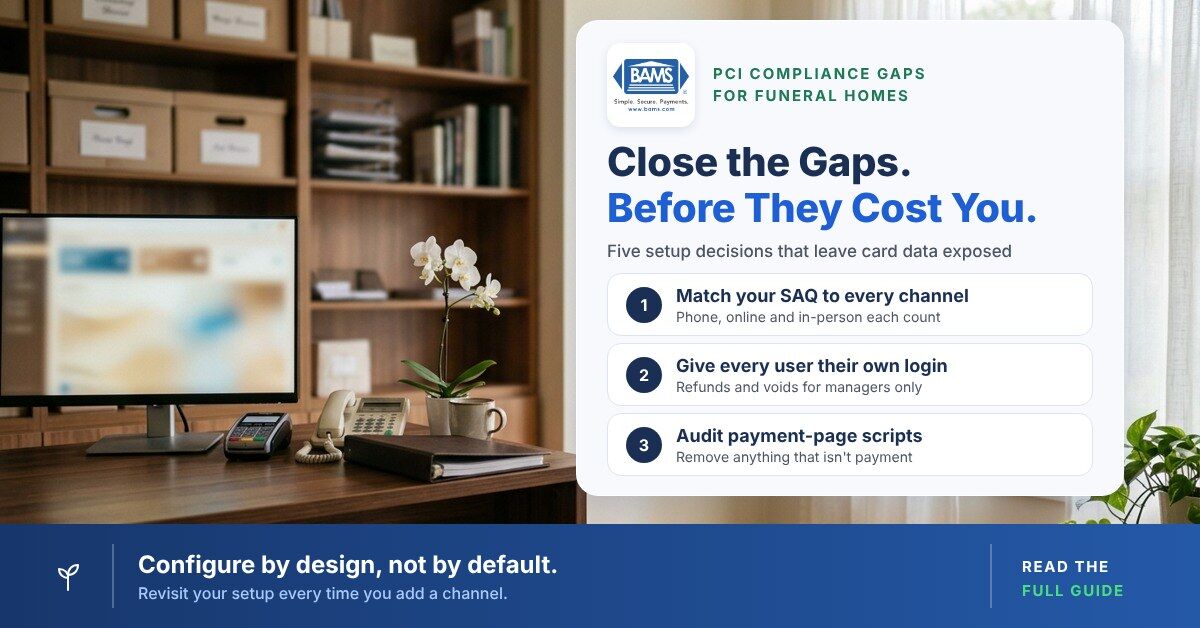
5 PCI Compliance Gaps in Funeral Home Payment Systems
Last Updated on November 10, 2026 by Dimitri Akhrin
The PCI Compliance Gaps Hiding in Funeral Home Payment Systems
Funeral homes handle transactions that carry unusual weight. Picture a grieving family authorizing a $12,000 charge by phone. Or a prepaid arrangement funded online, or a split payment across two cards at the arrangement desk. Each scenario creates a distinct data-handling obligation under PCI DSS. Yet most operators at the 1-to-10 location scale have never mapped which obligations apply to which channel.
That disconnect is where PCI compliance gaps open up. It’s not because funeral directors ignore security. It’s because the merchant account setup and monitoring decisions that determine compliance posture are often made by default rather than by design. 269 million card records were posted on dark web and clear web sources in 2024. Every extra payment channel a small merchant adds is another place for card data to leak.
This is not a general overview of PCI requirements. It is a focused look at five specific PCI compliance gaps in integrated payment systems. It’s written for operators who take payments across counters, phone lines, invoices and online portals.
TL;DR
- Match your SAQ to your actual payment channels – Phone payments, online portals and in-person terminals each require different PCI questionnaire types. Filing the wrong one creates invisible compliance gaps.
- Lock down staff access with individual logins and role-based permissions – The PCI Security Standards Council cites Verizon data showing 25% of breaches involve internal actors. Shared passwords and unrestricted refund authority are the most common small-merchant vulnerabilities.
- Audit every script on your online payment page – Analytics trackers, chat widgets and marketing pixels on checkout pages create data-exfiltration risk. Remove anything that does not directly support the payment function.
- Configure transaction monitoring for funeral-service patterns – Default fraud filters are built for retail averages and will flag legitimate high-ticket charges. Customize thresholds to avoid blocking grieving families and delaying your cash flow.
- Build a compliance calendar and assign ownership – Annual SAQ filing, quarterly scans and semi-annual access reviews need a named owner and scheduled dates. Compliance that exists only as a memory from initial setup is not compliance.
What This Guide Covers (and What It Doesn’t)
This guide is for family-owned funeral service operators running one to ten locations who accept card payments through more than one channel. These gaps apply directly to you if you process high-ticket transactions (often above $15,000). They also apply if staff handle card data by phone or you recently added an online payment portal.
We are not covering enterprise-level PCI programs, Level 1 merchant audits, or payment-application development standards. The focus is on merchant account setup decisions, transaction monitoring tools and staff-level controls. Each one closes a gap before a breach or a processor penalty forces the issue.
How These Five Gaps Were Selected
Each gap was chosen because it meets three criteria. It appears frequently in small-merchant payment environments. It can be fixed through configuration and process changes, not major capital investment. And it creates outsized risk relative to how little attention it typically receives. The order follows the lifecycle of a payment, from how the card data enters your system to how you monitor transactions after settlement.
5 PCI Compliance Gaps in Integrated Payment Systems
1. Mismatched SAQ Type for Your Actual Payment Channels
Why it matters: PCI compliance starts with the Self-Assessment Questionnaire (SAQ). The correct SAQ depends on how your business actually handles card data, not how your processor assumed you would. A funeral home that takes card numbers over the phone during arrangement conferences has different obligations than one using only a countertop terminal. Filing the wrong SAQ creates a false sense of compliance and leaves gaps unaddressed.
What it looks like today: Many small merchants are enrolled in a generic SAQ path during onboarding, even though the right questionnaire depends on the payment environment. If you added an online invoice portal last year but never updated your SAQ, you may be validating against the wrong standard.
How to apply it: List every way card data enters your business: in-person terminal, phone (MOTO), online payment page, keyed entry into a virtual terminal. Then confirm with your processor that your SAQ type matches that list. If your processor cannot explain which SAQ you are filing, that is a sign to revisit the relationship.
2. Uncontrolled Staff Access to Card Data and Payment Terminals
The PCI Security Standards Council’s small merchant guide cites Verizon data showing that 25% of breaches involve internal actors. In a funeral home, arrangement directors, office managers and accounting staff may all touch payment systems. Yet few operations define who can process a refund, void a transaction, or access stored card information. Without role-based access, every staff member with a login becomes a potential compliance gap.
What it looks like today: Shared terminal logins, a single admin password for the virtual terminal and no written policy on who can process what. These defaults are common at locations where the payment system was set up once and rarely revisited.
How to apply it: Assign individual logins to every staff member who touches the payment system. Restrict refund and void authority to managers. Document these permissions in writing and review them at least twice a year. Your merchant account configuration should reflect these role boundaries, not just your internal policy manual.
3. Unmanaged Third-Party Scripts on Online Payment Pages
Why it matters: Some funeral homes accept payments through a website for preneed arrangements, memorial donations, or invoice settlement. If yours does, every script running on that payment page is a potential data-exfiltration vector. Forty percent of scripts identified in a recent Verizon payment-security analysis were found on payment pages. Unmanaged third-party code such as analytics trackers, chat widgets and marketing pixels creates real exposure.
What it looks like today: A funeral home’s web developer adds a Facebook pixel or a Google Analytics tag to the entire site, including the checkout or payment page. Nobody audits which scripts load when a family enters card data. PCI DSS v4.0.1 (Requirement 6.4.3) requires merchants whose own pages host or embed the payment form to inventory, authorize and justify every script on those pages.
How to apply it: Ask your web developer to list every script that loads on your payment or checkout page. Remove anything that does not directly support the payment function. A hosted payment page sends the family to your processor’s page to enter card data. If you use one, your exposure here drops significantly. Confirm with your processor whether your current setup is hosted or embedded.
4. No Active Transaction Monitoring for Unusual Patterns
Why it matters: Funeral transactions have distinctive patterns: high individual amounts, low volume and payers who often aren’t the cardholder. A family member paying on behalf of the estate is common. Monitoring that ignores these patterns creates PCI compliance gaps of its own. Without transaction monitoring tools configured for these patterns, your system cannot distinguish a legitimate $18,000 casket-and-service charge from a fraudulent one. Merchants reported rejecting an estimated 6% of eCommerce orders due to suspected fraud. That’s real lost revenue when legitimate families are flagged incorrectly.
What it looks like today: Many small merchants rely entirely on their processor’s default fraud filters. Those filters are often calibrated for retail averages, not funeral-service transaction profiles. A $15,000 charge might trigger an automatic hold or decline, delaying funds during a period when families and your business both need resolution.
How to apply it: Work with your processor to adjust velocity filters and transaction-amount thresholds to match your actual business patterns. Set alerts for genuinely unusual activity (multiple cards from the same IP, rapid-fire small charges) rather than flagging every high-ticket transaction. A merchant services partner like BAMS provides dedicated account representatives, so you have a person to ask when a legitimate high-ticket charge is flagged.
5. No Documented Compliance Calendar or Validation Cadence
Why it matters: PCI compliance is not a one-time event. It requires annual SAQ revalidation, quarterly network scans (if applicable) and ongoing documentation of security practices. Yet most funeral home operators treat compliance as something that was “handled during setup” and never revisit it. When a breach or processor audit occurs, the absence of current documentation is itself a violation.
What it looks like today: The SAQ was completed two years ago. No one remembers the login for the compliance portal. The quarterly scan vendor sends emails that go to a former employee’s inbox. The gap is rarely willingness. It is the lack of a simple structure for staying current.
How to apply it: Create a simple compliance calendar with four entries. Include annual SAQ completion and quarterly scan scheduling (if your SAQ type requires it). Add a semi-annual staff-access review and an annual review of all payment channels against your SAQ type. Assign one person at each location as the compliance point of contact. If your processor charges a PCI compliance fee, confirm exactly what services that fee includes. Ask whether it covers scan scheduling, SAQ filing assistance, or both.

Each gap has a configuration fix, and a calendar with a named owner keeps them closed.
The Pattern Across These Five Gaps
Every one of these PCI compliance gaps shares a root cause. Decisions were made (or not made) during merchant account setup and never revisited as the business added channels, staff, or online capabilities. PCI compliance is not primarily a technology problem for funeral homes. It is a configuration and documentation problem.
The tradeoff operators face is between simplicity and coverage. A single countertop terminal with no online payments creates the smallest compliance surface. Every additional channel (phone payments, online portals, emailed invoices with payment links) adds obligations. The goal is not to eliminate channels but to ensure each one is accounted for in your SAQ, your access controls and your monitoring rules.
When these five items work together, they form a closed loop. You know how card data enters your system, who touches it and what code runs near it. You also know what patterns to watch for and when to revalidate the whole structure.
Where to Start: Prioritizing for 1-to-10 Location Operations
There’s no need to close all five gaps at once. Start with Gap 1 (SAQ type verification) because every other decision depends on knowing which compliance standard actually applies to your payment environment. Gap 2 (staff access controls) is the next priority because it requires no new technology, only policy and configuration changes.
Gaps 3 and 4 matter most for operators who accept online payments or process high-ticket transactions regularly. Gap 5 (the compliance calendar) is the simplest to implement and the easiest to neglect. If your processor offers dedicated account representatives and compliance support, lean on that resource. A well-supported merchant account costs far less than a breach, a fine, or a frozen account. That matters most in a week when three families are depending on you.
Frequently Asked Questions
How can funeral homes close PCI compliance gaps when accepting payments by phone?
Phone payments (MOTO transactions) require a specific SAQ type. That’s typically SAQ C-VT if you key card numbers into a virtual terminal, or SAQ C if you use a payment application connected to the internet. Document that phone payments are part of your payment environment and confirm your SAQ reflects this channel. Train staff to never write down full card numbers and use a virtual terminal that tokenizes data immediately upon entry.
What PCI compliance fees should a funeral home expect to pay?
Reasonable PCI compliance fees for small merchants typically fall in the $70 to $120 per year range. According to BAMS research on PCI compliance fees, that fee should cover access to self-assessment questionnaires, basic vulnerability scanning tools and documentation support. Does your processor charge significantly more without explaining what the fee covers? Then request an itemized breakdown or explore other processor options.
Does using a hosted payment page reduce PCI compliance requirements?
Yes. When families are redirected to your processor’s hosted payment page to enter card data, your website never directly handles card numbers. This typically qualifies you for SAQ A, which has fewer requirements than SAQ types where card data touches your own systems. Confirm with your processor whether your online payment setup is truly hosted or if card data passes through your server.
How often does a funeral home need to revalidate PCI compliance?
PCI compliance requires annual revalidation through SAQ completion. If your SAQ type requires external vulnerability scans, those must be completed quarterly by an Approved Scanning Vendor (ASV). Beyond formal requirements, review your payment channels and staff access permissions at least twice a year. That catches changes that affect your compliance posture.
What transaction monitoring tools should a funeral home use to stay PCI compliant?
At minimum, your processor should provide configurable fraud filters and transaction alerts. For funeral homes, the key is adjusting default thresholds to accommodate legitimate high-ticket transactions ($10,000 and above). At the same time, keep flagging suspicious patterns like rapid small charges or multiple declined cards from the same source. Ask your processor whether their monitoring rules can be customized to your average transaction size and volume.
What happens if a funeral home is found non-compliant with PCI DSS?
Consequences can range from a monthly non-compliance fee charged by your processor to account termination in serious cases. If a breach occurs while you are non-compliant, your business may be liable for forensic investigation costs, card-replacement fees and fines from the card brands. That exposure hits small operators hardest. Proactive compliance costs far less than reactive remediation.


