
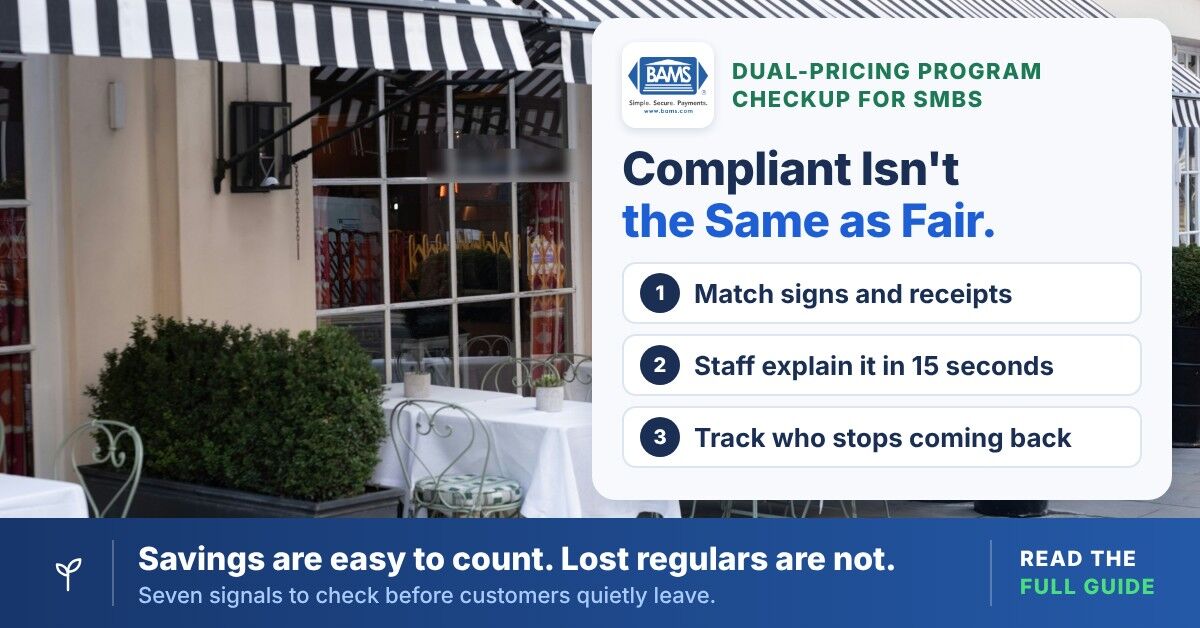
7 Signs Your Dual-Pricing Program Is Losing Customers
TL;DR
- Compliance isn’t the whole picture – Your dual-pricing program can pass every legal check and still push loyal customers away through poor communication, inconsistent staff explanations and surprise pricing at checkout.
- Seven diagnostic signals matter – Track repeat-customer payment shifts, surcharge cap compliance, receipt clarity, staff readiness, signage placement, exception documentation and whether your success metrics account for customer loss.
- Continuous monitoring beats periodic audits – Regulations change at the state level without direct merchant notification. Quarterly reviews of your program’s customer-facing mechanics prevent both legal exposure and silent revenue erosion.
- Start with three low-effort checks – Audit your signage, test your receipt language with real customers and pull a 90-day payment-method trend report. These need little or no budget and about two hours of work.
- Measure what you’re losing, not just what you’re saving – Processing cost savings are easy to count. Lost customers, negative word of mouth and declining visit frequency are harder to see but often more expensive.
Why Your Dual-Pricing Program Might Be Quietly Bleeding Customers
Most small and midsize businesses adopt dual pricing to protect margins against rising processing fees. The logic is sound: give customers a cash price and a card price, keep your costs in check, stay competitive. But the financial compliance workflows that govern these programs tend to focus on one question (“Are we legally compliant?”) while ignoring a more expensive one (“Are we losing customers we’ll never hear from again?”).
Regulation around surcharging and dual pricing shifts at the state level with little fanfare. A rule that was compliant last quarter may not be today. And even where the letter of the law hasn’t changed, customer perception of fairness can. Perceived unfairness doesn’t require a formal complaint to erode your revenue.
Continuous monitoring of your dual-pricing program isn’t just a compliance exercise. It’s a diagnostic one. The signals below reveal where margin protection quietly becomes margin destruction.
Who This Is For, What It Covers and What It Doesn’t
This guide is built for owners, managers and finance directors at small to midsize businesses running dual-pricing, zero-fee, or cash-discount payment programs. If you’ve implemented one of these programs and haven’t revisited its customer-facing mechanics since launch, this is your audit framework.
We are not covering enterprise regulatory compliance (SOX, Basel III, GDPR). We’re also not covering initial program setup. This is about what happens after go-live, when the program runs on autopilot and the quiet costs start accumulating.
How These Signals Were Selected
Each signal was chosen because it meets three criteria: it typically goes undetected by standard pass/fail compliance checks, it has a measurable financial consequence and it can be addressed without overhauling your payment infrastructure. These are diagnostic indicators, not policy violations.
7 Signals Your Dual-Pricing Program Is Pushing Loyal Customers Away
1. Repeat Customers Quietly Shift to Cash (or Disappear)
Why it matters: When loyal card-paying customers start paying cash or reducing visit frequency, they’re voting with their wallets before they ever leave a review. Most POS reports won’t flag this as a dual-pricing issue. They’ll show it as a payment-method mix shift, if they show it at all.
What it looks like today: Your card-to-cash ratio tilts over a 60- to 90-day window. Average ticket size may drop for customers who switch to cash. You see fewer repeat visits from previously high-frequency card users.
How to apply it: Run a quarterly cohort analysis on your top 20% of customers by visit frequency. Track their payment method over time. If card usage drops noticeably in a cohort (10% is a reasonable starting threshold), investigate whether your pricing disclosure or surcharge amount changed during that window.
2. Your Surcharge Percentage Exceeds the State or Network Cap Without Anyone Noticing
Why it matters: Card networks cap credit card surcharges. Visa caps them at the lower of your merchant discount rate or 3%. Mastercard caps them at the lower of your average effective merchant discount rate or 4%. Neither network allows surcharges on debit or prepaid cards. States add their own layer: Visa’s merchant guidance (current as of February 2024) lists Connecticut, Maine, Massachusetts, Oklahoma and Puerto Rico as prohibiting surcharges and Colorado, Minnesota, New Jersey and New York as having their own requirements. These rules change. A program that launched compliant can drift out of bounds when a rate adjustment or a state-level rule change goes unnoticed.
What it looks like today: Your processor may not automatically adjust surcharge caps when regulations shift. The gap between your posted surcharge and the legal maximum narrows or inverts. You may be technically non-compliant without a single internal alert firing. The same drift can happen in a cash discount program: under Visa’s rules, if a card payment shows an added fee at checkout, it may be treated as a surcharge.
How to apply it: Build a simple regulatory calendar. Check card network bulletins and state attorney general updates quarterly. Cross-reference your current surcharge percentage against both network rules and the specific states where you operate. If you start or change surcharging, remember that Visa requires 30 days’ notice to your acquirer and Mastercard requires 30 days’ notice to both Mastercard and your acquirer. For businesses in multiple states, monitoring tools that generate alerts become far more valuable.
3. Receipt Language Creates Confusion Instead of Clarity
Why it matters: Research in the Journal of Service Research on dynamic pricing found that price confusion raises perceptions of unfairness, which increases negative word of mouth. For frequent purchasers, confusion was the main driver. If your receipt says “service fee” instead of clearly explaining the dual-pricing structure, you’re generating confusion at the exact moment the customer is deciding how they feel about the transaction.
What it looks like today: Receipts show a line item labeled “non-cash adjustment,” “service charge,” or “technology fee” with no context. Some customers search these terms, find complaint threads and associate your business with deceptive pricing. In a Yale School of Management study of a restaurant price increase, framing a $1 upcharge as a “service fee” reduced both purchase likelihood and perceptions of fair pricing.
How to apply it: Audit your receipt language against your point-of-sale signage. Both should use identical terminology. Replace vague labels with specific ones: “Card price” and “Cash price” are clearer than “Adjusted price” and “Base price.” In a dual-pricing program, the receipt should show the card total in full rather than adding a fee at the end. Test your receipt with five customers who aren’t employees. If any of them can’t explain the pricing in one sentence, rewrite it.
4. Staff Can’t Explain the Program in Under 15 Seconds
Why it matters: Your employees are the last line of defense between a confused customer and a lost one. When a customer asks “Why is my total different?” the answer needs to be immediate, confident and consistent. Hesitation or inconsistency signals that even your own team doesn’t fully understand (or endorse) the program.
What it looks like today: New hires receive no dual-pricing training. Tenured staff offer different explanations. Some say “It’s a fee,” others say “It’s a discount for cash.” These are legally and perceptually different statements and inconsistency breeds distrust.
How to apply it: Create a one-sentence script and test it monthly. Example: “We show two prices for everything, a cash price and a card price. You choose how you’d like to pay.” If you run a surcharge program instead, the script should say so plainly and match your receipt. Role-play the three most common customer objections during onboarding. If you haven’t revisited your merchant services setup defaults since launch, your team may be explaining a program configuration that no longer matches reality.
5. You Haven’t Audited Your Signage Placement in Over Six Months
Why it matters: Visa requires surcharging merchants to disclose the practice at the point of entry and at the point of sale and to show the surcharge on every receipt. State rules can add more. Signage gets moved, covered, or removed during renovations, seasonal displays, or simple cleaning. A missing sign doesn’t just create legal exposure. It creates a customer experience where the price difference feels like a surprise, which is the fastest route to perceived unfairness.
What it looks like today: The door sign is behind a seasonal poster. The countertop placard fell behind the register three months ago. Your eCommerce checkout page discloses the surcharge in a tooltip that most shoppers never open. Boston Consulting Group warns that companies risk a backlash when prices change without a corresponding change in value. A surprise fee feels exactly like that.
How to apply it: Walk your customer journey quarterly. Enter through the front door. Stand at the register. Complete a test transaction. Photograph every disclosure touchpoint. For eCommerce, complete a test checkout on mobile and desktop. Document what a first-time customer actually sees versus what your compliance file says they should see.
6. Your Exception Handling Has No Paper Trail
Why it matters: Every dual-pricing program generates exceptions: a manager waives the surcharge for a VIP, a staff member overrides the system for a large order, a glitch applies the wrong price tier. Without a documented trail, these exceptions become invisible precedents that erode program consistency and create audit vulnerabilities.
What it looks like today: Overrides happen at the register with no logging. Managers grant ad-hoc discounts verbally. Your POS system records the final price but not the reason for deviation. When a customer disputes a charge or a regulator asks for records, you have transaction data but no decision context.
How to apply it: Require a reason code for every surcharge override or manual price adjustment. Review exception reports monthly. If overrides exceed a small share of card transactions (5% is a reasonable starting threshold), your program rules may need recalibration rather than more exceptions. Your processor’s reporting can help. If you work with BAMS, ask your dedicated account representative which override and payment-method reports your terminal or gateway can export. For businesses already dealing with dispute fallout, understanding how chargebacks affect your funding timeline adds urgency to getting exception handling right.
7. You Measure Program Success Solely by Processing Cost Savings
Why it matters: The most dangerous signal is the one hiding inside your own success metric. If you evaluate your dual-pricing program only by how much you’ve saved on processing fees, you will never see the customers who left, the negative reviews that weren’t written (but were spoken), or the revenue that didn’t materialize because a first-time visitor felt nickel-and-dimed.
What it looks like today: Your monthly report shows $2,000 saved in processing costs. It does not show the three regulars who now drive to a competitor, the first-time visitors who felt nickel-and-dimed or the lifetime value of customers who quietly churned. The savings are real. The losses are real too, just harder to count.
How to apply it: Add three metrics to your dual-pricing dashboard: repeat-customer visit frequency (by payment method), average ticket size trend (cash vs. card) and online review sentiment mentioning fees, surcharges, or pricing. If your processing costs spike with seasonal volume, these customer-experience metrics become even more critical during peak periods when new customer acquisition is highest.

Start with signage, receipts and payment mix, then review the other four every quarter.
The Pattern Across All Seven Signals
Every signal on this list shares a common structure: a compliance-passing program that is quietly failing a customer-experience test. The technical infrastructure works. The rules are (probably) followed. But the human layer, the perception, the communication, the consistency, degrades over time without continuous monitoring.
The deeper pattern is that dual-pricing programs create an ongoing relationship between price transparency and customer trust. That relationship requires maintenance. Financial compliance workflows catch rule violations. They don’t catch the moment a loyal customer decides your pricing feels adversarial rather than fair. Treating your program as a living system rather than a set-and-forget policy is what separates margin protection from margin erosion.
The tradeoff is real: every hour spent on diagnostic monitoring is an hour not spent on operations. But the cost of not monitoring is measured in customers you never see leave.
Where to Start Without Overwhelming Your Team
You don’t need to address all seven signals this week. Start your dual-pricing program review with three: audit your signage (Signal 5), test your receipt language with real customers (Signal 3) and pull a 90-day payment-method trend report (Signal 1). These three require no new technology, no budget approval and less than two hours of work.
Once those are clean, build a quarterly review cadence that cycles through the remaining signals. The goal isn’t perfection. It’s a rhythm of attention that keeps your dual-pricing program aligned with both regulatory requirements and customer expectations. Risk management solutions don’t have to be complex to be effective. They have to be consistent.
Frequently Asked Questions
Why is ongoing compliance important for dual-pricing programs?
Dual-pricing and surcharging regulations change at the state level and through card network bulletins, often without direct notification to merchants. A program that launched in full compliance can drift out of bounds within a single quarter. Ongoing compliance prevents both legal exposure and the customer-experience damage that comes from inconsistent or outdated pricing practices.
How can technology improve ongoing compliance processes for small businesses?
Continuous control monitoring systems can automate transaction tracking, flag surcharge overrides and generate audit trails without requiring manual review of every transaction. For small businesses, even basic POS reporting tools can surface payment-method mix shifts and exception patterns that indicate program drift. The key is building alerts rather than relying on periodic manual audits.
When should companies start focusing on compliance optimization for their payment programs?
Immediately after launch. Most businesses treat go-live as the finish line, but dual-pricing programs begin degrading the moment staff turnover introduces inconsistent explanations, signage gets moved, or a state regulation shifts. A 90-day post-launch review followed by quarterly check-ins is a practical starting cadence.
Which industries benefit most from dual-pricing compliance monitoring?
Retail, food service, professional services and any business with high transaction volume and thin margins. These industries see the most customer-facing friction from dual pricing because transactions are frequent and customers develop strong expectations around price consistency. eCommerce businesses face additional complexity because disclosure requirements differ from in-store environments.
How do I know if my surcharge percentage is still legal in my state?
Check three sources quarterly: your state attorney general’s website for surcharging statutes, Visa and Mastercard surcharge rules for network cap updates (currently the lower of your merchant discount rate or 3% for Visa and 4% for Mastercard) and your payment processor’s compliance documentation. If you operate in multiple states, each location may have different rules. Do not assume your processor automatically adjusts your surcharge cap when regulations change.
What’s the difference between a “cash discount” and a “surcharge” from a compliance perspective?
A cash discount lowers the price for cash payers from a posted (higher) price. A surcharge adds a fee on top of a posted (lower) price for card payers. The legal treatment differs significantly by state. Some states ban surcharges but permit cash discounts. Under Visa’s rules, a card total that shows an added fee at checkout may be treated as a surcharge, even if you call it a cash discount. Your signage, receipt language and POS configuration must match whichever model you’ve adopted, because mislabeling one as the other creates both legal risk and customer confusion.
Sources
- Visa: U.S. Merchant Surcharge Q&A
- Mastercard: Merchant Surcharge Rules
- Journal of Service Research: Consumers’ Intentions to Spread Negative Word of Mouth About Dynamic Pricing for Services
- Yale School of Management: Clearing Costs: Justifying Dynamic Pricing to the Consumer
- Boston Consulting Group: How Companies Can Make Dynamic Pricing Fairer for Customers

