Apple Pay: Why Higher Approval Rates Hide a Cash Flow Problem
Last Updated on August 3, 2026 by Dimitri Akhrin
The 3-day deposit lag quietly undermining the working capital your conversion metrics promised you
Learn why celebrating Apple Pay’s higher approval rates and mobile conversion rates can mask a serious cash flow gap. This piece reframes deposit timing as the overlooked metric that determines whether captured revenue actually strengthens your business.
TL;DR
- Front-end metrics are only half the story – Higher Apple Pay approval rates and mobile conversion rates mean little if your processor holds funds for 3+ business days, quietly draining your working capital.
- Deposit speed is the most undervalued metric in eCommerce payments – The gap between “transaction approved” and “funds available” has a real, compounding cost that most eCommerce teams never quantify.
- Apple Pay’s fraud reduction only pays off with fast funding – Tokenization and fewer chargebacks create cleaner revenue, but the benefit is muted if deposits are delayed.
- Measure your real conversion rate – Think of it as the percentage of revenue that becomes usable cash within 24 hours, not just the percentage of customers who click “buy.”
Your Apple Pay Dashboard Looks Great. Your Bank Account Disagrees.
eCommerce teams love to celebrate higher approval rates and mobile conversion rates. And they should. Apple Pay is delivering on its promise: faster checkout, fewer declines, more completed orders. But here’s the thing nobody talks about in the post-launch victory lap. That revenue you just “captured” might not hit your bank account for three, four, sometimes five business days. And in the gap between conversion and cash, your business is running on fumes.
The Metrics Everyone Watches (and the One They Don’t)
The industry has spent years optimizing the front end of the payment experience. Reduce friction. Eliminate form fields. Let biometrics replace passwords. It’s worked. Digital wallets have become a mainstream payment method for both eCommerce and in-store purchases, prompting merchants to redesign checkout experiences around faster, lower-friction payments. PwC’s Future of Payments highlights the continued shift toward digital wallets and real-time payment experiences as merchants modernize their payment operations.
Conversion rate dashboards glow green. Approval rate charts trend upward. Marketing celebrates. Product celebrates. Finance, meanwhile, is quietly managing a cash flow crunch that nobody attributes to payment processing.
This isn’t anyone’s fault, exactly. The payments industry trained us to obsess over the moment of sale. The assumption was always: if you win the transaction, the money follows. And it does follow. Eventually. But “eventually” is a dangerous word when you have payroll on Friday and your processor funds on a T+3 schedule.
The Real Bottleneck Isn’t Conversion. It’s Funding.
Here’s what we actually believe: deposit speed is the most undervalued metric in eCommerce payments, and it matters more than your approval rate.
A bold claim. Let us make the case.
Why Faster Deposits Change the Math on Apple Pay
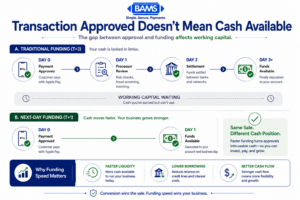
Higher approval rates create revenue, but deposit timing determines when that revenue becomes usable cash. Faster funding shortens the gap between making a sale and improving cash flow.
Consider a mid-size eCommerce brand doing $400,000 per month in Apple Pay transactions. As digital wallet adoption continues to grow across eCommerce, payment volume flowing through Apple Pay has become significant enough that funding delays can materially affect working capital. Statista identifies digital payments and mobile wallets as one of the fastest-growing segments of the global payments ecosystem.
Now imagine two scenarios.
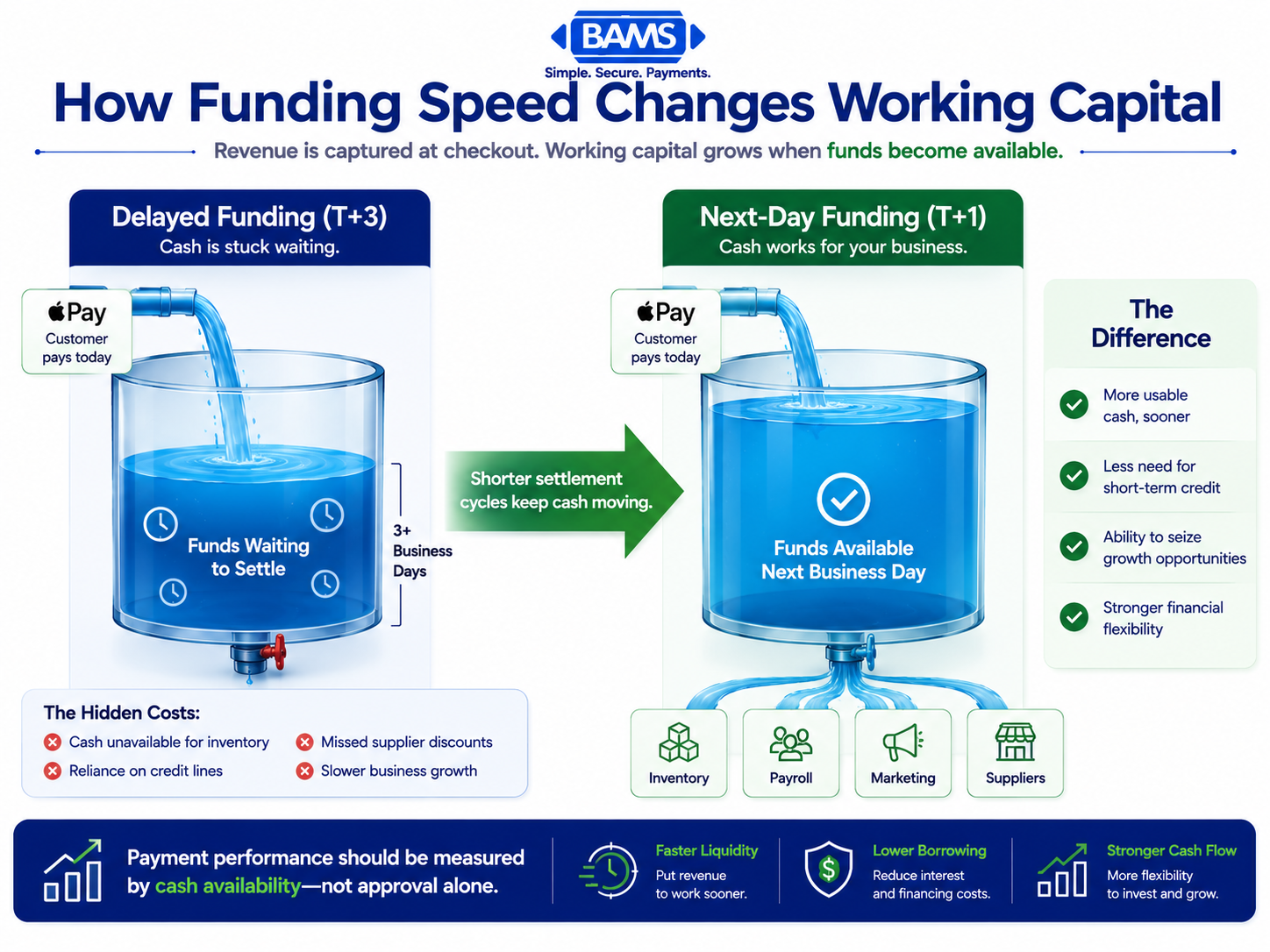
In Scenario A, their processor holds funds for three business days. At any given moment, roughly $40,000 to $60,000 is sitting in limbo. That’s cash they can’t use for inventory, ad spend, or vendor payments. They compensate with a line of credit, paying interest on money they’ve already earned.
In Scenario B, they receive next-day funding. That float shrinks to under $15,000. The credit line stays untouched. They reorder inventory 48 hours sooner. They capture early-payment discounts from suppliers. The same revenue, the same approval rate, the same conversion funnel. Completely different financial outcome.
This isn’t theoretical. We’ve seen this pattern repeatedly across eCommerce operations in the 10-to-50 employee range. The businesses that treat deposit timing as a strategic lever (not a processing afterthought) consistently outperform on working capital metrics.
And here’s where it compounds. Apple Pay’s tokenized security model has eliminated over $1 billion in fraud globally, which means fewer chargebacks, fewer reversals, fewer disruptions to your cash flow. But that benefit only materializes fully when you’re actually receiving the money promptly. Reduced fraud on a slow funding cycle is like putting premium gas in a car with the parking brake on.
This is where a processor’s back-end infrastructure matters as much as its front-end integrations.
BAMS, for example, pairs next-day funding with proactive chargeback defense, which means the cash arrives fast and stays in your account. For eCommerce managers tracking both interchange fees and cash position, that combination changes the operational math significantly.
The data supports the broader shift, too. Sarah Banerji, Senior Payments Analyst at PYMNTS Intelligence, has noted that Apple Pay’s tokenized security model drives higher real-time approval rates compared to traditional card-not-present transactions. Higher approvals plus faster funding plus fewer chargebacks isn’t just incrementally better. It’s a different operating model.
The Hidden Cost of “Good Enough” Processing
Most eCommerce managers we talk to know their Apple Pay approval rates to the decimal. They can tell you their mobile conversion rates by device type. But ask them what their effective cost of capital is due to deposit lag, and you’ll get a blank stare.
That’s not a knowledge gap. It’s a framing problem. The payments industry positioned deposit timing as a back-office concern, something for the CFO to worry about. But for a 30-person eCommerce company, the eCommerce manager is the CFO. Or at least, they’re the one who notices when the ad budget runs dry on Wednesday because Friday’s deposits haven’t cleared.
What Changes If Deposit Speed Is the Real Lever
If this thesis is right, then a lot of eCommerce teams are optimizing the wrong end of the payment stack. They’re A/B testing checkout button colors while leaving tens of thousands of dollars in float on the table every month.
It means your processor comparison shouldn’t start with “do they support Apple Pay?” (they all do). And it should start with “when do I get my money, and what happens when a chargeback hits?” It means the real ROI of Apple Pay as a mobile commerce channel can’t be measured at the point of sale. It has to be measured at the point of deposit.
And it means the eCommerce teams that figure this out first will have a quiet, compounding advantage over competitors who are still celebrating approval rates while their working capital bleeds out through funding delays.
A Better Way to Think About Payment Performance
Stop measuring your payment stack by what happens at checkout. Start measuring it by what happens in your bank account.
We think of it this way: your real conversion rate isn’t the percentage of customers who complete a purchase. It’s the percentage of revenue that becomes usable cash within 24 hours.
That reframe changes everything. It connects front-end experience (Apple Pay’s speed, biometric authentication, higher mobile conversion rates) to back-end outcomes (funding speed, chargeback defense, net cash position). It turns “payments” from a cost center into a working capital strategy. And it gives eCommerce managers a metric they can actually act on, one that finance will care about too.
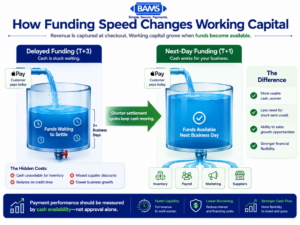
Revenue enters your business when customers pay, but working capital only grows when funds become available. Faster deposits keep cash flowing where it’s needed most.
The Merchants Who Win This Next Phase Won’t Be the Ones With the Best Checkout Flow
They’ll be the ones who understood that every hour between “transaction approved” and “funds available” has a cost. That Apple Pay’s real gift to merchants isn’t just higher approval rates or reduced fraud. It’s cleaner, more predictable revenue, but only if your processing partner delivers it to you without unnecessary delay.
The front end is solved. The back end is where the advantage lives now.
Frequently Asked Questions
What fees do merchants incur when accepting Apple Pay?
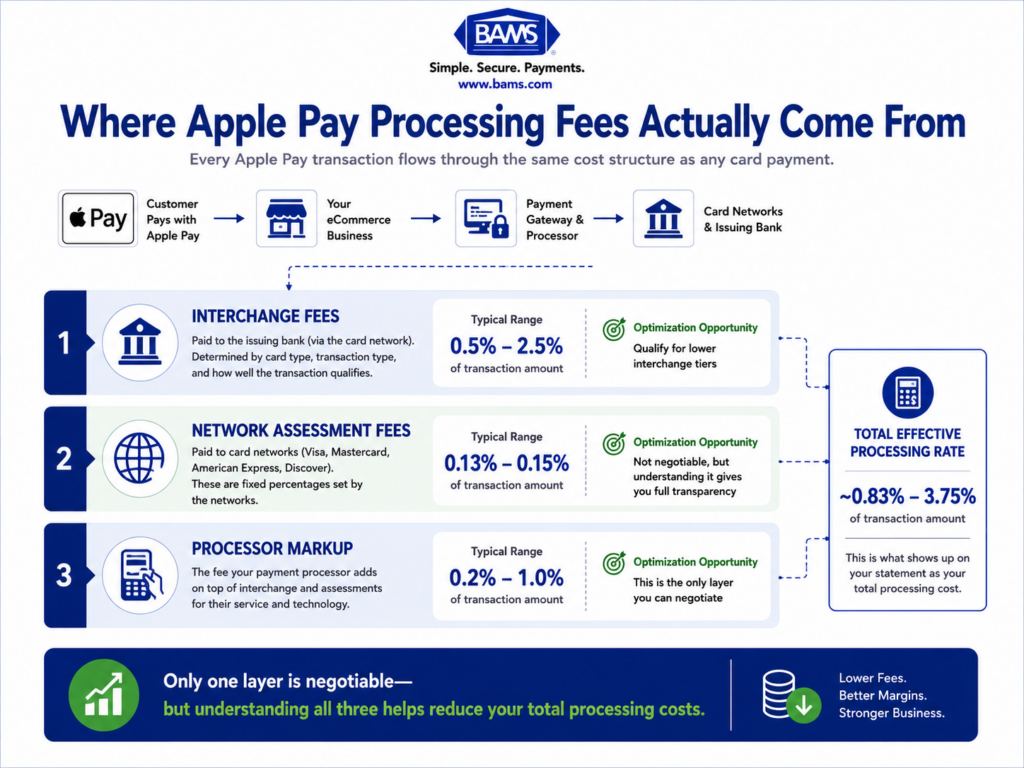
Apple doesn’t charge merchants a fee for Apple Pay transactions. However, standard credit card processing fees (interchange, assessment, and processor markup) still apply, just as they would with any card transaction.
Why is Apple Pay beneficial for reducing fraud costs?
Apple Pay uses device-specific tokenization and biometric authentication, which means actual card numbers are never shared with merchants. This significantly reduces fraud-related chargebacks and the costs associated with disputing and absorbing fraudulent transactions.
How does deposit timing affect the real cost of payment processing?
When processors hold funds for 2 to 4 business days, merchants effectively lose access to working capital, often forcing them to rely on credit lines. Next-day funding eliminates that float, reducing borrowing costs and freeing cash for operations.