7 Chargeback Cost Metrics That Shift with Apple Pay
Last Updated on October 14, 2026 by Dimitri Akhrin
How tokenized payments move fraud rates, dispute costs, and mobile conversion in ways most checkout audits miss
Learn which chargeback cost benchmarks change when Apple Pay enters your checkout flow. This guide connects tokenization mechanics to measurable fraud reduction, dispute savings, and mobile conversion lift for eCommerce managers.
TL;DR
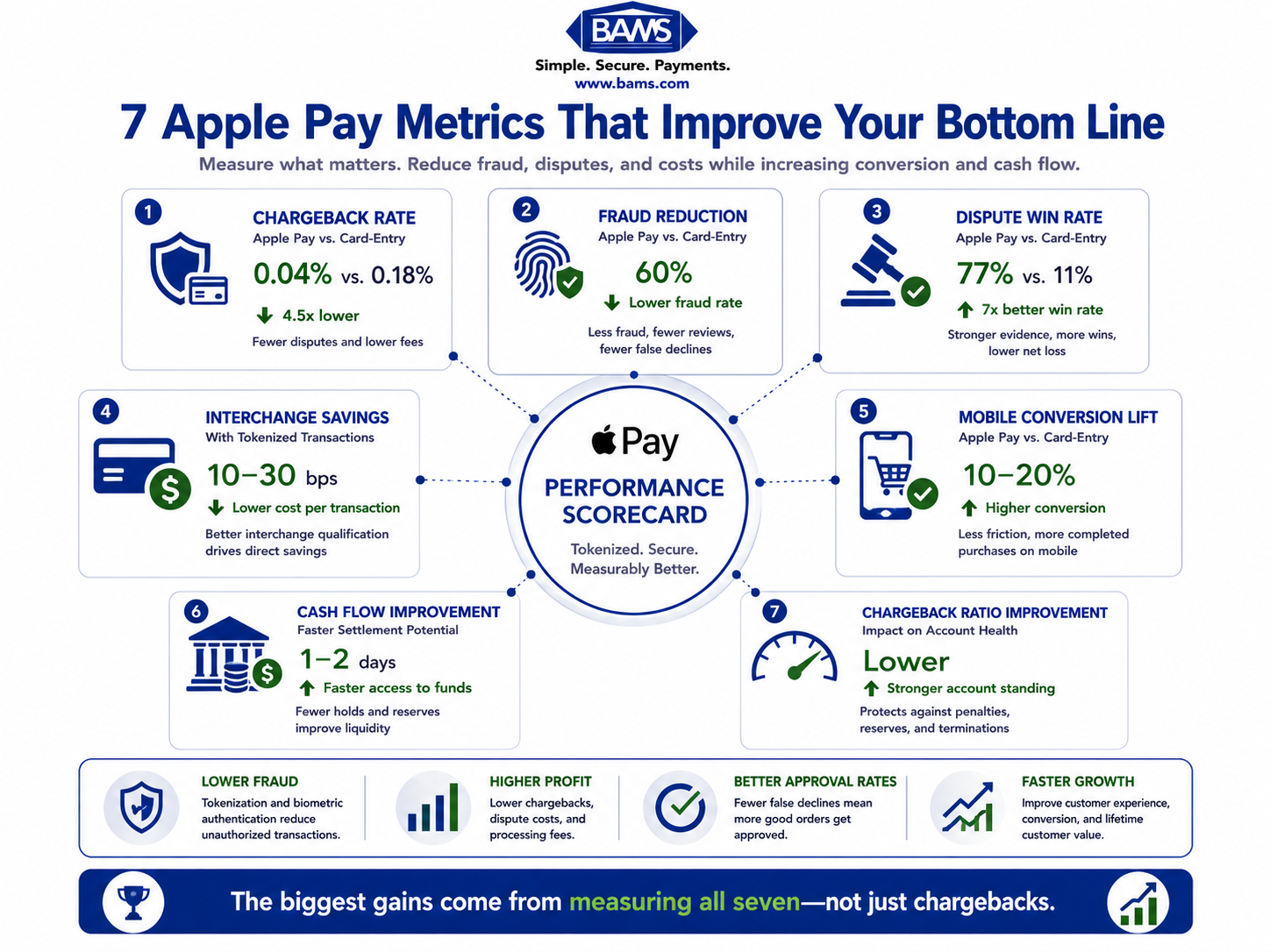
- Apple Pay’s chargeback rate is dramatically lower – At 0.04% versus 0.18% for card-entry, it’s 4.5x safer, and merchants win 7x more disputes when they fight back with Apple Pay transaction evidence.
- Fraud reduction compounds into multiple savings – A 60% lower fraud rate means fewer manual reviews, fewer false declines on legitimate orders, and less pressure on your entire fraud prevention stack.
- Interchange qualification is the hidden cost lever – Apple Pay’s tokenized, biometrically authenticated transactions can qualify for lower interchange tiers, potentially saving 10 to 30 basis points per transaction compared to standard card-not-present entries.
- Mobile conversion lifts when friction disappears – Replacing form fields with a single biometric tap directly addresses cart abandonment on mobile, where checkout friction is highest.
- Start by segmenting your data – Pull chargeback rates and interchange qualification by payment method. Those two reports tell you whether the Apple Pay opportunity is significant enough for your business to act on.
Why Fewer Chargebacks Don’t Automatically Mean More Money in Your Account
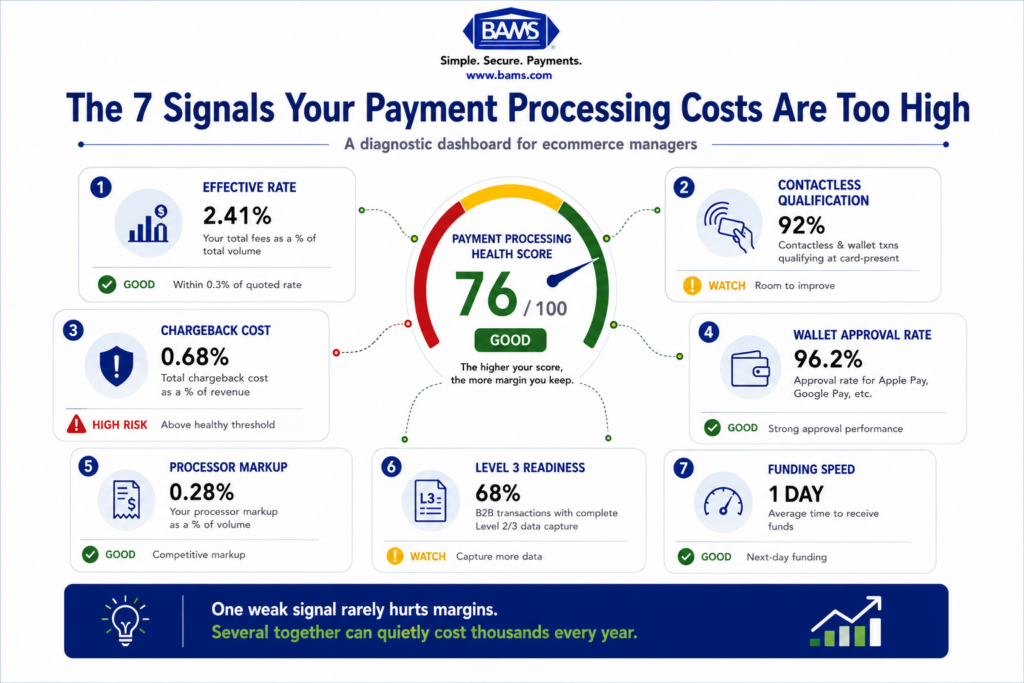
eCommerce managers know that chargeback costs do more than sting once. Chargebacks create costs that extend well beyond the original transaction amount. In addition to lost revenue, merchants often incur processing fees, operational costs, customer service expenses, and additional time spent preparing dispute responses. Yet most advice about reducing chargebacks stops at “add fraud filters” or “tighten return policies.”
What gets overlooked is how the payment method itself shapes your exposure. Apple Pay, for example, is typically discussed as a checkout convenience feature. Rarely does anyone break down the specific mechanisms that make it shift chargeback rates, fraud exposure, and mobile conversion rates simultaneously. Those three signals connect directly to margin, and each one is measurable.
What This List Covers (and What It Doesn’t)
This guide is for eCommerce managers at established online businesses who want to connect Apple Pay adoption to concrete financial outcomes. If you’re evaluating where to position Apple Pay in your checkout, or whether the effort justifies the return, these benchmarks give you a framework for that decision.
We’re not covering Apple Pay setup tutorials, consumer-facing marketing tactics, or comparisons across every digital wallet. Instead, we focus on the measurable levers: how tokenized transactions interact with interchange qualification, why chargeback win rates shift, and where conversion gains actually appear. Each item below ties back to a number you can track.
How We Selected These Benchmarks
Each item was chosen based on three criteria: it must be directly measurable through your payment processor or analytics platform, it must connect to margin (not just volume), and it must reflect a mechanism specific to Apple Pay’s architecture rather than generic digital wallet benefits. Items that only apply to card-present retail were excluded.

Apple Pay delivers more than faster checkout. Tracking these seven metrics helps merchants measure lower fraud, stronger conversion, improved cash flow, and reduced payment processing costs.
7 Benchmarks That Turn Fewer Chargebacks Into Real Savings
1. Chargeback Rate Differential: Apple Pay vs. Card-Entry
Why it matters: Most merchants track their overall chargeback ratio without segmenting by payment method. That aggregate number hides the fact that different entry methods carry dramatically different dispute profiles.
What it looks like today: Card networks flag merchants whose chargeback ratio exceeds 0.9% to 1%. Every fraction of a percentage point matters when you’re managing threshold risk. Apple Pay transactions use device-specific tokens rather than actual card numbers, which eliminates a category of disputes rooted in card-not-present fraud.
How to apply it: Pull your chargeback data by payment method for the last 90 days. Calculate separate ratios for Apple Pay, other digital wallets, and traditional card entry. If your Apple Pay volume is too small to be statistically meaningful, that itself is a signal about checkout positioning.
2. Chargeback Win Rate on Tokenized Transactions
Why it matters: Winning a dispute recovers revenue. Losing one costs you the transaction amount plus fees. The evidence package for a tokenized Apple Pay transaction is fundamentally stronger because it includes device authentication, biometric verification, and a unique token that proves the cardholder’s device was present. Tokenized transactions provide additional authentication information that can strengthen dispute evidence when merchants respond to eligible chargebacks. Mastercard Developers provides technical documentation describing tokenized payment credentials, authentication, and secure digital payment processing.
What it looks like today: Friendly fraud accounts for nearly 79% of chargeback disputes. When a customer claims “I didn’t make this purchase” but biometric data shows their Face ID or Touch ID authorized the payment, that claim collapses. Your evidence package writes itself.
How to apply it: Track your dispute win rate segmented by payment method. If you’re using a chargeback management system, tag Apple Pay transactions so you can measure representment success rates separately. Even a modest improvement in win rate compounds across hundreds of disputes annually.
3. Fraud Rate Reduction and Its Downstream Cost Impact
Why it matters: Fraud doesn’t just create chargebacks. It triggers manual review queues, increases false decline rates, and forces you to tighten filters that then reject legitimate orders. Apple Pay’s fraud rate runs approximately 60% lower than traditional card transactions, which means fewer false positives clogging your review process.
What it looks like today: Many eCommerce teams treat fraud tools as a cost center without measuring how much revenue they block alongside the fraud they catch. When a payment method inherently reduces fraud through tokenization and biometric authentication, it relieves pressure on your entire fraud stack.
How to apply it: Compare your manual review rate and false decline rate for Apple Pay orders versus card orders. If Apple Pay transactions require fewer manual reviews, quantify the labor savings. Then look at whether your fraud filters are declining legitimate Apple Pay transactions unnecessarily. Loosening rules for tokenized payments can recover lost revenue without increasing risk.
4. Interchange Qualification and Processing Cost Per Transaction
Why it matters: Apple Pay transactions often qualify for lower interchange tiers because they carry strong authentication data. Card networks reward transactions that present lower fraud risk with better interchange rates. This is the cost lever almost no competitor content addresses.
Transaction qualification depends on factors including authentication method, card type, merchant category, and processor configuration. Properly authenticated digital wallet transactions may qualify more favorably than comparable manually entered card-not-present transactions. According to the Federal Reserve Bank of St. Louis, card fee revenue continues to grow as electronic payments become an increasingly important part of the U.S. payments ecosystem, making payment efficiency and dispute management increasingly important for merchants.
What it looks like today: Your interchange rate depends on factors like card type, merchant category, and how the transaction is authenticated. Apple Pay’s tokenized, biometrically authenticated transactions can qualify as “card-present” equivalent even in eCommerce contexts, potentially dropping your effective rate by 10 to 30 basis points per transaction compared to manually keyed entries.
How to apply it: Request an interchange detail report from your payment processor. Compare the qualification tier of Apple Pay transactions against your other card-not-present transactions. If you’re not seeing favorable qualification, ask your processor whether their gateway is passing the correct authentication indicators. Partners like BAMS can audit your interchange qualification and identify where you’re overpaying due to misconfigured transaction routing.
5. Mobile Conversion Rate Lift at Checkout
Why it matters: Reducing chargebacks saves money you’ve already earned. Improving mobile conversion rates earns money you’re currently leaving behind. Apple Pay collapses the mobile checkout process from multiple form fields to a single biometric confirmation, which directly addresses cart abandonment on mobile devices.
What it looks like today: Mobile cart abandonment rates remain significantly higher than desktop. Much of that friction comes from tiny form fields, billing address entry, and card number input on small screens. Apple Pay eliminates all of those steps. The conversion lift varies by vertical, but merchants consistently report measurable improvements when Apple Pay is positioned prominently rather than buried below traditional payment options.
How to apply it: Run an A/B test with Apple Pay as the default mobile payment option versus its current placement. Measure conversion rate, average order value, and time-to-completion. If you can’t A/B test, compare mobile conversion rates for sessions where Apple Pay was available versus sessions on browsers or devices where it wasn’t.
6. Cash Flow Velocity: Connecting Fewer Disputes to Faster Funding
Why it matters: Every chargeback freezes funds. Even when you win the dispute, the money is held for weeks or months. Fewer chargebacks mean fewer holds, which means more predictable cash flow. This effect compounds when paired with next-day funding.
What it looks like today: Most eCommerce businesses experience a 2 to 3 day funding delay as standard. During that window, chargebacks and holds can create gaps that force businesses to dip into credit lines or delay vendor payments. When your Apple Pay transactions generate fewer disputes, fewer funds get frozen. Pair that with a processor that offers faster deposits for eCommerce, and the cash flow improvement becomes measurable within a single billing cycle.
How to apply it: Calculate your average funds-in-dispute at any given time. Then model what that number looks like if your Apple Pay chargeback rate (0.04%) applied to a larger share of your transactions. The difference represents capital that stays available for operations, inventory, or growth.
Tokenized wallet transactions generally experience lower unauthorized fraud because sensitive card credentials are never shared with the merchant and each transaction is authenticated using secure device-based methods. PCI Security Standards Council guidance explains how tokenization protects payment credentials by replacing sensitive card information with secure payment tokens.
7. Chargeback Ratio Threshold Management
Why it matters: Visa and Mastercard monitor your chargeback ratio monthly. Exceed their thresholds (typically 0.9% for Visa’s dispute monitoring program) and you face escalating penalties: fines, mandatory remediation plans, and potentially losing your merchant account. Shifting transaction volume toward lower-dispute payment methods is a structural defense against threshold breaches.
What it looks like today: Worldwide chargeback losses are estimated at approximately $33.79 billion across 261 million disputed transactions, with those losses expected to increase by about 23% by 2028. As dispute volumes rise industry-wide, maintaining a healthy ratio becomes harder. Apple Pay’s lower dispute rate acts as a counterweight, diluting your overall ratio as its share of transactions grows.
How to apply it: Monitor your chargeback ratio weekly, not monthly. Segment it by payment method. If you’re approaching threshold territory, increasing Apple Pay adoption among your customers becomes a chargeback defense strategy with measurable impact. Promote Apple Pay at checkout, in confirmation emails, and through saved payment preferences to shift the mix over time.
The Pattern Across All Seven Benchmarks
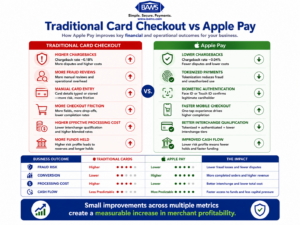
Apple Pay improves more than checkout speed. Lower fraud, fewer disputes, stronger conversion, and better interchange qualification create measurable financial benefits across the payment lifecycle.
Three themes connect these metrics. First, tokenization is the mechanism doing the heavy lifting. Apple Pay doesn’t reduce fraud through marketing or policy. It reduces fraud by never exposing the actual card number, which eliminates an entire category of attack vectors. Second, every benchmark here compounds. Lower fraud rates lead to fewer chargebacks, which lead to better threshold standing, which lead to lower processing costs and more predictable cash flow. Third, none of these benefits activate automatically. They require deliberate measurement, checkout positioning, and processor configuration.
The merchants who capture the most value from Apple Pay are the ones who treat it as a margin tool, not a checkout accessory. That means tracking these numbers, adjusting placement based on data, and ensuring your payment processor passes the right authentication signals to qualify for favorable interchange.
Where to Start Without Overcommitting
You don’t need to overhaul your checkout to capture these gains. Start with two actions: segment your chargeback data by payment method (benchmark #1) and audit your interchange qualification on Apple Pay transactions (benchmark #4). Those two data points will tell you whether the opportunity is significant enough for your business to justify further optimization.
If the numbers look promising, move to checkout positioning (benchmark #5) and dispute evidence tagging (benchmark #2). Save the cash flow modeling and threshold management work for after you’ve established a baseline. The goal is measurable progress, not a six-month project plan that never ships.
Frequently Asked Questions
What fees do merchants incur when accepting Apple Pay?
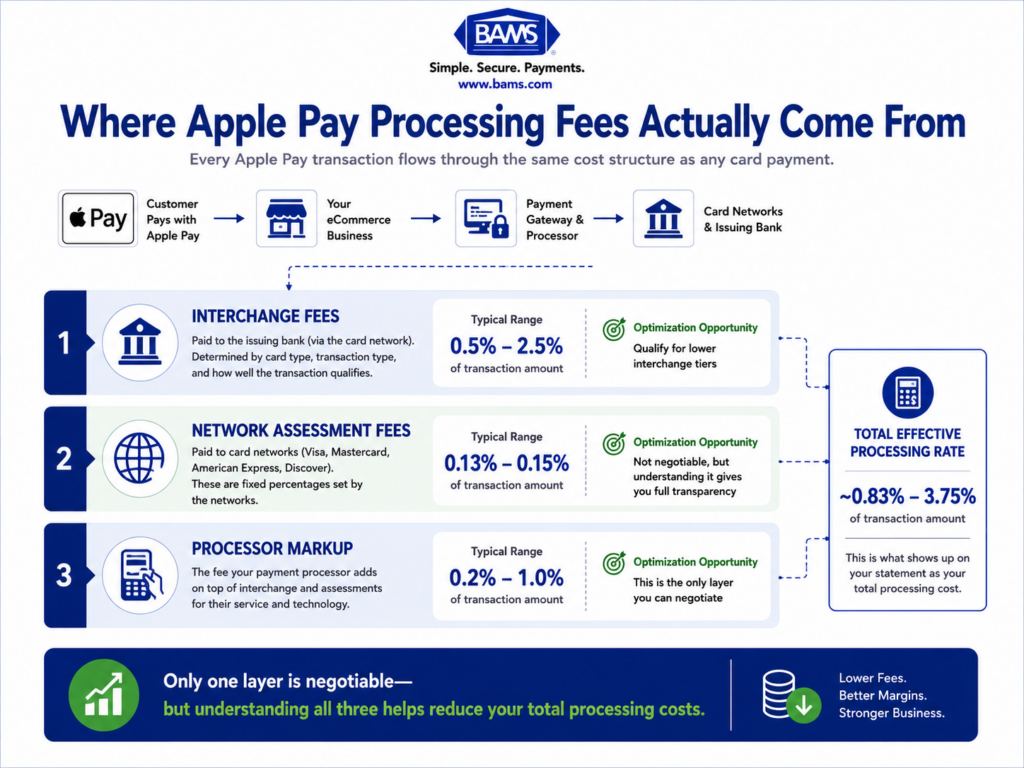
Apple does not charge merchants a separate fee for accepting Apple Pay. Your costs come from your payment processor’s standard transaction fees, including interchange, assessment, and markup. Because Apple Pay transactions carry strong authentication data, they may qualify for lower interchange tiers than manually keyed card-not-present transactions. The net cost per transaction can actually be lower than traditional card processing, depending on your processor’s configuration.
How does Apple Pay help reduce fraud costs for eCommerce businesses?
Apple Pay replaces the actual card number with a device-specific token and requires biometric authentication (Face ID or Touch ID) for every transaction. This means stolen card numbers can’t be used through Apple Pay, and the cardholder’s physical device must be present. The result is a fraud rate approximately 60% lower than traditional card transactions, which reduces manual review queues, false declines, and the downstream costs of fraud-related chargebacks.
Why is Apple Pay’s chargeback rate lower than traditional card payments?
Two mechanisms drive the difference. First, tokenization prevents card-not-present fraud because the real card number is never transmitted. Second, biometric authentication creates strong evidence that the actual cardholder authorized the purchase. This makes “I didn’t make this purchase” claims much harder to sustain, which reduces both the volume of disputes filed and increases the merchant’s win rate when disputes do occur.
When should businesses promote Apple Pay to customers at checkout?
Promote Apple Pay when the data supports it. If your chargeback and fraud rates are lower on Apple Pay transactions, and your mobile conversion rate improves when Apple Pay is prominently positioned, those are signals to make it more visible. Consider placing it as the default mobile payment option, featuring it in post-purchase confirmation emails for repeat buyers, and enabling it as a saved payment preference. The goal is to shift your transaction mix toward the lower-risk, higher-converting method.
How does Apple Pay compare to traditional credit card processing fees?
The base interchange and assessment fees are similar because Apple Pay transactions still run on the underlying card networks (Visa, Mastercard, etc.). However, Apple Pay transactions may qualify for better interchange tiers due to their strong authentication data. The indirect savings from fewer chargebacks, lower fraud review costs, and reduced penalty exposure can make the effective cost per Apple Pay transaction meaningfully lower than a standard card-not-present transaction.
Can Apple Pay transactions still result in chargebacks?
Yes. Apple Pay reduces chargebacks significantly but does not eliminate them entirely. Customers can still dispute transactions for reasons like product not received, product not as described, or subscription billing confusion. However, the category of fraud-based disputes drops dramatically, and your evidence package for fighting remaining disputes is stronger because of the biometric and tokenization data attached to each transaction.