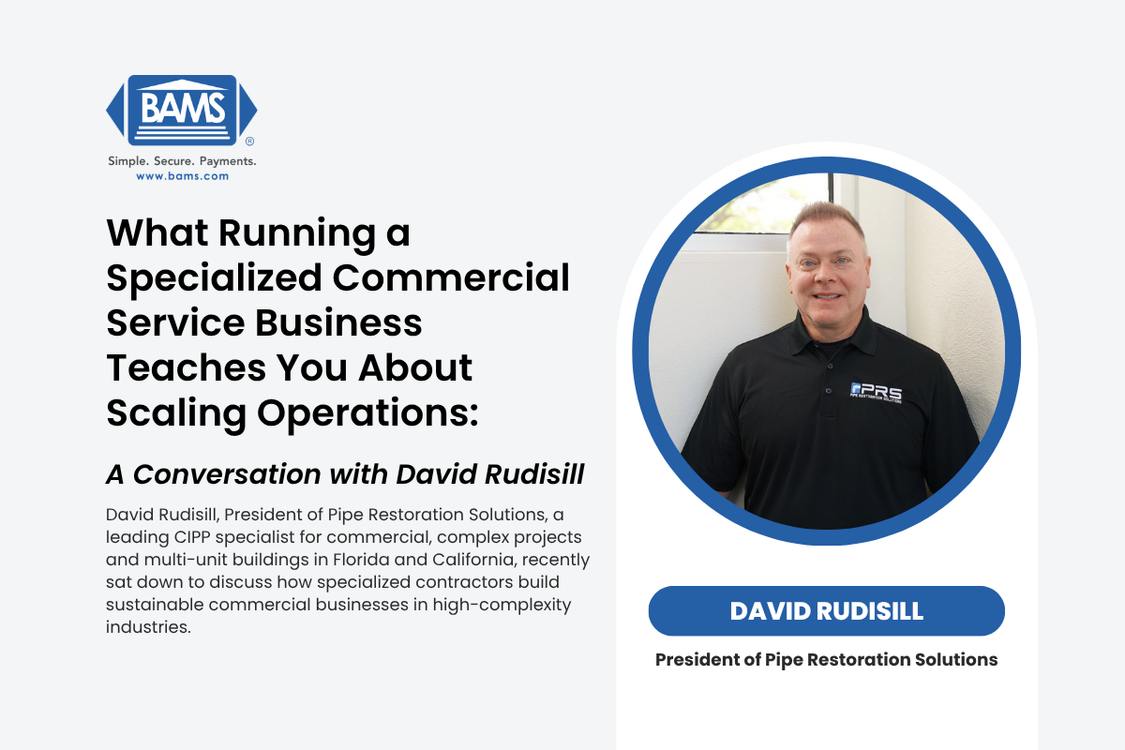
What Running a Specialized Commercial Service Business Teaches You About Scaling Operations: A Conversation with David Rudisill
Last Updated on May 12, 2026 by Dimitri Akhrin
For business owners scaling specialized service operations, the challenges involve strategic equipment investments, multi-state expansion decisions, and positioning in premium market segments. David Rudisill, President of Pipe Restoration Solutions, a leading CIPP specialist for commercial, complex projects and multi-unit buildings in Florida and California, recently sat down to discuss how specialized contractors build sustainable commercial businesses in high-complexity industries.
Q1: David, you’ve built Pipe Restoration Solutions into a multi-state operation serving some of the most complex commercial projects in your industry. For business owners trying to move beyond local residential work into commercial and multi-unit projects, what adaptations need to happen?
A1: The shift isn’t just about landing bigger projects, it’s about rebuilding your business model. When we started focusing on complex commercial projects and multi-unit buildings, a lot changed: our equipment requirements, our team structure, and even how we think about client relationships.
In residential work, you’re usually solving problems for individual homeowners. Projects typically last days, payments come quickly, and you move to the next job. Commercial and multi-unit work is fundamentally different. A single 20-story condo building represents a multi-week project coordinating with property managers, HOA boards, and residents. The decision-making process involves committees, budgets get approved months in advance, and execution requires minimal disruption to occupied buildings.
The business infrastructure required is completely different; you need specialized equipment, materials, training, and project systems that require significant investment.. You also need technicians trained for scenarios they rarely encounter in residential work, like rehabilitating vertical pipe stacks 15 stories up, working in commercial facilities where operational disruptions must be minimized, and managing projects that span multiple buildings in HOA communities.
Q2: You mentioned equipment investment. When you’re expanding into commercial work or opening new markets, how do you think about those capital decisions?
A2: Equipment decisions in specialized commercial work can help teams access entirely new market segments they couldn’t bid on before.
Many residential-focused CIPP contractors are primarily set up for smaller-diameter pipe work, often in the 2″ -8″ range. That handles virtually all residential work. But commercial properties and multi-unit buildings often have 10″ , 12″ , even 18″ or larger main sewer lines. When we invested in equipment capable of handling 2″ -36″ diameter systems, we eliminated much of our competition for those projects. There simply aren’t many contractors with that capability.
For business owners evaluating equipment investments, ask whether this purchase expands your addressable market into higher-complexity, higher-margin work that your competitors can’t handle.
Q3: You operate across Florida and California now. What’s the reality of multi-state expansion for a specialized service business?
A3: Multi-state expansion is often seen as a growth milestone, but the operational reality is challenging if you don’t have the right foundation. You need dedicated teams in each market, as complex commercial projects require local presence, immediate response capability, and relationships with property managers and HOA boards. We serve Jacksonville, Sarasota, Naples, Miami, Irvine, and Long Beach from regional offices because large-scale, occupied building projects require strong local coordination and reliable field support.
Talent development also becomes more difficult. Finding technicians capable of diagnosing pipe failures in a 26-story building, coordinating with property managers, and executing complex rehabilitation in occupied structures—that expertise takes years to develop. You can’t just hire locally and hand them equipment.
The lesson for specialized contractors: don’t expand geographically until you’ve perfected operations, built repeatable systems, and established market leadership in your first region.
Q4: How do you position a specialized commercial business to attract the right clients rather than competing on price with general contractors?
A4: When a property management company oversees a 15-story luxury condo with failing pipe systems, they’re looking for proven expertise in exactly that scenario: occupied high-rise buildings where traditional replacement would displace residents, require wall demolition on every floor, and cost millions in disruption.
Our positioning comes from our project portfolio. We can show documented experience with multi-story buildings, sprawling HOA communities, and occupied commercial facilities where operations couldn’t stop. That track record creates referral networks—property managers recommend us to other properties, HOA boards refer us to neighboring communities, commercial general contractors bring us in as specialized subcontractors.
Q5: What’s your advice for business owners in specialized service industries who want to scale into commercial work sustainably?
A5: First, commit fully to specialization or stay generalist—half measures fail. It’s difficult to treat complex commercial work as an add-on service. The equipment investment, talent development, and market positioning required for complex commercial projects demand complete operational focus.
Second, perfect your service delivery before scaling. We spent years refining processes, training protocols, and project management systems before expanding markets. Premature growth spreads resources thin and prevents you from building the deep expertise that justifies premium positioning.
Third, build operational systems that create predictable outcomes. Complex commercial projects involve dozens of stakeholders, multi-week timelines, and occupied building constraints. You need documented processes, trained teams, and quality control systems that deliver consistent results regardless of project complexity.
Finally, recognize that a single property management company might represent 20 buildings and hundreds of thousands in annual revenue. One successful high-rise project leads to referrals across their entire portfolio. Client lifetime value often matters more than individual project margins.
The opportunity in specialized commercial work is substantial for contractors willing to make the commitment. But it requires different infrastructure, different positioning, and different operational capabilities than general service businesses.
Pipe Restoration Solutions is a leading CIPP specialist for commercial, complex projects and multi-unit buildings in Florida and California. Learn more at piperestorationsolutions.com.