7 Hidden Fees That Inflate Interchange-Plus Pricing
Last Updated on July 28, 2026 by Dimitri Akhrin
A diagnostic checklist for B2B eCommerce merchants losing margin to opaque processing costs
Learn how to identify the specific line items and fee structures that quietly inflate your effective credit card processing rate. This diagnostic checklist helps B2B eCommerce merchants spot cost leaks hiding in plain sight on their statements.
TL;DR
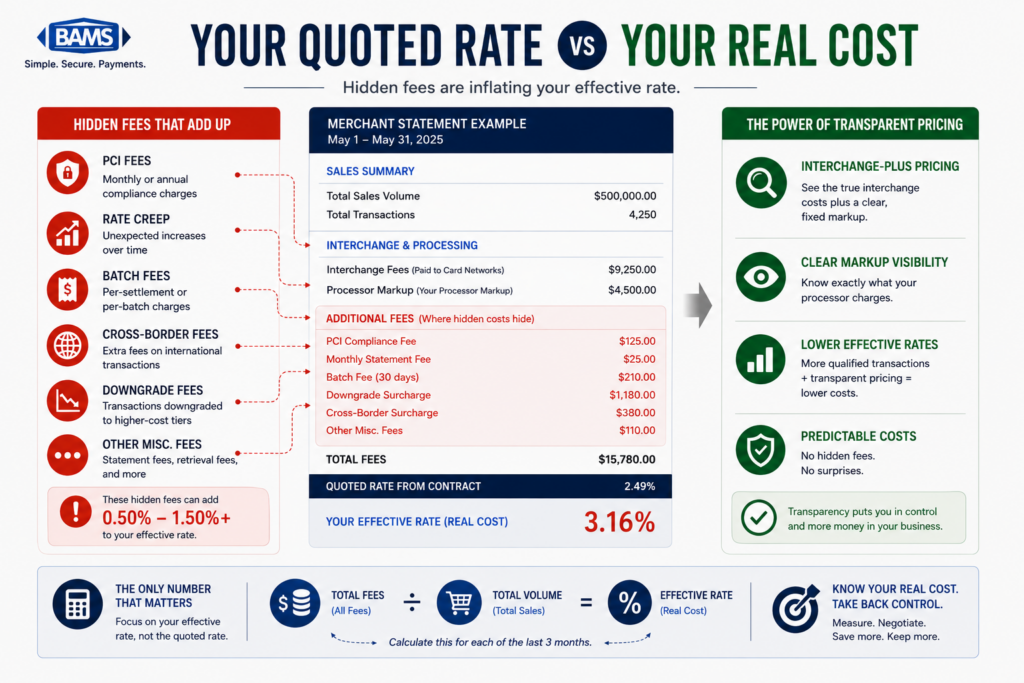
- Your quoted rate isn’t your real rate – Calculate your effective processing rate (total fees ÷ total volume) and compare it to what you were quoted. A gap of more than 0.3% signals hidden fee inflation.
- Tiered pricing is the root cause – Interchange-plus pricing makes every cost component visible and verifiable. Tiered pricing lets your processor decide which bucket your transactions fall into, and that decision costs you money.
- B2B merchants lose the most to downgrades – Failing to submit Level 2/3 data on corporate card transactions adds 0.5% to 1.0% per transaction. Check whether your B2B orders are actually qualifying at commercial interchange rates.
- Small recurring fees add up fast – PCI non-compliance fees, inflated assessments, duplicate batch fees, and account maintenance charges can collectively cost thousands per year while appearing insignificant individually.
- Start with a one-hour audit – Calculate your effective rate, check B2B interchange qualification, and identify recurring fees with no clear service attached. These three steps reveal whether your statement reflects reality or obscures it.
The Fees You Don’t See Are the Ones That Cost the Most
Most eCommerce businesses review their processing statements the same way they read terms of service: quickly, if at all. That’s a problem. Many businesses pay more than necessary because of opaque pricing structures, interchange downgrades, and recurring account fees that are difficult to identify from summary statements alone. For B2B merchants processing high-ticket orders, the damage compounds fast.
According to the Federal Reserve’s 2025 Small Business Credit Survey, controlling operating expenses remains a priority for many businesses. Even small improvements in payment acceptance costs can have a meaningful impact on profitability as transaction volume grows.
The hidden fees in merchant services don’t announce themselves. They appear as vague line items, bundled surcharges, and qualification downgrades that inflate your effective rate well beyond what you were quoted. The gap between your quoted rate and your actual cost is where margin disappears.
This isn’t a pricing pitch. It’s a diagnostic checklist. The seven items below identify the specific fee structures that quietly erode B2B processing margins, and show you how to confirm whether each one is affecting your business.
Who This Is For, and What It Covers
This guide is built for ecommerce managers at established online businesses (10-50 employees) who process a mix of B2B and high-ticket consumer orders. If your monthly processing volume is significant enough that a 0.5% rate difference translates to thousands of dollars annually, every item here applies to you.
This is not a comparison of processors. It’s not a guide to finding the cheapest rate. It’s a framework for identifying cost leaks that exist regardless of which provider you use. If you want to understand why low cost merchant services often aren’t what they seem, start with your effective processing rate, not the number on your contract.
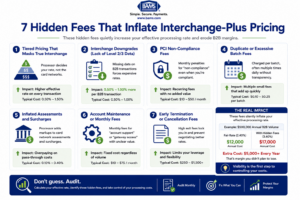
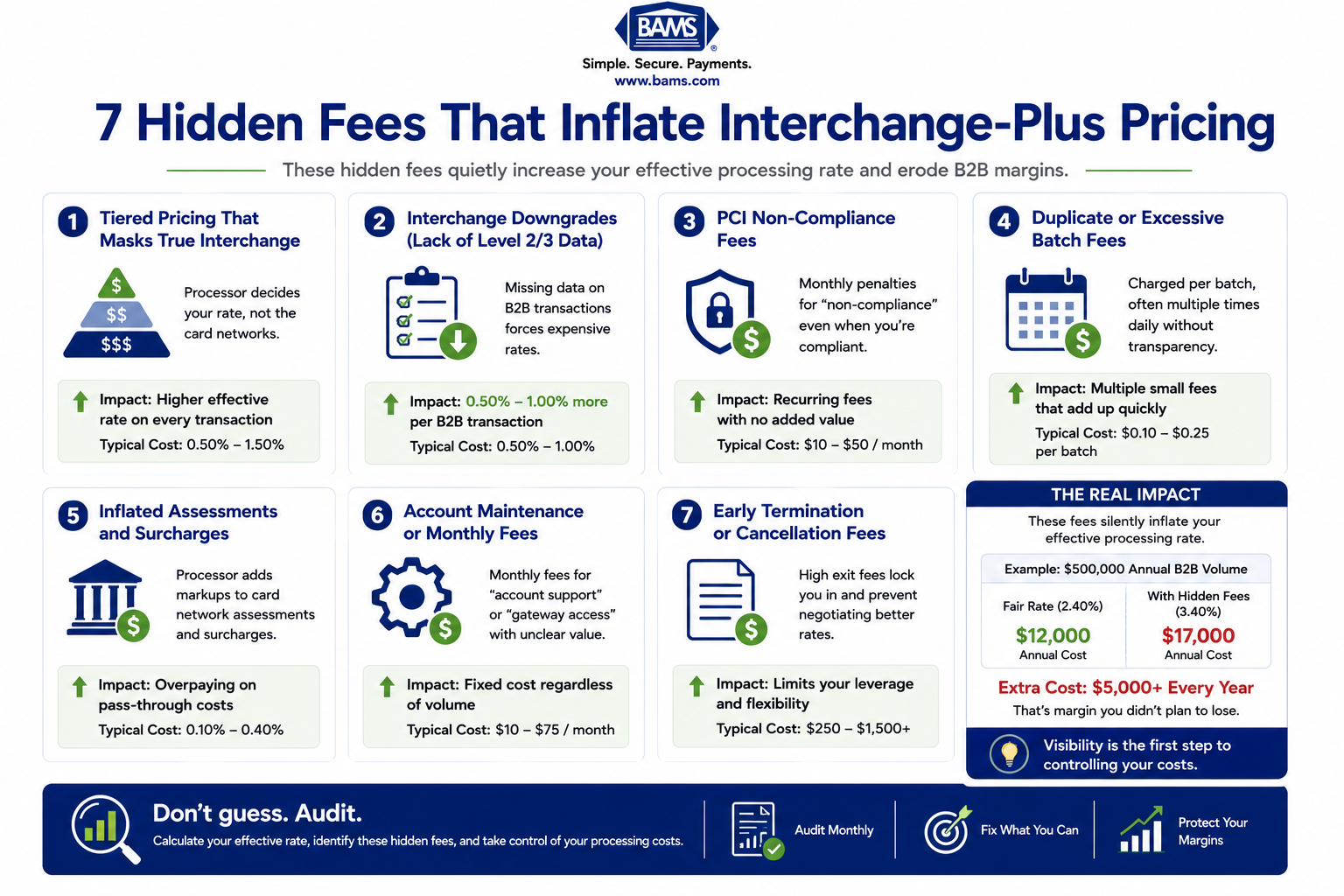
Hidden fees often appear as small recurring charges, but together they can significantly increase your effective processing rate and reduce B2B profit margins.
How These Fee Signals Were Selected
Each item was selected based on three criteria: frequency (how often it appears across mid-market B2B processing statements), magnitude (the dollar impact relative to total processing volume), and obscurity (how effectively the fee avoids detection during routine statement reviews). Items that score high on all three represent the biggest risks to your margins.
7 Hidden Fees That Inflate B2B Processing Costs
1. Tiered Pricing That Masks True Interchange Costs
Why it matters: Tiered pricing bundles hundreds of interchange categories into three buckets: qualified, mid-qualified, and non-qualified. This sounds simple, but simplicity is the problem.
Visa’s payment processing guidance explains how interchange, network assessments, and processor markups combine to determine total payment acceptance costs. Your processor decides which bucket each transaction lands in, and that decision is rarely in your favor. As the BAMS analysis team has noted, “Don’t accept a lower quoted rate that still uses tiered pricing, because the same hidden fees will reappear.”
What it looks like today: You see a low “qualified” rate on your contract (maybe 1.65%), but your statement shows most transactions landing in the mid-qualified or non-qualified tiers at 2.5% to 3.5%. The quoted rate applies to a narrow slice of transactions. Everything else gets marked up.
How to apply it: Calculate your effective processing rate by dividing total fees by total volume. If it’s more than 0.3% above your quoted rate, tiered bucketing is likely the cause. The fix is interchange-plus pricing, which passes actual interchange costs through transparently with a fixed markup you can verify line by line.
2. Interchange Downgrade Surcharges on B2B Transactions
Why it matters: B2B and corporate card transactions qualify for lower interchange rates when Level 2 and Level 3 data (tax amounts, line-item details, customer codes) is submitted. When that data isn’t passed, the transaction “downgrades” to a higher interchange tier. Downgrades cost businesses 0.5% to 1.0% more per transaction than necessary.
What it looks like today: Your statement shows line items labeled “EIRF” (Electronic Interchange Reimbursement Fee) or “Standard” tier charges on transactions that should have qualified at commercial or purchasing card rates. Many processors claim to support Level 2/3 optimization but don’t actually pass the required data fields. The Visa Commercial Enhanced Data Program (CEDP) explains how enhanced transaction data helps eligible commercial card transactions qualify for more favorable interchange categories.
How to apply it: Pull a month of B2B transactions and check whether they settled at commercial card interchange rates or defaulted to standard consumer rates. If you see consistent downgrades, your gateway or processor isn’t submitting the required data. This is one of the largest recoverable cost leaks in B2B eCommerce.
3. PCI Non-Compliance Fees Charged Indefinitely
Why it matters: PCI compliance fees are legitimate. PCI non-compliance fees are a revenue stream. Many processors charge a monthly non-compliance penalty ($19.95 to $99.95) that continues even after you’ve completed your SAQ (Self-Assessment Questionnaire), simply because the compliance status was never updated in their system.
What it looks like today: A recurring line item labeled “PCI Non-Compliance Fee” or “Security Non-Validation Fee” on your monthly statement. Some processors bury it under a “Regulatory” or “Account Maintenance” section. It’s easy to mistake for a standard cost of doing business.
How to apply it: Confirm your PCI compliance status directly with your processor and request written confirmation that the non-compliance fee has been removed. If you’ve been paying it for months after completing your SAQ, request a retroactive credit. This is one of the simplest fees to eliminate.
4. Batch Processing Fees That Multiply Quietly
Why it matters: Every time you settle your daily transactions, your processor charges a batch fee (typically $0.10 to $0.30 per batch). For most businesses, that’s one batch per day. But some gateway configurations or multi-location setups trigger multiple batches per day, multiplying a small fee into a meaningful annual cost.
What it looks like today: Your statement shows 45 to 90 batch fees per month instead of the expected 30. This happens when your system auto-settles at multiple intervals or when different payment types (credit, debit, corporate) settle in separate batches without your knowledge.
How to apply it: Count the batch fees on your last three statements. If the number consistently exceeds the number of business days in the month, investigate your settlement configuration. Consolidating to a single daily batch is usually a gateway setting change, not a processor change.
5. “Assessment” Fees That Exceed Actual Card Brand Costs
Why it matters: Card brands (Visa, Mastercard, Discover) charge assessment fees, typically between 0.13% and 0.15%. These are fixed, publicly available rates. Some processors pass these through accurately. Others add their own markup on top of the assessment and label the combined charge as the “assessment fee,” making it appear non-negotiable.
What it looks like today: Your statement lists assessment fees at 0.18% to 0.25%, above the published card brand rates. The overage is processor margin disguised as a pass-through cost. With U.S. merchants already paying the highest card acceptance fees globally, even small assessment markups compound significantly at scale.
How to apply it: Compare the assessment rates on your statement against the current published rates from Visa and Mastercard. Any difference is processor markup. On interchange-plus pricing, this markup should be zero or clearly disclosed as a separate line item.
6. Monthly Minimum Fees and Account Maintenance Charges
Why it matters: Monthly minimums require you to pay a floor amount in processing fees regardless of actual volume. If your fees for the month total $18 and your minimum is $25, you pay $25. For growing ecommerce businesses with seasonal volume fluctuations, this creates a hidden tax during slow months. Account maintenance fees ($5 to $15/month) stack on top.
What it looks like today: A line item labeled “Monthly Minimum” or “Minimum Discount Fee” appears in months where your processing volume dips. Separately, “Account Fee,” “Statement Fee,” or “Service Fee” charges appear every month regardless of volume. These fees rarely appear in the initial sales conversation.
How to apply it: Review your contract for monthly minimum thresholds and request their removal, especially if your average monthly fees consistently exceed the minimum. For account maintenance fees, ask for an itemized explanation of what each fee covers. Fees with no clear service attached are negotiable. Tools like BAMS offer transparent pricing structures where these types of charges are disclosed upfront, so you can compare what you’re paying now against a clear alternative.
7. Early Termination Fees and Auto-Renewal Traps
Why it matters: Many processing contracts include early termination fees ($295 to $595 or a liquidated damages formula based on remaining months) and auto-renewal clauses that extend your contract by 1-2 years if you miss a narrow cancellation window. These don’t inflate your per-transaction costs, but they lock you into an arrangement where every other hidden fee on this list continues unchecked.
What it looks like today: Your contract auto-renewed three months ago. You didn’t receive a notification. The cancellation window was 30 days before the renewal date, buried in section 12 of your agreement. Now switching processors means paying a penalty that offsets months of potential savings. Opaque billing practices like these have led to class-action settlements in the industry.
How to apply it: Locate the termination and renewal clauses in your current agreement. Set a calendar reminder 60 days before any renewal date. When evaluating new processors, prioritize month-to-month agreements or contracts with no early termination fee. The ability to leave is the strongest negotiating leverage you have.
The Pattern Behind These Fees

A structured diagnostic framework helps merchants move from reviewing statements to identifying hidden fees, validating interchange qualification, and negotiating with processors using data instead of estimates.
Every fee on this list shares a common trait: it relies on your inattention. Tiered pricing works because you trust the quoted rate. Downgrades persist because you don’t audit interchange qualification. PCI fees continue because nobody checks the compliance status. These aren’t pricing errors. They’re structural incentives built into opaque billing models.
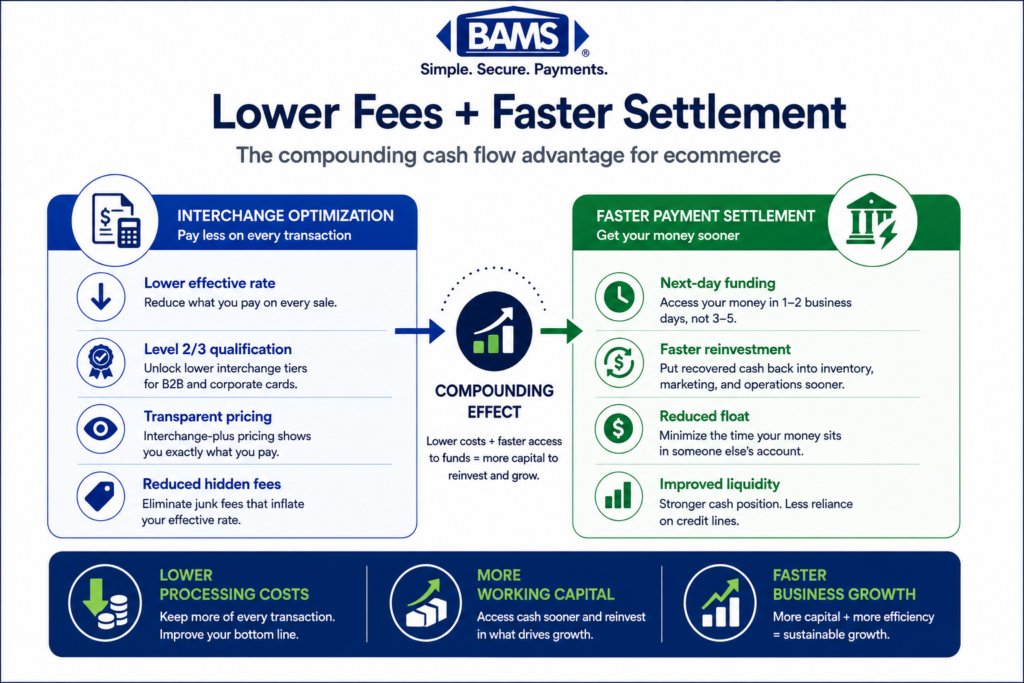
The connecting thread is that interchange-plus pricing eliminates most of these problems by design. When interchange is passed through at cost and the processor’s margin is a fixed, visible markup, there’s nowhere for hidden fees to hide. The remaining fees (batch fees, minimums, account charges) become individually identifiable and negotiable.
The second pattern is that B2B merchants absorb disproportionate damage. Small businesses often pay higher effective processing costs than larger organizations because they have less negotiating leverage and lower transaction volume. Level 2/3 optimization is the primary mechanism for closing that gap on B2B orders, yet most mid-market processors don’t implement it properly.
Where to Start: Prioritizing Your Fee Audit
You don’t need to address all seven items at once. Start with three actions that deliver the most immediate clarity. First, calculate your effective processing rate (total fees divided by total volume) and compare it to your quoted rate. Second, check whether your B2B transactions are qualifying at Level 2/3 interchange rates or downgrading. Third, scan your statement for recurring fees (PCI non-compliance, account maintenance) that have no clear service justification.
These three steps take less than an hour and will tell you whether your current processing costs reflect reality or a billing structure designed to obscure it. From there, you can negotiate from a position of data, not guesswork. If you want a framework for evaluating whether your processor is actually transparent, look beyond the rate and examine the statement itself.
Frequently Asked Questions
What is interchange-plus pricing and how does it work?
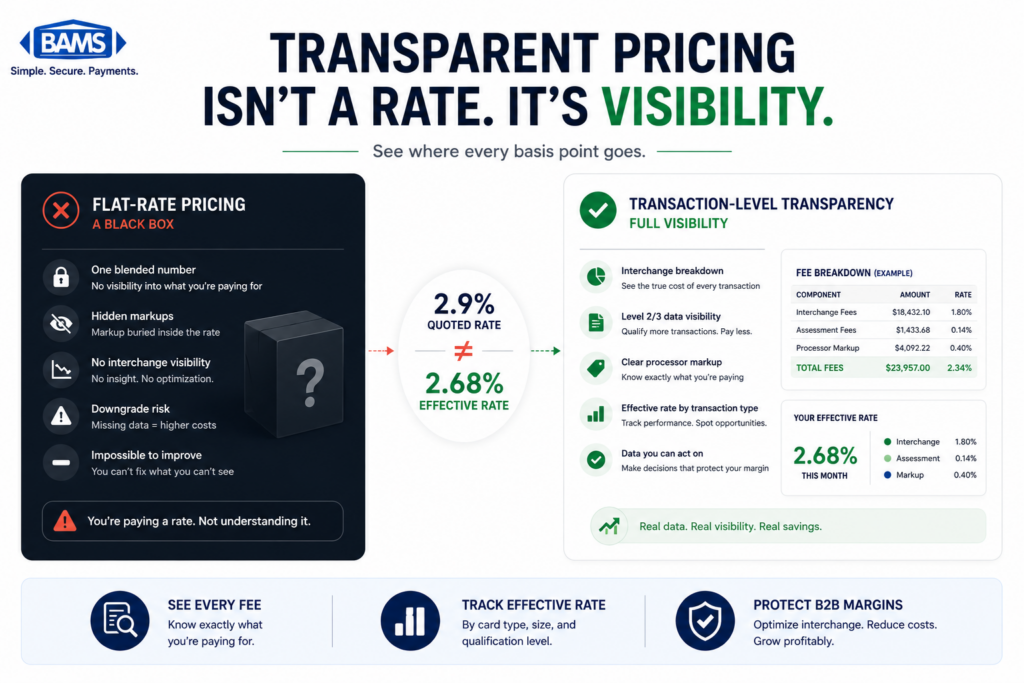
Interchange-plus pricing separates your processing cost into three visible components: the interchange fee (set by the card networks), the card brand assessment fee, and your processor’s markup. Instead of bundling everything into opaque tiers, each component appears as a separate line item on your statement. This makes it straightforward to verify exactly what you’re paying and where your money goes.
What are the common hidden fees in merchant services that businesses should watch out for?
The most frequent hidden fees include PCI non-compliance charges, inflated assessment fees, batch processing fees that multiply due to settlement configurations, monthly minimums, account maintenance fees, and early termination penalties. These fees often appear as small, recurring line items that individually seem insignificant but collectively add thousands of dollars per year to your processing costs.
Why should businesses consider Level 2/3 optimization for B2B transactions?
B2B and corporate card transactions qualify for lower interchange rates when additional data fields (tax amount, customer code, line-item details) are submitted with the transaction. Without this data, transactions “downgrade” to higher consumer-level interchange rates, costing 0.5% to 1.0% more per transaction. For merchants processing significant B2B volume, Level 2/3 optimization can reduce interchange costs by 30-40%.
How can I tell if my processor is actually qualifying transactions at Level 2/3?
Pull a sample of B2B transactions from your processing statement and check the interchange category each one settled at. If you see categories like “EIRF” or “Standard” instead of “Commercial” or “Purchasing,” your transactions are downgrading. Your processor may claim to support Level 2/3 data, but the statement is the only proof that matters.
When is the best time to negotiate processing fees with your merchant services provider?
The strongest negotiating position comes from having specific data: your effective processing rate, the gap between your quoted and actual rate, the dollar value of interchange downgrades, and any non-essential fees you’ve identified. Approach negotiations after completing a thorough statement audit, and time the conversation 60-90 days before any contract renewal date to avoid auto-renewal traps.
Which payment processing model is more cost-effective for high-volume transactions?
For established eCommerce businesses with consistent volume, interchange-plus pricing is almost always more cost-effective than tiered or flat-rate models. Flat-rate pricing (e.g., 2.9% + $0.30) simplifies billing but overcharges on debit transactions and lower-interchange card types. Interchange-plus passes actual costs through, so you benefit from lower interchange categories rather than subsidizing a blended rate.