Surcharge Compliance for Funeral Homes: A Complete Guide
Last Updated on October 20, 2026 by Dimitri Akhrin
This guide addresses a specific operational problem: how to implement surcharging or dual pricing on funeral transactions without violating FTC Funeral Rule disclosure requirements or card network rules. Surcharge compliance and dual pricing funeral services sit at the intersection of two regulatory frameworks that most operators treat separately, creating compounding risk.
This guide is for family-owned funeral service operators managing one to ten locations who accept card payments on high-ticket arrangements (sometimes $10,000 to $20,000 or more). By the end, you’ll understand how to structure fee disclosures that satisfy both the Funeral Rule’s itemized pricing mandate and card brand surcharging rules, identify which implementation shortcuts create violations and make a clear decision between surcharging and dual pricing for your business.
This guide does not cover preneed trust accounting, insurance assignment mechanics, or general Funeral Rule compliance beyond its intersection with payment processing. For cash flow timing issues related to insurance assignments and preneed installments, see Working Capital Management for Funeral Homes.
TL;DR
- Surcharging is a compliance design problem, not a terminal setting — The fee should be disclosed on your General Price List, during phone inquiries and in the arrangements conference, not just at checkout. Funeral Rule requirements and card network rules both apply simultaneously.
- Debit cards cannot be surcharged — Your terminal must distinguish credit from debit at the BIN level. If it can’t, consider dual pricing instead, which applies the same card price regardless of card type.
- Your surcharge can’t exceed your actual processing cost — A 3% surcharge on a $15,000 transaction ($450) likely exceeds your real cost of acceptance. Calculate your effective rate and set the surcharge at or below that number.
- Dual pricing may be simpler for multi-state operators — Some states prohibit surcharging. If any location is in one, dual pricing (cash and card prices on every line item) keeps your approach consistent everywhere.
- Audit quarterly, not just at setup — Staff turnover, rate changes, GPL reprints and state law updates all create compliance drift. A dated audit log for each location is your best protection against compounding violations.
Why Surcharge Compliance Matters for Funeral Home Merchant Services
A single at-need arrangement can reach $15,000. At a processing rate of 2.20% plus $0.20, that keyed or online transaction costs you approximately $330.20 in processing fees. Across 200 families per year, you could be absorbing $50,000 to $70,000 in card processing costs alone. That’s margin you can recover, but only if the recovery mechanism is built correctly.
The temptation is straightforward: add a surcharge at the terminal and recoup the fee. But funeral services operate under the FTC Funeral Rule, which requires itemized price transparency at every stage of the consumer interaction, including over the telephone. A surcharge that appears only at the payment terminal, or a dual price structure that isn’t reflected on your General Price List, can create problems under the Rule’s disclosure requirements. In one FTC case, a court order required a cremation provider to post its prices online and give clear disclosures about its locations.
Multi-location operators face compounding exposure. If your surcharge implementation is flawed at one location, it’s likely flawed at all of them. Each location’s General Price List, each phone inquiry, each Statement of Funeral Goods and Services Selected becomes a separate potential violation. The cost of getting this wrong isn’t a single fine; it’s a systemic compliance failure.
Meanwhile, card network rules add a second layer. Visa and Mastercard each have distinct surcharging requirements around caps, signage, debit card exclusions and registration. State laws add a third. Getting any one of these wrong while the other two are correct still leaves you exposed.
Core Concepts: Surcharging vs. Dual Pricing and the Funeral Rule Connection
Surcharging Defined
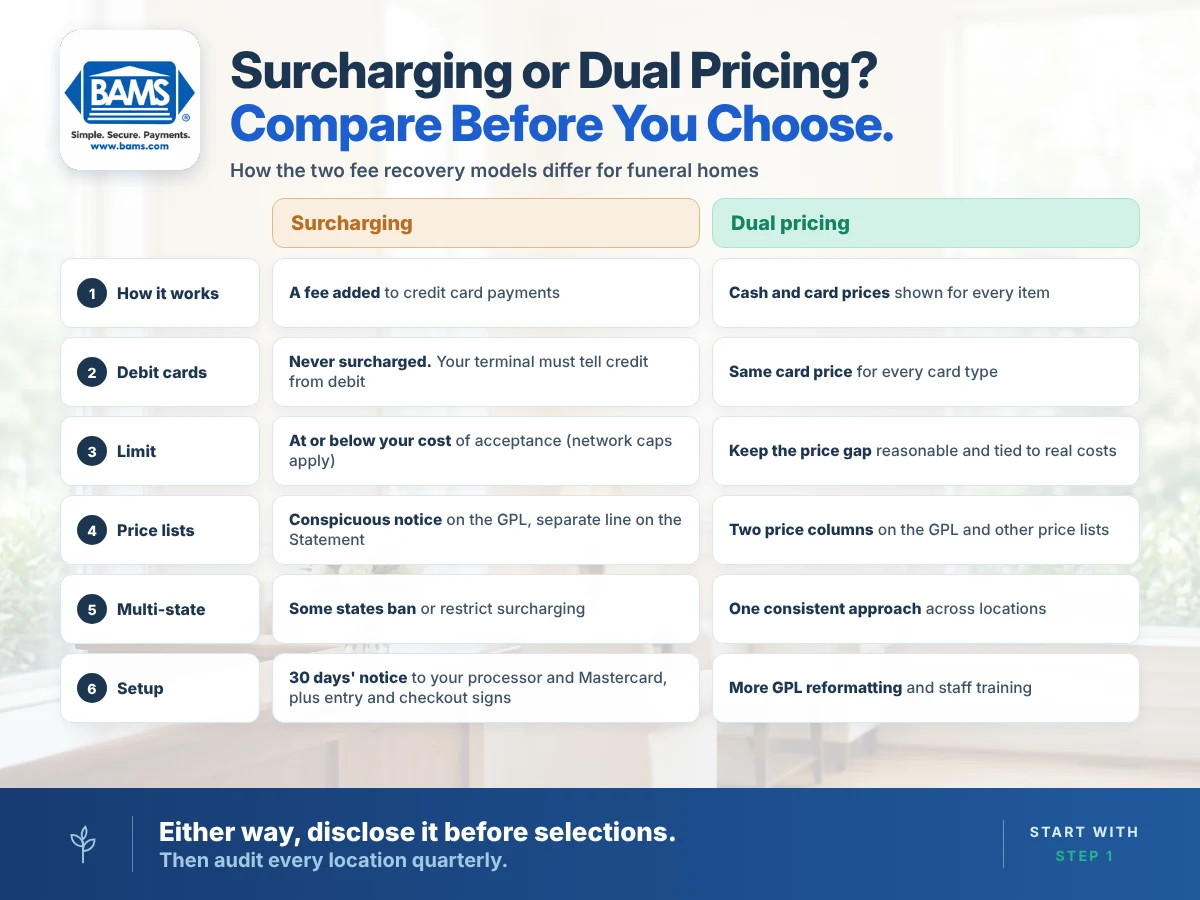
A surcharge is a fee added to a transaction when a customer pays with a credit card. It is framed as an additional cost above the listed price. Card networks cap surcharges (currently 3% for Visa and 4% for Mastercard) and the surcharge cannot exceed your actual cost of acceptance. Critically, surcharges may not be applied to debit card transactions, even when the debit card is run as credit.
Dual Pricing Defined
Dual pricing displays two prices for every item or service: a cash price and a card price. Rather than adding a fee at checkout, you present both prices upfront. The card price is the standard price; the cash price is the discount. This distinction matters because dual pricing is generally treated as a discount program rather than a surcharge. That changes the regulatory and network requirements. For a detailed breakdown of how to embed dual pricing into your General Price List, see General Price List: A Dual Pricing Compliance Guide.
The Funeral Rule’s Pricing Mandate
The FTC identifies three required funeral price lists: the General Price List, Casket Price List and Outer Burial Container Price List. These lists must contain itemized prices and the information provided to consumers (including over the phone) must be accurate and match what’s on the lists. Any fee that changes the total cost of the arrangement may be called a surcharge, convenience fee or service charge. Whatever the name, disclose it in a way that doesn’t undermine the itemized pricing structure the Rule requires.
The Critical Misconception
Most operators treat surcharging as a terminal configuration issue: flip a switch, the fee appears at checkout. In funeral services, it’s a compliance design problem. The fee must flow backward through your entire disclosure chain, from the Statement of Funeral Goods and Services Selected, through the General Price List, to the telephone price inquiry. If it doesn’t, you have a gap.
The Compliance Design Framework
Treating surcharge or dual pricing implementation as a compliance design problem means working through four interconnected phases. Each phase addresses a different regulatory layer and skipping any one creates exposure in the others.
- Regulatory Mapping (Phase 1) — Identify which federal, state and card network rules apply to your locations and payment methods.
- Disclosure Architecture (Phase 2) — Design how fees appear across every consumer-facing document and interaction point.
- Payment System Configuration (Phase 3) — Align your terminal, gateway and processor settings with the disclosure structure you’ve designed.
- Operational Verification (Phase 4) — Test, train and audit to ensure the system works as designed across all locations.
These phases are sequential. You cannot configure your terminal correctly (Phase 3) if you haven’t decided how the fee appears on your GPL (Phase 2). You cannot design your disclosure architecture if you don’t know whether your state permits surcharging at all (Phase 1). The framework prevents the most common failure: building backward from the terminal and hoping the disclosures catch up.
Step-by-Step Breakdown: Building a Compliant Fee Recovery System
Step 1: Map Your Regulatory Constraints
Objective: Determine exactly which fee recovery methods are legally available at each of your locations.
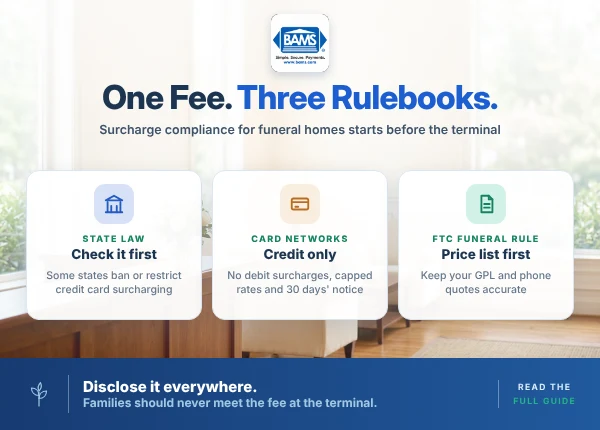
Start with state law. Several states prohibit or restrict credit card surcharging. If you operate across state lines or have locations in different jurisdictions, you may need different approaches for different locations. A surcharge program that’s compliant in Texas may be illegal in Connecticut. Check your state attorney general’s office or consult with a payments attorney for current status.
Next, confirm card network registration requirements. Visa requires merchants to notify their acquirer (processor) at least 30 days before surcharging. Mastercard requires at least 30 days’ notice to both Mastercard and your acquirer. Skipping these steps can create compliance problems with your processor and the card networks.
Then map the debit card exclusion. Surcharges cannot be applied to debit card transactions. Your system must be able to distinguish between credit and debit at the point of sale. If your terminal or gateway cannot make this distinction reliably, surcharging creates an automatic compliance risk on every debit transaction that gets surcharged incorrectly.
Anti-patterns: Assuming one state’s rules apply everywhere. Using a single surcharge configuration across locations in different states. Ignoring the debit card exclusion because “most people pay credit.”
Success indicators: You have a written, location-by-location matrix showing which fee recovery method (surcharge, dual pricing, or neither) is permitted. You’ve confirmed registration requirements with your processor.
Step 2: Design Your Disclosure Architecture
Objective: Create a disclosure structure where the fee is visible and consistent across every consumer touchpoint, satisfying both the Funeral Rule and card network signage requirements.
The FTC describes the General Price List as the “keystone” of Funeral Rule compliance because it must contain itemized prices and required disclosures. Any surcharge or dual pricing structure should be reflected here. The Rule doesn’t address payment fees directly. Disclosing the fee only at the payment terminal, though, risks giving families price information that doesn’t match what they pay.
If you choose dual pricing, every line item on your GPL, Casket Price List and Outer Burial Container Price List should show both the cash price and the card price. The Statement of Funeral Goods and Services Selected should reflect whichever price applies to the family’s chosen payment method. When someone calls for pricing information, your staff must quote both prices or clearly explain the pricing structure.
If you choose surcharging, your GPL should include a clear, conspicuous surcharge notice. It should state the specific percentage (not to exceed your actual cost of acceptance) added to credit card transactions. This notice should appear before the itemized prices, not buried in footnotes. The surcharge must also appear as a separate line item on the Statement of Funeral Goods and Services Selected.
Card networks require signage at the point of entry (front door) and at the point of sale (terminal). These requirements exist independently of the Funeral Rule, so you need both the GPL disclosure and the physical signage.
Anti-patterns: Disclosing the surcharge only on a sign at the register. Listing only one price on the GPL and adding the card fee verbally. Using vague language like “processing fees may apply” instead of a specific percentage.
Success indicators: A family reviewing your GPL can determine the exact cost of their arrangement under either payment method before they sit down for the arrangements conference. Your phone staff can answer a pricing question accurately, including the fee structure, without consulting a manager.
Step 3: Separate Credit from Debit at the System Level
Objective: Ensure your payment system never applies a surcharge to a debit transaction, regardless of how the card is presented.
This is where many funeral home surcharge programs fail silently. A family member hands over a debit card. Your staff runs it as credit (a common practice). The terminal applies the surcharge. You’ve just violated card network rules and in some states, consumer protection law.
Your terminal and gateway must perform BIN (Bank Identification Number) lookup to identify whether a card is credit or debit before applying any surcharge. Not all terminals and not all processor configurations support this automatically. If yours doesn’t, you need to upgrade your equipment or switch to dual pricing (which sidesteps the debit exclusion issue). A manual verification step is another option, but it’s error-prone for high-volume or multi-location operations.
This is a specific area where your processor’s capabilities matter significantly. BAMS, for example, offers dedicated support from BAMS specialists. It also configures compliant dual pricing and cash discount programs for funeral homes, aligned with state laws and card network rules. The configuration isn’t generic; high-ticket transactions with mixed payment types require deliberate setup.
Anti-patterns: Relying on staff to ask “Is this debit or credit?” as your compliance mechanism. Assuming all cards run as credit are credit cards. Using a processor that cannot distinguish card types at the BIN level.
Success indicators: Run five test transactions with known debit cards processed as credit. Verify that no surcharge is applied to any of them. Document the results.
Step 4: Align the Surcharge Amount with Actual Cost of Acceptance
Objective: Set a surcharge percentage that recovers processing costs without exceeding your actual cost of acceptance or the network cap.
Card networks require that your surcharge not exceed your actual cost of acceptance. For a $15,000 transaction, a 3% surcharge equals $450. But if your actual processing cost on that transaction is $247.70 (at 1.65% plus $0.20 for a card-present transaction), a 3% surcharge exceeds your cost and violates network rules.
Calculate your effective rate across your actual transaction mix. Include interchange, assessments and processor markup. If your blended effective rate is 2.1%, your surcharge should be 2.1% or less. Review this quarterly, because interchange rates change and your transaction mix shifts seasonally.
If you’re using dual pricing instead of surcharging, the “cost of acceptance” cap doesn’t apply in the same way. You’re offering a discount for cash rather than adding a fee for cards. Still, make sure the price differential is reasonable and defensible. A $600 difference on a $15,000 arrangement will draw scrutiny; a $250 to $350 difference aligned with your actual processing costs is transparent and justifiable.
For a deeper look at where hidden fees inflate your effective rate beyond what you see on your statement, review 7 Payment Processing Cost Signals Funeral Homes Should Audit.
Anti-patterns: Setting the surcharge at the maximum network cap regardless of actual costs. Never recalculating after the initial setup. Ignoring non-interchange fees (assessments, gateway fees, PCI fees) in your cost calculation.
Success indicators: You can produce documentation showing your actual cost of acceptance and how your surcharge percentage was derived. The surcharge percentage is at or below your effective rate.
Step 5: Train Staff on Disclosure Timing and Language
Objective: Ensure every consumer interaction, from the first phone call to the final statement, communicates fees consistently and accurately.
The FTC requires that funeral providers disclose itemized prices and provide accurate information to consumers who ask by telephone. This means your surcharge or dual pricing structure isn’t just a document issue; it’s a staff training issue. Every person who answers the phone or sits in an arrangements conference must be able to explain the fee structure clearly.
Develop a script for phone inquiries that includes the fee disclosure naturally. Example: “Our General Price List shows both cash and card prices for each item. The card price includes our processing cost. Would you like me to walk through specific items?” This is not a legal disclaimer read at speed; it’s a transparent explanation delivered in the same tone as any other pricing discussion.
In arrangements conferences, the fee should be visible on the GPL before any selections are made. Discuss it as part of the pricing overview and reflect it on the Statement of Funeral Goods and Services Selected. The family should never encounter the fee for the first time at the payment terminal.
Anti-patterns: Training staff to mention the fee only if asked. Treating the disclosure as a legal formality rather than a service conversation. Using different language at different locations.
Success indicators: Mystery-call your own locations. Ask for pricing on a basic service package. If the person answering the phone can explain the cash/card pricing difference without hesitation, your training is working.
Step 6: Audit and Document Across All Locations
Objective: Verify that the system works as designed and create a compliance record that protects you in the event of a challenge.
Funeral providers must maintain distributed price lists for at least one year and retain completed Statements of Funeral Goods and Services Selected for at least one year after the arrangements conference. Your surcharge or dual pricing documentation should be part of this retention practice.
Conduct a quarterly audit at each location. Check that GPL signage matches terminal configuration. Verify that the surcharge percentage on the terminal matches your documented cost of acceptance. Review a sample of completed Statements to confirm the fee appears correctly. Check that point-of-entry and point-of-sale signage is posted and legible.
For multi-location operators, inconsistency is the primary risk. Location A might have updated its GPL after a rate change while Location B still shows the old percentage. Your audit should specifically compare configurations across locations. Consider using payment orchestration principles to centralize configuration management rather than relying on each location to maintain its own settings independently.
Anti-patterns: Auditing only when a complaint arises. Assuming that because the system was set up correctly, it remains correct. Delegating compliance verification to the same staff responsible for implementation (no independent check).
Success indicators: You have a dated audit log for each location showing GPL version, terminal surcharge percentage, signage status and sample Statement review. Discrepancies are flagged and corrected within 48 hours.
Practical Examples: Surcharging vs. Dual Pricing in Action
Scenario A: Single Location, Surcharge Model
A funeral home in a surcharge-permitted state processes an average of 15 at-need arrangements per month, with an average ticket of $12,000. Their effective processing rate is 1.85%. They notify their processor and Mastercard at least 30 days ahead and set the terminal surcharge at 1.85%. Then they add a conspicuous surcharge notice to the GPL, post entrance and terminal signage and train phone staff.
Monthly recovery: approximately $3,330 (15 × $12,000 × 1.85%). Annual recovery: approximately $39,960. The surcharge is defensible because it matches actual cost. Its GPL disclosure prevents Funeral Rule issues. The BIN lookup at the terminal prevents debit card surcharging.
Scenario B: Three Locations Across Two States, Dual Pricing Model
An operator with three locations discovers that one state prohibits surcharging. Rather than running two different programs, they implement dual pricing across all three locations. Each GPL line item shows a cash price and a card price. The card price is the base price; the cash price reflects a 2% discount. The Statement of Funeral Goods and Services Selected automatically populates the correct column based on payment method selection during the arrangements conference.
This approach eliminates the debit/credit distinction problem (dual pricing applies the same card price regardless of card type). It also simplifies multi-state compliance and creates a consistent family experience across locations. The tradeoff: dual pricing requires more extensive GPL reformatting and staff training on presenting two price columns clearly.
Scenario C: The Common Failure
A funeral home enables surcharging at the terminal but doesn’t update its GPL. A family selects $14,500 in services based on the GPL prices, then sees a $435 surcharge added at the terminal. They file a complaint. The FTC investigates and finds the GPL doesn’t mention the surcharge. Phone staff weren’t trained to disclose it. The surcharge was also applied to three debit card transactions in the previous month. The operator faces potential problems on multiple fronts: Funeral Rule disclosure concerns, card network rule violation and possible state consumer protection violation.
Common Mistakes and Pitfalls
- Treating surcharging as a terminal-only decision. The terminal is the last step, not the first. Start with your GPL and work forward.
- Applying surcharges to debit cards. This is the single most common technical violation. If your system can’t distinguish card types, don’t surcharge.
- Using vague fee language. “A fee may apply” is not a disclosure. Specify the percentage and the conditions.
- Failing to update after rate changes. Your surcharge percentage must track your actual cost. If your processor changes rates and you don’t update, you’re either overcharging (violation) or underrecovering (lost margin).
- Assuming compliance at setup means ongoing compliance. Staff turnover, GPL reprints, terminal updates and state law changes all create drift. Quarterly audits are the minimum.
These mistakes are predictable and preventable. The operators who avoid them are the ones who treat fee recovery as a compliance system rather than a one-time configuration.
What to Do Next
Start with Step 1. Pull up your state’s surcharging rules and confirm whether surcharging, dual pricing, or both are available to you. If you operate in multiple states, build the location-by-location matrix before making any other decisions.
Then review your current GPL. If it doesn’t mention your payment fee structure, that’s your most immediate compliance gap, regardless of what your terminal is doing. For a detailed walkthrough of GPL formatting for dual pricing, see General Price List: A Dual Pricing Compliance Guide.
This guide is a reference, not a checklist to complete in a single afternoon. Revisit it as your state laws change, your processing rates shift, or you add locations. The goal is a system that recovers margin without creating risk and that system requires maintenance as conditions evolve.
Frequently Asked Questions
What is the FTC Funeral Rule and why does it matter for surcharging?
The FTC Funeral Rule requires funeral providers to give consumers accurate, itemized price information through three required price lists. These are the General Price List, Casket Price List and Outer Burial Container Price List. Any fee that changes the total cost, including a credit card surcharge, should be disclosed consistently across these documents and during phone inquiries. The Rule doesn’t address payment fees directly. Still, a surcharge that only appears at the payment terminal undermines the accurate, itemized pricing the Rule requires.
How does the FTC Funeral Rule affect pricing transparency when dual pricing is used?
Dual pricing requires showing both a cash price and a card price on every line item of your General Price List and other required price lists. The Rule mandates that consumers receive accurate pricing information before making selections, so both prices must be visible during the arrangements conference and available to callers. The Statement of Funeral Goods and Services Selected should reflect the prices that correspond to the family’s actual payment method.
Can funeral homes apply surcharges to debit card transactions?
No. Card network rules explicitly prohibit surcharging debit card transactions, even when the debit card is processed through a credit network (run as credit). Your payment terminal must perform a BIN lookup to identify the card type before applying any surcharge. If your system cannot reliably distinguish debit from credit, dual pricing is a safer alternative because it applies the same card price regardless of card type.
What is the maximum surcharge a funeral home can charge on a credit card transaction?
Card networks cap surcharges (currently 3% for Visa and 4% for Mastercard), but there’s an additional constraint: your surcharge cannot exceed your actual cost of acceptance. If your effective processing rate on a $15,000 transaction is 1.65%, your surcharge must be 1.65% or less, not the network maximum. You should recalculate your effective rate quarterly and adjust accordingly.
When must funeral homes provide surcharge or dual pricing disclosures to consumers?
Disclosures should be available at every consumer touchpoint. That includes the General Price List (before selections are made), telephone price inquiries and the arrangements conference. It also includes the Statement of Funeral Goods and Services Selected, entry and checkout signage and online pricing pages. The fee should never be encountered for the first time at the payment terminal.
How can funeral homes optimize their merchant services to comply with the FTC Funeral Rule while recovering processing costs?
The key is treating fee recovery as a compliance design problem. Map your state and network rules first. Then design disclosures that flow from the GPL through every interaction point. Configure your payment system to match those disclosures and audit regularly. Working with a processor that understands high-ticket funeral transactions and can configure terminals for proper BIN lookup and surcharge settings reduces the risk of technical violations.
Sources
- Federal Trade Commission: Complying with the Funeral Rule
- FTC Consumer Alert: Funeral Home Now Has to Post Prices Online
- Federal Trade Commission: Funeral Industry Guidance
- Visa: U.S. Merchant Surcharge Q&A
- Mastercard: Merchant Surcharge Rules
- Federal Register: Public Workshop Examining Potential Amendments to the Funeral Rule