
8 Processing Fees You Can Negotiate Down Today
Last Updated on October 6, 2026 by Dimitri Akhrin
A line-item negotiation checklist for B2B eCommerce managers recovering margin from existing processors
Learn which processing fee categories routinely move during negotiation and the volume thresholds that give B2B eCommerce accounts real leverage. A practical checklist for cutting costs without switching platforms.
TL;DR
- Only the processor markup is negotiable – Interchange and assessment fees are set by card networks. Focus your negotiation energy on the markup, and start by switching from bundled or flat-rate pricing to interchange-plus.
- Level 2/3 data qualification is the biggest B2B savings lever – Properly passing enhanced transaction data can cut 0.5% to 1% per transaction. Ask your processor for a qualification report to verify your transactions are actually hitting lower rates.
- Administrative fees stack up silently – Statement fees, PCI non-compliance penalties, batch per-item fees, and reporting access charges can add $50 to $150/month. Most are removable upon request.
- Your volume growth is your strongest negotiating tool – If your processing volume has increased since you signed your contract, you likely qualify for lower pricing tiers your processor hasn’t proactively applied.
- Start with three actions – Calculate your effective processing rate, verify your Level 2/3 qualification percentage, and check your contract’s termination clause. These give you the data foundation for every other fee negotiation.
The Fees You Don’t See Are the Ones Costing You the Most
For many businesses, payment acceptance is one of the largest operating expenses after payroll and inventory. Even relatively small improvements in processing costs can have a meaningful impact on profitability, especially as transaction volume grows. For B2B eCommerce operations, the damage is often worse than the headline number suggests. Negotiating processing fees isn’t just an enterprise-level play. It’s a practical, line-item exercise that established mid-market businesses can use right now to recover margin hiding in plain sight on their monthly statements.
Most eCommerce managers treat processing costs as a fixed line item, something you shop once and accept forever. But processors build negotiation room into their fee structures by design. The trick isn’t switching platforms. It’s knowing which fees move, which thresholds trigger automatic savings, and when your volume gives you leverage you haven’t used yet.
Who This Is For, What This Covers, and What It Doesn’t
This guide is for eCommerce managers at established B2B businesses (roughly 10 to 50 employees) processing enough monthly volume that fee reductions translate into meaningful annual savings. If you’re running $100K or more in annual card volume, every tactic here applies to you.
This is not a processor comparison guide. You won’t find a recommendation to rip out your current stack and start over. Instead, these are the specific fee categories and volume-based pricing tiers where negotiation consistently moves the number with your existing provider.
How We Selected These Fee Categories
Each item on this list meets three criteria: it appears on a majority of B2B merchant statements, it carries a processor markup that is demonstrably negotiable, and it can be addressed without a platform migration. We prioritized fees where the gap between what processors charge by default and what they’ll accept after a conversation is widest.
8 Hidden Fees Where Negotiating Processing Fees Pays Off

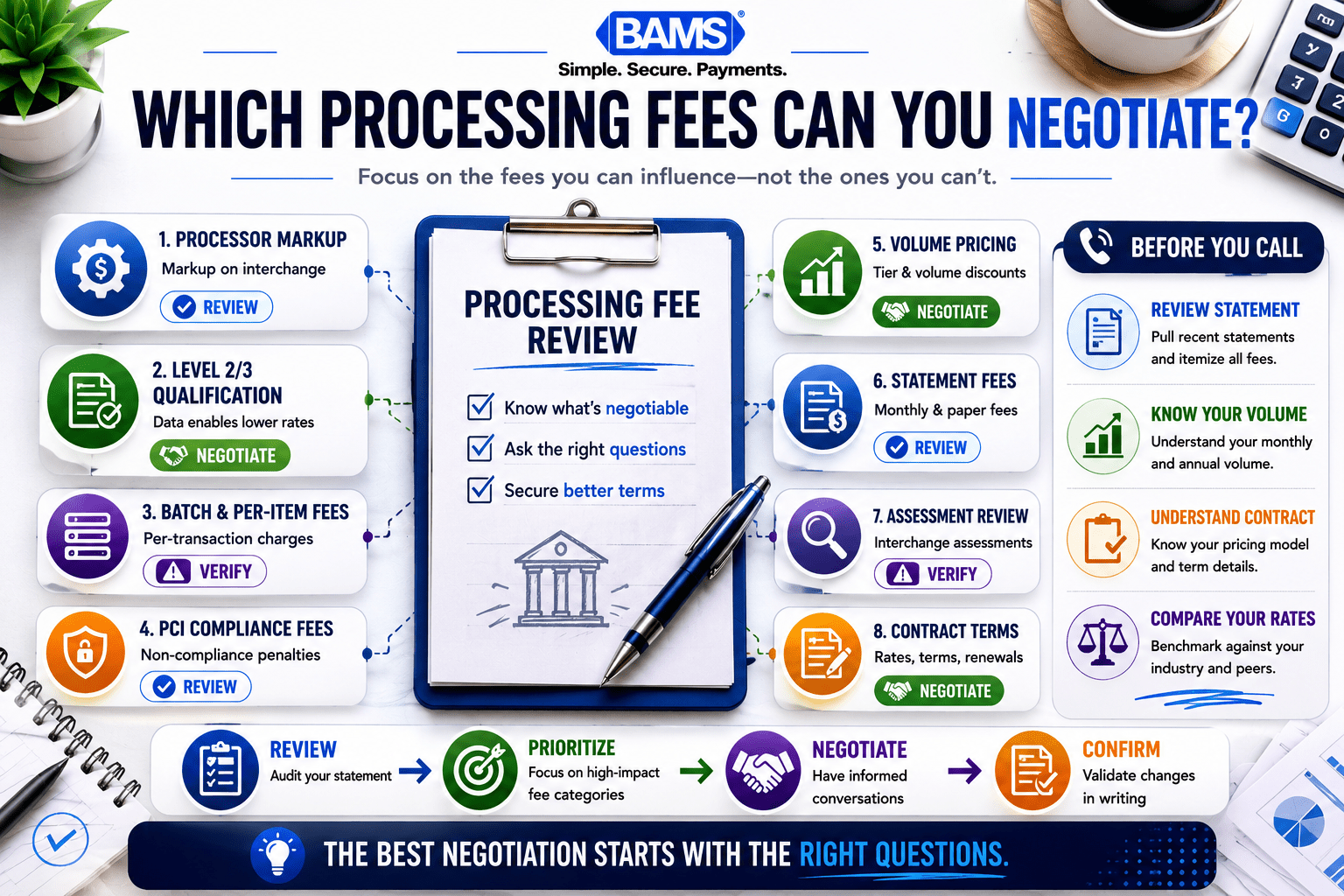
Professional infographic highlighting the payment processing fee categories merchants can negotiate with their existing processor.
1. Processor Markup on Interchange-Plus Pricing
Why it matters: Only the processor’s markup is negotiable. Interchange rates are established by the card networks, while assessments are set by the networks themselves. Negotiations should therefore focus on the processor’s markup and pricing model rather than interchange. Visa’s payment processing guidance explains how interchange and network rules form the foundation of card acceptance costs.
What it looks like today: Switching from a bundled flat rate to interchange-plus pricing for businesses processing several hundred thousand dollars annually can reduce overall processing costs when the merchant’s pricing structure better aligns with their transaction mix and interchange qualification. That’s 0.30% to 0.80% back on every transaction, without changing a single integration.
How to apply it: Pull six months of statements and calculate your effective processing rate (total fees divided by total volume). If you’re above 2.5% on B2B transactions, request an interchange-plus quote from your current processor. Use your calculated effective rate as your baseline in the conversation.
2. Level 2/3 Data Qualification Gaps
Why it matters: Card networks offer lower interchange rates for B2B transactions that include enhanced data (purchase order numbers, tax amounts, line-item detail). If your gateway isn’t passing Level 2 and Level 3 data correctly, every transaction is processed at a higher “standard” rate. Many processors claim to support Level 2/3 but don’t actually qualify the majority of your transactions.
What it looks like today: Properly submitting Level 2 and Level 3 data can can improve interchange qualification for eligible commercial card transactions, reducing payment acceptance costs over time. The Visa Commercial Enhanced Data Program describes how enhanced transaction data supports commercial card qualification. On $500K in annual B2B volume, that’s $2,500 to $5,000 recovered annually.
How to apply it: Ask your processor for a qualification report showing what percentage of your transactions actually hit Level 2 or Level 3 rates. If the number is below 80%, you have a data-passing problem, not a pricing problem. For a deeper diagnostic, review our guide on signals your processing statement is leaking B2B margins.
3. Batch Fee Stacking
Why it matters: Batch fees are charged every time you settle your daily transactions. On the surface, $0.10 to $0.25 per batch seems trivial. But some processors stack additional per-item fees inside the batch settlement, or charge batch fees on accounts that also pay per-transaction authorization fees. The duplication is easy to miss.
What it looks like today: Processors commonly charge a batch header fee plus a per-item settlement fee. For businesses running hundreds of daily transactions, per-item batch fees can quietly add hundreds of dollars monthly.
How to apply it: Compare your batch fee line to your authorization fee line on your statement. If you’re paying both a per-transaction authorization fee and a per-item settlement fee, request that one be waived or consolidated. Most processors will remove the per-item batch fee for accounts with consistent volume.
4. PCI Compliance and Non-Compliance Fees
Why it matters: PCI compliance fees range from $79 to $120 per year at most processors. But the real cost is the PCI non-compliance fee, often $19.95 to $34.95 per month, that processors charge when your annual Self-Assessment Questionnaire lapses. Some processors charge both the compliance fee and a monthly “security” fee, which is a different line item for the same obligation.
What it looks like today: A surprising number of mid-market merchants pay non-compliance penalties for months without realizing it, simply because the SAQ renewal notification went to a former employee’s email. Others pay a compliance fee and a separate “breach protection” fee that duplicates coverage.
How to apply it: Confirm your PCI compliance status directly with your processor today. If you’re current, request removal of any non-compliance fee retroactively. Then check whether your “breach protection” fee duplicates coverage you already carry through cyber liability insurance. For a full breakdown, see our guide to 7 hidden fees draining margins.
5. Volume-Based Pricing Tier Thresholds
Why it matters: Most processor contracts include volume-based pricing tiers that automatically reduce your markup once you cross certain monthly thresholds. The problem: many processors don’t proactively move you into a lower tier when your volume grows. You stay at the rate you signed at, even if your volume has doubled.
What it looks like today: As businesses grow, higher transaction volumes often strengthen their negotiating position with payment providers because larger accounts typically represent greater long-term value. According to the Federal Reserve’s 2025 Small Business Credit Survey, managing operating expenses and maintaining healthy cash flow remain ongoing priorities for businesses.
If your transaction volume has grown, your negotiating position has grown with it. Processors value high-growth accounts and will often trade a lower percentage for the security of a long-term, high-volume partnership.
How to apply it: Collect your last 12 months of processing volume and compare it against the tier thresholds in your contract. If you’ve crossed a threshold (or are close), call your processor and request a rate review. Bring a competing interchange-plus quote to anchor the conversation.
6. Statement and Reporting Fees
Why it matters: Statement fees ($5 to $15/month) are a legacy artifact from when processors mailed paper statements. In a digital reporting era, there’s no cost basis for this charge. Yet it persists on a majority of mid-market merchant accounts, often alongside a separate “online reporting” fee for access to the portal that replaced the paper statement.
What it looks like today: Some processors charge a monthly statement fee, a monthly online access fee, and a monthly account maintenance fee as three separate line items. Combined, these administrative fees can reach $30 to $50 per month with zero value delivered.
How to apply it: Request paperless billing and ask for the statement fee to be waived. If your processor charges a separate online reporting fee, push back. This is a standard cost of doing business for the processor, not a premium service. Most will remove it upon request.
7. Network Assessment Markups
Why it matters: Card network assessments (Visa, Mastercard, Discover, Amex) are technically pass-through costs. But some processors add a small markup on top of the published assessment rate. Because assessments are listed as a separate line item from interchange, merchants rarely scrutinize them. The markup is typically 0.01% to 0.05%, but it compounds across every transaction.
What it looks like today: With most merchants paying between 2.5% and 3.5% all-in, a hidden 0.03% assessment markup seems negligible. On $1M in annual volume, it’s $300. Across assessment fees for all four networks, it can reach $1,000 or more annually.
How to apply it: Compare the assessment rates on your statement to the published rates on Visa and Mastercard’s websites. If the numbers don’t match, you’ve found a markup. Request true pass-through on assessments as part of your next rate negotiation. Understanding your effective processing rate versus your advertised rate is critical here.
8. Early Termination and Auto-Renewal Clauses
Why it matters: Early termination fees ($295 to $595 is common) are the silent enforcer that keeps merchants from negotiating aggressively. If your processor knows you can’t leave without a penalty, your leverage drops significantly. Auto-renewal clauses that extend your contract by 12 months with 30 to 90 days’ notice requirements create the same lock-in effect.
What it looks like today: Many processors have moved to month-to-month agreements for new accounts, but legacy contracts from two to three years ago often still carry termination fees. If you signed a three-year contract with auto-renewal, you may already be in a renewal window without knowing it.
How to apply it: Review your contract for the termination clause and the auto-renewal notice window. If you’re inside the notice window, send written cancellation notice even if you plan to stay. This removes the termination fee as a barrier and gives you full negotiating leverage on every other fee on this list. A transparent provider like BAMS offers dedicated account management and won’t lock you into long-term contracts with hidden exit penalties, which is the kind of structure you should be negotiating toward.
The Pattern Across All 8 Fee Categories
Three themes connect every item on this list. First, processors profit from complexity. The more line items on your statement, the harder it is to calculate your true cost, and the easier it is to embed margin in places you won’t check. Second, volume is your primary negotiating currency. Every concession on this list becomes easier to win when you can demonstrate consistent or growing transaction volume. Third, the negotiation window matters. Contract renewal dates, volume threshold crossings, and competitive quotes all create moments where processors are most willing to adjust.
These aren’t isolated savings. Stacking interchange-plus pricing with Level 2/3 qualification and removing administrative fee clutter creates a compounding effect. A merchant recovering 0.50% on interchange qualification plus eliminating $40/month in junk fees on $500K annual volume saves over $3,000 per year, and that’s before renegotiating the processor markup itself.
Where to Start Without Overwhelming Your Team
Preparation creates stronger negotiating leverage than assumptions.
You don’t need to tackle all eight categories at once. Start with three moves: calculate your effective processing rate, verify your Level 2/3 qualification percentage, and check your contract’s termination clause. These three actions take less than a day and give you the data foundation for every other negotiation on this list.
If your processor can’t provide a clear qualification report or won’t discuss your effective rate, that resistance is itself a signal. Providers built around transparent pricing models, like BAMS with its interchange-plus structure and proactive account management, will walk through these numbers with you. The goal isn’t to find the cheapest processor. It’s to make sure the one you have is charging you what your volume and data quality actually justify.
Frequently Asked Questions
What is interchange-plus pricing and how does it work?
Interchange-plus pricing separates your processing cost into three transparent components: the interchange rate set by the card network, the network assessment fee, and your processor’s markup. You see exactly what each party charges. This model replaces bundled or tiered pricing where the processor’s margin is hidden inside a single blended rate, making it much easier to identify and negotiate the only part of the fee that’s actually negotiable: the processor markup.
Why should B2B businesses care about Level 2/3 data optimization?
Card networks like Visa and Mastercard offer lower interchange rates for transactions that include enhanced purchase data (tax amounts, purchase order numbers, line-item details). B2B transactions are specifically eligible for these reduced rates. Without proper Level 2/3 data submission, your transactions default to higher consumer-grade interchange categories. The savings from proper qualification can reach 0.5% to 1% per transaction, which adds up quickly on high-ticket B2B orders.
When is the right time to negotiate processing fees with your provider?
The strongest negotiation windows are when your contract is approaching renewal, when your monthly volume has crossed a new threshold, or when you have a competing quote in hand. Seasonal peaks also create leverage because processors can see your volume trending upward. Avoid negotiating during your lowest-volume months when your leverage is weakest.
What are the most common hidden fees in merchant services?
The most frequently overlooked fees include PCI non-compliance penalties, batch settlement per-item fees stacked on top of authorization fees, statement and online reporting fees, network assessment markups above published rates, and account maintenance fees. Individually, each may seem small. Combined, they can add $50 to $150 per month to your processing costs with no corresponding value.
How can I tell if my processor is actually qualifying my B2B transactions at Level 3?
Request a transaction qualification report from your processor. This report should show the percentage of your transactions that settled at Level 1, Level 2, and Level 3 interchange rates. If your processor can’t produce this report, or if fewer than 80% of your B2B transactions are qualifying at Level 2 or Level 3, you’re likely overpaying on interchange. The issue is usually a data-passing gap in your gateway configuration, not your pricing plan.
Which payment processing model is more cost-effective for high-volume B2B transactions?
For B2B merchants processing several hundred thousand dollars or more annually, interchange-plus pricing almost always outperforms flat-rate or tiered models. Flat-rate pricing (like 2.9% + $0.30) is simple but embeds a significant processor margin. Interchange-plus exposes the actual interchange cost and lets you negotiate only the markup. Combined with Level 2/3 data qualification, interchange-plus can reduce your effective rate by 0.30% to 0.80% compared to flat-rate alternatives.


