Working Capital Management for Funeral Homes
Last Updated on September 21, 2026 by Dimitri Akhrin
How to close the cash flow gaps created by at-need payments, insurance delays, and pre-need installments
Learn how each funeral home revenue stream creates a distinct timing gap and what to do about it. This guide treats next-day funding and settlement terms as operational tools that close specific cash flow gaps without adding administrative burden.
TL;DR
- Three streams, three gaps – At-need card payments, insurance assignments, and pre-need installments each create a different timing delay between service delivery and cash receipt. Treat them as separate problems with separate solutions.
- Next-day funding closes the card gap – Ensure your merchant services agreement includes next-day funding and train staff to process payments before the daily batch cutoff. Missing the cutoff by minutes can delay deposits by a full business day.
- Insurance assignments need front-end verification – Confirm the insurer accepts assignments and submit a complete claim packet on day one. Incomplete filings are the top cause of 30-to-60-day payment delays.
- Bridge with partial card payments – Collect itemized third-party costs by card at arrangement to cover immediate vendor expenses while the insurance assignment processes. This keeps you paying suppliers from revenue, not credit.
- Build a weekly cash position report – Track expected deposits by revenue stream and compare against upcoming obligations. Predicting gaps five days out eliminates the cash flow surprises that force reactive borrowing.
Guide Orientation: What This Covers and Who It’s For
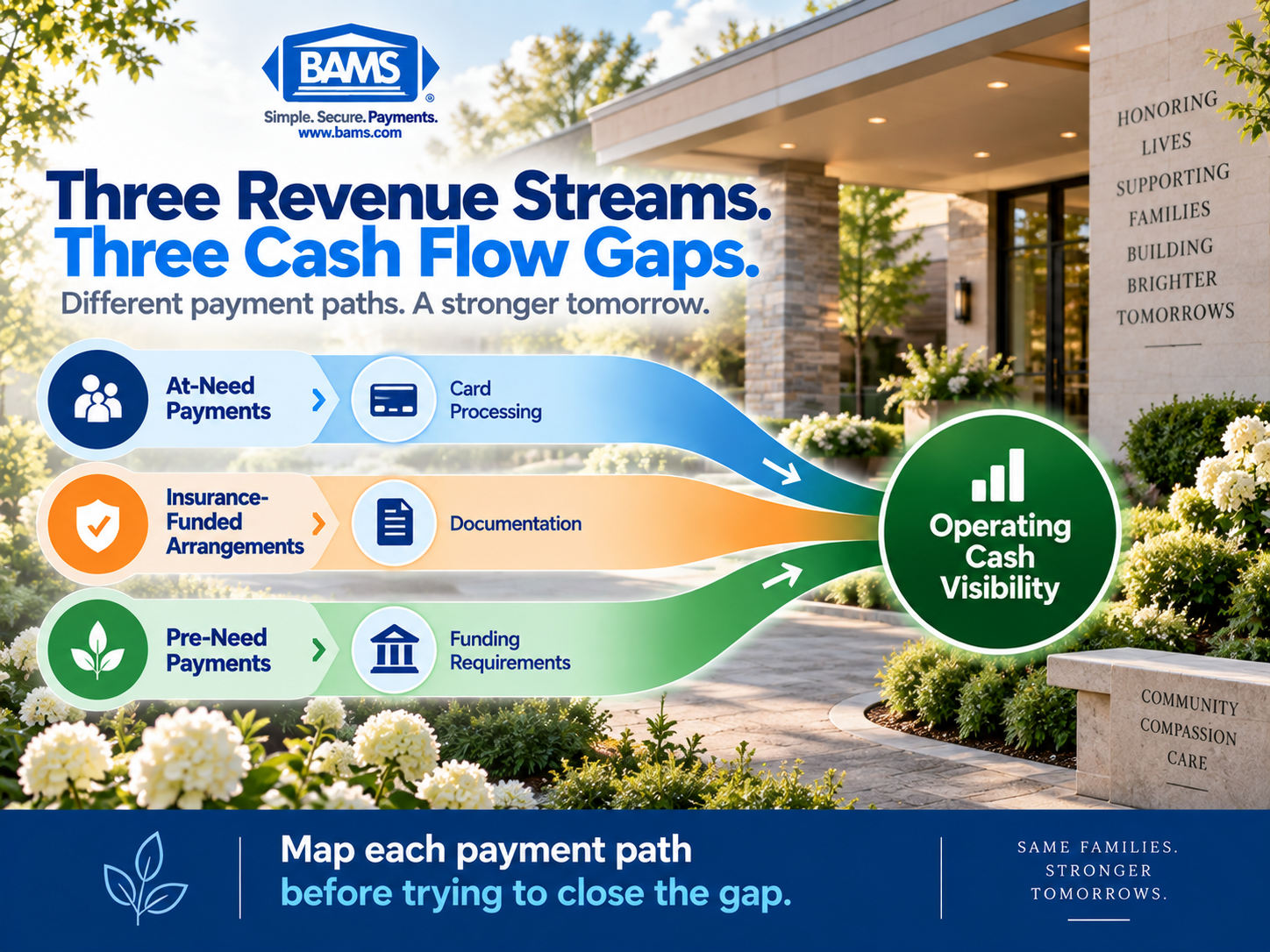
This guide breaks down working capital management for funeral homes into three distinct problems, not one. Each revenue stream you operate (at-need family payments, insurance assignment proceeds, and pre-need installment contracts) creates its own timing gap between when you deliver services and when cash arrives in your account.
If you run a family-owned funeral home with one to ten locations and regularly handle transactions above $15,000, this is for you. By the end, you’ll understand exactly where each cash flow gap originates, how settlement terms and next-day funding function as operational tools (not just payment features), and what specific steps close each gap without adding administrative burden.
This guide does not cover pre-need trust investment strategies or state-by-state preneed licensing. It focuses on the payment mechanics: how money moves from families and insurers to your bank account, and what you can control to speed that up.
Why Working Capital Management Matters for Funeral Homes
Funeral homes face a cash flow problem that no other service industry shares. You deliver a high-value, emotionally sensitive service before you collect full payment, often before you even know which revenue stream will fund it. A family walks in on Monday, you coordinate services by Wednesday, and the insurance assignment check might not arrive for 30 to 60 days.
Meanwhile, your costs are immediate. Casket suppliers, vault companies, florists, and crematory fees don’t wait for an insurer’s claims department. Neither does payroll. The result is a structural mismatch: your expenses are front-loaded and your revenue is back-loaded, spread across three streams that each move at a different speed.
Generic payment advice assumes a single transaction model: customer pays, merchant receives funds, done. That model doesn’t account for the reality that a single funeral arrangement might involve a partial card payment at arrangement, an insurance assignment filed the same week, and a remaining balance collected over installments. Each piece has its own delay, its own compliance considerations, and its own risk of falling into a gap.
The cost of ignoring this is measurable. When cash arrives unpredictably, you either carry a line of credit (paying interest on money already earned) or delay vendor payments (risking supplier relationships). Neither option is sustainable for a business built on trust and reputation. Understanding where each gap lives is the first step to closing it.
Core Concepts: Three Revenue Streams, Three Timing Problems
At-Need Payments
These are the card and check payments families make at the time of arrangement or shortly after. They’re your fastest revenue stream, but “fast” is relative. A credit card payment processed at 6 PM might not settle until two business days later depending on your processor’s batching rules and deposit timing gap. If you process on Friday evening, that money may not arrive until Tuesday or Wednesday.
Insurance Assignments
Insurance-funded arrangements can create a timing gap between providing services and receiving funds. The timing depends on the insurer, documentation requirements and the specific arrangement. For the funeral home, the operational challenge is managing expenses while payment remains outstanding.
This is not a transfer of policy ownership. It’s a direct-pay instruction. Once the claim is approved, the insurer pays you the covered amount and sends any remaining benefit to the beneficiary. The problem: claim review and approval can take weeks, and you’ve already delivered services.
Pre-Need Installments
Pre-need contracts funded through monthly installment payments create a long, slow trickle of revenue. The service obligation is locked in at today’s price, but the payments arrive over months or years. State regulations often require a portion of these funds to be held in trust, meaning the cash you collect isn’t fully accessible. This creates a third timing gap: contractual revenue that’s partially illiquid.
The Key Distinction
These aren’t three versions of the same problem. They’re three different problems requiring three different solutions. Treating them as one “cash flow issue” leads to generic fixes that address none of them well. The framework below maps each stream to its specific gap and the tools that close it.
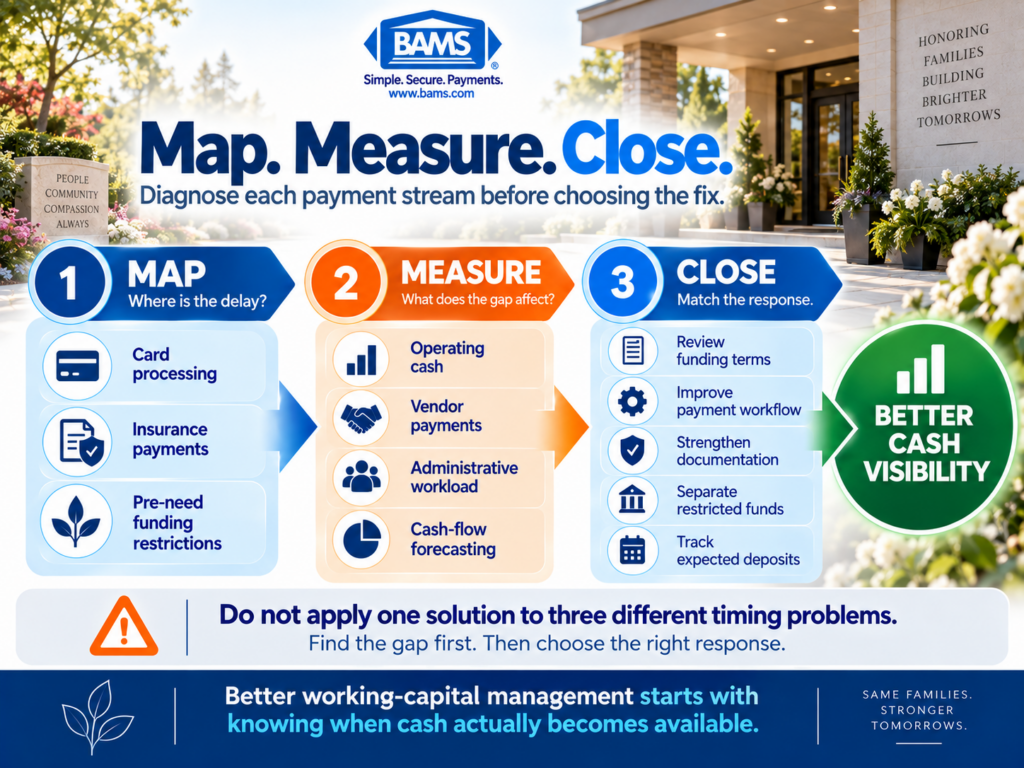
The Framework: Map, Measure, Close
This guide uses a three-phase approach applied to each revenue stream individually. The phases are sequential but cyclical: you’ll revisit them as your case mix and payment patterns shift.
Phase 1: Map the Gap. Identify exactly where the delay occurs for each revenue stream. Is it processor settlement? Insurer review? Trust fund restrictions? You can’t fix what you haven’t located.
Phase 2: Measure the Cost. Quantify what each gap costs you in real terms: interest on credit lines, late payment penalties to suppliers, administrative hours spent chasing payments. This turns an abstract “cash flow problem” into a dollar figure you can act on.
Phase 3: Close the Gap. Apply the right tool to the right gap. Next-day funding solves settlement delays but does nothing for insurance assignment timelines. Better assignment verification speeds insurer payments but doesn’t help with installment liquidity. Matching the solution to the specific gap is the entire point.
The following steps walk through each phase in detail, organized by the revenue stream where they have the most impact.
Step-by-Step Breakdown: Closing Each Gap
Step 1: Audit Your Current Settlement Timeline for Card Payments
Objective: Know exactly how many hours elapse between when a family’s card is charged and when that money is available in your operating account.
Start by pulling your last 30 days of card transactions and matching each one to its corresponding bank deposit. Note the date and time of the transaction, the date the deposit appeared, and the number of business days in between. Most funeral homes discover their actual settlement time is two to three business days, not the “next day” they assumed.
The gap often hides in batching. Next-day funding depends on a daily cutoff window, often around 8 to 10 PM, before transactions batch for settlement. If your staff processes a payment after the cutoff, it rolls to the next business day’s batch, adding a full day to the timeline. Friday transactions processed after cutoff won’t arrive until Tuesday at the earliest, since weekends and federal holidays are excluded from standard settlement.
Anti-patterns: Don’t assume your processor’s advertised funding speed matches your actual experience. “Next-day funding” means next business day after the batch closes, not next day after the card is swiped. Also avoid batching manually at inconsistent times, which creates unpredictable deposit patterns that make cash flow forecasting nearly impossible.
Success indicators: You can state with confidence the average hours-to-deposit for each day of the week. You know your processor’s exact cutoff time. You’ve identified which transactions consistently miss the window.
Step 2: Restructure Batching and Settlement Terms for Next-Day Funding
Objective: Reduce card payment settlement to one business day consistently, not occasionally.
Once you know your current timeline, the fix is mechanical. First, confirm whether your merchant services agreement includes next-day funding or whether you’re on a standard two-to-three-day cycle. If you’re not on next-day terms, this is a negotiation point, not a feature request. Your transaction volume and average ticket size (often $8,000 to $15,000 or more for funeral services) give you leverage that a coffee shop doesn’t have.
Second, train your arrangement staff around your processor’s daily cutoff and funding schedule. Transactions processed after a cutoff may move into a later processing window, affecting when funds become available. Payment rail also matters. Nacha explains that ACH settlement timing can range from the same banking day to subsequent banking days depending on the transaction. Understanding the timing rules that apply to each payment method can make cash flow easier to forecast.
This is where your merchant services partner matters. BAMS merchant services for funeral homes are designed around the payment needs of funeral providers, including next-day funding for eligible card transactions. Faster access to card-payment funds can help reduce the gap between collecting from a family and having those funds available for operating expenses.
Anti-patterns: Don’t treat settlement terms as fixed. They’re negotiable, especially for businesses with high average tickets and low chargeback rates. Don’t ignore weekend and holiday gaps; build them into your weekly cash projection.
Success indicators: Card payments processed before cutoff consistently arrive next business day. Your weekly cash flow projection accounts for weekend and holiday delays. You’ve eliminated surprise deposit gaps on Mondays and post-holiday Tuesdays.
Step 3: Tighten Insurance Assignment Verification Before Services Begin
Objective: Confirm the insurer will accept the assignment and estimate the payment timeline before you commit resources to the service.
The insurance assignment gap is the widest and least controllable of the three. A family arrives, names a life insurance policy as the funding source, and you begin arranging services. If you file the assignment after the funeral, you’ve already absorbed all costs and now wait for the insurer’s claims process, which can stretch 30 to 60 days or longer if documentation is incomplete.
Close this gap at the front end. During the arrangement conference, collect the policy number, insurer name and beneficiary information. Contact the insurer promptly to confirm the documentation and payment requirements that apply to the claim. Because insurer procedures and payment timing can vary, verifying the process early can help reduce avoidable delays.
Build a standard assignment packet that includes the signed assignment form, your itemized General Price List statement, a certified copy of the death certificate, and any insurer-specific claim forms. Submitting a complete packet on day one eliminates the most common cause of delays: insurer requests for additional documentation that restart the review clock.
Anti-patterns: Don’t assume every life insurance policy supports assignment. Don’t wait until after services to file the claim. Don’t submit incomplete packets and expect the insurer to process them on your timeline.
Success indicators: Assignment verification happens during or immediately after the arrangement conference. Your claim packet is complete at first submission at least 90% of the time. Average days-to-payment from insurers has decreased compared to your prior baseline.
Step 4: Bridge the Insurance Gap with Partial Card Payments
Objective: Collect a portion of the service cost via card at arrangement to cover immediate expenses while the assignment processes.
When discussing third-party expenses with a family, clearly identify the applicable goods and services. FTC guidance explains that cash advance items are goods or services obtained from third parties and paid for on the consumer’s behalf. Funeral homes should structure these payment practices around the federal and state requirements that apply to their business.
This is both a cash flow consideration and a transparency practice. Families need clear information about the goods and services they select. The FTC Funeral Rule requires funeral providers to give consumers itemized price information and specified disclosures. Any payment structure should also account for applicable state requirements.
Process this partial payment before your processor’s daily cutoff, and with next-day funding, those dollars are in your account the following business day. You’ve now covered your immediate out-of-pocket costs while the assignment works through the insurer’s timeline. The gap still exists for the remaining balance, but it’s no longer threatening your ability to pay suppliers.
Anti-patterns: Don’t collect large deposits without itemizing what they cover. Don’t frame the partial payment as a “requirement” rather than a practical arrangement for third-party costs. Don’t neglect state-specific regulations around collecting funds before services are complete.
Success indicators: You collect partial card payments on at least 75% of insurance-funded cases. Third-party vendor payments are funded from revenue, not credit. Families receive clear itemization of what the partial payment covers.
Step 5: Separate Pre-Need Installment Tracking from Operating Cash Flow
Objective: Prevent pre-need installment revenue from masking or distorting your at-need cash flow picture.
Pre-need contracts paid in installments create a unique accounting challenge. The revenue trickles in monthly, but the service obligation is fixed at the contract price. State regulations in most jurisdictions require a percentage of pre-need funds to be deposited into a trust or used to purchase insurance, making those dollars partially or fully inaccessible until the contract is fulfilled.
The operational risk is subtle: if pre-need installment deposits flow into the same account as at-need revenue, your bank balance looks healthier than your available cash actually is. You see $80,000 in the account but $30,000 of it is pre-need trust-obligated. This leads to spending decisions based on inflated availability.
Separate your accounts. Maintain a dedicated account for pre-need installment receipts and transfer trust-obligated portions promptly. Your operating account should reflect only at-need revenue and the non-restricted portion of pre-need income. This separation doesn’t require complex software. It requires discipline and a clear cash flow forecasting framework that treats each stream independently.
Anti-patterns: Don’t commingle pre-need trust funds with operating cash. Don’t count installment revenue as “available” without subtracting trust obligations. Don’t ignore the gap between contractual price and collected-to-date amounts.
Success indicators: Pre-need and at-need funds are in separate accounts. Your weekly cash position reflects only available operating funds. Trust fund compliance is current and auditable.
Step 6: Build a Weekly Cash Position Report by Revenue Stream
Objective: See your actual cash position each week, broken down by the three revenue streams, so you can anticipate gaps before they become emergencies.
This is where the framework comes together. Create a simple weekly report with three sections: at-need card and check payments (with expected deposit dates based on your settlement terms), insurance assignments in process (with estimated payment dates based on filing date and historical insurer response times), and pre-need installments received (with trust-obligated amounts subtracted).
For at-need payments, your deposit timing awareness from Steps 1 and 2 feeds directly into this report. You know that Monday’s card payments arrive Tuesday. Friday’s arrive Monday. Holiday weeks shift everything by a day. For insurance assignments, track each pending claim with the filing date, insurer name, expected amount, and status. After a few months, you’ll have reliable averages for each major insurer’s payment timeline.
The report’s value is predictive, not retrospective. When you see that next week’s expected deposits total $22,000 but your vendor obligations total $35,000, you know today, not next Thursday, that you need to accelerate a collection, draw on a line of credit, or adjust a payment schedule.
Anti-patterns: Don’t build the report from your accounting software’s revenue recognition. Build it from actual expected deposit dates. Don’t update it monthly; cash flow gaps emerge and close within days, not months.
Success indicators: You review the report every Monday. You can predict your bank balance five business days out within 10% accuracy. Cash surprises (positive or negative) have decreased significantly.
Practical Examples: How This Looks in Operation
Scenario A: The Wednesday At-Need Case
A family arranges services on Wednesday afternoon. Total cost: $11,400. The family pays $4,200 by credit card for third-party costs at 3 PM. The remaining $7,200 is covered by a life insurance assignment. Your processor’s cutoff is 9 PM. The $4,200 card payment batches that evening and, with next-day funding from BAMS, arrives in your account Thursday morning. You pay the vault company and florist Thursday afternoon from revenue, not from a credit line.
Meanwhile, your arrangement director verified the insurance policy Wednesday morning and submitted the complete assignment packet by Thursday. The insurer approves the claim in 18 days and pays $7,200 directly to your funeral home. The remaining $14,800 in policy benefits goes to the beneficiary. Total time with cash exposure on the insurance portion: 18 days, bridged by the upfront card collection.
Scenario B: The Friday Pre-Need Conversion
A pre-need contract holder passes away on Friday. The contract was funded through installments, with $6,800 collected and $5,100 held in trust. The family owes an additional $2,400 for services and merchandise beyond the original contract. They pay the $2,400 by card at 7 PM Friday. With standard two-to-three-day settlement, that $2,400 wouldn’t arrive until Wednesday. With next-day funding (and the transaction processed before the cutoff), it arrives Monday morning.
The trust-held $5,100 is released according to state procedures once the death certificate is filed and the contract is fulfilled. This might take 10 to 20 business days depending on the trustee. Your weekly cash position report already accounts for this timeline, so there’s no surprise gap.
Scenario C: The Missed Cutoff
A family completes arrangements at 9:45 PM on a Tuesday. Your staff processes the $9,000 card payment at 10:02 PM, twelve minutes past the processor’s cutoff. Instead of arriving Wednesday, the payment batches with Wednesday’s transactions and arrives Thursday. For one transaction, this is a minor inconvenience. Across 15 cases a month where staff processes payments near closing time, the pattern creates a persistent one-day cash shortfall that compounds with vendor payment schedules. The fix isn’t technology. It’s process: train staff to process payments before the cutoff, or adjust your arrangement conference scheduling to allow time.
Common Mistakes and Pitfalls
Treating all revenue as one stream. The single biggest mistake is managing funeral home cash flow as a single number. When you lump at-need card payments, pending insurance assignments, and pre-need installments into one mental bucket, you lose visibility into where gaps actually form.
Filing incomplete insurance assignment packets. Every missing document restarts the insurer’s review clock. A claim that could resolve in three weeks stretches to six or eight because of a missing beneficiary signature or an un-itemized bill.
Ignoring processor cutoff times. Next-day funding only works if transactions batch before the cutoff. This is a process discipline issue, not a technology limitation, and it’s the easiest gap to close once you’re aware of it.
Commingling pre-need trust funds. This creates both a compliance risk and a cash flow visibility problem. Your bank balance looks available, but a portion of it isn’t yours to spend on operations.
Over-relying on credit lines to bridge gaps. A line of credit is a safety net, not a cash flow strategy. If you’re routinely drawing on credit to cover vendor payments while waiting for deposits, the problem is timing, and timing is fixable.
What to Do Next
Start with Step 1. Pull your last 30 days of card transactions and match each one to its bank deposit. That single exercise will show you exactly how wide your at-need settlement gap is and whether your current processor’s terms are costing you working capital.
From there, build outward. Verify your processor’s cutoff time. Check whether your settlement terms include next-day funding or whether you need to renegotiate. Create a simple spreadsheet that tracks your three revenue streams separately.
This isn’t a one-time project. Your case mix shifts seasonally, insurer response times vary, and pre-need contract volumes fluctuate. Revisit your weekly cash position report regularly and adjust as patterns change. The goal isn’t perfection. It’s visibility: knowing where your money is, when it’s arriving, and what’s actually available to run your business.
Frequently Asked Questions
When should I negotiate better settlement terms with my payment processor?
Negotiate when your average ticket size exceeds $5,000 and your chargeback rate is low. Funeral homes have natural leverage because high-ticket, low-dispute transactions are low-risk for processors. If you’re currently on two-to-three-day settlement, request next-day funding. If your processor won’t offer it, that’s a signal to evaluate alternatives. Review terms annually or whenever your monthly volume changes significantly.
Which factors affect the settlement timeline for card payments in my funeral home?
Four main factors: your processor’s daily batch cutoff time, the card network involved (Visa, Mastercard, Amex, and Discover each have different settlement windows), whether your account is enabled for next-day funding, and weekends or federal holidays that pause settlement. A transaction processed at 8 PM on a Thursday with next-day funding arrives Friday. The same transaction processed at 10 PM might not arrive until Monday.
How does a life insurance assignment actually work for funeral homes?
The beneficiary signs an assignment form authorizing the insurer to pay your funeral home directly from the policy benefit. You submit the assignment form along with an itemized bill, death certificate, and any insurer-specific claim forms. Once approved, the insurer pays you the covered amount and sends the remaining benefit to the beneficiary. It’s a direct-pay instruction, not a transfer of policy ownership.
What can I do to speed up insurance assignment payments?
Verify the policy is active and the insurer accepts assignments before finalizing services. Submit a complete claim packet on the day of (or day after) arrangement, including the signed assignment form, itemized statement, death certificate, and all insurer-required forms. Incomplete submissions are the most common cause of delays. Track each pending claim weekly and follow up with the insurer if the review exceeds their stated timeline.
How should I handle pre-need installment funds to stay compliant and maintain cash flow?
Keep pre-need installment receipts in a separate bank account from your at-need operating funds. Transfer trust-obligated portions to the appropriate trust or insurance product promptly, per your state’s requirements. Only count the non-restricted portion of pre-need revenue as available operating cash. This protects you from compliance violations and prevents you from making spending decisions based on money that isn’t available for operations.
Do I need different payment processing for each revenue stream?
Not necessarily different processors, but you do need different processes. At-need card payments benefit from next-day funding and disciplined batching before cutoff times. Insurance assignments require a verification and documentation workflow that’s entirely separate from card processing. Pre-need installments need their own tracking and account segregation. One merchant services account can handle the card processing side, but your internal workflows should treat each stream as distinct.