Same-Day Funding vs Next-Day Funding: Real Costs
Last Updated on July 1, 2026 by Dimitri Akhrin
Cut-off times, fee structures, and eligibility rules that determine whether faster deposits are worth the premium
Learn the concrete tradeoffs between same-day and next-day funding for merchant settlements. This comparison covers fees, cut-off windows, qualifying conditions, and which business scenarios justify paying more for speed.
TL;DR
- Next-day funding wins for most eCommerce businesses – It’s cheaper, more widely available, and creates a predictable daily deposit rhythm that simplifies cash flow planning.
- Same-day funding has a narrow use case – It only makes financial sense when a single day’s delay costs you more than the ongoing surcharge, and your entire payment stack must support it.
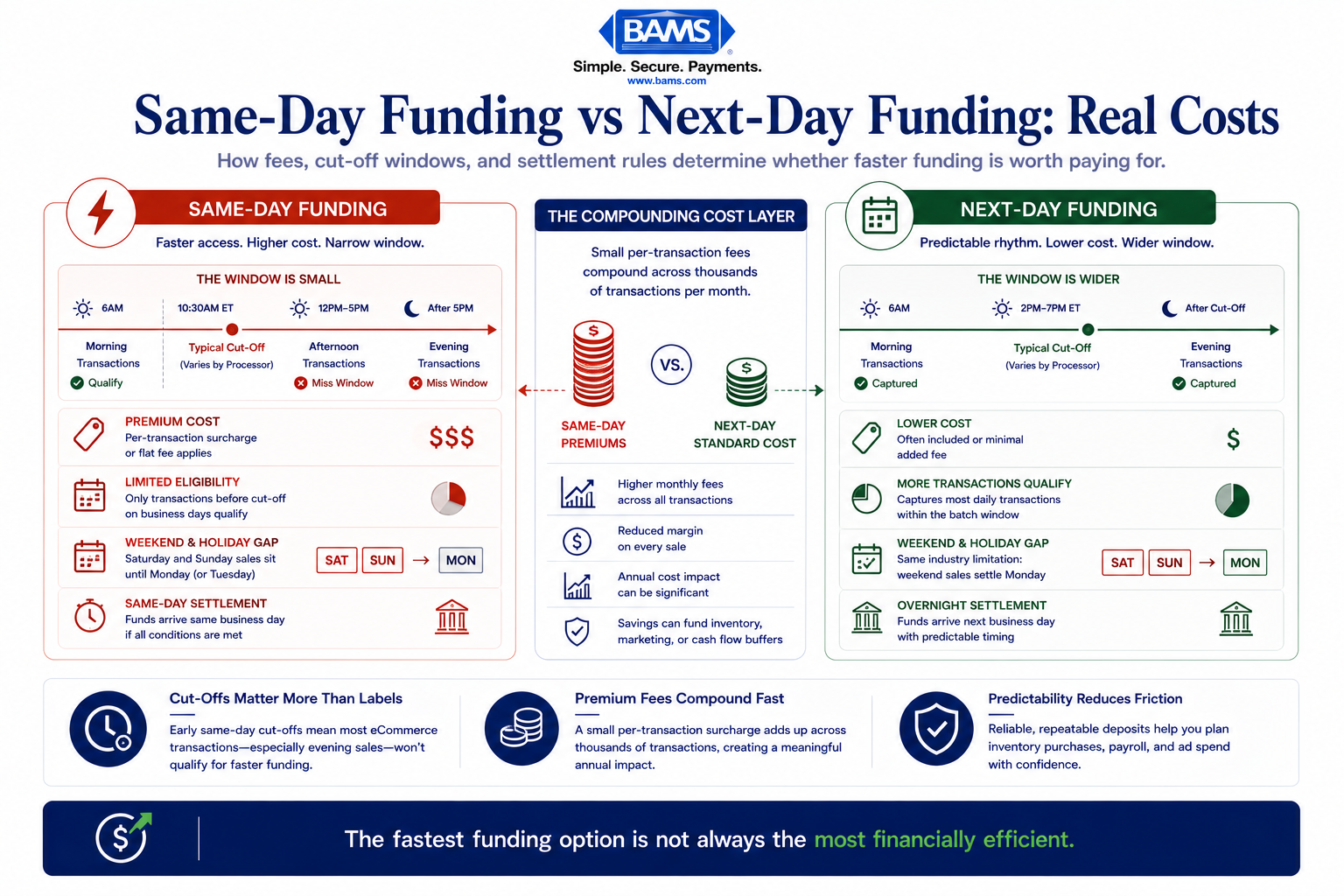
- Cut-off times matter more than speed labels – Same-day cut-offs (often before 10:30 a.m. ET, weekdays only) mean most evening and weekend eCommerce transactions won’t qualify anyway.
- Neither option solves the weekend gap – Saturday and Sunday sales sit until Monday settlement under both models, a persistent industry limitation.
- Focus on total cost, not just speed – The per-transaction premium for same-day funding compounds across thousands of monthly transactions. Invest savings into better cash flow systems instead.
Same-Day vs Next-Day Funding: What Actually Changes for Your Business
The difference between same-day funding and next-day funding looks like 24 hours on paper. In practice, the gap is defined by cost, eligibility requirements, cut-off times, and whether your business setup can even take advantage of the faster option. For eCommerce managers juggling delayed deposits and high transaction fees, understanding these tradeoffs is more useful than chasing the fastest-sounding marketing claim.
This comparison breaks down what each funding speed actually delivers, what it costs, who qualifies, and which business scenarios justify paying a premium for faster payment processing speed. We’re focused on merchant services settlement (the money from your customer transactions hitting your bank account), not business loans or lines of credit.
Quick Verdict: Same-Day Funding vs Next-Day Funding
Choose next-day funding if you run a steady eCommerce operation, want predictable deposits without extra fees, and can plan cash flow around a one-business-day delay. For most online businesses with 10 to 50 employees, this is the sweet spot of speed and cost.
Choose same-day funding if your business has acute, time-sensitive cash needs (payroll on tight cycles, perishable inventory restocking, or seasonal surges) and you’re willing to pay higher per-transaction fees and work within strict cut-off windows.
|
Criterion |
Same-Day Funding |
Next-Day Funding |
Winner |
|---|---|---|---|
|
Speed |
Funds arrive same business day |
Funds arrive next business day |
Same-Day |
|
Cost |
Higher fees (per-transaction surcharge or flat fee) |
Often included or minimal added cost |
Next-Day |
|
Cut-Off Flexibility |
Very early morning cut-offs (often before 10:30 a.m. ET) |
Later cut-offs (typically early evening) |
Next-Day |
|
Weekend/Holiday Coverage |
Weekdays only; no weekend or holiday processing |
Weekdays only; batches from weekends settle Monday |
Tie |
|
Eligibility Requirements |
Stricter: volume thresholds, account history, risk profile |
Broadly available to established merchants |
Next-Day |
|
Ecommerce Compatibility |
Limited by gateway and platform integration |
Widely supported across platforms |
Next-Day |
|
Cash Flow Predictability |
Faster but less consistent due to cut-off constraints |
Reliable, daily deposit rhythm |
Next-Day |
Evaluation Criteria: What Actually Matters
Not every comparison dimension carries equal weight for an eCommerce operation. Here’s how we’re evaluating, and why each criterion matters for businesses managing daily transactions and recurring expenses.
- Speed of access: How quickly funds move from settlement to your bank. This directly affects your ability to cover operating costs.
- Cost and fee structure: The real price difference between the two options, including hidden surcharges. For businesses processing thousands of transactions monthly, even small per-transaction fees compound fast.
- Cut-off times and operational windows: When you must submit your batch to qualify. This determines whether “same-day” actually means same-day for your business.
- Weekend and holiday behavior: eCommerce sales don’t pause on weekends. How each option handles non-business-day transactions matters.
- Eligibility and qualification: What your processor requires before you can access each tier.
- Platform and gateway compatibility: Whether your existing tech stack supports the funding speed you want.
- Predictability: Consistency of deposit timing, which affects financial planning and vendor payments.
Head-to-Head Breakdown
Speed of Access
Same-day funding gets money into your account within hours of batch submission. If you submit before the cut-off (often early morning), funds can arrive by afternoon. This is genuinely useful when you need to cover a supplier payment or make payroll that same day.
Next-day funding delivers deposits the following business day. According to BAMS research on payout timing, next-day funding can be as fast as 10 hours after a transaction batch is submitted, provided the batch goes in before the processor’s cut-off. For most eCommerce operations, receiving yesterday’s sales revenue by mid-morning is fast enough to maintain healthy cash flow.
Verdict: Same-day wins on raw speed, but the practical advantage shrinks when you factor in cut-off constraints. Next-day funding covers the vast majority of cash flow needs without the operational gymnastics.
Cost and Fee Structure
Same-day funding almost always carries a premium. Processors charge this as a per-transaction surcharge, a flat monthly fee, or a percentage bump on your effective rate. Over thousands of monthly transactions, these costs add up significantly. Some processors bundle it into a higher overall pricing tier, making the true cost harder to isolate.
Next-day funding is increasingly offered as a standard feature by competitive processors, sometimes at no additional cost beyond your normal processing fees. When there is a fee, it’s typically modest compared to same-day surcharges. Businesses that prioritize transparent, interchange-plus pricing can often negotiate next-day funding into their agreement without a major rate increase.
Verdict: Next-day funding wins clearly. The cost differential is real and recurring. Unless your business has a specific, quantifiable reason to pay for same-day access, the premium rarely justifies itself over a full year of processing.
Cut-Off Times and Operational Windows
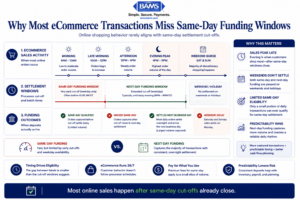
Most ecommerce revenue happens outside same-day funding windows, which reduces the practical advantage of faster settlement.
Same-day funding requires early batch submissions. Industry data shows cut-offs as early as 10:30 a.m. ET on weekdays only. If your eCommerce store processes most of its orders in the afternoon and evening (as many do), those transactions won’t qualify for same-day settlement anyway. You’re paying for speed that only applies to a fraction of your daily volume.
Next-day funding offers more generous cut-off windows, typically in the early evening. This means a larger share of your daily transactions can be batched and settled in the next cycle. For eCommerce businesses where peak shopping hours run late, this flexibility captures more revenue per batch.
Verdict: Next-day funding wins for eCommerce. The later cut-off aligns better with online shopping patterns. Same-day cut-offs are designed around brick-and-mortar schedules, not digital storefronts.
NACHA ACH Network resources continue to emphasize how ACH settlement windows and submission timing directly affect merchant funding availability.
Weekend and Holiday Behavior
Same-day funding does not operate on weekends or holidays. Transactions processed Friday afternoon through Sunday sit in limbo until Monday’s settlement cycle. For eCommerce businesses that see weekend sales surges, this creates a multi-day gap that same-day branding doesn’t advertise.
Next-day funding has the same limitation. Weekend and holiday transactions batch together and settle on the next business day (typically Monday or the day after a holiday). Neither option solves the weekend delay problem.
Verdict: Tie. Both options are constrained by banking hours. The underlying payment rails (ACH, same-day ACH, and emerging systems like FedNow) still operate within business-day frameworks for merchant settlement, though this is evolving.
Eligibility and Qualification
Same-day funding typically requires a clean processing history, minimum monthly volume thresholds, low chargeback ratios, and sometimes a specific bank relationship. High-risk merchant categories are often excluded entirely. The qualification process can involve additional underwriting, and approval isn’t guaranteed even if you meet the stated criteria.
Next-day funding is broadly available to established merchants with a standard risk profile. Most processors offer it to businesses that have been processing for at least a few months with acceptable chargeback rates. The barrier to entry is significantly lower.
Verdict: Next-day funding wins on accessibility. More businesses qualify, and the requirements are straightforward. Same-day funding’s eligibility hurdles make it impractical for many small-to-midsize eCommerce operations.
Platform and Gateway Compatibility
Same-day funding requires your payment gateway, processor, and bank to all support accelerated settlement. If any link in that chain doesn’t participate, you’re stuck at next-day or slower regardless of what your processor advertises. Ecommerce platforms like Shopify, WooCommerce, and BigCommerce each have their own settlement mechanics that may not align with same-day capabilities. Understanding how eCommerce payment processing works end-to-end helps you identify where bottlenecks occur.
Next-day funding is widely supported across major gateways and eCommerce platforms. The infrastructure for next-day ACH settlement is mature and standardized. You’re far less likely to encounter compatibility issues.
Verdict: Next-day funding wins on compatibility. Same-day funding’s dependency on full-stack support creates integration headaches that most eCommerce managers don’t need.
Cash Flow Predictability
Same-day funding sounds more predictable because it’s faster. In reality, the strict cut-off times and weekday-only availability create inconsistency. Some days you get same-day deposits; other days (weekends, holidays, late batches) you don’t. This variability makes cash flow forecasting harder, not easier.
Next-day funding creates a reliable daily rhythm. Every business day, you receive the previous day’s settled transactions. This consistency makes it easier to plan payroll, vendor payments, and inventory purchases. Federal Reserve data from 2023 shows that 50% of small business financing applicants sought $100,000 or less, often to bridge short-term cash flow gaps that predictable deposits could reduce.
Verdict: Next-day funding wins. Predictability beats raw speed for ongoing financial planning. A consistent deposit schedule reduces the need for emergency credit lines or short-term borrowing.
Use Case Mapping: Which Option Fits Your Business
If you run a steady eCommerce operation with predictable daily sales, choose next-day funding. The cost savings compound over time, and the reliable deposit schedule lets you automate vendor payments and payroll without surprises.
If you manage perishable inventory that requires same-day restocking, same-day funding may justify its premium. Restaurants, fresh food delivery services, and floral eCommerce businesses sometimes fall into this category.
If you experience major seasonal surges (holiday sales, flash sales, product launches), next-day funding handles the volume without extra per-transaction costs eating into your margins during your highest-revenue periods.
If you’re a newer eCommerce business building processing history, next-day funding is likely your only option. Focus on maintaining low chargeback rates and consistent volume to keep your qualification strong.
If your business has irregular, high-value transactions (custom orders, B2B invoicing), neither option may perform ideally. Large transactions can trigger additional review holds regardless of your funding tier.
What Both Options Get Wrong
Neither same-day nor next-day funding solves the weekend gap. Ecommerce businesses generate significant revenue on Saturdays and Sundays, but those funds don’t move until Monday under either model. The industry is slowly addressing this through real-time payment rails, but merchant settlement hasn’t caught up yet.
Both options also assume your processor, gateway, and bank are all performing optimally. A single delay anywhere in the chain pushes your actual deposit timing beyond what’s advertised. Cash flow planning based on promised funding speed, rather than observed funding speed, leads to shortfalls. Choosing the right payment gateway is one way to minimize these hidden delays.
Migration and Switching Costs
Switching from one funding speed to another within the same processor is usually straightforward, often requiring just an account upgrade and possibly a new agreement. Switching processors entirely to get better funding terms involves more friction: gateway reconfiguration, potential downtime, PCI compliance re-validation, and a new underwriting process.
Data portability is a real concern. Your transaction history, chargeback records, and customer payment tokens may not transfer cleanly between processors. Budget two to four weeks for a full migration, and run both systems in parallel during the transition if possible.
Lock-in factors to watch for include long-term contracts with early termination fees, proprietary gateway dependencies, and equipment leases. Switching makes sense when your current processor’s funding delays or fee structure is costing you more than the migration effort. For businesses evaluating a move, providers like BAMS offer next-day funding with transparent pricing and dedicated account management, which can simplify the transition and eliminate the guesswork around when your deposits actually arrive.
Final Recommendation
For most eCommerce businesses processing steady daily volume, next-day funding is the better choice. It’s cheaper, more widely available, more compatible with online selling platforms, and creates the predictable deposit rhythm that makes financial planning reliable. The one-day difference in speed rarely justifies the ongoing premium that same-day funding demands.
Same-day funding has a narrow but legitimate use case: businesses with acute, time-sensitive cash needs where a single day’s delay has a measurable cost. If that describes your operation, confirm that your entire payment stack supports it before committing. For everyone else, invest the money you’d spend on same-day surcharges into improving your overall cash flow systems instead.
Frequently Asked Questions
What is next-day funding in merchant services?
Next-day funding means the revenue from your processed transactions is deposited into your bank account the following business day. If you batch your transactions before your processor’s cut-off time (typically early evening), those funds arrive by mid-morning the next business day. It’s one of the fastest standard settlement options available to most merchants.
Why is next-day funding important for small businesses?
Faster access to revenue reduces the need for short-term borrowing and helps cover operating expenses like payroll, inventory, and vendor payments without gaps. Recent small business cash flow data shows that cash flow was the top concern for 31% of small businesses, ahead of inflation at 29%. Predictable next-day deposits directly address this pressure.
How can a business qualify for next-day funding?
Most processors require an established processing history (typically a few months), a low chargeback ratio, and a standard risk profile. High-risk merchant categories may face additional scrutiny. Maintaining clean transaction records and consistent monthly volume strengthens your qualification.
What are the differences between next-day funding and standard funding?
Standard funding (sometimes called “two-day” or “three-day” funding) settles transactions in two to three business days after batching. Next-day funding cuts that to one business day. The practical difference is significant for cash flow: with standard funding, a Monday transaction might not hit your account until Wednesday or Thursday.
When should a business consider using same-day funding services?
Same-day funding makes sense when a one-day delay has a measurable financial cost, such as missing a supplier payment window for perishable goods, or when payroll timing requires same-day access to revenue. If the cost of the delay exceeds the cost of the same-day surcharge, it’s worth considering.
Which factors affect the approval for next-day funding?
Key factors include your chargeback rate, monthly processing volume, business type and risk category, length of processing history, and your bank’s ability to receive ACH deposits on an accelerated schedule. Your payment gateway and platform integration also play a role, since the entire chain must support faster settlement.