The Cash Flow Problem Nobody Itemizes on the General Price List
Last Updated on October 27, 2026 by Dimitri Akhrin
The Cash Flow Problem Nobody Itemizes on the General Price List
Funeral homes operate in a financial environment unlike any other small business. You commit real dollars to third-party vendors (cemetery fees, crematory charges, flowers, obituary placements) before a family pays you a cent. When preneed contracts finally convert to at-need cases, the gap between cash out and cash in can stretch weeks or months. That gap is where margin disappears.
The problem compounds because the 2023 median U.S. funeral cost reached $8,300 for a viewing and burial. Certain cash advance charges are not included in that median, so the total a family owes is often higher. When funeral service pricing decisions are made at the transaction level without considering payment timing, you’re quietly financing other people’s obligations with your own working capital.
TL;DR
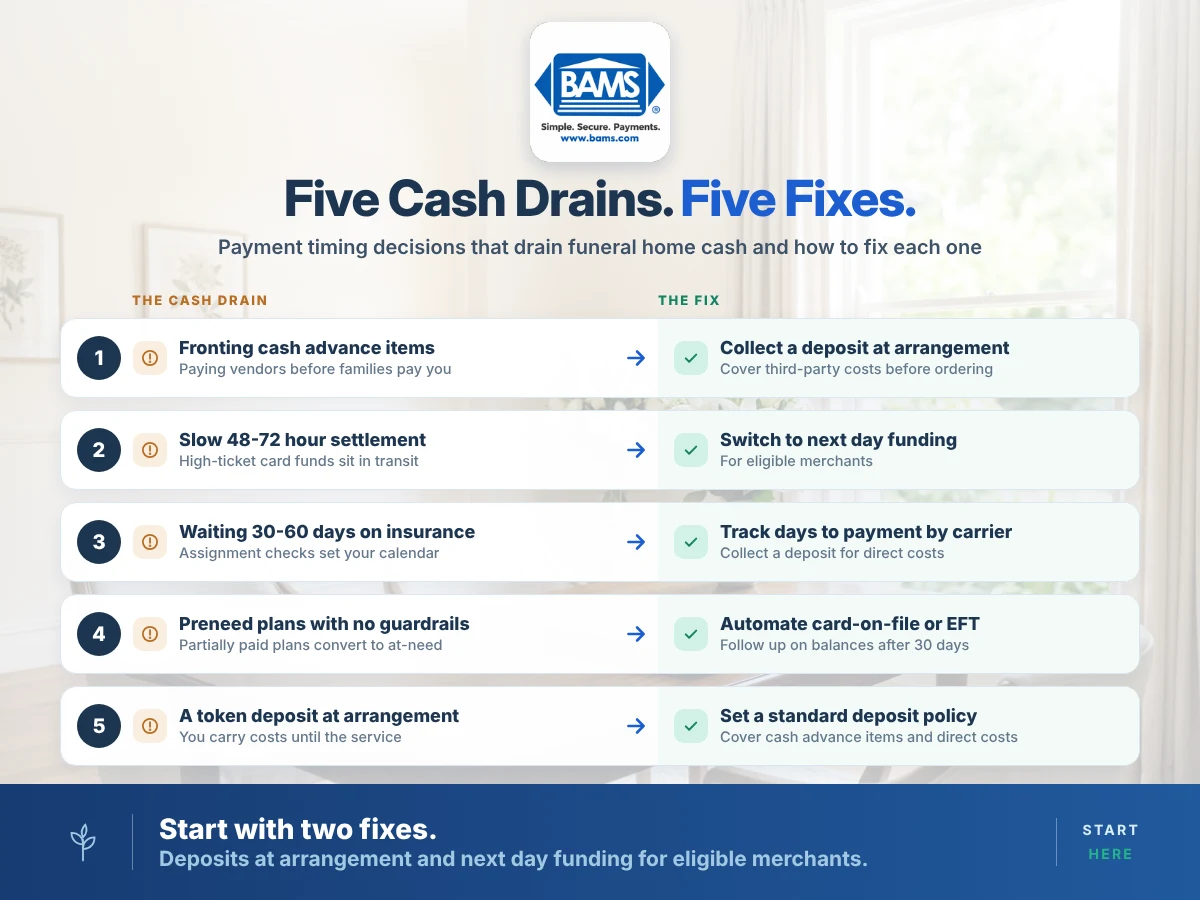
- Stop fronting cash advance items – Collect a deposit covering third-party costs (cemetery, crematory, flowers) at the arrangement conference before placing any orders on the family’s behalf.
- Switch to next-day funding – High-ticket funeral transactions sitting in a 48-72 hour settlement cycle can trap $10,000-$25,000 in perpetual transit. Next-day funding closes that gap immediately.
- Separate insurance-funded cases in your cash flow plan – Track average days-to-payment by carrier. Collect deposits covering direct costs so you aren’t floating expenses for 30-60 days waiting on assignment checks.
- Automate preneed installment collection – Use recurring card-on-file or EFT charges. Define what happens when a partially paid plan converts to at-need and follow up on unpaid balances after 30 days.
- Start with two changes – Require cash-advance-covering deposits at arrangement and move to a next-day funding processor. These two moves close the largest timing gaps for most family-owned funeral homes.
Who This Is For (and What It Isn’t)
This is for family-owned funeral home operators running one to ten locations who handle both preneed and at-need arrangements. If you’ve ever covered a $3,000 cemetery bill out of pocket while waiting on an insurance assignment or a family’s payment plan installment, these five decisions are already costing you money.
This is not a compliance checklist for the FTC Funeral Rule or a guide to preneed trust regulations. It’s a focused look at five specific transaction-level timing decisions that create cash flow gaps before a single service is rendered.
How These Five Decisions Were Selected
Each item on this list meets two criteria. First, it involves a payment timing decision (not a pricing decision) that funeral home operators control directly. Second, it compounds over multiple cases per month, meaning the cash flow impact scales with volume. These are structural leaks, not one-time mistakes.
5 Payment Timing Decisions That Quietly Drain Cash from Funeral Homes
1. Fronting Cash Advance Items Before Collecting from Families
Why it matters: Cash advance items (cemetery fees, crematory charges, clergy honoraria, death certificates, flowers) are third-party costs you pay on a family’s behalf. When you pay these before collecting, you become an unsecured lender. The median cremation fee alone reached $400 in 2023. Stacking multiple cash advance items across several active cases can tie up $5,000-$15,000 at any given time.
What it looks like today: Many operators still absorb these costs upfront as a courtesy, then invoice families after the service. Some wait 30, 60, or even 90 days for reimbursement. Meanwhile, vendors expect payment within their own terms. The result is a structural mismatch: your payables move faster than your receivables.
How to apply it: Trout CPA’s 2025 cash management guidance recommends requesting payment upfront for merchandise and cash advances. Require a deposit covering estimated cash advance items before you place any third-party orders. Present this as standard practice on your itemized price list, not as an exception. For families who need flexibility, offer card payment at arrangement time rather than invoicing later. For a deeper look at which cash advance items create the biggest transparency and timing problems, review how each line item interacts with your deposit structure.
2. Accepting Slow Settlement Timelines on High-Ticket Card Payments
Why it matters: A single funeral transaction can exceed $8,000. Your merchant services provider may hold those funds for two to three business days (or longer for flagged high-ticket transactions). That’s effectively an interest-free loan to your processor. Multiply that delay across 15-20 cases per month and you may have roughly $10,000-$25,000 perpetually in transit.
What it looks like today: Many generic payment processors settle on a 48-72 hour cycle. Some flag funeral transactions as unusual due to ticket size, triggering additional holds. Operators rarely question this timeline because it feels standard. It isn’t. Standard merchant services setups are often misconfigured for low-frequency, high-ticket transactions like those in death care.
How to apply it: Negotiate or switch to a processor that offers next-day funding on card transactions. BAMS, for example, offers next-day funding at no extra cost to qualifying merchants. A $9,000 card payment batched on Monday can reach your account as soon as Tuesday. For funeral homes processing more than $25,000 monthly in card payments, this single change can free up working capital that would otherwise sit in processing limbo.
3. Letting Insurance Assignment Payments Set Your Cash Flow Calendar
Why it matters: Insurance assignments are a major revenue source for preneed-heavy funeral homes, but carriers pay on their own schedule. A 30-to-60-day wait for an insurance check means you’ve already paid staff, covered overhead and fronted cash advance items long before the revenue arrives. When multiple assignments stack up, the gap can become a liquidity crisis.
What it looks like today: Some operators treat insurance assignments as guaranteed revenue and spend against them before the funds arrive. Others avoid the problem by requiring families to pay out of pocket and seek their own reimbursement. That creates friction and can reduce conversion on preneed arrangements. Neither approach optimizes timing.
How to apply it: Separate insurance-funded cases from card-funded cases in your cash flow planning. Track average days-to-payment by carrier and build that delay into your working capital forecast. For cases where insurance is the primary funding source, collect a deposit covering your direct costs (staff time, facility, cash advance items) at arrangement. The insurance payment then covers your service fees and margin when it arrives, rather than reimbursing costs you’ve already floated. For a framework on mapping these distinct revenue streams to separate timing problems, break each stream into its own receivables cycle.
4. Structuring Preneed Installment Plans Without Cash Flow Guardrails
Why it matters: Preneed installment plans lock in future revenue, but they also lock in future costs. Sometimes a preneed contract converts to an at-need case while the family is still making payments. You then bear the full cost of the service while collecting only a fraction of the price. The median nondeclinable basic services fee alone reached $2,495 in 2023 and that’s before any merchandise or cash advance items.
What it looks like today: Many family-owned funeral homes offer preneed installment plans informally. There’s often no automated collection or clear policy for a plan that is only partially paid at time of need. Outstanding receivables can balloon. One funeral home reduced its outstanding receivables from $450,000 to $200,000 in three months simply by implementing structured follow-up and collection policies.
How to apply it: Automate preneed installment collection through recurring card-on-file charges or EFT. Define in your preneed contract what happens if the plan is not fully paid at conversion. Either the family pays the balance before services proceed, or the service package adjusts to match the funded amount. Follow up on any unpaid balance after 30 days. Treat preneed installments as active receivables, not passive revenue.
5. Ignoring the Deposit-to-Service Gap on At-Need Arrangements
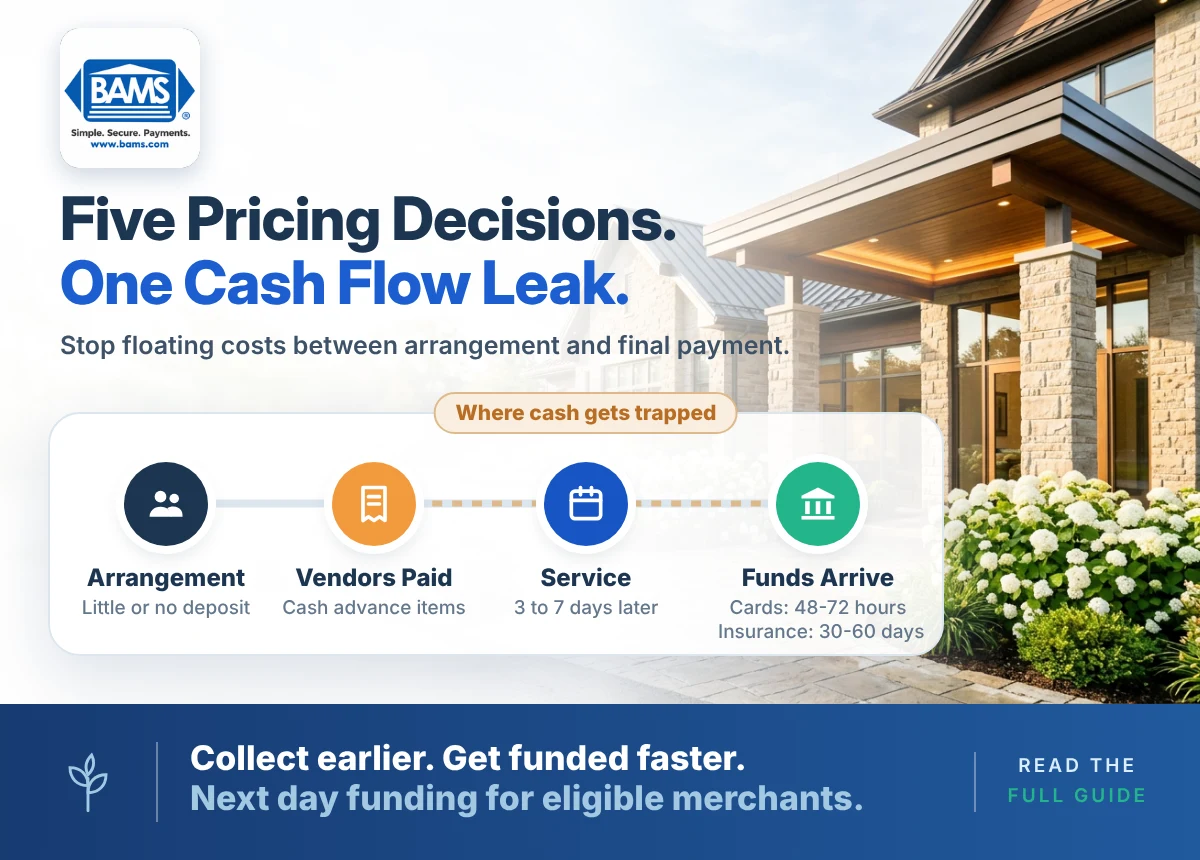
Why it matters: The window between the arrangement conference and the service date is where most cash flow damage occurs. With little or no deposit at arrangement, you fund every cost element for three to seven days before the service. Then you wait additional days or weeks for final payment. For a funeral totaling $8,300, even a five-day gap means you’re carrying that full amount as an interest-free advance to the family.
What it looks like today: Operators often hesitate to request substantial deposits during an emotionally charged arrangement meeting. The result is that the deposit (if any) covers a fraction of the actual costs incurred between arrangement and service. Some progressive operators now use payment orchestration approaches to match payment collection timing to the specific cost structure of each case.
How to apply it: Set a standard deposit policy that covers at minimum your estimated cash advance items and direct costs. Present it during the arrangement conference as part of your normal process, included on your General Price List. Accept the deposit via card at the time of arrangement so funds settle quickly. With a next-day funding processor, that deposit reaches your operating account the following business day. It covers the costs you’ll incur before the service. Frame the deposit as protecting the family’s arrangements, not as a financial demand.
The Pattern Underneath These Five Decisions
Every item on this list shares the same structural problem: funeral homes absorb timing risk that belongs elsewhere. You pay vendors before families pay you. Meanwhile, you wait on insurance carriers and installment plans while your own obligations arrive on schedule. You accept settlement delays from processors as if they’re fixed laws of nature.
The common fix is also structural. Move collection earlier in the transaction lifecycle (deposits at arrangement, card-on-file for installments). Accelerate settlement on the payments you do collect (next-day funding instead of 48-72 hour batches). Stop financing third-party costs that families should cover upfront. These aren’t aggressive tactics. They’re the same payment timing disciplines that every other high-ticket service business already practices.
Where to Start Without Overhauling Everything
You don’t need to implement all five changes at once. Start with the two that release the most trapped cash: require deposits covering cash advance items at arrangement and switch to a payment processor that funds next-day. Those two moves alone close the largest timing gaps for most one-to-ten location funeral homes.
Once those are in place, automate preneed installment collection and build carrier-specific timelines into your cash flow forecast. The goal isn’t to eliminate all receivables. It’s to stop involuntarily financing costs that compound across every case you handle.
Frequently Asked Questions
What are cash advance items in funeral service pricing?
Cash advance items are third-party costs that a funeral home pays on a family’s behalf. Common examples include cemetery or crematory fees, clergy honoraria, death certificates, flowers and obituary placement fees. Under the FTC Funeral Rule, these must be disclosed on an itemized price list. The cash flow risk arises when funeral homes pay these costs before collecting reimbursement from families, effectively becoming short-term lenders.
How does the FTC Funeral Rule affect pricing transparency for funeral homes?
The FTC Funeral Rule requires funeral homes to provide an itemized General Price List, a Casket Price List and an Outer Burial Container Price List to consumers. Funeral directors must disclose prices over the phone and in person before any services are selected. This transparency requirement means your pricing structure and payment timing policies need to be clearly documented and consistently applied across every arrangement.
Why does payment settlement speed matter for funeral home merchant services?
Funeral transactions are high-ticket and low-frequency, which means each delayed settlement ties up a significant amount of working capital. A processor that holds funds for 48-72 hours on an $8,000 transaction creates a compounding cash gap across multiple cases per month. Next-day funding closes that gap, putting collected revenue into your operating account the following business day.
How can funeral homes reduce outstanding receivables from preneed installment plans?
Automate collection through recurring card-on-file charges or electronic funds transfer. Define clear contract terms for what happens if a preneed plan is not fully funded at time of need. Follow up on any unpaid balance after 30 days. One funeral home reduced receivables from $450,000 to $200,000 in three months by implementing structured collection and follow-up policies.
What deposit amount should funeral homes collect at the arrangement conference?
At minimum, collect a deposit that covers your estimated cash advance items and direct costs for the case. This ensures you aren’t fronting third-party expenses (cemetery fees, crematory charges, flowers) out of your own operating funds. Present the deposit as a standard part of your arrangement process, documented on your General Price List and accept it via card so funds settle quickly.
Which payment methods are affected by surcharging regulations in the funeral industry?
Surcharging rules vary by state and apply differently to credit cards versus debit cards. Visa’s merchant surcharging rules do not allow surcharges on debit or prepaid card purchases. Visa also caps credit card surcharges at the lower of your merchant discount rate or 3%. Some states also restrict credit card surcharging. Dual pricing (showing a cash price and a card price) is an alternative approach, but it also has state-specific rules. Funeral homes should verify their state’s regulations and ensure their payment processing setup correctly distinguishes between card types to avoid compliance issues.