Negotiating Processing Fees: Why Volume Advice Fails You
Last Updated on October 6, 2026 by Dimitri Akhrin
Mid-market eCommerce needs order-level qualification visibility, not enterprise volume playbooks
Learn why volume-based pricing tiers don’t solve the real cost problem for mid-market B2B eCommerce. Discover how single transaction qualification failures silently inflate fees on high-ticket orders.
TL;DR
- Volume-tier negotiations miss the real problem – Mid-market B2B eCommerce businesses lose more money to per-transaction qualification failures than to an uncompetitive processor markup.
- Interchange qualification is the biggest lever – Interchange makes up 70% to 90% of processing cost, and Level 2/3 data optimization can save 40 to 60 basis points per high-ticket order.
- Your effective rate is a distribution, not a number – Stop benchmarking your blended rate and start auditing individual transactions for downgrades, especially on orders above $1,000.
- Visibility beats negotiation – A processor that proactively flags qualification failures saves you more than one that offers a marginally lower markup but keeps you in the dark.
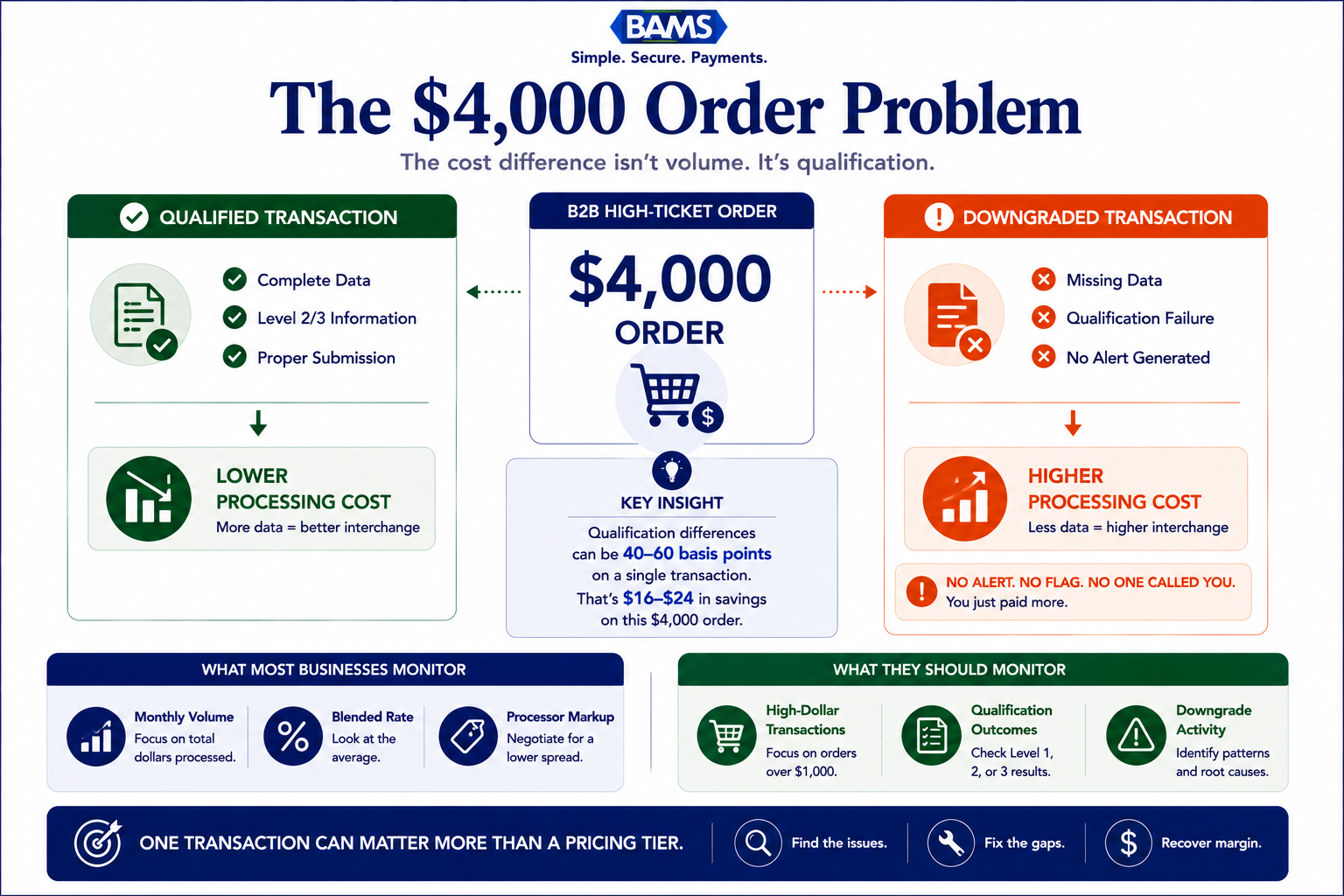
Your $4,000 Order Just Cost You $124. Nobody Flagged It.
Somewhere in your last month of processing, a high-ticket B2B order quietly downgraded. The interchange rate ballooned. Your effective rate on that single transaction hit 3.1%. And the total fee on a $4,000 sale landed north of $120. No alert. No flag. No one called you. This is the reality of negotiating processing fees when the conversation starts and stops at volume.
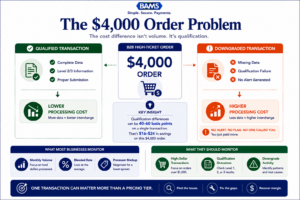
The biggest processing cost problem often isn’t your monthly volume. It’s the individual transactions nobody is monitoring.
The Volume Playbook Everyone Follows
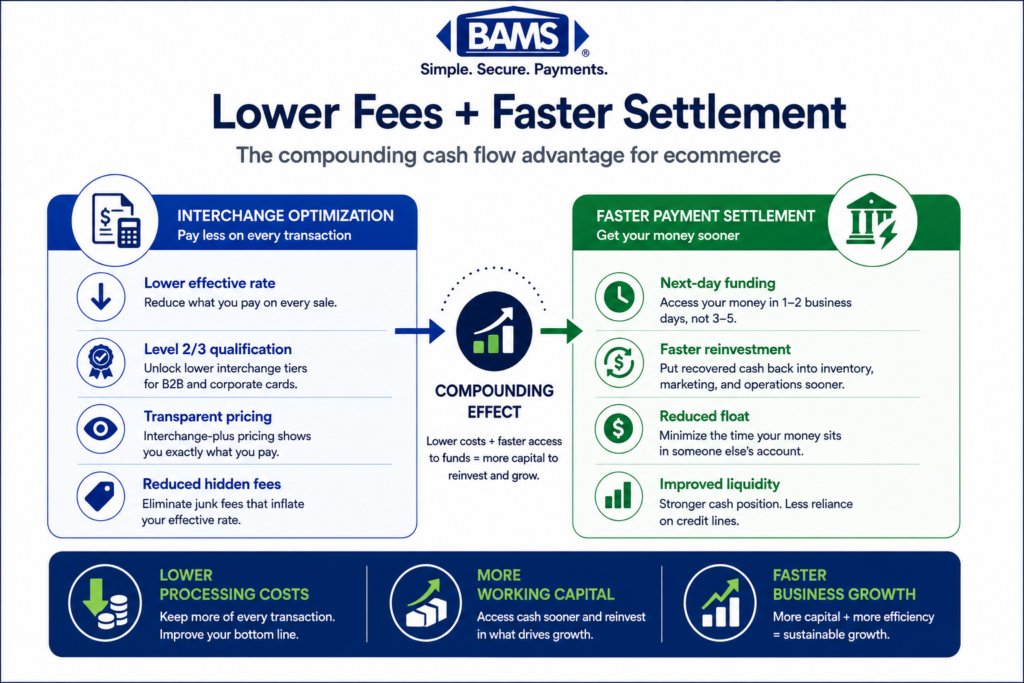
The dominant advice for reducing transaction cost savings in B2B payments goes like this: grow your monthly volume, negotiate volume-based pricing tiers, and your processor will reward you with lower rates. It’s a framework borrowed from enterprise merchants processing millions per month, and it makes sense at that scale. When you’re running 50,000 transactions a month, shaving a few basis points off your aggregate rate adds up fast.
This playbook became gospel because it worked for the biggest players. Processors built their sales decks around it. Consultants built practices around it. And the content ecosystem followed, churning out guides on how to leverage your monthly throughput for better pricing.
The problem? Most mid-market eCommerce businesses don’t process millions monthly. They process hundreds of thousands. And their pain isn’t aggregate. It’s surgical. It’s that one $4,000 order, or that cluster of $2,500 orders, where qualification failures silently inflate costs order by order.
The Real Problem Isn’t Your Volume. It’s Your Visibility.
Here’s what we actually believe: for mid-market B2B eCommerce, the biggest cost leak isn’t your pricing tier. It’s the per-transaction qualification failures no one is showing you.
Volume negotiation is a ceiling game. Order-level qualification is a floor game. And most businesses are playing the wrong one.
Where the Money Actually Disappears
Let’s talk about what happens inside a single transaction. When you process a B2B credit card payment, the card networks (Visa, Mastercard) assign an interchange rate based on how much data you pass with the transaction. There are three levels.
Level 1 is basic: card number, amount, date. Level 2 adds tax amount, customer code, and merchant postal code. Level 3 goes further with line-item detail, product codes, quantities, and freight amounts. The more data you pass, the lower the interchange rate the networks assign. The difference between Level 1 and Level 3 qualification on a commercial card can be 40 to 60 basis points.
On a $4,000 order, that’s $16 to $24 in savings on a single transaction. Multiply that across every B2B order in a month, and you’re looking at real margin recovery.
But here’s the catch: most processors don’t tell you when a transaction fails to qualify at the optimal level. There’s no red flag on your statement. The transaction just processes at a higher interchange tier, your effective rate creeps up, and you absorb the cost without knowing it happened. Interchange fees make up 70% to 90% of total processing cost, which means the qualification tier on each transaction is the single biggest lever you have. Not your negotiated markup. Not your volume tier. Federal Reserve interchange fee data demonstrates how interchange costs represent a significant portion of overall payment acceptance expenses, making transaction qualification one of the most important drivers of processing costs.
We’ve seen this pattern repeatedly with established eCommerce businesses in the 10 to 50 employee range.
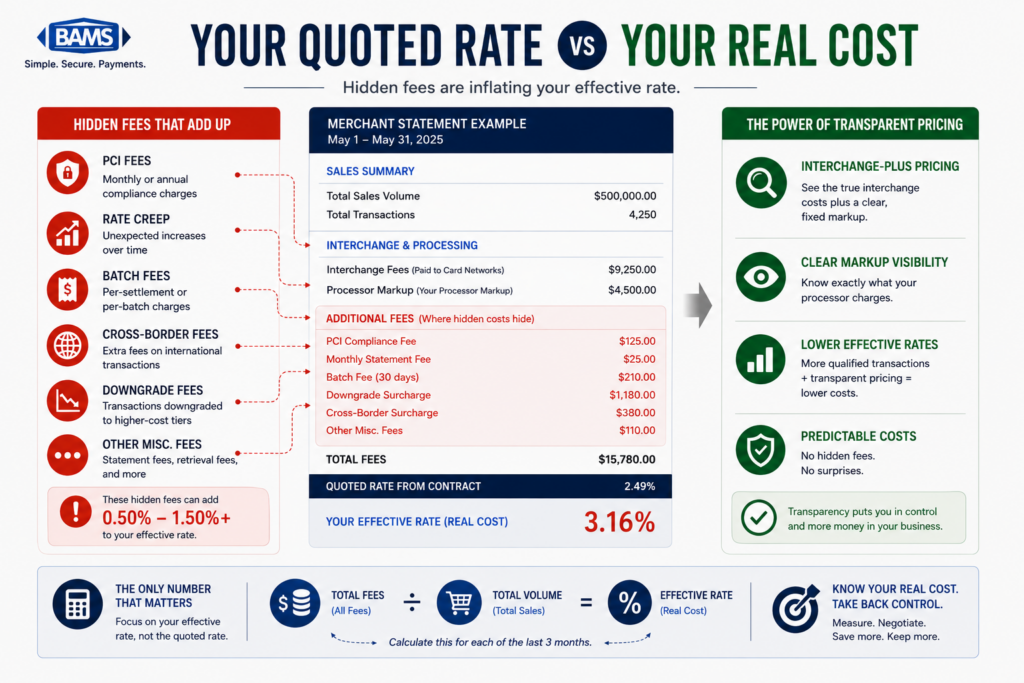
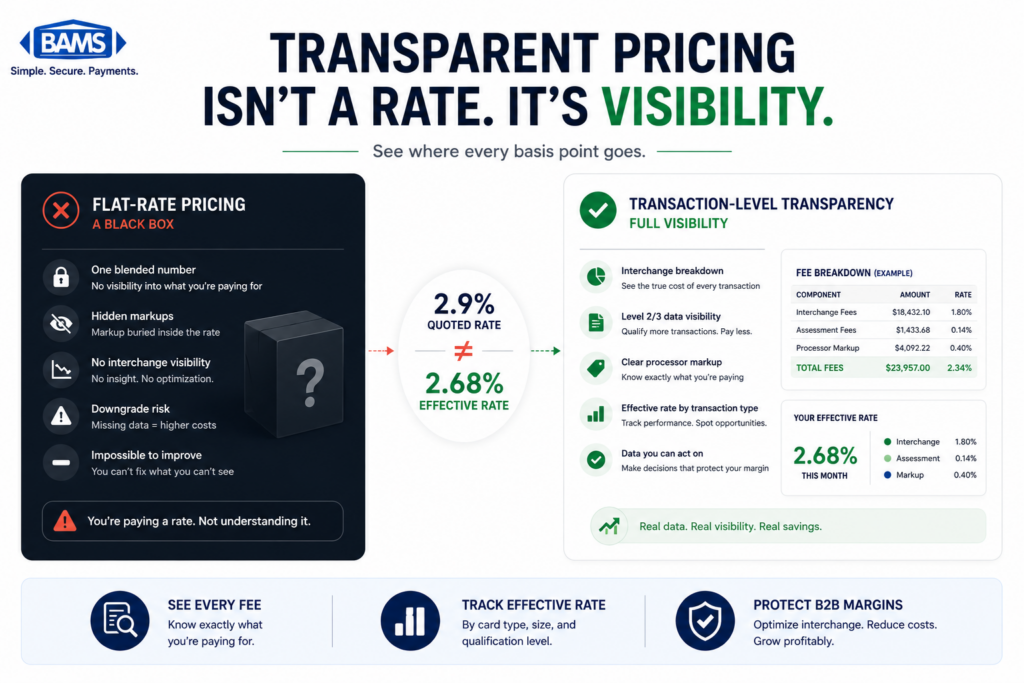
They’re on interchange-plus pricing (which is good, it’s the most transparent model). They’ve negotiated a reasonable processor markup. And they still see effective rates north of 3% on B2B orders because the underlying interchange is inflated by qualification downgrades they can’t see.
Consider the math. Credit card processing fees typically cost 1.5% to 3.5% of each transaction. A well-qualified Level 3 B2B transaction should land near the low end of that range. A downgraded one lands near the top. The difference on a $4,000 order is roughly $60 to $80 in fees you didn’t need to pay. That’s not a rounding error. That’s your margin. Visa interchange reimbursement fee schedules illustrate how transaction qualification, card type, and submitted transaction data directly affect the interchange category assigned to each payment.
The advice to “collect 3 to 6 months of statements before renegotiating” is sound. But what you do with those statements matters more than the negotiation itself. If you’re scanning for your blended rate and comparing it to a competitor’s quote, you’re looking at the wrong number. You need to look at individual transaction lines, identify which ones downgraded, and understand why.
This is where a partner like BAMS changes the equation. Instead of just offering a competitive markup and calling it a day, BAMS provides the kind of order-level visibility and transparent pricing that lets you see exactly where qualification failures are costing you, paired with dedicated account management that proactively flags the problem rather than waiting for you to find it on page seven of your statement.
What This Means for Your Next Conversation About Fees
If this thesis is right, then the way most mid-market eCommerce teams evaluate their processing costs is fundamentally backwards. You’re benchmarking your blended effective rate against industry averages (roughly 2.2% on average) when you should be auditing your highest-dollar transactions individually. Merchant Payments Coalition resources continue to highlight how interchange qualification differences and payment processing inefficiencies can materially increase merchant costs over time.
It means that switching processors for a lower markup while ignoring Level 2/3 qualification is like refinancing your mortgage to save $50 a month while leaving a broken pipe flooding your basement. The structural issue isn’t the rate on the contract. It’s the rate on the transaction.
It also means your processing statement is a diagnostic tool, not just a bill. Every downgraded transaction is a signal. Every inflated effective rate on a high-ticket order is a clue. If no one at your processor is helping you read those signals, that silence is itself a cost.
Stop Negotiating Your Rate. Start Auditing Your Transactions.
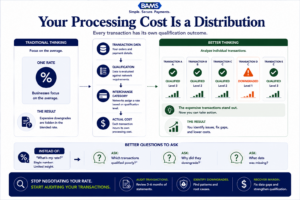
A blended rate is an average. The expensive transactions are often hidden inside that average.
The mental model shift is this: your processing cost is not a rate. It’s a distribution. You don’t have “a” rate. You have hundreds of individual rates, one per transaction, each determined by qualification, card type, and data completeness. Your blended effective rate is just the average of that distribution, and averages hide the outliers that are actually hurting you.
When you start thinking in distributions instead of averages, the question changes. It’s no longer “how do I get a lower rate?” It’s “which transactions are qualifying poorly, and what data am I missing?” That question leads to far more actionable, far more profitable answers than any volume-based pricing negotiation ever will.
The Basis Points That Matter Are the Ones You Can See
Volume-based pricing tiers will keep dominating the conversation because they’re easy to pitch and easy to understand. But easy isn’t the same as accurate. For mid-market B2B eCommerce, the real savings live in the transactions you’ve already processed, hiding in plain sight on statements nobody taught you to read.
The question isn’t whether you can negotiate a better rate. It’s whether you even know what rate you’re actually paying, order by order, right now.
Frequently Asked Questions
What is Level 2/3 data optimization and why does it matter for B2B transactions?
Level 2 and Level 3 data optimization means passing additional transaction details (tax amounts, line items, product codes) to card networks so they assign lower interchange rates. For B2B and high-ticket orders, proper qualification can reduce interchange by 40 to 60 basis points per transaction.
How can I tell if my transactions are qualifying at the best interchange rate?
Review your processing statement at the transaction level, not just the summary. Look for interchange downgrades on commercial or purchasing card transactions, which indicate missing data caused a higher rate than necessary.
When is the best time to negotiate processing fees with your merchant services provider?
Gather 3 to 6 months of statements and analyze your card mix, average ticket size, and per-transaction qualification before starting any conversation. Negotiating from specific data (especially downgrade frequency) gives you far more leverage than simply asking for a lower blended rate.